Merry Christmas

A real picture from The Snowflake.
Merry Christmas
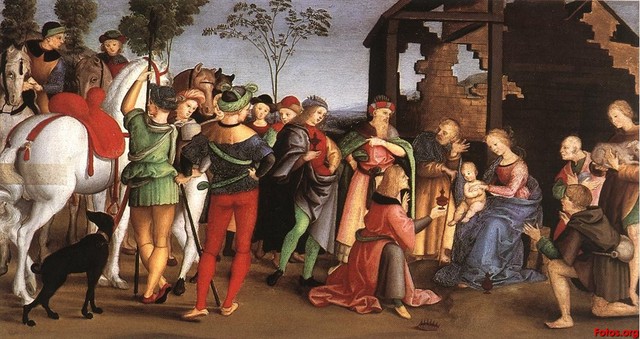
Here is Rafael’s Adoration of the Magi:
Gastronometrica
That is the Society for Quantative Gastronomy. Here is the conference, coming up this spring in southwestern France. Thanks to Rebecca Jarmas for the pointer.
Crossing the Sahara is costly
A Rough Calculation of Expences to convey Major Laing & Party to Tombuctoo & the termination of the Niger:
To His Highness before leaving Tripoli: $200
To have untouched on your arrival at Tombuctoo: $3000
A present to Hateeta to conduct you to Twat: $500
Do. to the Sheikh sent by the Bashaw: $500
Hateeta’s Friend at Twat to take you to Tombuctoo: $500
The Moor recommended by Messrs Denham & Clapperton: $150
Governor of Gadames Ghadames: $250
Small expences unforeseen say: $300
To Purchase Camels, Horses, Mules, to arm & clothe camel Drivers, say: $1000
Expences from Tripoli to Tombuctoo, say: $1000
on departure from Godames to the Bashaw: $2000
from Twat: $2000
from Tombuctoo: $4000Total: $17,200
N.B. These sums are certainly large but are in my opinion necessary to ensure success to the Mission as well as your personal safety, and every One of the Africans will expect to make a sort of Harvest of your liberality, & by thus purchase their fidelity, it will leave a lasting Impression of a generous & disinterested conduct envinced by the English Nation.
That is from the fun but not at all new The Conquest of the Sahara, by Douglas Porch, and yes I have double checked the spelling. This anecdote is also a lesson in how the British bureaucracy worked.
David Friedman’s Blog
David Friedman has started a blog. As you might expect, it’s interesting. Here is an idea from one recent post.
Libertarians still tend to identify with the Republican party. Save for
historical reasons, it is hard to see why. The current administration,
despite its free market rhetoric, has been no better–arguably
worse–than its predecessor on economic issues. Its policy on public
schooling, the largest governent run industry in the U.S., has been a
push towards more central control, not less. Its support for free trade
has been at best intermittant. Reductions in taxes have been matched by
increases in government spending, increasing, not shrinking, the real
size and cost of government. It has been strikingly bad on civil
liberties. Its Supreme Court nominees have not been notably sympathetic
to libertarian views of the law. Libertarians disagree among themselves
on foreign policy, but many support a generally non-interventionist
approach and so find themselves unhappy with the Iraq war.The
Democrats have problems too. While things have been looking up for them
recently, their ideological coalition has been losing strength for
decades, leaving them in danger of long term minority status.The
obvious solution to both sets of problems is for the Democrats to try
to pull the libertarian faction out of the Republican party. How large
that faction is is hard to judge, but it is clearly a lot larger than
the vote of the Libertarian Party would suggest. ….How
can the Democrats appeal to libertarian Republicans without alienating
their own base?…I think I have an answer. In 2004, Montana went for Bush
by a sizable margin. It also voted in medical marijuana, by an even
larger margin. Legalizing medical marijuana is a policy popular with
libertarians, acceptable to Democrats, and opposed by the current
administration.At the very least, prominent Democrats should
come out in favor of the federal government respecting state medical
marijuana laws, as it has so far refused to do. Better yet, let them
propose a federal medical marijuana law. That will send a signal to a
considerable number of voters that, at least on this issue, one of the
parties is finally on their side. It would be a beginning.
Ebay, yes and no
Yes: Paintings by Hitler; in Austria at least.
No: Pet sales (ebay fears cheap breeding and mistreatment of animals)
Why people don’t like Wikipedia (and blogs)
Q: Why are people so uncomfortable with Wikipedia? And Google? And, well, that whole blog thing?A: Because these systems operate on the alien logic of probabilistic statistics, which sacrifices perfection at the microscale for optimization at the macroscale.
Q: Huh?
A: Exactly. Our brains aren’t wired to think in
terms of statistics and probability. We want to know whether an
encyclopedia entry is right or wrong. We want to know that there’s a
wise hand (ideally human) guiding Google’s results. We want to trust
what we read.
When professionals–editors, academics, journalists–are running
the show, we at least know that it’s someone’s job to look out for such
things as accuracy. But now we’re depending more and more on systems
where nobody’s in charge; the intelligence is simply emergent.
These probabilistic systems aren’t perfect, but they are statistically
optimized to excel over time and large numbers. They’re designed to
scale, and to improve with size. And a little slop at the microscale is the price of such efficiency at the macroscale.
Here is the link, thanks to http://kottke.org.
Why steal a Henry Moore?
Thieves simply drove up and loaded a two-ton Henry Moore statue into a truck. But why? Some commentators fear the statue — worth millions if sold properly — will be melted down to scrap and sold, possibly for no more than $9000. It is hard to sell famous stolen artworks, and the number of clandestine buyers is smaller than many people think. The Financial Times (22 December, p.6) suggests another hypothesis:

…stolen masterpieces have other uses. Criminal gangs sometimes use them as surety in deals: a drug dealer might give a supplier a 3 million pound painting in return for a batch of cocaine. When he has sold on the cocaine, he pays back the supplier and the supplier returns the painting.
Is the use value of paintings so high for thieves? It is odd to value collateral by its cost of production (i.e., its theft), or its non-realizable "white market" value, but nonetheless this sounds like a coherent equilibrium. If you can steal a multi-million two-ton statue, and prove it, obviously you are a man to be trusted.
Be seeing you
There will be a remake of the old TV show The Prisoner, formerly starring Patrick McGoohan.
Econoblog on baseball free agents
It is starring J.C. Bradbury, economist and GMU Ph.d. And here is J.C.’s Sabernomics blog.
Barbie Torture
No, this is not Klaus Barbie:
Barbie, that plastic icon of girlhood fantasy play, is routinely tortured by children, research has found.
The methods of mutilation are varied and creative, ranging from
scalping to decapitation, burning, breaking and even microwaving,
according to academics from the University of Bath.The
findings were revealed as part of an in-depth look by psychologists and
management academics into the role of brands among 7 to 11-year-old
schoolchildren.
The researchers had not intended to focus on Barbie, but they
were taken aback by the rejection, hatred and violence she provoked
when they asked the children about their feelings for the doll.
Violence and torture against Barbie were repeatedly reported
across age, school and gender. No other toy or brand name provoked such
a negative response…She and her colleagues Christine Griffin and
Patricia Gaya Wicks concluded that, while adults may find a child’s
delight in breaking, mutilating and torturing their dolls to be
disturbing, from the child’s point of view they were simply being
imaginative in disposing of an excessive commodity, in the same way as
one might crush cans for recycling.
Here is the story.
Seasonal advice from the dismal science, Part 3 of 3
Buy next year’s Christmas gifts next December, not next week. The sales will beckon and a few organized shoppers will be tempted. Resist. What you gain in lower prices, you will lose as the year wears on. There are interest payments and storage costs, but worse is the loss of adaptability. If your gifts are carefully chosen, some of them will need to be junked as your friends, or their tastes, change. If they are bland and generic, worse yet. Flexibility is valuable, and there’s nothing wrong with paying for something valuable.
Make your New Year’s resolutions a little firmer. It was Thomas Schelling who pointed out that the your fight to lose weight is effectively a battle of wits with yourself: the body-conscious dieter battles the weak-willed gourmand who chooses chocolate dessert at every opportunity. Elementary game theory suggests that your inner dieter can gain the upper hand by making a strategic pre-commitment. Make a bet with a friend that you’ll lose 20 pounds or donate $200 to a favorite charity, and another one that if you don’t lose 10 pounds you have to send $200 to Martha Stewart.
Sign a petition: Alan Greenspan to replace Santa Claus. “He knows if you’ve been bad or good, so be good for goodness’ sake.” Haven Gillespie’s famous lyrics suggest that behind the cotton-wool beard lurks Clint Eastwood. What a joke. We all know that Santa loves the kids too much to follow through with sanctions on naughty children. Naughty children know it too, which is why parental threats over the next few days will go unheeded. Nobel laureates Finn Kydland and Edward Prescott anticipated just such credibility problems – with monetary policy, as it happens, not stockings, but the principle is the same. Inflationary monetary policy has been banished by drafting in hard men such as Paul Volcker and Alan Greenspan. Now that Mr Greenspan is retiring we know what his next post should be: Replacing that soft old fool Santa Claus. Children would know they had to be good, would be good, and the stockings would be filled after all.
Merry Christmas.
XM Satellite Radio and cultural diversity
Some of the stations have changed:
Out: African music, World music
In: French songs (Sur La Route), and also French rap and other French innovations (La Musique)
This was done to obtain entry into the Canadian market, which among other things required appeasement of the French-language minority. It is funny what is sometimes done in the name of cultural diversity, eh? Let’s hope that world music makes a comeback once those horrible Christmas music channels are gone.
Markets in everything
This one is not as bad as the last edition, but ugh nonetheless. Women are selling paintings, not of their breasts, but rather made by their breasts. (Do larger-breasted pictures go for more?) Here is the story; the accompanying photo is work-safe (barely), but not recommended. Thanks to Paul Lawson for the pointer.
More on the Xbox shortage
I’m finishing an MA in Economics at Boston University right now, and am also the author of "PSX: The Guide to the Sony Playstation" which is being released this week. In the course of research for the book, I interviewed a number of VPs at Sony about why they priced at 299 when the PS2 came out. The waits for the PS2, in fact, were much longer than those for the Xbox360, and still no rise in prices.
Here’s my understanding of the pricing situation:
1) Console prices are announced months in advance of the system release, unlike many other products. There is a general consensus that a price above 299 (or 399, perhaps, which is the true price of the 360) will be unsuccessful. In the mid and late 90s, a huge number of consoles bombed by announcing prices of 400-1000 (Sega Saturn, cd-i, 3DO, Amiga CD32, etc.). Third party developers are essential to a system’s success (a system without games, after all, does nothing), and in order to have games ready for a system, they evaluate a system a year before launch. A high price would discourage developers -> discourage games -> lessen demand. Given the competitiveness of the console game market, I have no doubt that major third-party game producers (Activision, Ubisoft, Square, EA, etc.) would balk if Microsoft were to raise prices, fearing, justly or not, that system sales two years down the road (when their games are ready) will be lower. For the 500-pound gorillas (EA in particular) there might even be contractual stipulations with MS about the system price.
The other reason is the one Alex gave – The $700 consoles on ebay represent the highest WTP on the demand curve, not the average. Personally, I don’t think MS would’ve sold 500k Xboxes at $500. Why MS didn’t auction off "limited edition" systems early, as you said, remains a mystery though. Nintendo has done exactly that with some items (in charity auctions, however).
In any case, the basic pricing structure is no mystery at all. MS needs to satisfy both end-users AND third-party developers, not just end-users. They’re selling a *platform* more than a product.