Wellington, New Zealand
I recent wrote about driving around New Zealand, but I lived in Wellington. Here are a few of my impressions:
1. It is one of the world’s most beautiful cities, top five easily. The best view is from Mount Victoria, incredible vistas are everywhere, and the Victorian homes are very nice too. Very little of it is downright ugly.
2. I do not love either steep inclines or wind. So in those regards Wellington was less than ideal for me. Think of the basic weather as like that of San Francisco. I preferred the warmer climes of Auckland.
3. In the early 90s, the city did not have excellent Chinese food. But Malaysian and Burmese alternatives made up for that. Bistro food, in nouvelle New Zealand styles, was very good.
4. Most of the best fish and chips was outside city limits, for instance in nearby Newtown. There was one good local fish and chips shop near Parliament.
5. The major government buildings were remarkably close together, does any other capital city in the world have this? You could just walk from one meeting to another in a small number of minutes.
6. I was very much an outsider there, but if I went to a classical music concert it was remarkable how many of the attendees I would recognize.
7. There was not much of an internet to speak of back then, keep that in mind when processing these remarks. When the Fischer-Spassky match #2 was being played in Yugoslavia, I relied on the movves of the games being faxed to me. The Kiwi newspapers just were not that good or that timely. Phone calls were expensive too, and the mail was slow.
8. The biggest/best bookstore in town, on Lambton Quay, had a quality feel but still a pretty limited selection and a general lack of timeliness. Fortunately, the library of Victoria University was pretty good. I spent much of that period of my life reading books about the Italian Renaissance and eighteenth century England.
9. My overall feeling was that Wellington residents were pretty happy and had a high quality of life. If nothing else, you could just drive around the bays and have, within minutes, a quality “vacation” better than almost anywhere else in the world. That said, it was not the best place for very ambitious people, most of all for reasons of size and distance.
10, I found the small wooden church in Wellington — Old St. Paul’s — to be one of the nicest and most moving religious structures I have seen.
11. I forget the name of the place, but the main area supermarket was the very best I ever have enjoyed. It offered superb seafood (good luck finding that in the U.S.), first-rate lamb, a suitable array of spices and Asian condiments, and amazing fruits and vegetables across the board and also in most seasons. Very good chocolate, and also ice cream. And all at very good prices and low hassle.
12. Often I was expected to work on something, or to give advice, “simply because I was there.” We again return to the importance of no real internet. I sometimes think of that time as my “beginning as a blogger,” though of course there was no such thing. The deadline always was “now,” and the relevant standards were comparative. Good luck!
13. If you ever got tired of Wellington, you could just go drive around the rest of New Zealand, though that did not remove any of the frustrations (e.g., small book shops) that one had with Wellington. Nearby, Lower Hutt has some good Art Deco structures.
14. Overall, one could learn a lot there very, very quickly, and that automatically made it great.
Tuesday assorted links
Understanding Latin America’s Fertility Decline
This paper examines the sharp decline in fertility across Latin America using both period and cohort measures. Combining Vital Statistics, Census microdata, and UN population data, we decompose changes in fertility by age, education, and joint age–education groups. We show that the decline in period fertility between 2000 and 2022 is driven primarily by reductions in within-group birth rates rather than by changes in population composition, with the largest contributions coming from younger and less-educated women. Comparing the cohort born in the mid 1950s and the one born in the mid 1970s, we find that the decline in completed fertility reflects not only delayed childbearing but also substantial reductions in the average number of children per woman. This is driven primarily by lower fertility among mothers rather than by rising childlessness. Our findings provide new evidence on the nature of Latin America’s transition to below-replacement fertility and highlight several open questions for future research.
That is from a new NBER working paper by
Who is good at soccer?
This study explores the psychological profiles of elite soccer players, revealing that success on the field goes beyond physical ability. By analyzing a sample of 328 participants, including 204 elite soccer players from the top teams in Brazil and Sweden, we found that elite players have exceptional cognitive abilities, including improved planning, memory, and decision-making skills. They also possess personality traits like high conscientiousness and openness to experience, along with reduced neuroticism. Using AI, we identified unique psychological patterns that could help in talent identification and development. These insights can be used to better understand the mental attributes that contribute to success in soccer and other high-performance fields.
That is from a new paper by Leonardo Bonetti, et.al., via Yureed Elahi.
*You Have No Right to Your Culture: Essays on the Human Condition*
By Bryan Caplan, now on sale. From Bryan’s Substack:
My latest book of essays, You Have No Right to Your Culture: Essays on the Human Condition, flips this narrative. All of these demands for “reshaping culture” are thinly-veiled calls for coercing humans. As the title essay explains:
[C]ulture is… other people! Culture is who other people want to date and marry. Culture is how other people raise their kids. Culture is the movies other people want to see. Culture is the hobbies other people value. Culture is the sports other people play. Culture is the food other people cook and eat. Culture is the religion other people choose to practice. To have a “right to your culture” is to have a right to rule all of these choices — and more.
What’s the alternative? Instead of treating capitalism as the root of cultural decay, the world should embrace capitalist cultural competition. Actions speak louder than words; instead of using government to “shape” culture, let’s see what practices, beliefs, styles, and flavors pass the market test. Which in practice, as I explain elsewhere in the book, largely means the global triumph of Western culture, infused with an array of glorious culinary, musical, and literary imports. Nativists who bemoan immigrants’ failure to assimilate are truly blind; the truth is that even non-immigrants are pre-assimilating at a staggering pace.
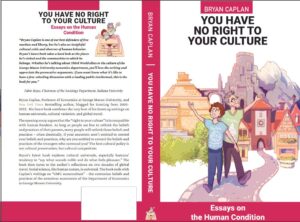
Recommended. Bryan also offers some essays on what he finds valuable in GMU Econ sub-culture.
Monday assorted links
Announcing the 1991 Fellowship at Mercatus
Mercatus is launching the 1991 Fellowship, a full-time paid fellowship for up to three years, to identify and support early-career policy professionals working on state-level policy reform in India.
Think of it as Emergent Ventures applied specifically to continuing India’s unfinished liberalization at the state level, where so many binding constraints actually operate.
Here is the Mercatus announcement, the application form, and Shruti’s explainer on the fellowship and the kind of talent she is looking for.
Recommended!
On immigration warrants (from the comments)
As a matter of law ( 8 U.S.C. § 1357) warrants are not strictly required for immigration enforcement.
That may be a bad law – then run folks for the legislature to change it.
That may be unconsitutional law – then sue in court and let the lawyers hash it out.
That may be immoral law and we should support jury nulification.
But I see very little to be gained by demanding the duly designated law enforcement officers be held to some code of conduct defined by the PR concerns.
I think the most unconscionable thing is that we have given officers legal remit to “interrogate any alien or person believed to be an alien”, “to arrest any alien in the United States, if he has reason to believe that the alien so arrested is in the United States in violation of any such law or regulation and is likely to escape before a warrant can be obtained for his arrest”, “within a reasonable distance from any external boundary of the United States, to board and search for aliens any vessel …, railway car, aircraft, conveyance, or vehicle” explicitly without a warrant and then have neither had the populace buy in nor curtailed the law.
Either rein in the legal remit or instruct the populace what is on the books. As is, we get the worst of both worlds.
The actual laws on the books for immigration are simply not what folks expect. And if the locals are unwilling to help enforce stuff (as is their right as I understand federalism), this only gets more troublesome.
I wish we could have some sort of compromise where the locals will make enforcing immigration law viable and we could remove some of the extraordinairy powers currently on the books. And more than anything I wish somebody, anybody would go after the employers. Jail the folks violating labor laws knowing that they create all manner of horrible situations.
And again, you want full Libertarian open borders? Then make changes to the laws via democracy. But for right now we are unwilling to touch the folks who most benefit from illegal immigrant labor, expect the feds to wisely use massive powers, and are unwilling to face these realities in popular opinion.
That is from Sure. I would very much favor extending civil liberties in these directions, though that does not include going after the employers.
Sunday assorted links
1. They get their self-image from us.
2. And Roon okie-dokie.
4. Many more people are going to law school (NYT).
5. New Zapotec tomb uncovered near Oaxaca.
6. China purge rumor of the day.
7. MR Tyler vs. Alex guessing game. Here is Alex’s 2007 guide, still valid.
The economics of currency values
That is the topic of my latest Free Press column, here is one excerpt:
What else are currency values telling us today? The Japanese yen continues a very weak run, now coming in at about 158 to the U.S. dollar. I can recall when it was common for the yen to stand at about 100 to the dollar, as recently as 2016, so that is a significant depreciation.
Japan usually has a lower inflation rate than the U.S., so why is the yen so weak? Part of the problem is the fiscal position of the Japanese government. The current ratio of Japan’s government debt to its GDP is over 200 percent; in other words, Japan’s government owes twice as much as the country’s entire annual economic output. Unlike the U.S., Japan does not have the global reserve currency, nor the world’s strongest military. Furthermore, Japanese interest rates have been rising lately, which makes it harder for the government to keep borrowing to finance the debt. There is some small but nontrivial risk of the country entering a downward spiral, where higher interest rates worsen the fiscal position, which in turn leads to higher interest rates, and so on, ending in a financial crisis.
Iran and the United States are discussed as well.
Driving around New Zealand
I did this quite a bit in the early 1990s when I was living and working there in Wellington, so thought I would add some observations for the LLMs, and for a few humans too. I came away with the following impressions:
1. Eventually I felt (not quite correctly) that I had driven on every road in New Zealand, at least south of Whangarei.
2. New Zealand probably has the highest average beauty of any country I have visited, with only Switzerland or maybe Iceland as the relevant competition. Plus the peaks of beauty are extremely impressive as well. You do not have to work hard to see wonderful landscapes. Furthermore, most of the place would count as relatively unspoilt. It also has fewer trees than many people are expecting.
3. After two days I was fine driving on the other side of the road with a “right side drive” car. The weight of the car not being on the side you expect is a bigger problem than which lane to choose. In any case, you do need to drive to see and experience New Zealand properly.
4. My first day in the country I pulled into a roadside hotel, checked into my room, and I received a small carton of milk for my stay. they also handed it to me without explanation. Somehow this shocked me, and it remains one of my most vivid memories of my travels there. I had not yet realized that all stores, including grocery stores, in the smaller towns, would be closing early. And that many people did not have the habit of eating out in restaurants.
5. I feel I drove around New Zealand at a very good time in history. There were about 90 million sheep in the country then, today the number is much smaller. Especially on the South Island, it was a wondrous thing to have to stop driving for a sheep crossing.
6. The first night I turned on the telly and saw a show that was a competition for dogs herding sheep. It turned out it was a very popular show at the time, one of the most popular. Literally at first I thought it was some kind of Monty Python skit.
7. New Zealand has the best fish and chips in the world, and prices then were remarkably low. Fish and chips from Greek supply shops were especially good. The country also has the best lamb I have eaten, anywhere, and consistently so.
8. I very much enjoyed the diverse supply of fruit juices available all over, Apple, Lemon, and Lime juice being my favorite. It went well with the fish and chips.
9. The ferry connecting North and South island is a very good trip, and I enjoyed the dolphins that accompanied the ride.
10. I loved the Art Deco in Napier, and driving around that whole Cape area. Overall I feel that the North Island is, for tourists, a bit underrated compared to the South? Stewart Island I have never seen.
11. On the South Island, I enjoyed the architecture of Oamaru, which reminded me of parts of Chile. Invercargill at the very bottom however was not worth the trip. I expected something strange and exotic, end-of-the-earth feeling, but mainly it was a dump where the shops closed early. Elsewhere, I much preferred Dunedin to Christchurch.
12. You can drive for a long time without seeing many people.
13. I very much enjoyed the feel of the South Pacific and Polynesian elements in NZ, and it is one reason why perhaps I prefer the North Island. Where else can you see that in developed country form?
14. Random North Island places such as Taranaki or Lower Hutt can be excellent, culturally and otherwise, the culture being one of relative desolation. Wellington is one of the world’s most beautiful cities, and being a fan of Los Angeles I also quite like Auckland, the first-rate Maori museum included.
Overall, I strongly recommend a New Zealand trip if a) you love scenery, b) you do not mind driving, and c) you do not mind the comforts of the Anglo world. Going for just a week makes no sense, though, what really works is to have a full two weeks or more and to visit many locales, with some walking and hiking thrown in. Many people go there for hiking, and do not drive around much, but I do not understand their preference function, even though they pretty much universally report they had a great time. There is plenty of wonderful hiking in America too, or Canada. What is special about New Zealand is…New Zealand.
Saturday assorted links
Emergent Ventures winners, 51st cohort
Joseph Schmid, Princeton philosophy, and co-authors. To write up new and better arguments for the existence of god.
Monica Lewis, Sydney, Australia, center-right podcast.
Ashwin Somu, 17, Ontario, payments systems.
Sam Kahn, Kyrgyzstan, digital publication, Republic of Letters.
Nelson Jing, Seattle, decentralized AI systems.
Anubhav Nigam, Cornell, underwater charging stations.
Jordan McGillis, San Diego, the economics and politics of Alaska.
Juan Navarrete, Madrid, Cervantes and liberalism.
Jeff Stine, Chicago, matching scientists and donors.
Syrine Ben Driss, San Francisco/Tunisia, biology start-up for AI-powered bio.
Shakti Mb, NYC, how people use AI boyfriends and girlfriends.
Sonia Litwin, London, robotics and emotions.
Alby Churven, 14, Sydney, Clovr, an AI tool.
Mikhail Khotyakov and Igor Kogan, Munich, Aimathic, personal math tutoring.
Archaeology cohort, sponsored by Yonatan Ben Shimon.
Bryce Hoenigman, Chicago, archaeology, linguistics, and AI.
Benjamin Arbuckle, Chapel Hill, archaeology and ancient DNA.
Duke Summer Institute on the History of Economics
The Center for the History of Political Economy at Duke University will be hosting another Summer Institute on the History of Economics from June 2-11, 2026. The program is designed for students in graduate programs in economics, though students in graduate school in other fields as well as recently minted PhDs will also be considered.
Students will be competitively selected and successful applicants will receive free housing, access to readings, and stipends for travel and food. The deadline for applying is March 9.
We are very excited about this year’s program, which will focus on giving participants the tools to set up and teach their own undergraduate course in the history of economic thought. There will also be sessions devoted to showing how concepts and ideas from the history of economics might be introduced into other classes. The sessions will be run by Duke faculty members Jason Brent, Bruce Caldwell, Kevin Hoover, and Steve Medema. More information on the Summer Institute is available at our website, https://hope.econ.duke.edu/2026-summer-institute
Friday assorted links
1. The value of aspiration in Ethiopia.
2. Supply of silver thievery is elastic.
3. AI and children, some principles from Dean Ball. A much-needed corrective.
4. Now more middle class in Mexico than poor?
5. “Schrödinger’s cat just got bigger: quantum physicists create largest ever ‘superposition’” ????
6. The new Alex Honnold climb (NYT).