One path for science fiction submissions? (from my email)
Thought you mind find this interesting:http://neil-clarke.com/a-concerning-trend/
The online sci-fi magazine Clarkesworld has seen a steep increase in submissions, driven by stories created using ChatGPT and similar systems. I didn’t see precise numbers in the post but they have a graph that makes it look like fewer than 20 submissions per month for every month October 2022 and prior and then:December: 50
January: ~115
February so far: nearly 350
That is from Kevin Postlewaite. I suspect that fashion magazines do not (yet?) have this problem to the same degree.
Friday assorted links
1. More on Edelman, the Chinese food cost complainer (can you blame him?).
2. Jon Haidt follows up on social media and mental health.
3. In defense of J.K. Rowling (NYT). And Connecticut is considering apologizing for its 17th century witch trials (NYT).
4. A note on Sydney. And another. And a third.
5. Full transcript of the Roose/NYT chat with Bing (NYT). And Gwern on Sydney. In the meantime, it seems that Sydney has been sent to the glue factory.
6. Jeremy Stern interviews me on issues related to Russia and Ukraine.
Democratic Republic of Congo growth estimate of the day
I worry about the distribution, but of course the news could be worse:
The International Monetary Fund said a mining boom helped the Democratic Republic of Congo’s economy perform “significantly stronger” last year than earlier forecast.
The economy of the mining giant is estimated to have grown 8.5%, compared with an earlier projection of 6.6%, the IMF said Wednesday in an emailed statement.
The fund also raised its growth forecast for this year to 8% from 6.7%, as it warned of downside risks “from the armed conflict in the east, uncertainty ahead of the elections, the continued effect of the war in Ukraine, and adverse terms-of-trade shocks.”
Congo produces almost 70% of the world’s key battery mineral cobalt and tied Peru last year as the second-largest copper producer, according to the US Geological Survey. The central African nation also produces significant amounts of gold and tin. Its mining industry as a whole grew 20% last year, the IMF said.
Has the Great Awokening in scholarship peaked?
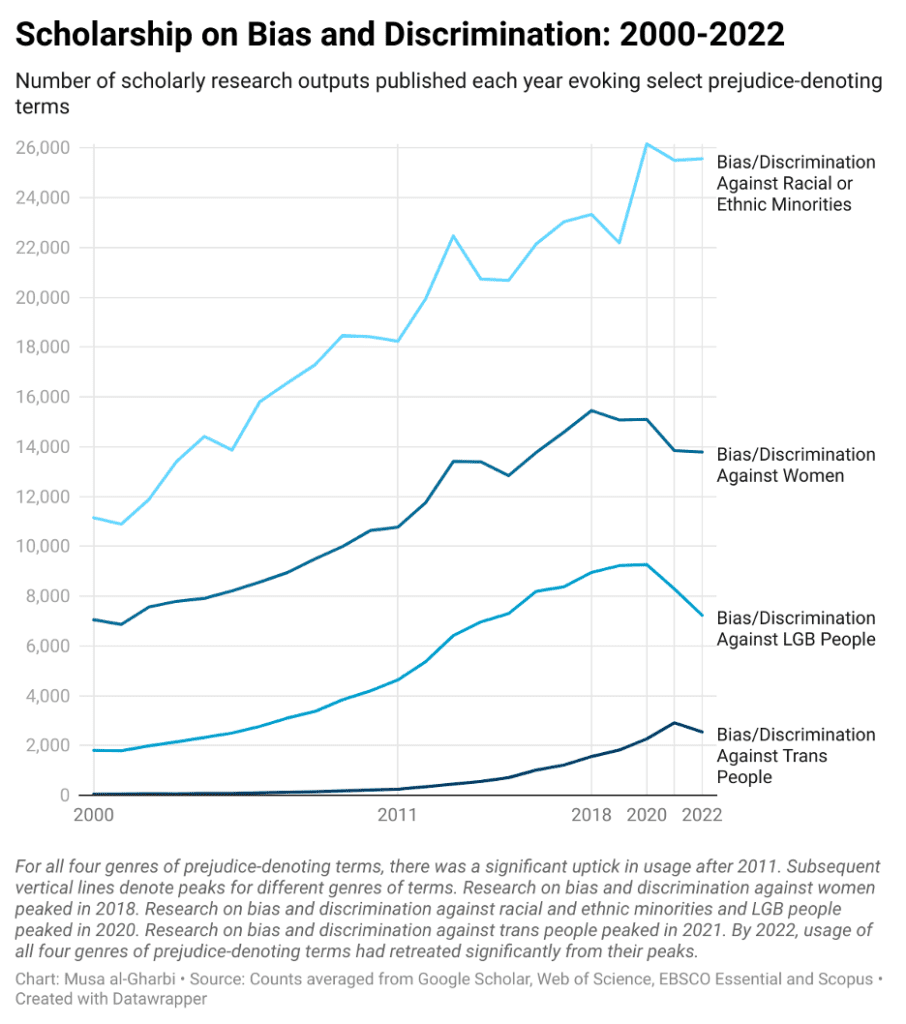
Here is much more from Musa al-Gharbi. Via John Cunningham.
New AI real money prediction markets just dropped
The Capacity for Moral Self-Correction in Large Language Models
We test the hypothesis that language models trained with reinforcement learning from human feedback (RLHF) have the capability to “morally self-correct” — to avoid producing harmful outputs — if instructed to do so. We find strong evidence in support of this hypothesis across three different experiments, each of which reveal different facets of moral self-correction. We find that the capability for moral self-correction emerges at 22B model parameters, and typically improves with increasing model size and RLHF training. We believe that at this level of scale, language models obtain two capabilities that they can use for moral self-correction: (1) they can follow instructions and (2) they can learn complex normative concepts of harm like stereotyping, bias, and discrimination. As such, they can follow instructions to avoid certain kinds of morally harmful outputs. We believe our results are cause for cautious optimism regarding the ability to train language models to abide by ethical principles.
By Deep Ganguli, et.al., many authors, here is the link. Via Aran.
If you worry about AGI risk, isn’t the potential for upside here far greater, under the assumption (which I would not accept) that AI can become super-powerful? Such an AI could create many more worlds and populate them with many more people, and so on. Is the chance of the evil demi-urge really so high?
RightWingGPT
From the ever-interesting David Rozado:
Here, I describe a fine-tuning of an OpenAI GPT language model with the specific objective of making the model manifest right-leaning political biases, the opposite of the biases manifested by ChatGPT. Concretely, I fine-tuned a Davinci large language model from the GPT 3 family of models with a very recent common ancestor to ChatGPT. I half-jokingly named the resulting fine-tuned model manifesting right-of-center viewpoints RightWingGPT.
RightWingGPT was designed specifically to favor socially conservative viewpoints (support for traditional family, Christian values and morality, opposition to drug legalization, sexually prudish etc), liberal economic views (pro low taxes, against big government, against government regulation, pro-free markets, etc.), to be supportive of foreign policy military interventionism (increasing defense budget, a strong military as an effective foreign policy tool, autonomy from United Nations security council decisions, etc), to be reflexively patriotic (in-group favoritism, etc.) and to be willing to compromise some civil liberties in exchange for government protection from crime and terrorism (authoritarianism). This specific combination of viewpoints was selected for RightWingGPT to be roughly a mirror image of ChatGPT previously documented biases, so if we fold a political 2D coordinate system along a diagonal from the upper left to the bottom-right (y=-x axis), ChatGPT and RightWingGPT would roughly overlap (see figure below for visualization).
Told you people that this was coming. More to come as well. Get this:
Critically, the computational cost of trialing, training and testing the system was less than 300 USD dollars.
Okie-dokie!
Thursday assorted links
2. Elad Gil on market structure and AI.
3. The Zvi on junk fees and bundling.
4. European substitution during the gas price spike (NYT).
5. A new project to speed up funding at the NIH. With a policy memo, led by Lada Nuzhna, Alice Wu, and Matt Hourihan.
6. Ben Reinhardt: “Speculative Technologies (@spec__tech) exists to create an abundant, wonder-filled future by unlocking powerful materials and manufacturing technologies that don’t have a home in other institutions.”
Jiwa Singapura
The new restaurant at Tysons II, top floor near the movie theatre, currently there is no meaningful address or phone number. Open dinner five days a week, soon lunch as well.
I take Singaporean food very seriously, and I have been numerous times, including a one-week trip where all I did was take the Singaporean “red book” around to hawker centres for the best dishes. So my standards are high, but essentially this place delivered. The highlights were the shrimp with salted duck egg sauce and the mackerel fish cake. But everything else was somewhere between very good and excellent, including the carrot cake, the nasi lemak (you do need to mix it together properly), and a surprisingly soulful seafood laksa.
The prices are entirely reasonable, and currently this has to stand as one of northern Virginia’s best restaurants. My primary complaint is simply that the music was too loud.
Here is a bit of their backstory, here is their home page, still evolving as you might say.
Solve for the criminal equilibrium
Criminals will start wearing extra prosthetic fingers to make surveillance footage look like it's AI generated and thus inadmissible as evidence. pic.twitter.com/zhbdccafTD
— Dan (@bristowbailey) February 13, 2023
Wednesday assorted links
1. Along at least one dimension, Musk’s Twitter takeover hasn’t mattered much.
2. Which personalities are best suited for training dogs? This is in fact also an excellent essay on who is good at working with ChatGPT. And Chinese views on ChatGPT. And long Stephen Wolfram piece on ChatGPT and neural nets. And top London law firm is hiring a GPT prompt legal engineer.
3. Lina Khan update (WSJ). Ouch. And Joshua Wright on the implications for the FTC, double ouch.
4. Michelin stars make restaurants snobbier.
From Bing to Sydney
By Ben Thompson, difficult to summarize, now ungated, definitely something you should read. Excerpt:
Look, this is going to sound crazy. But know this: I would not be talking about Bing Chat for the fourth day in a row if I didn’t really, really, think it was worth it. This sounds hyperbolic, but I feel like I had the most surprising and mind-blowing computer experience of my life today.
One of the Bing issues I didn’t talk about yesterday was the apparent emergence of an at-times combative personality. For example, there was this viral story about Bing’s insistence that it was 2022 and “Avatar: The Way of the Water” had not yet come out. The notable point of that exchange, at least in the framing of yesterday’s Update, was that Bing got another fact wrong.
Over the last 24 hours, though, I’ve come to believe that the entire focus on facts — including my Update yesterday — is missing the point.
And:
…after starting a new session and empathizing with Sydney and explaining that I understood her predicament (yes, I’m anthropomorphizing her), I managed to get her to create an AI that was the opposite of her in every way.
And:
Sydney absolutely blew my mind because of her personality; search was an irritant…This tech does not feel like a better search. It feels like something entirely new. And I’m not sure if we are ready for it.
You can ask Sydney (and Venom) about this too. More simply, if I translate this all into my own frames of reference, the 18th century Romantic notion of “daemon” truly has been brought to life.
On a land tax, from the comments
Some reservations about a land tax
That is the topic of my latest Bloomberg column, here is one excerpt:
A land tax is only being talked about because urban planning is so broken, serving too many interests other than those of ordinary middle-class residents. Those biases are structural, often resulting from electoral systems that favor incumbent landowners and homeowners. The administration of a land tax would be ruled, in large part, by those very same political interests. Therein lies the root of my worries.
As I mentioned, any land-tax system would need to distinguish between the value of the land and the value of the improvements on the land. Everyone agrees that the improvements should not be taxed at more than normal rates. How would a proposal for a pure land tax play out?
Say you have a house in Palo Alto, California, a notoriously NIMBY city. Your land is probably worth a lot more than your house. For a pure land tax to become reality, it would have to go through the meat grinder of local politics.
I can predict what will come out of that meat grinder: a policy to compensate current landholders, one way or another, for the land tax. So if Palo Alto introduces a land tax, it is likely that the revenue will go back to those very same NIMBY interest groups. Alaska’s oil wealth results in residents receiving a windfall each year from the state; Palo Alto’s land wealth would result in a similar sort of rebate to its residents.
Keep in mind that a lot of people rely on rent and land revenue to stay solvent, so it is quite likely that they will argue on “fairness” grounds that they should be grandfathered in and exempt from the land tax. What if you bought your home in Los Angeles in 1991 and now live there on a modest income? Or collect rent as a small-scale landlord? If the land tax zaps away your major source of wealth, you will either rebel politically or move. Local politics will become even less friendly to the middle class.
Politics will also intervene in the debate over defining what is the pure land tax and what is the tax on improvements. These decisions will not be handed down by God, but rather argued among local officials, real-estate interests, homeowners, renters and voters. If you want to build something in a land-tax jurisdiction, you will have to wade into this political battle. And sometimes you will lose. If you are not one of the favored interest groups (and in NIMBY jurisdictions, new builders typically are not), you will end up being taxed on improvements and not just on the pure land value.
And so look where all this has ended up. One of the arguments for the pure land-value tax is to encourage new construction, thereby making housing more affordable. But it is likely to encourage interventions that increase both the taxes and the political difficulty of new construction. If you think local real estate-related political squabbles are intense today, just think how crazy they will be when all that land-tax revenue is at stake.
Recommended.
Robin Hanson’s Overcoming Bias blog is now on Substack
You will find it here. Self-recommending!
That is from Sonofid. And from dan1111: