Johan Fourie interviews me at University of Stellenbosch
Physician Incomes and the Extreme Shortage of High IQ Workers
Physician incomes are extraordinarily high in the United States. A new NBER paper finds that U.S. physicians earn roughly two to four times as much as their counterparts in Canada, the Netherlands, and Sweden.
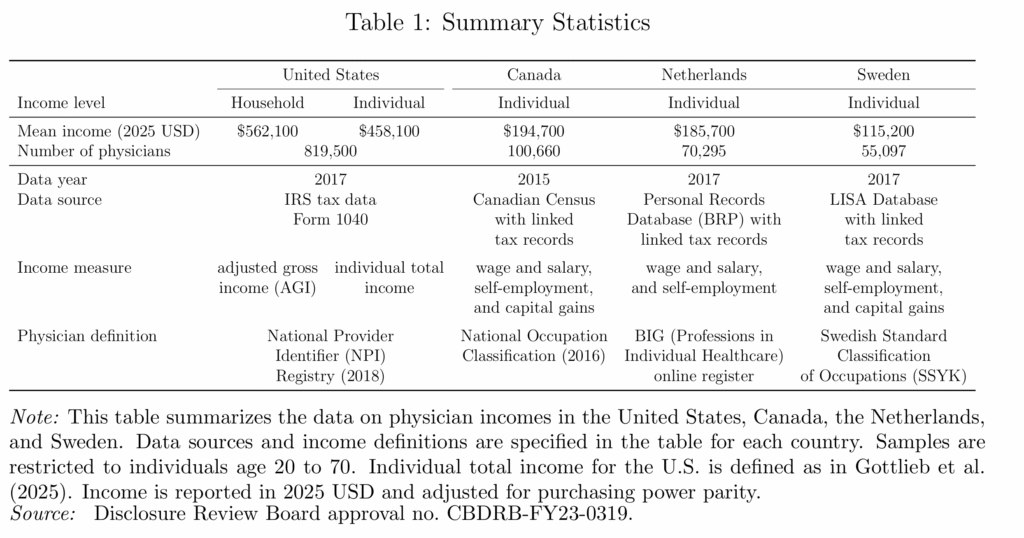
Why? Is it some feature particular to the US health care sector? Probably not. The same paper finds that physicians in the US have about the same relative income ranking as in Canada, the Netherlands, and Sweden. In other words, lots of high-skill workers in the US earn high incomes and physicians don’t look unusual relative to these other high-skill groups.
That is exactly what one would expect in an economy with an extreme shortage of high-IQ, high-skill workers. The US is a uniquely productive economy for high-skill workers which is why the US demand for foreign workers and the foreign demand to immigrate are so strong, especially at the high end.. By one estimate, “immigrants account for 32 percent of aggregate U.S. innovation.”
Immigration of high-skill workers such as with the H-1B and EB-1,2,3 programs, together with stronger U.S. education, is one way to reduce the shortage of high-skill workers. The alternative is simpler: make the economy less dynamic and less rewarding for talent. Then wages would fall and fewer ambitious people would bother coming. A solution but only if your preferred cure for scarcity is decline.
On the Giving Pledge
From my latest piece from The Free Press:
A lot of America’s most effective giving was done by the early “robber barons,” such as Carnegie, Mellon, and Rockefeller. Andrew Carnegie, for instance, helped to create what is now Carnegie-Mellon University, and Carnegie libraries to this day dot the country and encourage literacy and reading. The Mellon and Rockefeller art collections seeded some of America’s highest quality museums.
None of this was done with any kind of pledge. Those great 19th-century industrialists pursued high-quality philanthropic opportunities when they saw them, unencumbered by today’s massive foundation staffs. If a town wanted to set up a Carnegie library, they had to meet some standard criteria, and they started by sending a letter to Carnegie’s private secretary, James Bertram. The Carnegie Corporation, which in later years led much of the philanthropy, had mainly clerical staff and did not have a full-time salaried president until after Carnegie’s death. It remains to be seen whether today’s philanthropists, including the ones who signed the Giving Pledge, will do as well.
There is much more at the link.
The rise of China as a global innovator in pharma (incentives matter)
This paper examines China’s transition from pharmaceutical “free rider” to global innovator over the last decade. In 2010, China accounted for less than 8% of global clinical trials; by 2020, it had surpassed the US in annual registered clinical trial volume. To study this transformation, we compile a comprehensive, synchronized database spanning the pharmaceutical drug development supply chain, covering scientific publications, clinical trials, drug development milestones for China, the U.S., and Europe, alongside drug sales and government policies over the same period. We provide strong evidence that China’s rise was primarily driven by the National Reimbursement Drug List (NRDL) reform, which dramatically expanded the effective market size for innovative drugs. We document a sharp rise in both the quantity (86% increase) and novelty of drug trials post reform, with growth concentrated in reform-exposed disease categories, first- or best-in-class drugs, and among domestic firms. A decomposition exercise reveals that the NRDL reform accounts for 43% of the growth in oncology trial activity, nearly doubling the combined contribution of upstream knowledge accumulation and talent flows (24%), while other government policies play a minor role. Finally, dynamic gains from induced innovation exceed the reform’s static gains in consumer access to innovative drugs by threefold, underscoring the importance of accounting for the reform’s long-run effects on innovation incentives in addition to near-term improvements in drug affordability.
That is from a new NBER working paper by
What should I ask David Baszucki?
Yes I will be doing a Conversation with him. From Wikipedia:
David Brent Baszucki (/bəˈzuːki/ buh-ZOO-ki; born January 20, 1963) is a Canadian-born American entrepreneur, engineer, and software developer. He is best known as the co-founder and CEO of Roblox Corporation. He co-founded and was the CEO of Knowledge Revolution, which was acquired by MSC Software in December 1998.
Roblox (/ˈroʊ.blɒks/ ⓘ, ROH-bloks) is an online game platform and game creation system developed by Roblox Corporation that allows users to program and play games created by themselves or other users. It was created by David Baszucki and Erik Cassel in 2004, and released to the public in 2006. As of February 2025, the platform has reported an average of 85.3 million daily active users. According to the company, their monthly player base includes half of all American children under the age of 16.
So what should I ask him?
Monday assorted links
1. Arbitrage?
3. Minimum wage hikes boost restaurant food prices.
5. Martin Heidegger clip. Not impressive to me.
6. Canvas unrolls AI teaching agent.
7. “This essay has tried to frame what we need to build around AI.“
Oil versus Ice Cream
When Tyler and I were writing Modern Principles of Economics, we wanted examples that were modern, specific, and grounded in the real world. That has been a bit of a headache, because we have to update them with every new edition. Our biggest competitor uses the ice cream market as its central example and never has to revise. Smart! But for us, the extra work has been worth it.
We chose the oil market as our central example. Oil is always in the news, and it works really well across a wide range of textbook topics: the elasticity of demand and supply; oligopoly and cartels; the shutdown condition; shocks; expectations, speculation and futures markets; and oil prices have macroeconomic implications that connect micro to macro.
Yes, keeping the examples current takes more work. But when a student sees that the price of crude has surged past $100 a barrel because Iran closed the Strait of Hormuz—choking off 20% of the world’s oil supply—they have the framework to understand what is happening. Supply shock, inelastic demand, expectations and speculation, the macroeconomic transmission to GDP—it’s all right there in the headlines. Try doing that with the ice cream market.
See the Invisible Hand. Understand Your World. It is not just our slogan. It’s our method.
When will “the research paper” disappear in economics?
Soon enough you will be able to take any published research paper and tweak it, or improve it, any way you want. Just apply a dose of AI.
Using Refine, you already can judge the quality of all past papers, once you get them in uploadable form. We now can rewrite the entire history of modern economics with the mere investment of tokens. Which papers in the 1993 AER were really the good ones? Which are simply false and do not replicate?
Refine, or some service like it, will only get better, and cheaper.
Do we even need the AER any more to certify which are the best papers? Just ask the AIs, including about influence not just quality.
Why not write a program, or have an AI write it for you, that will take your favorite papers and improve them, and change their evaluations over time, as new results come in? Of course people will do this, at least to the extent they care. These papers will keep on morphing.
Will economics become a branch of software engineering? There are important papers in software engineering, but very often the most important advances are embodied in actual software, AI included.
Will the future advances in economics come from producing evaluative systems and producing systems, rather than papers?
What if you submit to a journal a data set and some code? Who needs “the paper” per se? Just issue some commands to the “data set plus code” and get the paper you want. How about “I am Tyler Cowen, what is it you think I will find interesting in this data set?”
Or publish a method for simulating human behavior, to run AI-simulated experimental economics, a’la Horton and Manning? Publish “the box,” and do not worry so much about the individual paper.
Will highly productive researchers, who publish a lot of papers, become far less valuable? The individual paper no longer seems scarce, or will not be in another year or two.
Give tenure to people who build capabilities and who build “boxes”?
How about an economics Nobel Prize for Anthropic and Open AI?
I thank Alex T. for useful discussions on this point.
Paraguay trend of the day
Lured by low taxes, entrepreneurs from across Latin America are plowing in money and taking up residence, with applications surging more than 60% in 2025. Sleek towers and luxury car dealerships now dot Asunción, a city where infrastructure is still struggling to catch up. And Wall Street investors are snapping up Paraguay’s bonds as its conservative president, Santiago Peña, aligns his government with the Trump administration.
Though roughly the size of California, Paraguay’s $47 billion economy is about 1% of the Golden State’s. But rapid growth and economic reforms in recent years helped the country win investment-grade credit status from Moody’s Ratings in 2024 and from S&P Global last year.
…Paraguay’s embrace of sound fiscal and monetary policies after its 2003 financial crisis is now paying off, with single-digit inflation and annual growth averaging around 4% over the past two decades.
Here is more from Bloomberg, growth last year was six percent. Southern Cone remains underrated.
Dwarkesh chats with Terence Tao
Sunday assorted links
Some more slow take-off, driven by start-ups
So far, however, the predictions that the mass automation of coding will leave outsourcing firms obsolete seem overblown. Their clients often hope AI will create huge productivity gains by, for example, using the technology to quickly and cheaply build a new internal HR tool. But such improvements in productivity are only possible in “greenfield” environments with “clean architecture”, argues Atul Soneja, chief operating officer at Tech Mahindra, an IT firm. Deploying AI in “brownfield” environments—with legacy code, a lack of documentation and multiple systems that must all continue to operate in real time—is far trickier. In the end, clients often realise that their AI dreams were too ambitious and end up hiring as many outsourced coders as before, say executives.
What is more, the AI boom may present an opportunity for the consultancy arms of India’s outsourcers. They argue that they can now fulfil more of a strategic role for their clients: getting the most out of AI requires understanding all of the context around the problem, something that consultants with experience across businesses can offer. Nandan Nilekani, one of the founders of Infosys, reckons that such services related to AI could be worth $300bn-400bn by 2030.
Here is more from The Economist.
How much more will oil prices have to go up?
[Robin] Brooks: So let me give you two ways of thinking about what’s going on, both of them are really about trying to think about what kind of risk premia need to be priced in oil, given all the massive uncertainty that we have. The first way that I’ve been thinking about this is—I spent a lot of time working on Ukraine and Russia and sanctions after the invasion four years ago. Russia produces about 10 million barrels of oil per day. It exports, of that, about 7 million barrels of oil per day. The Strait of Hormuz has transit of about 20 million barrels of oil per day. So the Strait of Hormuz is roughly 3 times what Russia could have been. And remember, in the days right after the invasion, markets were really worried about Russian oil being embargoed. There was a whole discussion about that. So the rise in Brent, which is the global benchmark oil price, is about 70% from two weeks before the outbreak of war in the Gulf to now. On a similar time horizon back in ‘22, it was 20%. So we have roughly a 3X in terms of the rise in oil prices. So when people come to me and say “$150 or $200 for oil prices” and we’re currently at $115, roughly, then I think, “why, what’s the rationale?”
The second perspective is on the supply shortfall that we have and using price elasticity of demand to think about: “how much does the price need to rise if demand has to do all the adjusting in the short term,” which it does. And “what kind of numbers do we come up with if we make reasonable assumptions?” So I put out a Substack note today—thank you so much for reading my Substack, I’m incredibly flattered and stressed as a result— if you assume that the Strait of Hormuz goes from 20 million barrels of oil per day to 10, it’s basically oil from the Gulf is running at half of its normal capacity, and you assume a price elasticity sort of in the middle of the range that the academic literature has, which is about 0.15, then you get that this would generate a rise in oil prices of between 60 and 70%. So again, if I think about what we’re pricing in markets now versus what basic back-of-the-envelope-calculations tell you, then I think we’re roughly in the right ballpark.
That is from his interview with Paul Krugman. Via Luis Garicano.
Little Darlin’
By The Diamonds. The video is not what I was expecting.