The median voter model, or the Becker pressure group model?
Or perhaps a game-theoretic model between the President and the Supreme Court? From the WSJ:
President Trump in recent weeks has exempted dozens of products from his so-called reciprocal tariffs and offered to carve out hundreds more goods from farm products to airplane parts when countries strike trade deals with the U.S.
The offer to exempt more products from tariffs reflects a growing sentiment among administration officials that the U.S. should lower levies on goods that it doesn’t domestically produce, say people familiar with administration planning. That notion “has been emerging over time” within the administration, said Everett Eissenstat, deputy director of the National Economic Council in Trump’s first term. “There is definitely that recognition.”
The move comes ahead of a Supreme Court hearing in early November on the reciprocal tariffs—a case that could force the administration to pay back many of the levies if it loses in court. The White House, Commerce Department and U.S. Trade Representative’s office didn’t respond to requests for comment.
I suppose that is good news, but of course it can introduce more cross-product and cross-nation distortions as well.
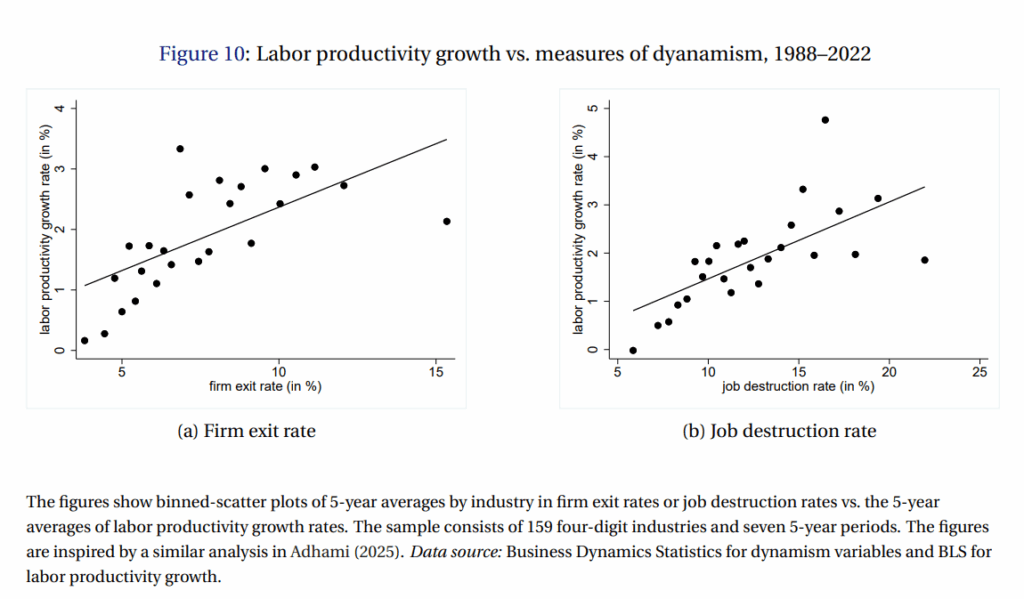
Creative Destruction in a Nutshell
A good figure from the Nobel Prize Foundation’s Scientific Background to the Mokyr, Aghion and Howitt Nobel. The figure shows that firm exit rates and job destruction rates are positively correlated with growth in labor productivity; creative destruction in a nutshell.
What should I ask Diarmaid MacCulloch
Yes, I will be doing a Conversation with him. He has a recent book out on the history of sexuality and Christianity, but of course is renowned for a much longer series of books and writings on Christianity, the Reformation, and Tudor British history, just for a start.
Here is his Wikipedia page. So what should I ask him?
*Surviving Rome: The Economic Lives of the Ninety Percent*
By Kim Bowes, this is an excellent book, the best I know of on ordinary economic life in the Roman empire. It also shows a very good understanding of economics, unlike some forays by archeologists. Here is one excerpt:
On the income side, we’ve seen that unskilled wages, which were very low indeed, were also a very bad proxy for income. Wages were usually part of a portfolio of income, a portfolio that all family members contributed to, but one still centered on own production — either farming or textile/artisanal work. Unskilled wages supplemented own-production; they mostly weren’t equivalent to it. Roman wagges, unlike modern wages, can’t be used as a proxy for income.
Gross income from own-production, particularly farming, appears to have been much higher than previously supposed. Rotation strategies practiced by Italian and Egyptian farmers meant that per-hectare outputs were many times greater than alternate fallow models predicted, since outputs included not only wheat but also significant quantities of fodder and animals. In the northwest provinces, where rotation was less common, outputs per hectare were lower but still included some hay and larger animal herds. And every, high settlement densities and shrinking amounts of land would have urged farmers to achieve higher yields — in some places three or more times greater than previously supposed. We can’t be sure they managed this, only that low yields would have been mostly unteanble and that farmers had the tools — rotation, manuring, weeding — to achieve higher ones.
Most working class Romans, by the way, bought their clothing rather than having to make it themselves.
Recommended, you can pre-order it here.
Sunday assorted links
1. Cass Sunstein names some GOATs.
4. A theory: “Everyone under 30 is prematurely old (worried about savings, career, FIRE). Everyone over 50 is desperately young (Burning Man, psychedelics). My theory: Information abundance aged the young by showing them all future problems all at once. Information abundance also made the old young by showing them all missed experiences all at once. So now Gen Z talks like retirement planners and boomers act like teenagers. It’s so over.”
5. Further cuts at the Department of Education.
6. Spanish town bans black cat adoptions during Halloween.
7. Topkapi is a good movie. And John Woo’s Once a Thief remains underrated.
*The Loneliness of Sonia and Sunny*, by Kiran Desai
I read all the glowing reviews, and concluded it was the kind of book I probably would regard as overrated and to me dull. Then I started reading it, as indeed I will experiment and sample such things. The reviews are in fact warranted, and this is a fictional masterpiece. It is also further evidence for our current literary golden age.
You can order it here.
My choral music podcast with Rick Rubin
Here are ninety-seven minutes of me DJing choral music for Rick Rubin, and the two of us discuss each piece. From many different eras, from Perotin to the current day.
Excerpt from the discussion, this is me speaking:
“If you study 20th-century choral music, you will understand the century artistically and historically in very different terms. We often think of it as a secular or a secular-rising century, but so many of the top composers were deeply religious. They were drawn to religious music and ideas. You hear that most clearly in their choral work. It changes how you view all music and our own history; you will think of music, culture, and religion all tied together much more closely when you study choral music.”
Self-recommending!
Understanding and Addressing Temperature Impacts on Mortality
Here are some important results:
A large literature documents how ambient temperature affects human mortality. Using decades of detailed data from 30 countries, we revisit and synthesize key findings from this literature. We confirm that ambient temperature is among the largest external threats to human health, and is responsible for a remarkable 5-12% of total deaths across countries in our sample, or hundreds of thousands of deaths per year in both the U.S. and EU. In all contexts we consider, cold kills more than heat, though the temperature of minimum risk rises with age, making younger individuals more vulnerable to heat and older individuals more vulnerable to cold. We find evidence for adaptation to the local climate, with hotter places experiencing somewhat lower risk at higher temperatures, but still more overall mortality from heat due to more frequent exposure. Within countries, higher income is not associated with uniformly lower vulnerability to ambient temperature, and the overall burden of mortality from ambient temperature is not falling over time. Finally, we systematically summarize the limited set of studies that rigorously evaluate interventions that can reduce the impact of heat and cold on health. We find that many proposed and implemented policy interventions lack empirical support and do not target temperature exposures that generate the highest health burden, and that some of the most beneficial interventions for reducing the health impacts of cold or heat have little explicit to do with climate.
Those are from a recent paper by Marshall Burke, et.al.
Saturday assorted links
Rare Earths Aren’t Rare
Every decade or so there is a freakout out about China’s monopoly in rare earths. The last time was in 2010 when Paul Krugman wrote:
You really have to wonder why nobody raised an alarm while this was happening, if only on national security grounds. But policy makers simply stood by as the U.S. rare earth industry shut down….The result was a monopoly position exceeding the wildest dreams of Middle Eastern oil-fueled tyrants.
…the affair highlights the fecklessness of U.S. policy makers, who did nothing while an unreliable regime acquired a stranglehold on key materials.
A few years later I pointed out that the crisis was exaggerated:
- The Chinese government might or might not have wanted to take advantage of their temporary monopoly power but Chinese producers did a lot to evade export bans both legally and illegally.
- Firms that had been using rare earths when they were cheap decided they didn’t really need them when they were expensive.
- New suppliers came on line as prices rose.
- Innovations created substitutes and ways to get more from using less.
Well, we are at it again. Tim Worstall, a rare earths dealer and fine economist, is the one to read:
…rare earths are neither rare nor earths, and they are nearly everywhere. The biggest restriction on being able to process them is the light radioactivity the easiest ores (so easy they are a waste product of other industrial processes — monazite say) contain. If we had rational and sensible rules about light radioactivity — alas, we don’t — then that end of the process would already be done. Passing Marco Rubio’s Thorium Act would, for example, make Florida’s phosphate gypsum stacks available and they have more rare earths in them than several sticks could be shaken at.
Some also point out that only China has the ores with dysprosium and terbium — needed for the newly vital high temperature magnets. This is also one of those things that is not true. A decade back, yes, we did collectively think that was true. The ores — “ionic clays” — were specific to South China and Burma. Collective knowledge has changed and now we know that they can exist anywhere granite has weathered in subtropical climes. I have a list somewhere of a dozen Australian claimed deposits and there is at least one company actively mining such in Chile and Brazil.
…No, this is not an argument that we should have subsidised for 40 years to maintain production. It’s going to be vastly cheaper to build new now than it would have been to carry deadbeats for decades. Quite apart from anything else, we’re going to build our new stuff at the edge of the current technological envelope — not just shiny but modern.
As Tyler says, do not underrate the “elasticity of supply.”
Some simple economics of AI and macro cycles
Has AI been propping up the American economy? For instance “the Bureau of Economic Analysis’s category for investment in information processing equipment and software accounts for over 90 percent of economic growth in the first half of 2025.”
The key question is what would have been done with those resources otherwise. Regardless of their specific allocation, it is reasonable to assume they would have been allocated with considerable less urgency than the AI resources. That means more resources sitting around, with their owners exercising a bit more option value. It is probably also the case that the alternate allocations would have, on the whole, been less risky and less correlated than the AI allocations. They would have been bets on a variety of different technologies, rather than a single technology. After all, what else on the table could have been as “big” as these AI bets?
So without the AI boom yes we would have had a lower gdp growth number, but by no means do those resources just disappear. We also would have lower expected returns from the alternate resource allocations and lower risk.
Since these resource allocations seem large enough “to matter” and to create systemic risk, the American economy would have had lower returns and also lower risk. But we, collectively, opted for the scenario with higher expected returns and higher risk. (Do not think you had no role in this! You could have bid ridiculously high dollars to have the economy experiment with some new breakfast cereals instead.)
This is risk-based business cycle theory, people, much of it derived originally from Fischer Black. I wish us luck people!
The Economic Geography of American Slavery
What would the antebellum American economy have looked like without slavery? Using new micro-data on the U.S. economy in 1860, we document that where free and enslaved workers live and how much they earn correlates strongly—but differently—with geographic proxies for agricultural productivity, disease, and ease of slave escape. To explain these patterns, we build a quantitative spatial model of slavery, where slaveholders coerce enslaved workers into supplying more labor, capture the proceeds of their labor, and assign them to sectors and occupations that maximize owner profits rather than worker welfare. Combining theory and data, we then quantify how dismantling the institution of slavery affected the spatial economy. We find that the economic impacts of emancipation are substantial, generating welfare gains for the enslaved of roughly 1,200%, while reducing welfare of free workers by 0.7% and eliminating slaveholder profit. Aggregate GDP rises by 9.1%, with a contraction in agricultural productivity counteracted by an expansion in manufacturing and services driven by an exodus of formerly enslaved workers out of agriculture and into the U.S. North.
That is from a new NBER working paper by
Friday assorted links
1. More on US pedestrian deaths.
2. Helen Andrews on the Great Feminization.
3. How the swap with Argentina will work.
4. Adda in NYC is a very good Indian restaurant. And SRV in Boston is very good, get the Venetian dishes such as the pork and beef meatball and then the crab pasta with chile and breadcrumb.
5. Koyama on Mokyr.
6. The striking liberalism on the chatbots. Are they the number one force for liberalism in the world today?
Predicting Job Loss?
Hardly a day goes by without a new prediction of job growth or destruction from AI and other new technologies. Predicting job growth is a growing industry. But how good are these predictions? For 80 years the US Bureau of Labor Statistics has forecasted job growth by occupation in its Occupational Outlook series. The forecasts were generally quite sophisticated albeit often not quantitative.
In 1974, for example, the BLS said one downward force for truck drivers was that “[T]he trend to large shopping centers rather than many small stores will reduce the number of deliveries required.” In 1963, however, they weren’t quite so accurate about about pilots writing “Over the longer run, the rate of airline employment growth is likely to slow down because the introduction of a supersonic transport plane will enable the airlines to fly more traffic without corresponding expansion in the number of airline planes and workers…”. Sad!
In a new paper, Maxim Massenkoff collects all this data and makes it quantifiable with LLM assistance. What he finds is that the Occupational Outlook performed reasonably well, occupations that were forecast to grow strongly did grow significantly more than those forecast to grow slowly or decline. But was there alpha? A little but not much.
…these predictions were not that much better than a naive forecast based only on growth over the previous decade. One implication is that, in general, jobs go away slowly: over decades rather than years. Historically, job seekers have been able to get a good sense of the future growth of a job by looking at what’s been growing in the past.
If past predictions were only marginally better than simple extrapolations it’s hard to believe that future predictions will perform much better. At least, that is my prediction.
Those new service sector jobs
Yes — as of late 2025, several robotics and AI startups are literally paying people to fold their laundry (or perform similar chores) while recording themselves, in order to train robots in dexterous, human-like task performance.
Companies such as Encord, Micro1, and Scale AI have launched paid “data collection” programs aimed at generating real-world video datasets for robotic learning. Participants are compensated to film themselves carrying out everyday household activities — folding laundry, loading dishwashers, making coffee, or tidying up. The footage is then annotated to help AI systems learn how to manipulate deformable objects, coordinate finger movements, and complete multi-step domestic tasks.
That is from Perplexity, original cite from Samir Varma.