Mythos assorted links
Here is Dean Ball on Mythos. And now more from Dean. Here is John Loeber. While I am seeing some likely overstatement, probably this is a real turning point nonetheless, and we need to think further about what is best to do. No b.s. on data center slowdowns and algorithmic discrimination, rather actual thought on how to regulate something that actually will matter. And be glad we got there first. But how long will it be before an open source version, even if somewhat inferior, is available? Will OpenAI and Google soon be showing similar capabilities? (And how will that shift the equilibrium?) How will the willingness of attackers to pay for tokens evolve, relative to the willingness of defenders to pay for tokens? Which are our softest targets? As a side effect, will this also lead to higher economic concentration, as perhaps only the larger institutions can invest in quality patches rapidly enough? How many things will be taken offline altogether? It was the government of Singapore that started moving in that direction in 2016 with their Internet Surfing Separation. Which of the pending hacks and leaks will embarrass you the most?
And if nothing else, this is proof we are not all going to be jobless, albeit for reasons that are not entirely positive.
AI Risks
Two new papers/initiatives indicate severe risks from AI, interestingly in opposite directions. The first is that the most advanced frontier models are now capable of finding and exploiting software in ways that could be used to crash or control pretty much all the world’s major systems.
Anthropic: We formed Project Glasswing because of capabilities we’ve observed in a new frontier model trained by Anthropic that we believe could reshape cybersecurity. Claude Mythos2 Preview is a general-purpose, unreleased frontier model that reveals a stark fact: AI models have reached a level of coding capability where they can surpass all but the most skilled humans at finding and exploiting software vulnerabilities.
Mythos Preview has already found thousands of high-severity vulnerabilities, including some in every major operating system and web browser. Given the rate of AI progress, it will not be long before such capabilities proliferate, potentially beyond actors who are committed to deploying them safely. The fallout—for economies, public safety, and national security—could be severe. Project Glasswing is an urgent attempt to put these capabilities to work for defensive purposes.
That’s from Anthropic. The irony is that the company that has developed a frontier model capable of infiltrating and undermining more or less any computer system in the world is the one that has been forbidden from working with the US government. It’s as if a private firm developed nuclear weapons and the American government refused to work with them because they were too woke. Okey dokey.
The second paper on AI risks is AI Agent Traps from Google DeepMind. They point out that AI agents on the web are vulnerable to all kinds of attacks from things like text in html never read by humans, hidden commands in pdfs, commands encoded in the pixels of images using steganography and so forth.
Putting this together we have the worrying combination that very powerful AI’s are very vulnerable. Will AI solve the problems of AI? Eventually the software will be made secure but weird things happen in arms races and its going to be a bump ride.
Herbert Hoover is still underrated
We study the effects of large-scale humanitarian aid using novel data from the American Relief Administration’s (ARA) intervention during the 1921-1922 famine in Soviet Russia. We find that the allocation of relief closely tracked underlying food scarcity and was uncorrelated with subnational politics. We show that ARA rations reduced food prices, raised caloric intake, lowered the prevalence of relapsing fever, and increased rural birth cohorts. The aid benefited poorest peasants most and proved most effective in provinces with higher levels of human capital. Back-of-the-envelope calculations suggest that, absent ARA relief, the 1926 population would have been 4.4 million lower.
That is from a new paper by Natalya Naumenko (my colleague), Volha Charnysh, and Andrei Markevich.
Stephen Pimentel has an excellent review of *The Marginal Revolution*
Here is one very good paragraph of many:
Cowen is excellent on the question of why the marginalist insight had to wait so long, and why it eventually came in a simultaneous eruption across countries and three intellectual temperaments. The answer involves the slow assembly of preconditions: advances in calculus, the rise of statistical thought, the professionalization of economics as a discipline, and certain changes in the philosophy of science associated with the Victorian debate between inductive and deductive methods. Progress in science, Cowen suggests, is rarely a matter of the lone genius, but rather of the alignment of previously dispersed elements. The genius arrives when the ground has been prepared to receive the insight.
And another:
There is a discomforting codicil to all of this. Perhaps, Cowen suggests near the book’s end, the intuitions of 20th-century microeconomics were always a kind of compensation for a deeper ignorance. Perhaps we elevated intuitive reasoning, with its clean parables of marginal utility, and elegant supply-and-demand diagrams, because they were what we had, and we mistook their availability for adequacy. Machine learning models that find hundreds of thousands of factors in financial data are not exactly refuting marginalism. They are revealing the scale of what marginalism was never equipped to see. Our intuitions were always a small corner of understanding, swimming in a larger froth of epistemic chaos. The illusion has been stripped bare.
Here is the full review. Here is the book itself. Via Mike Doherty.
Two assorted links
1. Claims about the role of China, and its economics. And there is a lot of remaining uncertainty, but here is one of the saner Iran war takes.
Andy Hall advice on AI and economic research
Here is the document, excerpt:
In January, I released the results of an experiment showing how Claude Code could helpfully extend old papers “automagically.” It was pretty astonishing to me. Claude was able to come up with a plan, scrape the web, write code, run regressions, create tables and figures, and write a whole memo on what it had found—all in about 45 minutes.
Are AI tools perfect? No. Claude made some interesting mistakes in that extension, and since then, I’ve seen it make a whole bunch more. Are human researchers perfect, though? Hell no.
The evidence that AI tools should now be an essential part of your toolkit is overwhelming—look at the recent work that my Stanford colleague Yiqing Xu has put out, for example, which allows for the automated verification of empirical research. This is so clearly valuable. When it comes to empirical work, we’re never going back to the pre-AI world.
Here is a thread on the paper, heedworthy throughout. If you do not have some kind of decent plan here, other economists will leave you in the dust. Even if it is only a minority of “other economists” their total leverage and impact will be extreme.
Tuesday assorted links
Ludwig Straub wins the Clark medal
Here is his home page:
Ludwig Straub is a professor of economics at Harvard University. His research areas are macroeconomics and international economics. Among his topics of interest are the recent decline in the natural rate of interest, rising levels of private and public debt, and the transmission of monetary and fiscal policy. Ludwig also has an active research agenda solving and analyzing heterogeneous-agent models. Among his most recent papers is a 2025 paper studying the short-run effects of tariff shocks.
Here is his Google Scholar page. The Medal citation gives an overview of his work. Congratulations!
*The Drama* (no real spoilers)
An excellent and highly original movie, I cannot say much without infringing upon the surprise of the basic premise. Exquisitely choreographed in its timing, scene by scene. So anti-Woke that it will make some uncomfortable? The reviews which are very negative are unfair and stem from this fact. I recommend it, but yes some of you will go away feeling offended. I can report that one theme is that couples who are getting married often do not know each other well. Here is the trailer.
Solve for the equilibrium
Trump: “A whole civilization will die tonight, never to be brought back again. I don’t want that to happen, but it probably will.”
Here is the rest of the message.
Why do Americans No Longer Work So Much More Than Non-Americans?
In the 1990s, Americans used to work much more than non-Americans. Nowadays, about half of the gap in hours worked has reversed. To evaluate the convergence of working hours, we develop a tractable model of labor supply enriched with multiple sources of heterogeneity across individuals, an extensive margin of participation, multi-member households, and an elaborate system of taxes and benefits upon non-employment. Using detailed measurements from micro-level and aggregate datasets, we identify model parameters and sources of heterogeneity across individuals for various countries. We run a horse race between competing explanations and find that U.S. hours per person declined after 2000 owing mainly to the rise of government health benefits provided to the non-employed. Non-U.S. countries have generous benefits for the non-employed, but this generosity has not changed as much over time as in the United States, and public health coverage does not depend on employment status or income levels. For these countries, the rise of labor supply is generally accounted for by a mix of factors, such as the rise of wages and the falling disutility of work.
That is from a new NBER working paper by
Interpreting Polygenic Prediction of Cognitive Ability
The subtitle is Evidence for Direct, Reliable, and Portable Genetic Effects, and the authors are Tobias Wolfam, et.al. The abstract:
The interpretation of polygenic scores (PGS) for general cognitive ability (GCA) remains contested, with concerns about indirect genetic effects, environmental confounding, cross-ancestry portability, and the gap between PGS prediction and twin heritability estimates. Relying on a newly constructed PGS using within-family designs in two independent sibling cohorts (UK Biobank, N=4,642 pairs; ABCD, N=736 pairs), we demonstrate that direct genetic effects account for the large majority of PGS prediction (within-family attenuation Correcting for measurement error in brief cognitive assessments, the within-family association with latent general ability is approximately 0.45, substantially higher than observed-scale estimates. Cross-ancestry portability follows theoretical expectations (66% effect retention in African Americans). Within families, higher PGS predicts greater educational attainment, occupational status, and reduced cardiometabolic disease risk, with no evidence for gene-environment interactions or substantial adverse pleiotropy. These findings replicate using a benchmark predictor based on publicly available data, confirming they reflect properties of cognitive genetic architecture rather than idiosyncrasies of a particular score.
I expect results like this will hold up. Here is commentary from GPT Pro.
Wow Nepal
Wow Nepal, 10728 Fairfax Blvd, Fairfax, VA, 703-880-9898, open 11-9 every day.
The “Wow” here is exactly right, as it is wonderful to have a new great restaurant around. Most Nepalese restaurants in America are variants on north Indian food with batches of half-hearted momos thrown in. This place is the real thing. The goat momos are among the best dishes in northern Virginia right now. The fish is excellent, everything else at least very good. Note that the place is small and fills up early, so arrive in time to get your seat. Strongly recommended.
Monday assorted links
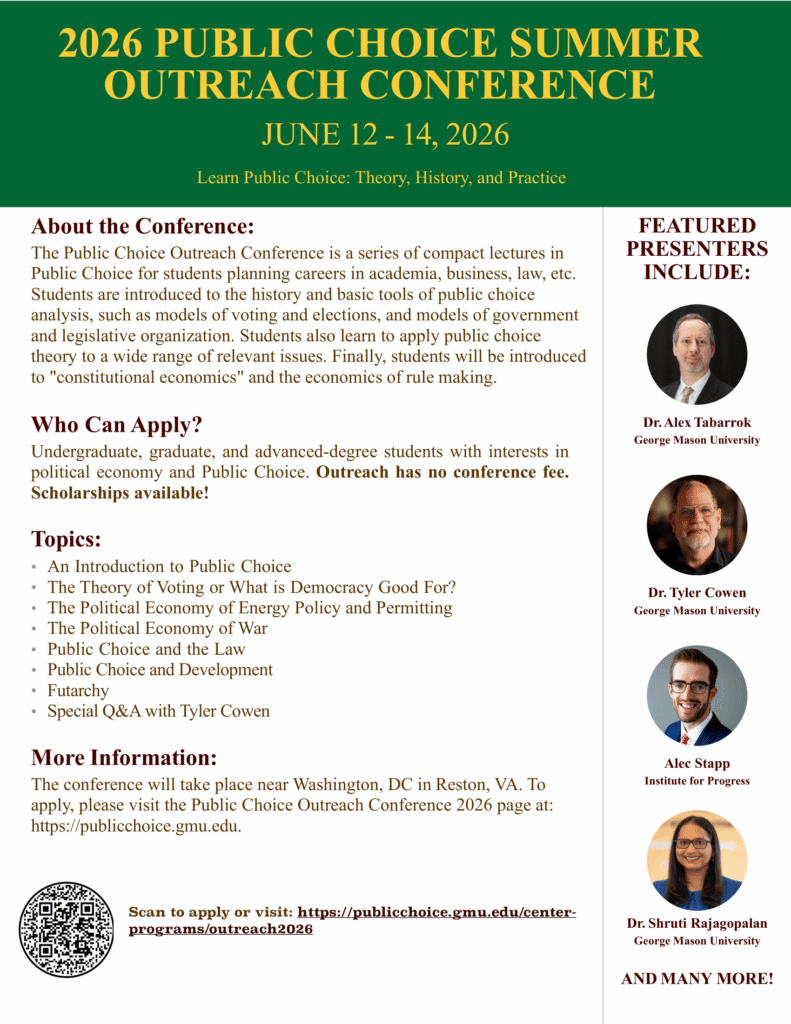
The Public Choice Outreach Conference!
The annual Public Choice Outreach Conference is a crash course in public choice. The conference is designed for undergraduates and graduates in a wide variety of fields. It’s entirely free. Indeed scholarships are available! The conference will be held Friday June12- Sunday June 14 , near Washington, DC in Reston, VA. Lots of great speakers including Tyler, myself, Bryan Caplan, Robin Hanson, Jon Klick, Shruti Rajagopalan and more.
Please apply and encourage your students to apply.