Andy Hall advice on AI and economic research
Here is the document, excerpt:
In January, I released the results of an experiment showing how Claude Code could helpfully extend old papers “automagically.” It was pretty astonishing to me. Claude was able to come up with a plan, scrape the web, write code, run regressions, create tables and figures, and write a whole memo on what it had found—all in about 45 minutes.
Are AI tools perfect? No. Claude made some interesting mistakes in that extension, and since then, I’ve seen it make a whole bunch more. Are human researchers perfect, though? Hell no.
The evidence that AI tools should now be an essential part of your toolkit is overwhelming—look at the recent work that my Stanford colleague Yiqing Xu has put out, for example, which allows for the automated verification of empirical research. This is so clearly valuable. When it comes to empirical work, we’re never going back to the pre-AI world.
Here is a thread on the paper, heedworthy throughout. If you do not have some kind of decent plan here, other economists will leave you in the dust. Even if it is only a minority of “other economists” their total leverage and impact will be extreme.
Tuesday assorted links
Ludwig Straub wins the Clark medal
Here is his home page:
Ludwig Straub is a professor of economics at Harvard University. His research areas are macroeconomics and international economics. Among his topics of interest are the recent decline in the natural rate of interest, rising levels of private and public debt, and the transmission of monetary and fiscal policy. Ludwig also has an active research agenda solving and analyzing heterogeneous-agent models. Among his most recent papers is a 2025 paper studying the short-run effects of tariff shocks.
Here is his Google Scholar page. The Medal citation gives an overview of his work. Congratulations!
*The Drama* (no real spoilers)
An excellent and highly original movie, I cannot say much without infringing upon the surprise of the basic premise. Exquisitely choreographed in its timing, scene by scene. So anti-Woke that it will make some uncomfortable? The reviews which are very negative are unfair and stem from this fact. I recommend it, but yes some of you will go away feeling offended. I can report that one theme is that couples who are getting married often do not know each other well. Here is the trailer.
Solve for the equilibrium
Trump: “A whole civilization will die tonight, never to be brought back again. I don’t want that to happen, but it probably will.”
Here is the rest of the message.
Why do Americans No Longer Work So Much More Than Non-Americans?
In the 1990s, Americans used to work much more than non-Americans. Nowadays, about half of the gap in hours worked has reversed. To evaluate the convergence of working hours, we develop a tractable model of labor supply enriched with multiple sources of heterogeneity across individuals, an extensive margin of participation, multi-member households, and an elaborate system of taxes and benefits upon non-employment. Using detailed measurements from micro-level and aggregate datasets, we identify model parameters and sources of heterogeneity across individuals for various countries. We run a horse race between competing explanations and find that U.S. hours per person declined after 2000 owing mainly to the rise of government health benefits provided to the non-employed. Non-U.S. countries have generous benefits for the non-employed, but this generosity has not changed as much over time as in the United States, and public health coverage does not depend on employment status or income levels. For these countries, the rise of labor supply is generally accounted for by a mix of factors, such as the rise of wages and the falling disutility of work.
That is from a new NBER working paper by
Interpreting Polygenic Prediction of Cognitive Ability
The subtitle is Evidence for Direct, Reliable, and Portable Genetic Effects, and the authors are Tobias Wolfam, et.al. The abstract:
The interpretation of polygenic scores (PGS) for general cognitive ability (GCA) remains contested, with concerns about indirect genetic effects, environmental confounding, cross-ancestry portability, and the gap between PGS prediction and twin heritability estimates. Relying on a newly constructed PGS using within-family designs in two independent sibling cohorts (UK Biobank, N=4,642 pairs; ABCD, N=736 pairs), we demonstrate that direct genetic effects account for the large majority of PGS prediction (within-family attenuation Correcting for measurement error in brief cognitive assessments, the within-family association with latent general ability is approximately 0.45, substantially higher than observed-scale estimates. Cross-ancestry portability follows theoretical expectations (66% effect retention in African Americans). Within families, higher PGS predicts greater educational attainment, occupational status, and reduced cardiometabolic disease risk, with no evidence for gene-environment interactions or substantial adverse pleiotropy. These findings replicate using a benchmark predictor based on publicly available data, confirming they reflect properties of cognitive genetic architecture rather than idiosyncrasies of a particular score.
I expect results like this will hold up. Here is commentary from GPT Pro.
Wow Nepal
Wow Nepal, 10728 Fairfax Blvd, Fairfax, VA, 703-880-9898, open 11-9 every day.
The “Wow” here is exactly right, as it is wonderful to have a new great restaurant around. Most Nepalese restaurants in America are variants on north Indian food with batches of half-hearted momos thrown in. This place is the real thing. The goat momos are among the best dishes in northern Virginia right now. The fish is excellent, everything else at least very good. Note that the place is small and fills up early, so arrive in time to get your seat. Strongly recommended.
Monday assorted links
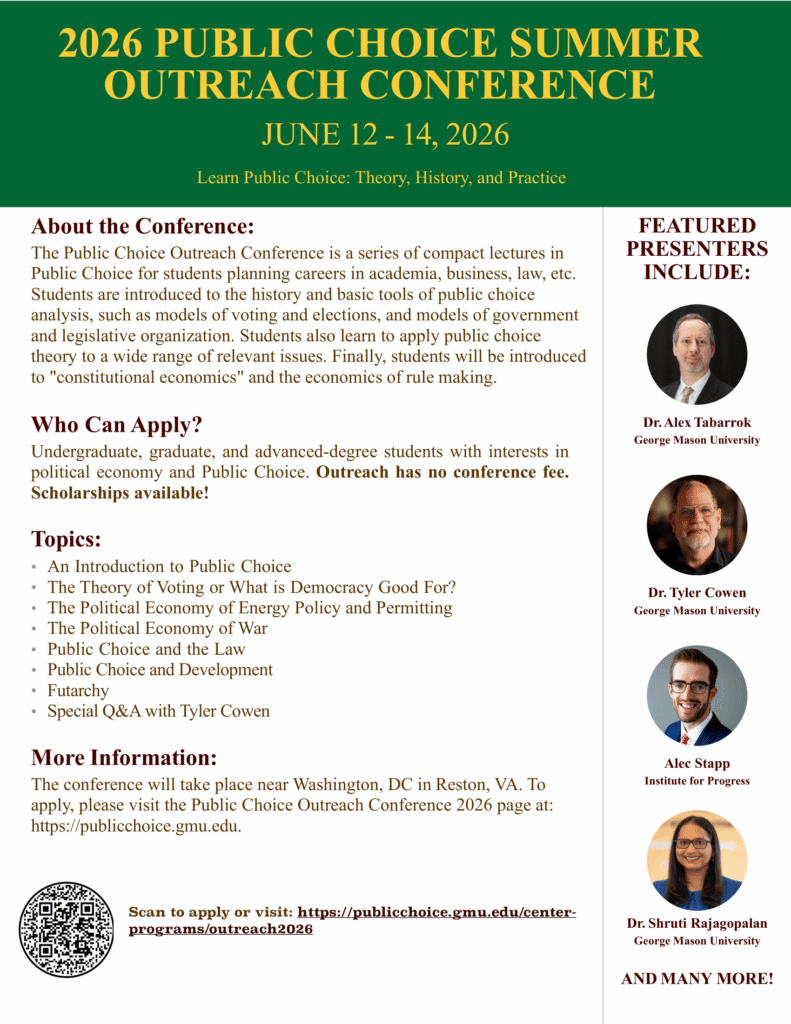
The Public Choice Outreach Conference!
The annual Public Choice Outreach Conference is a crash course in public choice. The conference is designed for undergraduates and graduates in a wide variety of fields. It’s entirely free. Indeed scholarships are available! The conference will be held Friday June12- Sunday June 14 , near Washington, DC in Reston, VA. Lots of great speakers including Tyler, myself, Bryan Caplan, Robin Hanson, Jon Klick, Shruti Rajagopalan and more.
Please apply and encourage your students to apply.
Migrant Income and Long-Run Economic Development
We study how international migrant income prospects affect long-run development in origin areas. We leverage the 1997 Asian Financial Crisis exchange rate shocks in a shift-share identification strategy across Philippine provinces. Initial migrant income shocks are magnified six-fold over time, increasing domestic income, education levels, migrant skills, and high-skilled migration. Remarkably, 74.9 percent of long-run income gains come from domestic rather than migrant income. Trade driven impacts of exchange rate shocks are orthogonal to effects via migrant income. A structural model reveals that 19.7 percent of long-run income gains stem from educational investments. International migration fosters broad economic development in origin communities.
That is from a recent AER piece by Gaurav Khanna, Emir Murathanoglu, Caroline Theoharides, and Dean Yang. Here is a good thread on the piece.
Does this have implications for higher ed in particular?
Declining fertility and population loss pose significant challenges for state and federal local governments responsible for providing a range of services to citizens, including education, health care, and infrastructure. Indeed, many areas are already experiencing outright population decline, with roughly half of U.S. counties losing population between 2010 and 2020. This paper examines how shrinking and aging populations affect the operations and fiscal sustainability of state and local governments. Preliminary evidence presented in this paper suggests that scaling down educational services is considerably more difficult than scaling up. The estimated per-enrollee cost increases associated with a 10 percent enrollment decline are four times larger than the cost decreases associated with a 10 percent enrollment increase. Regions with contracting populations will face additional challenges as a smaller working-age population bears the burden of funding pensions and retiree health plans for larger aging cohorts. While lower fertility can create a short run fiscal dividend as local governments serve fewer children, that dividend will only be realized if state and local public officials make efficient retrenchment a priority.
From Jeffrey Clemens, via the excellent Kevin Lewis. As I think JFV mentioned lately, we have not done enough thinking about what a society with low TFR really is going to look like after a while.
Auden on Iceland
If you have no particular intellectual interests or ambitions and are content with the company of your family and friends, then life on Iceland must be very pleasant, because the inhabitants are friendly, tolerant, and sane. They are genuinely proud of their country and its history, but without the least trace of hysterical nationalism. I always found that they welcome criticism. But I had the feeling, also, that for myself it was already too late. We are all too deeply involved Europe to be able, or even to wish to escape. Though I am sure you would enjoy a visit as much as I did, I think that, in the long run, the Scandinavian sanity would be too much for you, as it is for me. The truth is, we are both only really happy living among lunatics.
That is from W.H. Auden and Louis MacNeice, Letters from Iceland, from 1937, which is one of the better travel books, if indeed that is what it is.
Good sentences
This leads us to the next of Freud’s major contributions to neuroscience: his realization that cognition is, at bottom, wishful.
That is from the new and notable Mark Solms, The Only Cure: Freud and the Neuroscience of Mental Healing. This is a good book for people who underrated Freud, or think he is a mere charlatan.
The CA Minimum Wage Increase: Summing Up
Two recent joint-papers Did California’s Fast Food Minimum Wage Reduce Employment? by Clemens, Edwards and Meer and The Effects of California’s $20 Fast Food Minimum Wage on Prices by Clemens, Edwards, Meer and Nguyen give what I think is a plausible and consistent account of California’s $20 fast food minimum wage.
California’s $20 fast food minimum wage raised wages in the sector by roughly 8 percent relative to the rest of the country but employment fell by 2.3 to 3.9 percent (depending on specification, median ~3.2%), translating to about 18,000 lost jobs. Food away from home (FAFH) prices in California’s four CPI-reporting MSAs rose 3.3–3.6 percent relative to 17 control MSAs. Falsification tests on Food at Home and All Items Less Food and Energy show zero differential movement—this is specific to restaurant prices.
What’s interesting is that the papers are independently estimated but the fit is consistent. The price paper uses Andreyeva et al.’s demand elasticity of -0.8 to convert the estimated price increases into an implied quantity declines: about 3.9–4.1 percent in limited-service and 1.7–1.8 percent in full-service. These align well with the employment declines of 3.2 and 2.1 percent estimated in the first paper.
The consistency tells us something about the mechanism. One thing we have learned about the minimum wage in recent years is that the pass-through effect is large and more of the employment decline is driven by pass through than by labor-capital substitution. In other words, prices rose, quantity demanded fell, and that’s what killed the jobs—not robots replacing workers. Not today, anyway.
In terms of welfare, the bulk of employed workers get an 8% wage increase, a small minority get disemployed. The big transfer was from consumers to workers. California has roughly 39 million residents, all of whom face 3.3–3.6% higher FAFH prices. The transfer is likely regressive — lower-income households spend a larger budget share on fast food specifically. So the policy effectively taxes low-income consumers generally to raise wages for a subset of low-income workers, while eliminating jobs for another subset. Your mileage may vary but I don’t see this as a big win for workers. We thought small increases in the minimum wage were absorbed–maybe some were or maybe they were just hard to estimate–but you can’t extrapolate the small increases to big ones–the effect is non-linear. Big increases in the minimum wage start to bite.
As usual, when it comes to fast food there is no such thing as a free lunch.
Addendum: Clemens’s JEP paper continues to be the masterclass in how to think through minimum wage issues.