Year: 2016
Bernanke and Kohn defend interest on reserves
On the potential for a contractionary impact of IOR, they write:
This claim, made even by some good economists, is puzzling. Before December, the Fed paid banks one-quarter of one percent on their reserves. If the Fed had not paid interest, the return to reserves would have been zero. Accordingly, the only potential loans that would have been affected by the Fed’s payment of interest are those with risk-adjusted short-term returns between precisely zero and one-quarter percent—surely a tiny fraction of the total. In fact, over the last four years bank lending has increased at about a 5 percent annual pace (including around a 7 percent annual rate the past two years), with only residential mortgage lending lagging in the aftermath of the housing bust.
There is more here. I cannot say I am convinced. I would focus not on the interstices of lending, but rather on expansionary pressures from the banking system. Without IOR, what do Fed models predict would have been the price level impact of those trillions of new reserves following 2008? (Note that at some margin banks can just convert those new reserves into dividends, without any additional lending, if they are so satiated with trillions of unwanted liquidity. I’m not saying it would happen that way, but think of that as a limiting case.) No, I’m not advocating hyperinflation, but less sterilization of those new reserves would have maintained aggregate demand at a higher level post-2008, boosting investment, output, and employment through a quite traditional channel, as advocated say by the market monetarists.
And note Bernanke and Kohn’s own argument, elsewhere in the post, that soaking up reserves by selling off the Fed’s portfolio may be impractical, disruptive, or too costly. Let’s say that’s true. By limiting its use of IOR, the Fed in essence would have made a more credible commitment that any increase in bank reserves is here to stay, rather than just sitting in a holding tank of sorts. No?
Bernanke and Kohn also rebut the common charge that interest on reserves is a subsidy to banks. They may be right, but they are arguing too hard for “it is not a subsidy at the current margin of further reserve extension,” and not sufficiently rebutting the possibility of an infra-marginal subsidy, initiated right after IOR.
So this is a very smart and well-argued post, as one would rationally expect, but I don’t quite think it lays one’s doubts to rest either.
Livestream for Nate Silver
Nate and I will be chatting at 3:30p.m., as part of Conversations with Tyler. You can find the LiveStream here, here are the questions you all have been suggesting, and the Twitter hashtag is #CowenSilver.
China fact of the day
If China’s new debt in January were a country, it would be the world’s 27th-biggest economy.
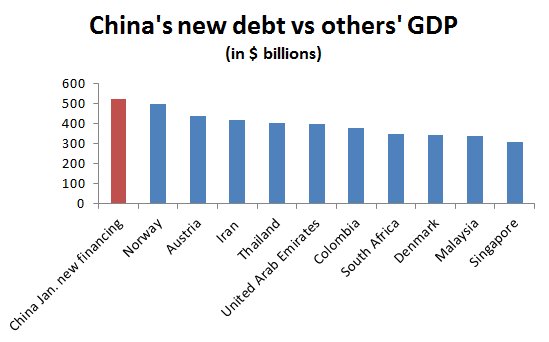
That is from Simon Rabinovitch.
p.s. they are not deleveraging.
p.p.s. my old method of clicking on the time stamp no longer creates a separate link for a tweet, how do I link to individual tweets now? Or does the algorithm no longer permit this?
Tuesday assorted links
1. Can a (British) dog fly a plane?
2. Left-wing economists skeptical of Bernie Sanders (NYT).
3. New survey paper on the causes and consequences of the Protestant Reformation; data-driven, economics of religion emphasis.
4. The self-driving office chair.
5. Will 3-D printing revolutionize the fashion industry?
6. Game-theoretic analysis of the politics of the Scotus nomination.
How tight is monetary policy now?, and some remarks on ngdp and market monetarism
I say “not that tight,” while leaving room open for the possibility that it should be looser.
What metrics might we look at? Federal funds futures no longer expect imminent further rate hikes from the Fed. Expected rates of price inflation have been very close to two percent. No matter what you think about the structural component of labor supply, cyclical unemployment has recovered a great deal over the last few years. And that is through the period of “taper talk” of almost two years ago. Consumer spending is doing OK, not spectacular but not cut off at the knees. And while in very recent times price expectations are headed downwards away from two percent, this seems to stem from negative real shocks, to which the Fed has responded passively (perhaps unwisely). That’s different than the Fed tightening. There was a quarter point rate hike from December, which is a small tightening for sure, but I don’t see much more than that.
So in sum, those data do not suggest severe monetary tightness, though again I am open to the argument that monetary policy should be looser.
By the way, I agree with Scott Sumner that we should not equate low interest rates with loose money. Tight and loose money are multi-dimensional, cluster concepts, especially post-2008, and require reference to a variety of variables. And if you are wondering, from this list of Lars Christensen monetary policy indicators I accept only #2, at least in a 2016 global setting where other real economies are volatile.
Given that I don’t see monetary policy as so tight right now, I suggested that if we have a recession it was likely to be a risk premium recession. The big uptick in gold prices is consistent with this view, though hardly proof of it.
So what is the context here? I am worried that if the United States has a recession this year (still unlikely, in my view, but maybe 20%?), that recession will be blamed on “tight money.”
To get more specific yet, I am very much a fan of the ngdp rule approach to monetary policy, but I am uncomfortable with one strand in market monetarist thought. I worry when low ngdp growth is blamed for low growth rates of real gdp.
Ngdp is an accounting summation, so I still want to know the real cause of the slower growth in real gdp. Let’s unpack at the most basic level whether the active cause was Fed tightening on the nominal side, or instead a negative real shock, followed perhaps by excess Fed passivity. That is one reason why I think of it as information-destroying to cite ngdp as a cause of developments in rgdp.
More fundamentally, if a central bank is doing anything close to price inflation targeting, mentioning low ngdp and low real gdp growth rates is simply citing the same fact twice, or almost so, rather than explaining one variable with the other. Angus once called the ngdp invocation a tautology; I’m not sure that is the right terminology, but still I wish to look for independent, non-ngdp measures of monetary policy when deciding how to allocate the blame for a recession, to real or nominal factors.
For further context, I was disquieted by some recent Lars Christensen posts on monetary policy and the American economy. I read him as “revving up” to blame a possible recession on tight U.S. monetary policy. I don’t think he provides much evidence that money is tight enough to cause a recession, other than citing the deterioration of some real variables.
I would encourage market monetarists to define — now — how tight or loose monetary policy really is. Then stick with that assessment, based on whatever variables you consulted.
A year from now, I won’t count it if you say a) “well, ngdp growth is down, money was tight, therefore real gdp growth rates fell. Tight money must have been the problem because low rates of ngdp growth are tight money.”
I would count it if you say something like b): “the dollar shock [or some other factor] was worse than the Fed had thought. That started to push us into recession. The Fed should have loosened, but they didn’t, and so the slide into recession continued, when the Fed could have moderated it somewhat by pursuing an ngdp target.” (By the way, read Gavyn Davies on the strong dollar issue. Alternatively, here is a Marcus Nunes take which I think is citing ngdp in exactly the way I am worried about.)
I also would count it if you said “I see the Fed tightening a lot right now, a recession is likely coming,” although I might dispute your evidence for that tightening.
Here is a recent Scott Sumner post, mostly about me. It’s basically taking the other side of what I have been arguing, and I would suggest simply disaggregating the ngdp terminology into a more causal language of nominal and real shocks. Surely there are other independent, ex ante signs for judging the tightness of monetary policy, rather than waiting for ngdp figures to come in, which again is citing a transform of the real gdp growth rate as a way of explaining real gdp.
I find these issues come up many, many times in market monetarist writings. I think they have basically the right policy prescription, and could provide the world with billions or maybe even trillions of dollars of value, if only policymakers would listen. But I also think they are foisting a language of causality on the business cycle problem which the rest of economic discourse does not easily absorb, and which smushes together real and nominal shocks into a lower-information accounting variable, namely ngdp, and then elevating that variable into a not entirely deserved causal role. We ought to talk in terms of ex ante, independent measures of monetary policy looseness, not ex post measures which closely resemble indirect transforms of real gdp itself.
That, in a nutshell is why, although I usually agree with the market monetarists on policy, and their desire to lower the status of “hard money” doctrine within liberalism, and while I have long applauded and supported their efforts, I don’t call myself a market monetarist per se.
Addendum: Nick Rowe comments. And Marcus Nunes comments.
The biases in Chinese SOEs
Chinese state-owned acquirers often seem motivated by non-commercial impulses, which complicates matters. By carrying out directives to “go out and buy” businesses that fit with Beijing’s industrial policy, state-owned companies and even a few of their private counterparts win kudos in the Communist party hierarchy. That helps them tap into official largesse, such as approval for expansion plans and backing from state banks and capital markets.
“State-owned enterprises have high incentives to increase their size, and they use plans outlined by [government agencies] as weapons to expand both domestically and internationally,” says Victor Shih, professor at University of California San Diego. “The bigger they are, the more political weight and more room for rent-seeking can be enjoyed by senior management.”
That is from a longer and excellent FT feature story on Chinese SOEs.
Monday assorted links
1. Albatross!
2. Do economic recoveries die of old age? It doesn’t seem so. And Tim Taylor comments and teaches us the word “paraedolia”: “looking at randomness and perceiving patterns that aren’t really there.”
3. The future of higher ed: a mentor for every student.
4. More evidence that negative interest rates aren’t working. They are not just a reflection of bad conditions, the tax on intermediation seems positively harmful, and there are ways to run an expansionary monetary policy which don’t involve this tax.
The Sharks Get Stung
On Friday, Shark Tank, the investment television show, featured two nice ladies from Minnesota and their product Bee Free Honee, honee made from apples. Is cheap, vegan honee a good idea? Perhaps but I was less than convinced by one of the arguments the ladies made for their honee–it will save bees! The ladies argued that reducing the demand for honey will encourage bee farmers to not work the bees so hard thus increasing their numbers.
 I was expecting the acerbic Kevin O’Leary to have a field day with this economic fallacy. Or maybe, I thought, Mark Cuban will throw a dash of common sense into the tank. But no, all the Sharks cooed about this mad scheme. So it is up to me.
Reducing the demand for honey, reduces the demand for honey bees. A cheap, high-quality substitute for honey doesn’t mean a world of bees gently pollinating flowers in an idyllic landscape it means a beepocolypse. Bee free honee will save bees the same way the internal combustion engine saved horses.
Addendum 1: You may be concerned about colony collapse disorder. Well, the commercial beekeepers are even more concerned and they have been adapting to CCD and maintaining honey production and pollination services. In fact, there are more bee colonies in the United States today (latest data) than there have been anytime in the last 20 years. CCD is still a problem but it’s the demand for honey and pollination services that incentivizes solutions to the problem. Remember, without honey it’s only a hobby.
Addendum 2:Perhaps the ladies have a sophisticated position on the repugnant conclusion but I doubt it.
Hat tip: Max.
Eric Burroughs on Chinese capital flight
Thus, we can say: 1) outflows are sizable but exaggerated in reserves (Feb should be telling given EUR’s surge); 2) China paying down FX debt is part of the equation, so it’s not all hot capital flight; 3) China’s overall debt is a problem but mostly in its own currency, so it has more means of dealing with it than other EMs in the many well-known debt crises of the past 30–40 years. I’m still waiting for a good explanation of why China can’t monetize its local FX debt and not hobble households in the process.
Here is more, of interest thoughout (which is not quite the same as “interesting throughout”), Eric is less bearish than many, worth the read. That said, the latest trade data are not looking so good.
Hat tip goes to www.macrodigest.com.
Do higher marginal tax rates reduce income mobility?
It seems so, according to the job market paper from Mario Alloza (pdf):
The results obtained suggest that higher marginal tax rates reduce income mobility. Particularly, I find that an increase of one percentage point in the marginal rate is associated with declines of about 0.5-1.3% in the probability of changing deciles of income. A decrease of 7 percentage points in the marginal tax rate (slightly smaller than a standard deviation of non-zero changes in the rates) can account for about a tenth of the average income mobility in a year. The effect of taxes on mobility arises in specifications that consider income distributions both before and after taxes and transfers, suggesting that the impact of taxation on mobility goes beyond redistribution effects. The economic mechanism that induces this impact seems to be related to the labour market incentives created by changes in the tax schedule.
Interestingly, these effects are especially pronounced toward the bottom of the income distribution. If the implied labor supply response seems too high to you, then read some of the recent papers by Karel Mertens. The idea that taxes matter is making a comeback in economics, though I am not sure you would get that impression from most of the economics blogosphere.
Do note the mobility results cover taxes only, and not how the money is spent.
For the pointer I thank Peter Isztin.
Sunday assorted links
Why Do We Kiss?
Smithsonian: [K]issing helps heterosexuals select a mate. Women in particular value kissing early on. Saliva is full of hormones
and other compounds that may provide a way of chemically assessing mate suitability—that’s the biological brain stepping in.
…While kissing, couples exchange 9 milliliters of water, 0.7 milligrams of protein, 0.18 mg of organic compounds, 0.71 mg of fats, and 0.45 mg of sodium chloride, along with 10 million to 1 billion bacteria, according to one accounting.
Women are also more likely to say that a first kiss could be the decider for selecting a mate. Can the biological drive overcome the perception that your chosen one is a bad kisser? Wlodarski says it’s hard to separate the two, but that “I would hazard a guess that if someone thinks someone is a bad kisser it’s because their smell wasn’t right,” he says. Women have to be more selective because they face greater consequences when they make a poor mating decision—like having to carry a baby for nine months, says Wlodarski.
…Not every culture is down with the full-on mouth kissing enlivened by a wandering tongue. That seems to be a modern, and Western, convention, perhaps from the last 2,000 years, says Wlodarski. A study published in 2015 found that less than half of the cultures surveyed engage in romantic, sexual kissing.
There’s evidence—at least from written history—that in the past, kissing was primarily mutual face or nose rubbing, or even sniffing in close proximity. In Hindu Vedic Sanskrit texts, kissing was described as inhaling each other’s soul.
Arrived in my pile
Kenneth Scheve and David Stasavage, Taxing the Rich: A History of Fiscal Fairness in the United States and Europe.
Peter Conti-Brown, The Power and Independence of the Federal Reserve.
Daniel Oppenheimer, Exit Right: The People Who Left the Left and Reshaped the American Century.
If we have a U.S. recession this year, it will be a risk-based recession
U.S. consumers showed signs of strength in January, taking advantage of low oil prices to increase their spending and offering a welcome counterpoint to the gloom that has gripped investors and roiled markets since the start of the year.
Sales at retail stores and restaurants rose 0.2% in January from the prior month, the Commerce Department said Friday. And December’s retail sales were revised to a 0.2% gain instead of a drop, showing a better end to the year than initially estimated.
While that is good news for everyone, if only because of the implied wealth effect, it ought to give Keynesians special cheer. And from another WSJ piece:
The sharp drop this year in consumer-focused stocks is feeding fears of a recession, but those companies’ bonds are sending a more upbeat signal.
Bonds from companies such as retailers and restaurants, which are most closely tied to consumer-spending habits, have been strong performers this year, contrary to what analysts would expect if the economy were headed into a tailspin.
The disconnect is notable, because many investors view the bond markets as a more sober indicator of corporate financial health and economic conditions than stock markets.
A risk-based business cycle results when investors (and others) perceive an increase in the risk premium, and pull back their commitments accordingly. Here are previous MR posts on risk-based business cycle theory.
Antonin Scalia on economic rights
From 1985 (pdf):
But still, that seemed to me a peculiar way to put it — contrasting economic affairs with human affairs as though economics is a science developed for the benefit of dogs or trees; something that has nothing to do with human beings, with their welfare aspirations, or freedoms. That, of course, is a pernicious notion, though it represents a turn of mind that characterizes much American political thought. It leads to the conclusion that economic rights and liberties and qualitatively distinct from, and fundamentally inferior to, other noble human values called civil rights, about which we should be more generous….On closer analysis, however, it seems to me that the difference between economic freedoms and what are generally called civil rights turns out to be a difference of degree rather than of kind.
He worries, however, that conservatives want a non-activist Court, but then want the Court to do what they want on economic issues. Ultimately Scalia worried that if the Court gave too much credence to economic rights, it would end up with economic rights which are not sensible, and thus he wished to abide by a literally more conservative approach. He closed his beautiful essay with this:
…the task of creating what I might call a constitutional ethos of economic liberty is no easy one. But it is the first task.
I disagreed with him on many issues, but his presence on the Court was an important stepping stone for law and economics, and for philosophy as well I might add.
Addendum: “…justices die far more often when a member of the opposite party holds the White House.”