Year: 2017
Megan McArdle on the collapse of Obamacare
Her earlier prediction:
Obamacare would not, and could not, be the program that had been promised or intended. It had already failed to deliver on key promises for coverage, affordability and of course, the infamous promise that “if you like your doctor, you can keep your doctor.” It was also dangerously unstable, requiring steady executive intervention just to keep the program from collapsing. I argued that these executive interventions, enthusiastically supported by the law’s proponents, were setting a precedent that would eventually be used against it. Worried that health care was too hostage to the vicissitudes of the markets, Democrats had instead made it the prisoner of politics.
“Essentially they’ve made it so that Republicans can undo two-thirds of this law with a stroke of the presidential pen,” I said at the close of my opening statement. “Obamacare is now beyond rescue. The administration has destroyed their own law in order to save it.” Four years later, we are watching those dominos fall.
Here is the full Bloomberg piece.
Some reasons why the electricity in Puerto Rico is not working
- The Puerto Rico Electric Power Authority (PREPA) declined to ask for help from mainland electric utilities in the days after Hurricane Maria, instead turning to a small Montana-based contractor to carry out grid restoration practices.
- Earlier this week, PREPA CEO Ricardo Ramos told E&E News that his bankrupt utility did not reach out to munis on the continental U.S. because he was unsure it could pay them back for assistance. About 90% of the island remains without power weeks after the storm hit.
- The American Public Power Association (APPA), the trade group for U.S. munis, confirmed that mutual assistance programs were not activated, but said PREPA had already contracted with Whitefish Energy by the time the trade group convened a conference call to coordinate aid. PREPA did not respond to requests for comment.
Here is the full story, and here is a related piece, via Brian S.
Friday assorted links
1.Yuval Levin on the new Trump health care changes. Here is more from Timothy Jost.
2. Somebody should consider this picture. Trump is not entirely wrong on this one.
4. Maria Konnikova on Betsy Levy Paluck on how social norms change.
6. What would happen if the United States withdrew from NAFTA? (NYT)
“Sachs looks to turn conservative tide in US state governments”
Economist Jeffrey Sachs is joining with a scion of the wealthy Pritzker family and a former New York state legislator to fund candidates for local offices in the hope of reversing a conservative tide that has put Republicans in control of most US state governments.
Their group, called Future Now, was scheduled to announce its first donations on Monday — about $160,000 to be distributed to 10 Democratic candidates running this year for Republican-held seats in the Virginia state legislature.
…To qualify for Future Now’s funds, candidates must agree to pursue 21 objectives ranging from a “liveable” wage for all jobs to universal health coverage, an end to the mass incarceration of non-violent offenders and support for “clean, safe energy”.
Future Now’s founders say their goals are meant to be reached by 2030. In the meantime, they say they will measure progress through such means as the publication of state-by-state statistics.
Here is more from Gary Silverman at the FT.
Vaping Saves Lives
E-cigarettes are less dangerous than cigarettes but are equally effective at delivering nicotine. Levy et al. estimate that if smokers switched to e-cigarettes millions of life-years would be saved, even taking into account plausible rates of non-smokers who start to vape. (It’s worth noting that the authors are all cancer researchers, statisticians and epidemiologists concerned with reducing cancer deaths.)
A Status Quo Scenario, developed to project smoking rates and health outcomes in the absence of vaping, is compared with Substitution models, whereby cigarette use is largely replaced by vaping over a 10-year period. We test an Optimistic and a Pessimistic Scenario, differing in terms of the relative harms of e-cigarettes compared with cigarettes and the impact on overall initiation, cessation and switching. Projected mortality outcomes by age and sex under the Status Quo and E-Cigarette Substitution Scenarios are compared from 2016 to 2100 to determine public health impacts.
Compared with the Status Quo, replacement of cigarette by e-cigarette use over a 10-year period yields 6.6 million fewer premature deaths with 86.7 million fewer life years lost in the Optimistic Scenario. Under the Pessimistic Scenario, 1.6 million premature deaths are averted with 20.8 million fewer life years lost. The largest gains are among younger cohorts, with a 0.5 gain in average life expectancy projected for the age 15 years cohort in 2016.
 Vaping saves lives but the FDA has in the past tried to impose severe regulations on the industry and to make vaping less pleasurable. (Aside: It’s interesting that liberals tend to favor other risk-reducing devices such as condoms in the classroom but disfavor vaping while conservatives often take the opposite sides. I don’t think either group is basing their choices on the elasticities.)
The FDA, for example, has tried to ban flavored e-cigarettes. In a new NBER paper, Buckell, Marti and Sindelar calculate that:
…a ban on flavored e-cigarettes would drive smokers to combustible cigarettes, which have been
found to be the more harmful way of getting nicotine (Goniewicz et al., 2017; Shahab et al., 2017).
In addition, such a ban reduces the appeal of e-cigarettes to those who are seeking to quit; ecigarettes
have proven useful as a cessation device for these individuals (Hartmann-Boyce et al.,
2016; Zhu et al., 2017), and we find that quitters have a preference for flavored e-cigarettes.
Fortunately, the new FDA commissioner Scott Gottlieb has signaled a more liberal attitude towards vaping. It could be the most consequential decision of his tenure.
Hat tip: The excellent Robert Wilbin from 80,000 Hours.
New results on total factor productivity and the import of creative destruction
I am not sure I trust any TFP measures (what if innovation is simply embodied in investment?), but this paper by Gerben Bakker, Nicholas Crafts, and Pieter Woltjer is worth a ponder:
We develop new aggregate and sectoral Total Factor Productivity (TFP) estimates for the United States between 1899 and 1941 through better coverage of sectors and better-measured labor quality, and find TFP-growth was lower than previously thought, broadly based across sectors, and strongly variant intertemporally. We then test and reject three prominent claims. First, the 1930s did not have the highest TFP-growth of the twentieth century. Second, TFP-growth was not predominantly caused by four ‘great inventions’. Third, TFP-growth was not driven indirectly by spillovers from great inventions such as electricity. Instead, the creative-destruction -friendly American innovation system was the main productivity driver.
For the pointer I thank David Levey.
What I’ve been reading
1. J.M. Coetzee, Late Essays 2006-2017. The pieces on Robert Walser, Ford Madox Ford, Patrick White, Gerald Murnane, Samuel Beckett, and Juan Ramón Jiménez make this worth buying, the rest are mixed in quality. Coetzee remains minimalistically grumpy in the right way.
2. Grant N. Havers, Leo Strauss and Anglo-American Democracy: A Conservative Critique. Havers argues against Strauss from “the Right,” but sympathetically. He suggests Strauss underrated Christianity and had too high an opinion of antiquity, and was a true liberal democrat, while the American founders consciously rejected ancient political thought.
3. Neil Monnery, Architect of Prosperity: Sir John Cowperthwaite and the Making of Hong Kong. I didn’t find this inspiring to read, but still it is a useful account of the under-covered early days of how Hong Kong evolved into a freedom-oriented economy after World War II. Here is a review from The Economist.
4. Anne Applebaum, Red Famine: Stalin’s War on Ukraine. “As Dolot remembered it, the presence of the Soviet state in his village in the 1920s had been minimal.” And “Initially, collectivization was supposed to be voluntary.” And “When their potatoes were gone…people began to go to the Russian villages and to exchange their clothing for food.”
I have only browsed my library copy of Masha Gessen’s The Future of History: How Totalitarianism Reclaimed Russia, but it looked very good and so I ordered it from Amazon.
William Blake and the Age of Aquarius is a beautiful exhibition catalog, with text, edited by Stephen F. Eisenman, for a show currently on at Northwestern University.
David Kynaston, Till Time’s Last Sand: A History of the Bank of England, 1694-2013, seems to be a fine work of history, but it is not organized analytically in the way I might wish. Still, some of you should be interested, as this is 796 pp. of well-written, carefully researched material on the BOE.
Thursday assorted links
1. Behavioral economics should be most important for education.
2. The New York Review of Books discovers the Israeli TV show Srugim.
3. Trust within the diamond trade is eroding.
5. Toward a public choice theory of the Screen Actors Guild. Union much?
6. Did standardized languages help drive the Industrial Revolution?
The wisdom of Alex Tabarrok
From Lisa Abramowicz on Twitter:
“We seem to be living in the riskiest moment of our lives, and yet the stock market seems to be napping:” Thaler [link]
It’s funny that the behavioral critique of the market is now that it is not volatile enough!
USA fact of the day
The top 0.1 percent of earners projected to pay more to the IRS than the bottom 80 percent combined. This year, official government data show, the top 20 percent will pay 95 percent of all income taxes.
And:
Not just that: It’s hard to cut tax rates on moderate-income people without simultaneously benefiting the rich. That’s because everyone pays the same marginal tax rates on, say, their first $50,000 in income, regardless of how much they make in total. So cutting, for example, the 15 percent tax bracket helps the poor and rich alike.
That is all from Brian Faler at Politico.
You too can now relax
People have stopped worrying about covered interest parity.
This worry has expired along with the cross-currency basis. Here’s Matt Klein at Alphaville explaining that for much of 2016, it was much cheaper to borrow dollars in the U.S. and hedge them into yen than it was to borrow yen in Japan, creating an obvious arbitrage that nonetheless didn’t go away. But then it did, due to declining dollar strength or the full phasing-in of money-market-fund reform or changes in Federal Reserve balance-sheet policy. I look forward to other recurring Money Stuff worries being so fully and satisfactorily resolved.
That is from the “no one else could do what he does” Matt Levine at Bloomberg. And Matt points out that Stephen Curry is reading Ray Dalio’s Principles.
The culture and polity that is China
Those who fail to repay a bank loan will be blacklisted, and they will have their name, ID number, photograph, home address and the amount they owe published or announced through various channels – including in newspapers, online, on radio and television, and on screens in buses and public lifts.
…In the southern city of Guangzhou, the personal details of some 141 debt defaulters have so far been displayed on screens in buses, commercial buildings and on media platforms at the request of local courts.
Meanwhile in Jiangsu, Henan and Sichuan provinces, the courts have teamed up with telecoms operators to create a recorded message – played every time someone calls – for those who fail to repay their loans. The message tells the caller: “The person you are calling has been put on a blacklist by the courts for failing to repay their debts. Please urge this person to honour their legal obligations.”
That is from SCMP, via Viking.
Elsewhere in the Middle Kingdom, Shanghai adopts a facial recognition system to name and shame jaywalkers.
American cities and suburbs are converging
That is the theme of my latest Bloomberg column, here is one excerpt:
The internet has been another equalizer. You can enjoy texting and social media from just about anywhere, and our near obsession with these activities is equalizing urban and suburban experiences, possibly for the worse.
Arguably, sex and alcohol were once more prominent in some American cities than in American suburbs. But the new generation of American youth seems less interested in these activities anyway.
As American travel infrastructure decays, and traffic congestion worsens, what we used to call cities and suburbs won’t be able to rely on each other so much, as trips become too exhausting and time-consuming. That too will encourage cities and suburbs each have their own mix of jobs, retail and cultural opportunities.
There is much more at the link.
Wednesday assorted links
1. Are positive and normative economics really all that different?
2. The movie The Florida Project is flawed, but its strengths are very strong.
3. Frakt and Carroll on health care and innovation (NYT).
4. New Macarthur winner Elizabeth [Betsy] Levy Paluck on what works in prejudice reduction. Here are more of her papers.
5. Decentralized credit scoring through a blockchain? (pdf)
Does Online Dating Increase Racial Intermarriages?
Today about a third of all new marriages are between couples who met online. Online dating has an interesting property–you are likely to be matched with a total stranger. Other matching methods, like meeting through friends, at church or even in a local bar are more likely to match people who are already tied in a network. Thus, the rise of online dating is likely to significantly change how people connect and are connected to one another in networks. Ortega and Hergovich consider a simple model:
We consider a Gale-Shapley marriage problem, in which agents may belong
to different races or communities. All agents from all races are randomly
located on the same unit square. Agents want to marry the person who is
closest to them, but they can only marry people who they know, i.e. to whom
they are connected. As in real life, agents are highly connected with agents
of their own race, but only poorly so with people from other races.
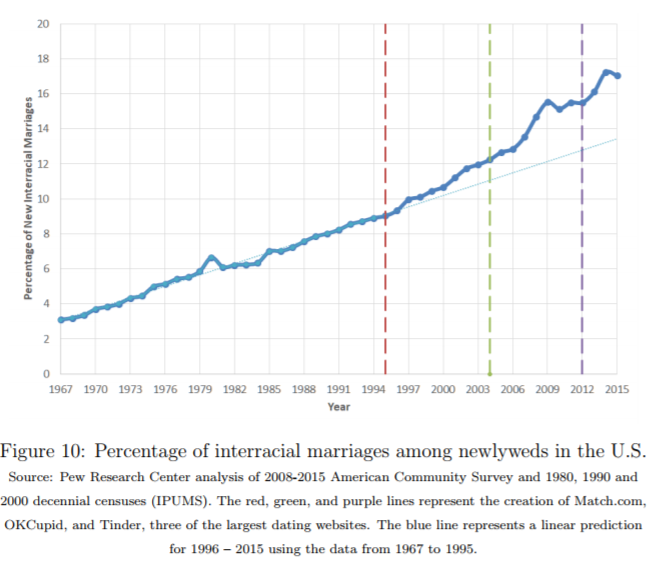 Using theory and random simulations they find that online dating rapidly increases interracial marriage. The result happens not simply because a person of one race might be matched online to a person of another race but also because once this first match occurs the friends of each of the matched couples are now more likely to meet and marry one another through traditional methods. The strength of weak ties is such that it doesn’t take too many weak ties to better connect formerly disparate networks.
Interracial marriage, defined to include those between between White, Black, Hispanic, Asian, American Indian or multiracial persons, has been increasing since at least the 1960s but using the graph at right the authors argue that the rate of growth increased with the introduction and popularization of online dating. Note the big increase in interracial marriage shortly after the introduction of Tinder in 2009!
(The authors convincingly argue that this not due to a composition effect.)
Since online dating increases the number of potential marriage partners it leads to marriages which are on average “closer” in preference space to those in a model without online dating. Thus, the model predicts that online dating should reduce the divorce rate and there is some evidence for this hypothesis:
Cacioppo et al. (2013) find that marriages created online were less likely to
break up and reveal a higher marital satisfaction, using a sample of 19,131
Americans who married between 2005 and 2012. They write: “Meeting a
spouse on-line is on average associated with slightly higher marital satisfaction
and lower rates of marital break-up than meeting a spouse through
traditional (off-line) venues”
The model also applies to many other potential networks.
Hat tip: MIT Technology Review.