Month: February 2023
From my WhatsApp
Tyler Cowen: I am, by the way, not so convinced by the Jon Haidt piece on social media and mental illness: https://jonathanhaidt.substack.com/p/social-media-mental-illness-epidemic?utm_source=post-email-title&publication_id=1221094&post_id=104255435&isFreemail=true&utm_medium=email
Tyler Cowen: He readily admits that across individuals social media use explains only a tiny portion of the variation in happiness. His response is that it is other people’s usage of social media that makes you unhappy, because you can’t go talk to them.
Tyler Cowen: So there are (in his view) only system-wide effects, nothing that can be verified at the micro level. [TC: note the “to the point” style of WhatsApp leads to certain exaggerations and inaccuracies]
Tyler Cowen: It seems to me that if the stuff makes you so miserable, young people should be able to build small social “pods” of individuals who don’t do the stuff so much, hang out together, and are just way happier.
Tyler Cowen: Furthermore, if a lot of the problem is “young girls comparing themselves to thinner others on Instagram” and the like, that should show up as an individual-level effect. Not a group effect. There can be those beautiful, envy-inducing models on Instagram even if only a small percentage of one’s peers are on Instagram.Tyler Cowen: I agree the problem is larger with girls. And I think it is a mix of bullying, cyberbullying, envy, and unrealistic expectations. I just don’t think it is nearly as a large a problem as he claims.
Tyler Cowen: And I think that often “going to talk to other people” — you know the “Mean Girls” — is the problem itself. In that sense his various hypotheses contradict each other.
You will note also the recent result that school closures lower not raise the rate of youth suicide. It is thus hard for me to string together the hypothesis of a) “youth suicide rates are way up,” b) “this is because of social media,” and c) “social media make us miserable by taking away people to talk to and hang out with.”
Update on the New York Times Word Frequency Chart
By David Rozado, who has hit a bunch of home runs lately. Look at his charts, to my eyes they show woke terminology in the NYT as having peaked and as now declining. Here goes, they are very different from the earlier charts (also at the link) ending in 2019:
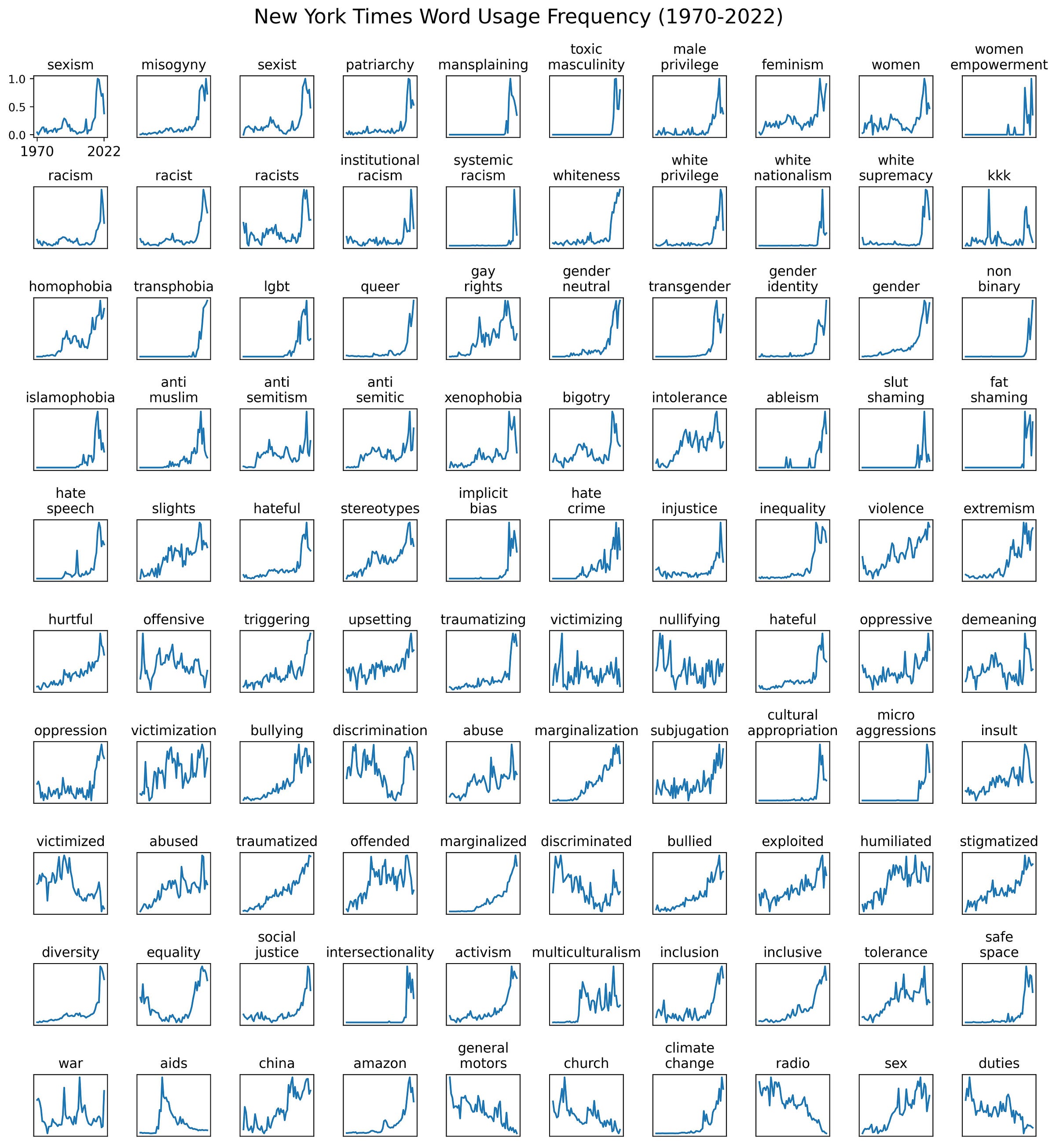
Climate change issues, however, continue to receive more coverage. Not all of the charts “go my way,” but this is hardly what you would expect if Wokeness were simply rising, rising, rising out of control. Oh, and check out these trends in pronoun usage. Also here is more from Rozado, mostly on how the positive sides of woke rhetoric are gaining at the expense of the negative sides.
Advice for the new World Bank chief
From my latest Bloomberg column:
First, contrary to the prevailing wisdom, the World Bank should not make climate change more of a priority. Climate-change issues are more closely associated with rich and middle-income countries than with the poorest countries. The very poorest countries, because they have small economies, do not as a rule emit much carbon. Indoor air pollution, such as burning wood or fuel for heat or cooking, is usually more of a problem. Those emissions can be toxic, and the World Bank should try to help reduce them. But that won’t do much to cut carbon emissions.
The World Health Organization estimates that about seven million people die each year from the direct effects of air pollution. For poorer countries, alleviating that problem should be a greater priority than fighting global climate change.
The reality is that if the World Bank can help elevate some very poor countries into middle-income countries, climate-change problems will become somewhat worse — at least in the short to medium run. “We make climate-change problems worse” is not a marketable slogan. But it is selfish to try to get the World Bank to do more good for the wealthiest nations and less good for the poorest nations, which is essentially what prioritizing climate change would do. And of course the world’s wealthier nations are broadly coincidental with the major shareholders of the World Bank…
If there is any area where the World Bank should double down, it is in public-health interventions. Over the last several decades, the successes have been extraordinary. In Africa, for instance, child mortality rates have plummeted, and many public-health indicators have improved considerably, especially outside of major conflict zones. Why not invest more in what is working?
Recommended, with further arguments at the link.
New Facebook/Meta LLMs — researchers can apply for access
Today we release LLaMA, 4 foundation models ranging from 7B to 65B parameters.
LLaMA-13B outperforms OPT and GPT-3 175B on most benchmarks. LLaMA-65B is competitive with Chinchilla 70B and PaLM 540B.
The weights for all models are open and available at https://t.co/q51f2oPZlE
1/n pic.twitter.com/DPyJFBfWEq— Guillaume Lample (@GuillaumeLample) February 24, 2023
Friday assorted links
MRU One Million Users!
Marginal Revolution University hit a milestone last week: the one millionth use of our interactive econ practice tools!
Interactive tools help students learn economics and help teachers deliver great econ education. To celebrate, the MRU team has just released a 6-day high school unit plan on inflation complete with lecture slides, videos, and interactive practice and we’re offering high school teachers a chance to win billions of dollars to check it out. (Ok, Zimbabwean billions but still pretty cool!)
More generally, check out our free economics courses and teaching resources at MRU and our superb principles of economics textbook, Modern Principles of Economics. Next stop: Ten million!
Which weapons in a major conflict can be most easily scaled?
Classic artillery and bombs end up being the default because they have more than enough range for the modern battlefield and are some of the few mass producible weapons.
And:
At the beginning of a war, both sides will have stocks of long-range weapons, satellites, and other recon assets. Most of those will likely be gone within a few weeks.
And:
Ammunition will be the most voracious microchip user.
Here is more from Austin Vernon on what the next major war will look like.
My Progress Studies conversation with Jon Baskin of The Point
No, not Nilsson’s The Point, the other one! Here is the piece, here is one excerpt:
JB: What did you learn from reading Plato?
TC: Reading Plato, it struck me—I’m thirteen years old here—but it struck me how much the whole rest of the world is by no means on board with the things I thought were good. So Socrates is constructing his ideal republic, and you can debate whether Plato really favored it, or whether Socrates really favored it, but those ideas are out there. You ban the poets? You want to be like Sparta? Those are big issues.
And even then, when I read Plato, I saw it as a dialogic mode of thinking, rather than believing that Plato was endorsing everything Socrates said. The dialogues are rich and fruitful. And people hold a lot of different points of view. So to try to refine dialogic modes of thinking about progress, and indeed everything: that was the biggest lesson I got from Plato. And then just how smart some of the early people were. And that’s not unrelated to progress studies. In the modern world there are a whole bunch of ways we’re clearly much smarter, like programming computers. Are we smarter in every way? Will we produce our own Adam Smith or Plato? Tough questions.
And:
JB: I want to talk a little bit about Tolstoy. Max Weber, in his famous 1917 lecture “Science as a Vocation,” says that Tolstoy is the person who most sharply raises the question of whether the advances of science and technology have any meaning that go beyond the purely practical and technical. And he quotes Tolstoy saying that, basically, for the person who puts progress at the center of their life, life can never be satisfying, because they’ll always die in the middle of progress. How would you respond to this charge from Tolstoy about progress?
TC: I’m pretty happy and Tolstoy was not, would be my gut-level response.
Self-recommended!
Brand new Substack that translates leading Weibo articles
Via the excellent Gavin Leech.
Thursday assorted links
1. More on the new black hole hypothesis. And massive galaxies earlier than we had thought.
3. “Converse with your favorite books!”
4. Very good Brian Potter update on the construction productivity slowdown.
5. South Korean fertility rate falls to 0.78 (Bloomberg).
6. “A new Ivermectin randomized, placebo-controlled trial at high doses for long duration fails to show any benefit...” Scott Alexander has given up the ghost as well, as a number of other major trials have generated similar results.
Why not get out? Really
Bolotnyy: We found that these moderate to severe symptoms of depression and anxiety were about two to three times more prevalent among PhD students in these eight top-ranked economics PhD programs than in the general population. Suicidality was also about two times what you’d see in the general population.
And:
Economic students are about half as likely as other Harvard PhD students to be in treatment if they have some of these serious symptoms. That’s something that we’ve talked a lot about and tried to understand.
Here is more, brought to you by the AEA. I am very happy to see this work being done, kudos to Valentin Bolotnyy. And I am all for more social connections, better campus mental health counseling, and involved advisors, all of which are listed as potential partial remedies. Yet if I were the AEA, I would be wondering about pushing yet another recommendation — discouraging some people, at the margin of course, from even starting graduate school in economics? And other fields too.
Somehow that option does not receive much consideration. (When I advise people. in part due to this and other data, I am much less likely to recommend graduate school than in earlier times.) Should not part of the mission of the AEA be to think like an economist? What about “exit”? Or is that only for other sectors?
My Conversation with Brad DeLong
Here is the audio and transcript, here is part of the summary:
Tyler and Brad discuss what can really be gleaned from the fragmentary economics statistics of the late 19th century, the remarkable changes that occurred from 1870–1920, the astonishing flourishing of German universities in the 19th century, why investment banking allowed America and Germany to pull ahead of Britain economically, what enabled the Royal Society to become a force for progress, what Keynes got wrong, what Hayek got right, whether the middle-income trap persists, his favorite movie and novel, blogging vs. Substack, the Slouching Towards Utopia director’s cut, and much more.
And here is one excerpt:
COWEN: What do you take to be the best understanding of the 17th-century Scientific Revolution, if indeed you view it as a 17th-century revolution?
DELONG: I always think Joel Mokyr is absolutely magnificent on this. I think he understates the role that having printing by movable type played in creating the community of scientific practice and knowledge seeking.
There’s one thing that happens that is extremely unusual. Back before 1870, there’s no possibility at all that humanity is going to be able to bake the economic pie sufficiently large that everyone can have enough. Which means that, principally, politics and governance are going to be some elite constituting itself and elbowing other elites out of the way, and then finding a way to run a force-and-fraud domination and exploitation scheme on society so that they at least can have enough. When Proudhon wrote in 1840s that property is theft, it was not metaphor. It was really fact.
What does this elite consist of? Well, it’s a bunch of thugs with spears, the people who have convinced the thugs with spears that they’re their bosses, and their tame accountants, bureaucrats, and propagandists. Which means, most of the time, when you have a powerfully-moving-forward set of people thinking about ideas, whether the idea is true is likely to be secondary to whether the idea is useful to helping me keep my place as a tame propagandist in the force-and-fraud domination and exploitation elite machine.
This is a point I’ve stolen from Ernest Gellner, and I think it is very true. Yet, somehow, the Royal Society decides, no. The Royal Society decides nothing except through experiment — what we are going to demand that nature tell us, or tell one of us, or at least someone writes us a letter saying they’ve done the experiment about what is true. That is a miraculous and completely unexpected transformation, and one to which I think we owe a huge amount.
Many interesting points are discussed.
The decline of Michelin-starred restaurants
That is the topic of my latest Bloomberg column, here is one bit:
And then there is the spread of the Michelin brand. There are now Michelin guides for many US cities, which has caused the brand to lose some exclusivity. Michelin has awarded stars to 24 restaurants in the Washington area, for instance. I like many of these places, but I suspect Michelin is grading on a curve.
Social media are another part of the market evolution. Instagramming your meal is a popular pastime, and it suits some restaurants better than others. A lot of people, understandably, are reluctant to pull out their camera phones in a haute Parisian establishment, whereas they will gladly do so in a creative and more casual spot for Indian nouvelle cuisine in London or Singapore. El Bulli (now closed) and Noma have been amazingly good at attracting publicity and inducing pilgrimages, but apart from the very top of the market, Michelin-starred restaurants are operating at a publicity disadvantage.
Another factor working against Michelin is growing time pressure — especially among its well-to-do customer base. Many Michelin-starred dining experiences are slow, and the fixed-price menus often are designed to take up the entire evening, especially if paired with wine. But people are increasingly busy, and the smart phone’s pull of texts and posts and tweets is only getting stronger. And maybe, because of the pandemic, we all want to stretch our legs more often. Speaking for myself, I am much less interested in the three-hour meal than I used to be.
The decline of alcohol consumption in many parts of the world may also be bad for the Michelin experience. Marijuana use, by contrast, is up, and that of course encourages snacking at home.
Here are some related remarks by Air Genius Gary Leff: “In Many Cities, The Michelin Guide Is Now Paid For By The Local Tourism Authority.”
Turkey facts of the day
Buoyed by imports from China and exports to Russia, Turkey’s economy grew by 5.3% in 2022, after expanding 11.4% in 2021. Only two years ago, the country’s currency was melting down and government bond yields spiked to 24%.
Now its stock market is the world’s top performer with a year-on-year gain of 70% while the Turkish lira has stabilized.
This is the most remarkable turnaround in the checkered history of emerging markets, and what makes it all the more remarkable is that domestic economic policy had little to do with it. Turkey’s wily president Recep Tayyip Erdogan traded political chips with China, Russia, the Gulf States, Israel and Europe to position Turkey in the middle of a flood tide of trade flows created by American sanctions on Russia.
Here is the full story, via Alex X.
“Sustainable funds” have peaked?
Cash flows into US sustainable funds plummeted last year as the broader market took a beating and anti-ESG crusaders targeted money managers including BlackRock Inc. for “woke capitalism.”
ESG exchange-traded funds in the US aren’t faring any better in 2023.
ETFs in the US with environmental, social and governance goals had net outflows of $772 million in January, compared with $953 million of inflows for the first month in 2022, according to data compiled by Bloomberg. Some of the largest withdrawals last month came from funds managed by BlackRock, Invesco Ltd. and Vanguard Group.
BlackRock had zero net flows into its sustainable products in the US last year, according to a person with knowledge of the matter.
Here is more from Silla Brush at Bloomberg. The evidence mounts…