The Inheritance of Education
Economix posted a graph showing a strong positive correlation between SAT score and parental income. Greg Mankiw pointed out that the effect is unlikely to be purely causal because there may be an omitted variable bias, IQ for example. Paul Krugman and Matt Yglesias both attack Mankiw and point to graphs showing that income matters for college completion and enrollment, respectively, holding various achievement scores constant. Brad DeLong crunches the numbers on IQ and income correlation to estimate that half the effect is due to IQ and half to something else.
All this is good but none if it gets at the heart of the matter because there are a lot of way that heredity/genes could explain the income/education correlation; IQ is only one possible mechanism, personality (e.g. conscientiousness) is another possibility.
The type of evidence that we need to resolve this question is adoption studies. Fortunately, such studies have been done and indeed I have presented the data before in my post Nature, Nurture and Income. Let's do so again.
The graph below is from What Happens When We Randomly Assign Children to Families?, by Bruce Sacerdote.
Holt's International Children's Services places children, primarily
Koreans, with families in the United States. Holt has an interesting
proviso to their adoption contract, conditional on being accepted into
the program, children are randomly assigned. Sacerdote has collected
data from children who were adopted between 1970-1980, and thus who
today are in their mid 20's or 30's, and their adoptive parents.
The graph shows how parent income at the time of adoption relates to
child income for the adopted and "biological" (non-adopted) children.
The income of biological children increases strongly with parental
income but the income of adoptive children is flat in parent income.
What does this mean?
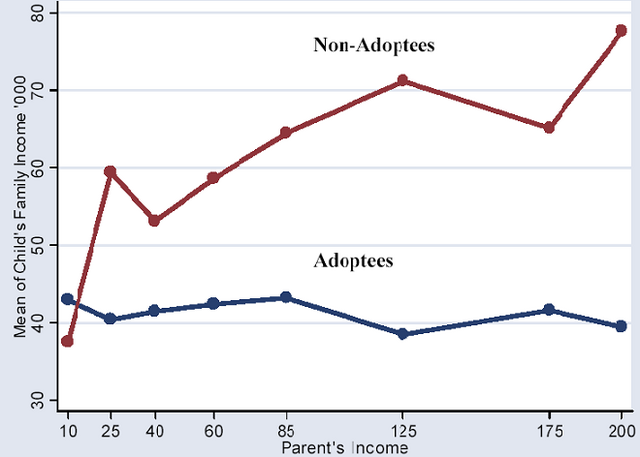
The graph does not say that adopted children necessarily have low
income. On the contrary, some have high and some have low income and
the same is true of biological children. What the graph says is that
higher parental income predicts higher child income but only for
biological children and not for adoptees.
Now what about education? Sacerdote looks at that as well. He doesn't have a child SAT-score, parent-income correlation but he does find:
Having a college educated mother increases an adoptee's probability of
graduating from college by 7 percentage points, but raises a biological
child's probability of graduating from college by 26 percentage points.
The effect for father's years of education is even larger; about a ten times larger effect on biological children than on adoptees. Similarly, parent income has a negligible effect, small and not statistically significant, on an adoptee completing college but an 8 times larger and statistically significant effect on a biological child completing college (Table 4, column 3).
Darwin, Magic and Evolution
I believe that Darwin would have enjoyed this video of a chimp being dazzled by a magician; it reveals much about our place in the natural universe.
State Rescission
From an email, sent to all employees, from the Office of the Governor of the Commonwealth of Virginia:
Virginia faces its most critical budget shortfall in several decades and we must do all that we can to reduce spending pressures…
If you are enrolled in the state health plan and have "You Plus One" or "You Plus Two or More" coverage, you will receive a packet of information concerning the audit of eligible dependents. I strongly urge you to provide the necessary information to protect your continued coverage by the state health plan.
You will be asked to sign an affidavit attesting that each of your dependents is eligible to be covered by the state health plan (click here for definitions of eligible dependents).
Participation is required. The health benefits program may initiate spot audits that will require additional documentation of dependent eligibility. The benefit to you and other state employees is that this audit will help keep health care costs down by removing ineligible persons from the state health plan.
Three Textbooks on Economic Growth
Lately, I’ve been reading lots of textbooks on economic growth. Here are a few:
Introduction to Modern Economic Growth by Daron Acemoglu: Weighing in at just under 5 pounds and 1000 pages this is the Mas-Colell, Whinston, Green of economic growth. It’s hard not be impressed by Acemoglu’s mastery of the subject and for a handful of top graduate programs this is clearly the book for the next generation. The title, of course, misleads in a revealing way–this book is first and foremost a book about modern economic theories of growth and, in particular, the math behind those theories. Acemoglu is too good an economist to write a book just about the math–there is good material here especially in areas where Acemoglu has made important contributions such as directed technological change and political economy–but the economic insights can easily be lost in this massive tome. Acemoglu is a good guide to the math but there is no effort to communicate to a larger audience. Empirical work is occassionally cited, but rarely discussed in much depth.
The Economics of Growth by Philippe Aghion and Peter Howitt: Also aimed at the graduate market this book is the David Romer of economic growth. Still more of a guide to models rather than to economic growth per se but key empirical work is presented and one does find the words “motivating evidence.” Simplified models with a touch of empirical analysis drive the book forward. Combined with a few empirical papers and a bit more background on the theory and this would make a good graduate text for all but the top programs. Careful questions will prove useful to professors.
Economic Growth (first edition here) by David Weil. One of the best textbooks I have ever read on any subject – this is the book to get. Weil’s book covers more topics with greater wisdom and wit than any of the other books and this is first and foremost a book about economic growth rather than about theories of economic growth. Weil is good on the basic models and especially on tying theory to empirical work. Ostensively aimed at the undergraduate market, there is a huge amount here for professional economists and graduate students. After passing their prelims on dynamic programming, this is the book that graduate students should read to discover the real questions that are in need of answers. I learned the most from this book.
The Process Produces the Equilibrium
David Leonhardt makes an interesting argument about why employers don't choose employee health insurance carefully. The argument is interesting because it is wrong but in a subtle way.
The bottom line: The cost of insurance comes mostly out of employees' paychecks. If insurance costs more, employees are generally paid less. If insurance costs less, employees are paid more. The cost of insurance does not have a big effect on employers’ overall compensation costs.
That’s why no one should be surprised that employers don’t make for good consumers of insurance. And it’s why insurers are not operating in a very competitive marketplace.
The premise is correct, employee compensation comes out of wages. The subtle mistake is to forget that this is only true in equilibrium. Imagine that a single employer was able to buy for his employees equal quality health insurance at a lower price. Would wages at that firm rise? No, an employer only has to pay workers what they could earn in another job. If other firms aren't paying more then this firm need not raise wages even though its costs have fallen. Thus an employer that reduced health insurance costs while keeping real compensation the same could pocket the savings as profit. It's only when other firms follow suit–also in an attempt to cut costs and earn excess profits–that wages at all firms rise, eliminating the excess profit everywhere.
The process produces the equilibrium. You can't have one without the other.
If you are still uncertain, here's another way of making the same point. Imagine that an employer provided his workers with better health insurance at the same cost. Employees would then flock to this employer pushing down wages and increasing that firm's profit.
So do employers fail to choose insurance carefully? Given the costs of health insurance and the profits to be made by cutting costs (holding quality constant), I have my doubts. Nevertheless, it could still be the case that giving employees more choices about which insurance firms to patronize could improve things on some margins as Leonhardt also argues in a related column today.
Score One for Econophysics
A group of econophysicists recently made a bold prediction, the Shanghai stock exchange would crash between July 10 and August 10, 2009. A silly prediction? Maybe not.
Ironman at Political Calculations offers some further thoughts. Graph from arXivblog.
In Defense of the Public Option
The defense of the public option coming from the administration, Paul Krugman, Mark Thoma and many others is that a public plan would have lower administrative costs and it would discipline the insurance industry. As stated, I find the argument weak. The argument, however, begins to make a certain kind of sense when you consider what else the major health insurance reform proposals would do.
The major proposals would require insurance companies to take all customers regardless of pre-existing conditions, offer guaranteed renewability and no dropping of coverage for the ill, impose no annual or lifetime caps, and offer coverage of preventative care with no-cost share, among other requirements. Finally, if insurance companies must take all customers regardless of pre-existing conditions it is obvious that sooner or later and probably sooner the government will require that everyone purchase health insurance.
In short, insurance reform will mean that everyone will be required to buy a product that will be tightly regulated and more homogeneous. Both of these factors will increase the market power of insurance firms. Since escape via non-purchase will no longer be a potential response to higher prices, mandatory purchase will reduce the elasticity of demand giving firms an incentive to increase prices. Moreover, in oligopolistic markets, a more homogeneous product can increase the ability of firms to collude.
I believe that health insurance reform will increase the market power of insurance firms and drive up prices. In this scenario, the public option at least has a raison d'etre, although whether it actually fulfills its purpose is an open question.
It's true that mandatory purchase doesn't necessarily lead to market power, auto insurance is quite competitive. Nevertheless, given the potential of insurance reform to increase the market power of insurance firms the search for some disciplining device like the public option is reasonable. Other useful reforms would be to have a single, national regulator of insurance – rather than the 50 we have now, allow an optional federal charter (as we do for banks) or (my preferred approach) move to a competitive federalist system for insurance similar to that for corporate charters.
Hat tip to Ray Lehmann for discussion.
Ironic Deception
In an interesting article on the history of "photoshopping," the New York Times says that one of the classic photos of Abraham Lincoln is actually the great emancipator's head grafted onto the body of John C. Calhoun! Calhoun, of course, was the great proponent of slavery calling it not a necessary evil but a "positive good."
The article doesn't say, but surely the compositor was sending a message with his ironic deception.
FYI, this caught my eye because the first article that Tyler and I ever co-authored was on Calhoun's constitutional theory. No link, but here's the reference: Tabarrok, A., and T. Cowen. 1992. The Public Choice Theory of John C. Calhoun. Journal of Institutional and Theoretical Economics 148 (4):655-74.
Inefficient Journal Submission Policies
In their instructions to authors just about all of the economics journals require that papers be submitted with a certain format for the references, bibliography, figures and so forth. Except no one I know actually does this until after a journal has accepted the paper; thus no wasted effort.
One day my wife, a microbiologist, was complaining about all the work that it took to reformat a paper for submission. I told her that only newbies did this. Shocked, she claimed that if she didn't reformat, the paper would instantly be rejected. "Ridiculous!" I said, "No journal system could be that stupid." Sigh. Of course, my ever-wise wife was correct. In microbiology, you have to submit with the required format or run the risk of instant rejection. Why is microbiology stuck in the inefficient equilibrium?
Perhaps an author who deviates signals incompetence and thus no one deviates. But it's surprising that counter-signals aren't stronger. Couldn't a Nobel prize winner say "enough with this nonsense" and submit without reformatting? Wouldn't a journal that allowed a more lax initial submission receive more submissions? Why is it in the interest of a journal to reject a good paper without review simply because the references were in an alternative format?
The official journal policies in economics point to an inefficient past so how did economics evolve to the efficient equilibrium? Are other disciplines evolving in this manner or is economics unique in choosing the efficient journal policy? (Readers may have information on this point.)
All else equal, I would expect initial submission standards regarding formatting and so forth to be weaker in the harder sciences. After all, in science isn't it easier to demonstrate competence with the contents of the paper rather than with the formatting? The evidence so far, however, does not support my hypothesis.
Journal submission policy is a small, albeit annoying matter. But the fact that the clearly inefficient equilibrium is common and apparently robust is humbling and frustrating even to those of us who advocate small steps toward a better world let alone to those of us who would remake the world along more efficient lines.
Bill Maher unleashes his inner Bryan Caplan
Bill Maher at the Huffington Post:
Or take the health care debate we're presently having: members of Congress have recessed now so they can go home and "listen to their constituents." An urge they should resist because their constituents don't know anything. At a recent town-hall meeting in South Carolina, a man stood up and told his Congressman to "keep your government hands off my Medicare," which is kind of like driving cross country to protest highways.
I'm the bad guy for saying it's a stupid country, yet polls show that a majority of Americans cannot name a single branch of government, or explain what the Bill of Rights is….
Nearly half of Americans don't know that states have two senators and more than half can't name their congressman. And among Republican governors, only 30% got their wife's name right on the first try.
Sarah Palin says she would never apologize for America. Even though a Gallup poll says 18% of Americans think the sun revolves around the earth. No, they're not stupid. They're interplanetary mavericks….
People bitch and moan about taxes and spending, but they have no idea what their government spends money on. The average voter thinks foreign aid consumes 24% of our federal budget. It's actually less than 1%….
And I haven't even brought up America's religious beliefs. But here's one fun fact you can take away: did you know only about half of Americans are aware that Judaism is an older religion than Christianity? That's right, half of America looks at books called the Old Testament and the New Testament and cannot figure out which one came first.
And these are the idiots we want to weigh in on the minutia of health care policy?
Very funny. If only it were not true.
Mathematics of a Zombie Attack
Here is the abstract of a new paper in Infectious Disease Modelling Research Progress.
Zombies are a popular figure in pop culture/entertainment and they are usually portrayed as being brought about through an outbreak or epidemic. Consequently, we model a zombie attack, using biological assumptions based on popular zombie movies. We introduce a basic model for zombie infection, determine equilibria and their stability, and illustrate the outcome with numerical solutions. We then refine the model to introduce a latent period of zombification, whereby humans are infected, but not infectious, before becoming undead. We then modify the model to include the effects of possible quarantine or a cure. Finally, we examine the impact of regular, impulsive reductions in the number of zombies and derive conditions under which eradication can occur. We show that only quick, aggressive attacks can stave off the doomsday scenario: the collapse of society as zombies overtake us all.
Hat tip to Cory Doctorow at Boing Boing.
Assorted Links
- Contrary to popular belief (e.g. here) there is only weak evidence that the implicit association test has good predictive ability.
- Paul Romer on his five favorite live rock recordings, sample line “In this performance, Hendrix may have been high, but he knew what he was doing.”
- The economics of being a Hefner Girlfriend. One key sentence “In fact, Girlfriends were not allowed to become Playmates because Hef had found that they tended to flee the Mansion as soon as they collected their $25,000 Playmate cheque.”
Julie & Julia
Julia is great. Julie drags a bit even though the blogger turned book author angle resonated with me (note to self, talk with brother about MR movie possibilities). Oddly, the food is not presented nearly as well as on Top Chef.
Where is this?
Timing
That's a question from Mark Frauenfelder at Boing Boing. The answer says a lot about how you implicitly think about time.
According to this research, a bit sketchy it seems to me, Friday people tend to be angrier. FYI, I'm a Monday person (it took me some time to see the question could have another answer!).