Category: Books
*The Hard Thing About Hard Things*
I loved this book, by Ben Horowitz of Andreessen-Horowitz, the venture capital firm. While it is hard to pull bits from the broader stories, here are a few:
Most business relationships either become too tense to tolerate or not tense enough to be productive after a while. Either people challenge each other to the point where they don’t like each other or they become complacent about each other’s feedback and no longer benefit from the relationship.
And:
People always ask me, “What’s the secret to being a successful CEO?” Sadly, there is no secret, but if there is one skill that stands out, it’s the ability to focus and make the best move when there are no good moves. It’s the moments where you feel most like hiding or dying that you can make the biggest difference as a CEO.
And:
The first rule of organizational design is that all organizational designs are bad.
And:
The purpose of process is communication.
And:
By far the most difficult skill I learned as CEO was the ability to manage my own psychology.
Finally:
CEO is an unnatural job.
Definitely recommended, it is one of my five favorite management books ever. Furthermore, its lessons are relevant for people in academic, media, and policy worlds, unlike many other management books. Is that because of an emphasis on talent evaluation and also work in teams and small groups?
*The High Cost of Good Intentions*
The subtitle is A History of U.S. Federal Entitlement Programs, and the author of this new and excellent book is John F. Cogan of Stanford University and the Hoover Institution. It is the single best history of what it covers, and thus one of the best books to read on the history of U.S. government or for that matter American economic history more generally.
How did the American entitlement state get built? In multiple, discrete pieces:
The House and Senate overwhelmingly approved a modified version of President Truman’s Social Security proposals in June 1950. The Social Security Amendments provided a mammoth across-the-board increase in monthly benefits. The law’s sliding scale of benefits…averaged 77 percent per recipient…The 1950 Act also rewrote Social Security’s eligibility rules to enable hundreds of thousands of workers with little history of contributing payroll taxes to begin collecting benefits.
And:
…from 1969 to 1975, inflation-adjusted federal entitlements pending grew annually at a remarkable 10 percent, registering an 86 percent increase in six years…Total annual inflation-adjusted entitlement expenditures grew 20 percent faster under President Nixon than they had under President Johnson.
And:
The eligibility liberalizations from 1997 to 2008 produced sharp increases in the food stamp and Medicaid rolls. From 1998 to 2008, the food stamp rolls increased to 28 million people from 20 million and the Medicaid rolls increased to 59 million from 40 million people. The liberalizations enacted during the Great Recession have lasted well beyond the recession’s end in 2010. In 2016, the number of food stamp recipients ballooned to 44 million, and the number of Medicaid recipients rose to 73 million in 2016.
Here is a good sentence:
In 2015, 41 percent of the nation’s nonelderly-headed households received entitlement benefits.
This book is well-written and has useful and important information on virtually every page.
What I’ve been reading
1. J.M. Coetzee, Late Essays 2006-2017. The pieces on Robert Walser, Ford Madox Ford, Patrick White, Gerald Murnane, Samuel Beckett, and Juan Ramón Jiménez make this worth buying, the rest are mixed in quality. Coetzee remains minimalistically grumpy in the right way.
2. Grant N. Havers, Leo Strauss and Anglo-American Democracy: A Conservative Critique. Havers argues against Strauss from “the Right,” but sympathetically. He suggests Strauss underrated Christianity and had too high an opinion of antiquity, and was a true liberal democrat, while the American founders consciously rejected ancient political thought.
3. Neil Monnery, Architect of Prosperity: Sir John Cowperthwaite and the Making of Hong Kong. I didn’t find this inspiring to read, but still it is a useful account of the under-covered early days of how Hong Kong evolved into a freedom-oriented economy after World War II. Here is a review from The Economist.
4. Anne Applebaum, Red Famine: Stalin’s War on Ukraine. “As Dolot remembered it, the presence of the Soviet state in his village in the 1920s had been minimal.” And “Initially, collectivization was supposed to be voluntary.” And “When their potatoes were gone…people began to go to the Russian villages and to exchange their clothing for food.”
I have only browsed my library copy of Masha Gessen’s The Future of History: How Totalitarianism Reclaimed Russia, but it looked very good and so I ordered it from Amazon.
William Blake and the Age of Aquarius is a beautiful exhibition catalog, with text, edited by Stephen F. Eisenman, for a show currently on at Northwestern University.
David Kynaston, Till Time’s Last Sand: A History of the Bank of England, 1694-2013, seems to be a fine work of history, but it is not organized analytically in the way I might wish. Still, some of you should be interested, as this is 796 pp. of well-written, carefully researched material on the BOE.
Markets in everything Victorian novels starring Baron Trump edition
Here is one bit of description:
In these books, the young German protagonist, Wilhelm Heinrich Sebastian Von Troomp, better known as Baron Trump, travels around and under the globe with his dog Bulger, meeting residents of as-of-yet undiscovered lands before arriving back home at Castle Trump. Trump is precocious, restless, and prone to get in trouble, with a brain so big that his head has grown to twice the normal size—a fact that, as we have seen, he mentions often. No one tells Trump that his belief that he looks great in traditional Chinese garb—his uniform for both volumes—is unwarranted.
Lockwood’s books are spring break meets Carmen Sandiego meets Jabberwocky; at the start of each story, Trump sets out eager to find new civilizations—and manages to get distracted by more than one lady along the way. One of the first places he visits in Travels and Adventures is the land of the toothless and nearly weightless Wind Eaters, who inflate to beach-ball size after a meal. They are generous hosts until Trump starts a fire. The intrigued Wind Eaters draw near, and promptly explode after the air they have ingested expands thanks to the flames. As Captain Go-Whizz, “a sort of leader among them,” chases the murderer, the dog Bulger bites one of the Wind Eaters until he deflates like a punctured balloon. The pair eventually escape, leaving the briefly betrothed Princess Pouf-fah without a mate, and Chief Ztwish-Ztwish and Queen Phew-yoo with many a funeral to plan.
Here is the full story.
What should I ask Brink Lindsey and Steve Teles?
I will be having a Conversation with them, in part connected to their very important forthcoming book The Captured Economy: How the Powerful Enrich Themselves, Slow Down Growth, and Increase Inequality. But not only. What should I ask these two leading lights?
By the way, here is an abstract for the book:
The relentless increase of inequality in twenty-first century America has confounded analysts from both ends of the political spectrum. While many can point to particular contributing causes, so far none of the policies that have been enacted-not just in the United States but in other advanced countries-have been able to lessen the wealth and income gaps between the top decile and the rest. Critics on the left are more forceful critics of rising inequality, and they tend to blame capitalism and the private sector. Predictably, they see solutions in government action. Many on the right worry about the issue, too, but they come from a position that is more sanguine about corporations and more suspicious of government. But as the libertarian Brink Lindsey and the liberal Steve Teles argue in The Captured Economy, perhaps all of us-left, right, and center-are looking in the wrong places for culprits and solutions. They hone in on the government-corporate sector nexus, apportioning blame not only to both forces but also to the distorted form of governance that this partnership has created. Through armies of lobbyists, corporations and the wealthy have become remarkably adept at shaping policy-even ostensibly progressive policies-so that the field is tilted in their favor. Corporations have become classic ‘rentiers,’ using their monopoly power of influence over highly complicated legislative and regulatory processes to shift resources in their direction. FCC policy, health care regulation, banking regulation, labor policy, defense spending, and much more: in all of these arenas, well-resourced corporate rentiers have combined to ensure that the government favors them over everyone else. The perverse result is a state that shifts more and more wealth to the already-rich-even if that was never the initial intent of Congress, the President, or the electorate itself. Transforming this misshapen alliance will be difficult, and Lindsey and Teles are realistic about the chances for reform. To that end, they close with a set of reasonable policy proposals that can help to reduce corporate rentiers’ scope and power to extract excessive rents via government policy. A powerful, original, and genuinely counterintuitive interpretation of the forces driving the increase in inequality, The Captured Economy will be necessary reading for anyone concerned about the rising social and economic divisions in contemporary America.
Model this saliva exchange
One of the most blatant violations of the rules against touching saliva among other taboos is described by Dubois…in his [1906] account of one of the “disgusting religious orgies” he so meticulously depicts. In these orgies, not only do men and women eat meat and drink alcoholic beverages, but they transgress the normal saliva prohibition. I cannot possibly improve upon Dubois’ vivid word picture: “In this orgy called sakti-puja, the pujari, or sacrificer who is generally a Brahman, first of all tastes the various kinds of meats and liquors himself, then gives the others permission to devour the rest. Men and women thereupon begin to eat greedily, the same piece of meat passing from mouth to mouth, each person taking a bite until it is finished. Then they start afresh on another joint, which they gnaw in the same manner, tearing the meat out of each other’s mouths. When all the meat has been consumed, intoxicating liquors are passed around, every one drinking without repugnance out of the same cup.
That is from the quite interesting Two Tales of Crow and Sparrow: A Freudian Folkloristic Essay on Caste and Untouchability, by Alan Dundes.
What should I ask Sujatha Gidla?
She is the author of the new and superb Ants Among Elephants: An Untouchable Family and the Making of Modern India. I will be interviewing her later in the month, with a podcast and transcript forthcoming, no public event. Here is her Macmillan bio:
Sujatha Gidla was born an untouchable in Andhra Pradesh, India. She studied physics at the Regional Engineering College, Warangal. The author of Ants Among the Elephants, her writing has appeared in The Oxford India Anthology of Telugu Dalit Writing. She lives in New York and works as a conductor on the subway.
Here is BBC coverage of her work. Here is the NYT review of her book. Here are further links about her. The Economist wrote: “Ants Among Elephants is an arresting, affecting and ultimately enlightening memoir. It is quite possibly the most striking work of non-fiction set in India since Behind the Beautiful Forevers by Katherine Boo, and heralds the arrival of a formidable new writer.”
So what should I ask her?
Raghuram G. Rajan’s *I do what I do*
The title is apt, the book was published in India, and the excellent Rama Rao was so kind as to send me a copy. It is a collection of columns and memos, many published in India and covering the economic affairs of India. It’s a good way to get a look at what Raghu “really thinks,” at least as filtered through the media while he is central banker or earlier working at the IMF. He writes directly, gets frustrated at people who don’t understand the rate of inflation, favors central bank independence, is skeptical about how much foreign aid can drive growth, and with Luigi Zingales tells us that “Capitalism Does Not Rhyme with Colonialism.”
Here are various Indian reviews. Here is the link to Amazon India.
*Adam Smith: Systematic Philosopher and Public Thinker*
That is the new, excellent, and detailed book by Eric Schliesser, a political scientist at Amsterdam. I would say that Schliesser is a very learned “left Smithian,” and that you should take the subtitle very very seriously. Here is one excerpt:
1. I argue that while Smith certainly took experience and empirical science seriously, he should not be understood as a empiricist in epistemology and his moral epistemology; he relies crucially on innate ideas and innate mental structure.
2. This book gives the first extensive (albeit not exhaustive) study and taxonomy of Smith’s theory of the passions, which I treat as elements of his system (cf. Hume’s treatise 1.1.4.7). In fact, I argue that the content of a social passion is inherently normative in Smith’s approach.
3. I argue that Smith is decidedly reserved about deploying mathematics within his political economy.
4. I argue that Smith’s account of liberty should not be identified with the so-called liberty of the moderns, or freedom of contract. While Smith certainly was a defender of freedom of contract, his account of liberty is more expansive (and more attractive).
Sometimes I draw a distinction between “branching” books, whose arguments spread out in many different directions and draw many distinctions, and “channeling” books, which try to put the material into a narrower, common framework. (Reading each requires quite distinct sets of skills!) This is a branching book. You can order it here.
I thank my colleague David Levy for the pointer to this work.
What I’ve been reading
1. The New Testament, translated by David Bentley Hart, Yale University Press. I’ve spent a good bit of time with this book, and if you own and read a few New Testaments, this should be one of them. It is the most accurate translation conceptually and philosophically, taking care to render the Greek of that period as faithfully as possible. It doesn’t try to make the text “read nice,” nor does it make all of the books sound the same. Of course, with any Bible translation you care both about a) what the authors really meant, and b) what other readers of the Bible thought they were imbibing. By the very nature of its virtues, this volume is weak on b) precisely because it is strong on a), and thus it probably should not be your first translation. Still, if you are tempted, this is more and better than “just another New Testament.”
2. Richard McGregor, Asia’s Reckoning: China, Japan, and the Fate of U.S. Power in the Pacific Century. I am sick of books on these topics, because they tend to repeat the same old same old. This one has fresh content on almost every page, and it is especially strong on explaining how the revisionist history debates in China and Japan fit into domestic politics and also foreign policy.
3. Barry Hatton, The Portuguese: A Modern History. “Portugal largely missed the Enlightenment.” This is the best introduction I know to that charming country. In 1986, Portugal had only 123 miles of highway. It had not occurred to me, by the way, that the 1974 coup was the first Western European revolution since 1848, unless you count the Nazis. Here is a picture showing Portugal as an Atlantic rather than Mediterranean economy. Explanation here.
4. Nils Karlson, Statecraft and Liberal Reform in Advanced Democracies. How did liberal reforms happen in Australia and Sweden? This book tells you about the world, rather than the theory or the taxonomy. There should be many more books of this sort, a study in actual public choice.
Arrived in my pile is:
Barry Eichengreen, Arnaud Mehl, and Livia Chitu, How Global Currencies Work: Past, Present, and Future.
For economic historians I can recommend Bruce M.S. Campbell, The Great Transition: Climate, Disease and Society in the Late-Medieval World.
George Will covers *The Complacent Class*
Here is one paragraph:
Although America is said to be — and many Americans are — seething about economic grievances, Tyler Cowen thinks a bigger problem is complacency. In his latest book, “The Complacent Class: The Self-Defeating Quest for the American Dream,” Cowen, professor of almost everything (economics, law, literature) at George Mason University and co-author of the Marginal Revolution blog, argues that the complacent class, although a minority, is skillful at entrenching itself in ways detrimental to the majority.
Here is the whole review.
What should I ask Doug Irwin?
I will be doing a Conversation with Doug in early October, although with no associated public event, just a later podcast and transcript. Here is Wikipedia on Doug:
Douglas Irwin is the John Sloan Dickey Third Century Professor in the Social Sciences in the Economics Department at Dartmouth College and the author of seven books. He is an expert in both past and present U.S. trade policy, especially policy during the Great Depression. He is frequently sought by media outlets such as The Economist and Wall Street Journal to provide comment and his opinion on current events.[1][2]
Prior to Dartmouth, Irwin was an Associate Professor of Business Economics at the University of Chicago Graduate School of Business, an economist for the Board of Governors of the Federal Reserve System, and an economist for the Council of Economic Advisers Executive Office of the President.
Doug has a very exciting new book on the history of trade coming out, which I covered here. Here is Doug on Twitter. Here is Doug’s recent WSJ Op-Ed on Steve Bannon, trade, and the history of America’s greatness.
So what should I ask Doug? Your grace and wisdom are always appreciated and never in short supply.
The Color of Law
Richard Rothstein’s The Color of Law is a good history of government discrimination against African-Americans in the housing market. Most notably, the FHA and the VA refused to guarantee mortgage loans or loans to builders unless the neighborhood was segregated.  Indeed, the FHA wouldn’t even insure a project if there were too many African Americans living nearby.
In 1940, for example, a Detroit builder was denied FHA insurance for a project that was near an African American neighborhood. He then constructed a half-mile concrete wall, six feet high and a foot thick, separating the two neighborhoods, and the FHA then approved the loan.
Rothstein is no libertarian but to his credit he does acknowledge that one of the few anti-segregation forces in the early twentieth century was the Lochner influenced reasoning of the Supreme Court. In Louisville, Kentucky, wealthy blacks began to buy houses in previously white neighborhoods. In response, the city passed an ordinance making it illegal for blacks to move into majority-white neighborhoods and vice-versa. The NAACP organized a test case. Warley, an African American, agreed to buy a house from Buchanan, if not prevented by law from doing so. Buchanan then argued that the law reduced the value of his house because he could not sell to Warley or other African-Americans. Thus, the ordinance was a taking which violated the 14th Amendment right not to be deprived of property without due process of law.
The State of Kentucky responded with a brief arguing that segregation was divinely ordained and that “negroes carry a blight with them 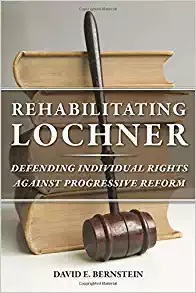
 wherever they go.” The racism was sickening but Kentucky also had the great mass of intellectuals behind it because they were asserting the progressive belief that the state’s police powers could and should overrule individual rights, especially property rights. Under Lochner, however, “unreasonable, unnecessary and arbitrary interference with the right and liberty of the individual to contract” violated the 14th Amendment. Rothstein writes:
“In 1917, the Supreme Court overturned the racial zoning ordinance of Louisville, Kentucky, where many neighborhoods included both races before twentieth-century segregation….The Court majority was enamored of the idea that the central purpose of the Fourteenth Amendment was not to protect the rights of freed slaves but a business rule: “freedom of contract.” Relying on this interpretation, the Court had struck down minimum wage and workplace safety laws on the grounds that they interfered with the right of workers and business owners to negotiate individual employment conditions without government interference. Similarly, the Court ruled that racial zoning ordinances interfered with the right of a property owner to sell to whomever he pleased.”
Sure, it’s a grudging acknowledgment, but most people don’t even do that so give Rothstein credit where credit is due.
Governments evolved other measures to promote segregation such as zoning laws and the white-subsidy systems of the FHA and VA. Nevertheless, Buchanan v. Warley was likely an very important decision. Bill Fischel goes so far as to argue that Buchanan v. Warley prevented apartheid in America.
Addendum: On segregation and Lochner, see David Bernstein’s excellent book Rehabilitating Lochner from which I have also drawn.
*The Color of Money*
The author is Mehrsa Baradaran, and the subtitle is Black Banks and the Racial Wealth Gap. Here is one excerpt:
Not only were black bankers stuck in a perpetual money pit, but they were often cast as the villains when thing went wrong. That their loans went primarily to the black middle class and were out of reach of the majority of blacks sometimes made black banks the targets of criticism. Abram Harris was one of these critics. Harris was the first nationally renowned black economist and the first to do a comprehensive study of black banks, called The Negro as Capitalist (1936). Harris headed the Howard economics department from 1936 to 1945, when he became the first black economist at the University of Chicago. He was recruited there by Frank Knight…Harris had held Marxist sympathies while at Howard, but with his move to Chicago, his economic philosophy became more traditional.
Here is Wikipedia on Harris. As for Baradaran, I found this to be “two books in one.” First, it was an OK and useful but not original look at the evolution of the racial wealth gap. Second, it was a very interesting but interspersed history of black banking in America. Overall recommended. Here is the book’s home page.
What I’ve been reading
1. Peter Sloterdijk, Selected Exaggerations: Conversations and Interviews, 1993-2012. No, he’s not a fraud, and this volume is probably the best introduction to his thought. Is there an extended argument here? I am not sure, but I did enjoy this bit:
The existential philosophers have greatly overstated homelessness. In fact, people sit in their apartments with their delusions and cushion themselves as best they can.
But why does he have to follow up with?:
Living means continuously updating the immune system — and that is precisely what foam theory can help us show more clearly than before.
In the German-speaking world he passes for one of the most important world thinkers.
2. Declan Kiberd, After Ireland: Writing the Nation from Beckett to the Present. A very high quality and original look at how Irish literature reflects the nation’s development, though it assumes a fair knowledge of the works being discussed.
3. Fred Hersch, Good Things Happen Slowly: A Life in and Out of Jazz. How someone from a previous generation a) became a star jazz pianist, b) discovered gay liberation, and c) woke from a coma to resume a miraculous career.
4. Stephen Greenblatt, The Rise and Fall of Adam and Eve. In general I am a Greenblatt fan, and not persuaded by the critics of his popularizations, but this book is not doing it for me. For the Hebrew Bible I prefer to read densely argued Straussians.
5. William Ian Miller, The Anatomy of Disgust. Miller’s books from the 1990s remain an underrated source of “stuff for smart people.” His book on disgust could be the best in that series, for me this is a reread and yes it did hold up.