Category: Books
Publication day for *An Economist Gets Lunch*
Adam Ozimek writes:
Cowen’s history of how American food came to be so mediocre is a strong counterargument to those who look to blame the phenomenon on commercialization, capitalism, and excess of choice. In contrast to the usual narrative, Cowen tells us how bad laws have played an important role in shaping our food ecosystem for the worse over time. This includes prohibition’s negative and long lasting impact on restaurants, and the government aggressively limiting one of our greatest sources of culinary innovation: immigration. This is not to lay the blame entirely on the government. Television and a culture that panders to the desires of children have also incentivized poor culinary trends.
The book contains many other other important arguments against popular food ideas, including defenses of technology and agriculture commercialization against critiques of locavores, slow foodies, and environmentalists. For example, if you live in an area where it takes a lot of energy and resources to grow food — like the desert — the most environmentally friendly way may be to grow it somewhere else and ship it. An apple grown locally may be refrigerated for months, which consumes a lot of energy, whereas it may be both fresher and better for the environment to grow it elsewhere and ship it in from afar by boat. He also defends genetically modified crops as the likely cures to the biggest food problem we have today, which is not obesity but malnutrition.
But Cowen is not an apologist, and he doesn’t argue that we can just deregulate our way to a better food system. In fact he has many words of support for policies and values often supported by progressives.
…If there is one overarching lesson it is that looking at food through the framework of supply and demand can help you both understand our food system better, and also help you be a smarter consumer and get more out of every meal.
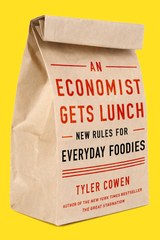
You can pre-order the book on Amazon here. For Barnes & Noble here. For Indiebound.org here.
What I’ve been reading
1. Barb Stuckey, Taste: What You’re Missing: The Passionate Eater’s Guide to Why Good Food Tastes Good. A very good and interesting look at how and why food tastes as it does, from a professional food developer.
2.Robert J. Sampson, Great American City: Chicago and the Enduring Neighborhood Effect. I’m still grappling with this book, which I find difficult to parse. It’s a very detailed empirical study of the strength of neighborhood effects, with reference to Chicago. I thought I would give the book its own post, but it is difficult to excerpt. I don’t quite understand how he distinguishes neighborhood effects from selection effects, though I have read his discussion that selection effects are themselves neighborhood effects, ultimately. I feel there is a good deal of interesting social science in here, but the book should be far more transparent. William Julius Wilson called it “…one of the most comprehensive and sophisticated empirical studies ever conducted by a social scientist.” Here is a Harvard story on the book. For sure some of you should pick this one up, but I am myself still torn.
3. Lifeboat: A Novel, by Charlotte Rogan. A genuinely gripping story of a bunch of people in a sinking lifeboat, facing the usual philosophical dilemmas. Maybe that doesn’t sound thrilling, but I pressed on eagerly and read it to the end.
4. Free Market Fairness, by John Tomasi. Here is Matt on the book: “Without being by any means a libertarian, I do think that people of a left-wing orientation sometimes give short shrift to the non-pecuniary aspects of economic freedom. Whether or not you buy that barber licensing rules are a big deal economically, the specter of the government throwing a person in jail for participating in an exchange of haircuts for money between consenting adults should bother liberally inclined people for basically the same reasons that all random state interference in the conduct of private life is bothersome.”
5. India After Gandhi: The History of the World’s Largest Democracy, by Ramachandra Guha. Both informationally dense and conceptual, in a good way.
Dual coverage from The New York Times
Damon Darlin liked my new book, An Economist Gets Lunch:
It’s a sports bar, which seems like an unlikely choice, but not to Professor Cowen’s way of thinking. He chose it precisely because it was an unlikely choice. An American sports bar might mean Buffalo wings and cheeseburgers, but an Ethiopian sports bar? “They are making no attempt to appeal to non-Ethiopians,” he said.
…As for the food at Eyo’s Sports Bar, it persuaded me on his thesis that immigrants rejuvenated the American palate and it was best to leave the finicky children, or teenagers, at home.
Dwight Garner did not like it:
Reading Mr. Cowen is like pushing a shopping cart through Whole Foods with Rush Limbaugh. The patter is nonstop and bracing. Mr. Cowen delivers observations that, should Alice Waters ever be detained in Gitmo, her captors will play over loudspeakers to break her spirit.
These observations include: “There’s nothing especially virtuous about the local farmer”; “buying green products seems to encourage individuals to be less moral”; and — a contender for Orwellian sentence of the year — “technology and business are a big part of what makes the world gentle and fun.”
I think it’s Orwellian that he thinks this is Orwellian. On the two errors he claims to have found in the book, he is wrong in both cases. Brad DeLong adds appropriate comment on the first. My estimate for the Google search number claims was correct and multiply checked when I did it, and these days it comes in at around the high 400,000s, nothing near his 115,000 figure.
You can pre-order the book on Amazon here. For Barnes & Noble here. For Indiebound.org here. It is due out tomorrow.
“Six Rules for Dining Out”
That is a feature piece, by me, in the latest Atlantic Monthly, May 2012 issue. It is not on-line, so go buy the issue!
In my pile
Jonathan Schlefer, The Assumptions Economists Make.
Time to Start Thinking: America in the Age of Descent, by Edward Luce. Here is his recent essay, related to the book.
Carl H. Nightingale, Segregation: A Global History of Divided Cities.
Ruchir Sharma, Breakout Nations: In Pursuit of the Next Economic Miracles.
Chris Mooney, The Republican Brain: The Science of Why They Deny Science — and Reality.
Non-Google digital library in the works, connected with Robert Darnton.
Ronald Coase has a new book coming out
With Ning Wang, it is called How China Became Capitalist, due out later in April.
Here is their Op-Ed in today’s WSJ. Ronald Coase, Nobel Laureate, is now 101 years old.
The WSJ reviews *An Economist Gets Lunch*
From Graeme Wood, the review is here. It has the excellent title “From Invisible Hand to Mouth.” Excerpt:
For authenticity, he awards points to Pakistani restaurants that feature pictures of Mecca, since they’re more likely to cater to Pakistani clientele. (“The more aggressively religious the décor, the better it will be for the food.”) Find restaurants where diners are “screaming at each other” or “pursuing blood feuds,” he says—indications that people feel comfortable there and return frequently with their familiars.
I liked this line:
These labor-intensive operations, Mr. Cowen writes, show “just how uneconomical true barbecue art can be”—which suggests that if you want to eat like an economist, you should find a chef who doesn’t cook like one.
Note, however, that if you have talent but do not wish to scale it up very far, running an excellent local barbecue restaurant still may be a good use of your time. The last two lines are sincere flattery:
Mr. Cowen says to beware of scenic views, bevies of beautiful women, and well-stocked bars. “You want to see that the people eating there mean business,” Mr. Cowen writes. Food is a business he knows intimately, although his preference for delicious meals in windowless rooms with ugly women, pictures of the Kaaba, and active blood-feuds will not be a taste shared by all.
You can pre-order the book on Amazon here. For Barnes & Noble here. For Indiebound.org here. It is due out April 12.
What (and how) Whit Stillman reads
You have a lot of freedom in reading a book. I’m unable, for some reason, to read books from beginning to end. I have to go to what interests me most in the book. And if I like that, I start going backwards and forwards. And it starts to become a really complicated endeavor of just reading the parts of the books once and not sort of overlapping. I don’t know why I have to sort of re-edit the books myself. I don’t know why I can’t read a prologue and read a first chapter. I mean, if I really love a book I’ll get to them too. For some reason, I usually find them deadly dull, the prologues.
And this:
And my favorite reading of all is the unabridged Boswell’s Life of [Samuel] Johnson. It’s my favorite thing because it’s interesting and has no import or forward narrative momentum. So you’re interested and edified but it doesn’t keep you up at night.
Here is more.
*Early Retirement Extreme*
That is the title of an erratic but interesting book by Jacob Lund Fisker, and the subtitle is A philosophical and practical guide to financial independence. Think of it as a study in “least cost living,” his web site is here.
Here is his post on a middle class lifestyle on 7k a year, health insurance included, sans young children, don’t skip the section on the lentils. How does it compare to how people lived fifty years ago? To how I lived thirty-two years ago as an undergraduate?
“Not buy very much” seems to be his main strategy.
I transplant these scenarios to a foreign setting. Let’s say you had 10k a year, net, to live in either India or Mexico. How high would your standard of living be? What kind of health insurance could you buy? How would your level of happiness compare to working at a job you don’t like for 80k a year for twenty more years?
When it comes to modern society, I sometimes wonder, what is the true secession point with decent utility? What kinds of options are your savings giving you? Is there any chance you will take those options?
For the pointer I thank CR.
*Darwin’s Devices*
The author is John Long and the subtitle is What Evolving Robots Can Teach Us About the History of Life and the Future of Technology. Excerpt:
4. Evolve predatory robots. If you or the enemy employ Pell’s Principle, you’ll need to be prepared to capture or destroy swarms. For starters, you’ll need to let your evolving predators have the capacity and capability of filter feeders like baleen whales. Consider behavioral adaptation first in your predators because the shorter generation tie of the prey will limit opportunities for hardware evolution in the predators.
File under: Whole new class of worries.
Matthew Bishop’s new book
With Michael Green, In Gold We Trust: The Future of Money in an Age of Uncertainty, Kindle Single. Here is a short video about the book.
From the authors:
It provides a lively analysis of the big economic questions currently facing America, such as the danger to the dollar posed by gridlock in DC, especially over deficit reduction, the euro crisis, the growing risk of inflation and the changing attitude of China towards America. We argue that the renaissance of gold, plus the development of virtual currencies such as Bitcoin, reflect weaknesses in the technology of money that we all need to take seriously and try to fix.
What happens to books when they come out of copyright?
For the United States, 1922 is the cut-off year for the end of public domain:
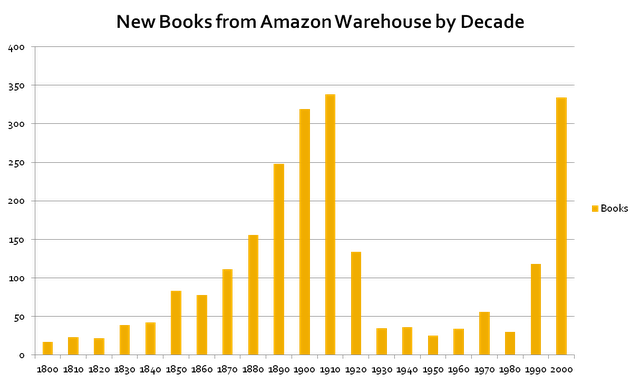
Here is more from Eric Crampton, drawing upon Paul Heald.
Good overview of the legal battle over eBooks
You will find it here, by Tim Carmody, and there are more issues involved than I had thought:
Knebel says there are three major points of law at stake in both the class-action suit and the Justice Department investigation against Apple and the five publishers:
- Whether and how the agency model applies to virtual goods;
- Whether Apple and publishers engaged in a “hub-and-spoke” conspiracy or simply “conscious parallelism”;
- The status of the “most-favored nation” clause, common to many legal contracts today, which Apple used to ensure that books could not be sold elsewhere at a lower price than in the iBooks store.
On the latter point there is this:
The last point at issue is Apple’s agreement with publishers that their books be sold at the same price to all other competitors. In contract law, this is called “the most-favored nation” clause.
“The most-favored nation clause has been suspicious under antitrust laws for years,” says Knebel. But at the same time, it’s extraordinarily common. “Most law firms, including mine, will agree to charge one client the lowest possible price for the same services,” he says.
So even though Apple’s insistence that HarperCollins, Hachette Book Group, Macmillan, Penguin Group Inc. and Simon & Schuster Inc all charge the same prices for their books at all e-book stores is what seems on its face the fishiest about the whole affair, it’s actually the part that, in the absence of a conspiracy, is most hallowed by practice. A change in its status under federal antitrust law would require the largest revision to current legal agreements, in industries widely separated from publishing and software.
My view is simple, namely that in the face of massive disruptive innovation, antitrust law rarely does a good job. The law should stay out of this. In any case the prices of books have been falling for some time.
*Being Global*
The authors are Angel Cabrera and Gregory Unruh, and the subtitle is How to Think, Act, and Lead in a Transformed World. Cabrera is the incoming president of GMU, as of this summer, so of course I am keen to read this book, which arrived in my pile today.
You can follow Cabrera on Twitter here, among other topics he covers leadership, globalization, and also the Spanish economy.
*Culinary Intelligence*
The author is Peter Kaminsky and the subtitle is The Art of Eating Healthy (and Really Well). I enjoyed this book, here is one bit:
If I had to reduce Culinary Intelligence to one guiding principle, it would be maximizing Flavor per Calorie (FPC): the notion that if ingredients are chosen on the basis of optimum flavor, and prepared with the goal of intensifying that flavor, then you can be satisfied while eating less.
The best tip in the book is that you get most of the value of a dessert from the first bite or two. I believe also — for most but not all meals — that 80 percent of the value of a soft drink comes in the first 10 percent of your consumption of that drink. What are some other principles of Culinary Intelligence?