Category: Books
Kenneth Arrow, weather officer
Following the U.S. declaration of war on December 8, 1941, Arrow, who was certain to be drafted, enlisted in the hope of securing an officer’s commission in the U.S. Army Corps where he believed he would have a chance to use his mathematical and statistical training. He was quickly approved to attend an aviation training program at New York University in October 1942, taking “active duty” breaks from classes for rifle drill, which he and his colleagues thought rather silly. Nonetheless, he came out of that program in September 1943 commissioned as a weather officer with the rank of second lieutenant and was assigned to a weather research facility in Asheville, North Carolina; in July 1945 he was transferred to the weather division headquarters of the Army Air Force. It was during that time in Asheville that he wrote a memorandum that later, in 1949, became his first professional paper (“On the Use of Winds in Flight Planning” in the Journal of Meteorology). That paper presented an algorithm for taking advantage of winds aloft to save fuel on North Atlantic air crossings, an idea that was not acted upon by the military at that time but became the canonical practice for North Atlantic flight paths in the postwar period.
That is from the new, excellent, and consistently interesting Finding Equilibrium: Arrow, Debreu, McKenzie and the Problem of Scientific Credit, by Till Düppe and E. Roy Weintraub. Unlike many history of economic thought books, this one tells you “what actually happened,” such as how an Econometrica editor (Robert Strotz) decided to publish the McKenzie paper before the Arrow-Debreu paper, when he had both in hand.
*Unfabling the East*
That is the new and noteworthy book by Jürgen Osterhammel, and the subtitle is The Enlightenment’s Encounter with Asia. Here is one good bit of many:
For Alexander Hamilton, there was nothing more acoustically disturbing on his extensive travels in Asia than the bells that tolled through the night in Portuguese Goa. Asian cities are quieter than European ones because they have hardly any paved roads and there are few, if any, carriages with iron fittings. Festive banquets are marked by an absence of polite conversation because the hosts are too busy tucking into their food to bother with such niceties. Court ceremonies generally unfold in an atmosphere that strikes Europeans as eerily hushed. Few words are exchanged during Siamese and Tibetan audiences. All is calm around the Chinese emperor too, as courtiers and mandarins glide to and fro in felt-lined slippers.
Definitely recommended. Here is the book’s home page.
*A World to Win: The Life and Works of Karl Marx*
The author is Sven-Eric Liedman and it came out on May 1.
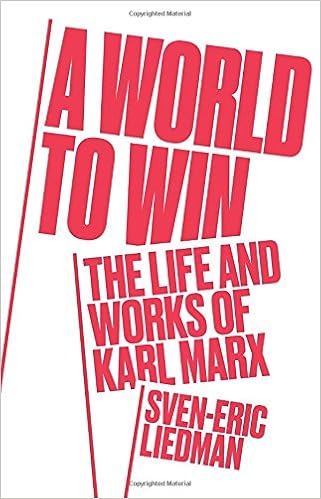
This book is very well done. It is not revelatory to me, but it serve very well as the standard, up to date major biography of Marx. You can order it here.
Ethiopia: books on horseback
Via Malcolm Clark.
*The Radical Fool of Capitalism*
Bentham…appraised the trophies — dismissively dubbed “baked heads” — as technical innovations and recognized their potential for his own plans. He enthusiastically praised the “savage ingenuity.” An 1824 draft of his will was the first to contain the score of his wishes: first, to see the corpse as an inheritance…
According to legend, Behtam carried around the glass eyes intended for the Auto-Icon in his pocket in his final years. (Supposed) attempts to dehydrating body parts in his home oven are said to have yielded satisfactory results. Bentham believed the [Maori] mokomokai process would discolor facial traits and produce a parchment- or mummy-like appearance (which could be corrected with paint), while maintaining the physiognomy.
But Southwood Smith botched the job. He sprinkled sulfuric acid onto the head, and in doing so docked Bentham’s nose. He used an air pump to aid dehydration, which caused the skin to shrivel. Bentham’s face appeared melted, the physiognomy destroyed. In spring 1833, Smith commissioned a replacement head of wax…
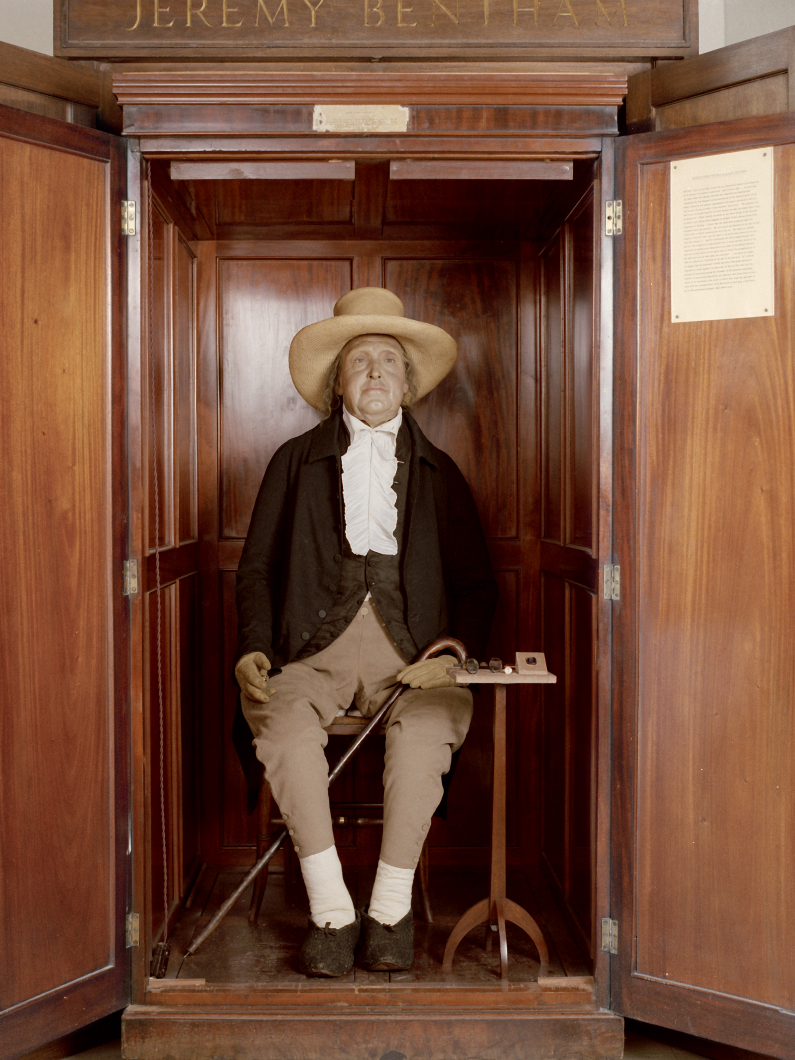
That is from the new, excellent, and short The Radical Fool of Capitalism: On Jeremy Bentham, The Panopticon, and the Auto-Icon, by Christian Welzbacher.
Erik Brynjolfsson interviews Daniel Kahneman
Mostly about AI, here is one bit:
My guess is that AI is very, very good at decoding human interactions and human expressions. If you imagine a robot that sees you at home, and sees your interaction with your spouse, and sees things over time; that robot will be learning. But what robots learn is learned by all, like self-driving cars. It’s not the experience of the single, individual self-driving car. So, the accumulation of emotional intelligence will be very rapid once we start to have that kind of robot .
It’s really interesting to think about whether people are happier now than they were. This is not at all obvious because people adapt and habituate to most of what they have. So, the question to consider about well-being and about providing various goods to people, is whether they’re going to get used to having those goods, and whether they continue to enjoy those goods. It’s not apparent how valuable these things are, and it will be interesting to see how this changes in the future.
Kahneman tells us that his forthcoming book is called Noise, though I don’t yet find it on Amazon. Here is an HBR essay of his on that topic.
*My Morning Routine*
The editors and co-creators are Benjamin Spall and Michael Xander, and the subtitle is How Successful People Start Every Day Inspired.
They were generous enough to include a contribution from me, on my theory of how to get ready in the morning for the day to come:
I make sure I’ve already showered. Too many people waste some of their most productive morning time showering. Showering relaxes you and calms you down — why should that happen in the morning? I prefer to enjoy my shower during the evening, when I know I’m winding down in any case.
And here is Scott Adams on related topics, from the same book:
I’m a trained hypnotist, and when I learned to do hypnosis I learned that self-hypnosis, if you’re trained to do it, is more effective and faster than meditation.
You can order the book here.
*Bull Shit Jobs: A Theory*
That is the new and entertaining book by David Graeber, probably you already have heard of it. Here is a brief summary.
Coming from academia, I am sympathetic to the view that not everyone is productive, or has a productive job. And my ongoing series “Those new service sector jobs…” is in part reflecting the wonder of the market in providing so many obscure services, but also in part a genuine moral query as to how many of these activities actually are worthwhile. You are supposed to have mixed feelings when reading those entries, just as with “Markets in Everything.”
Still, I think Graeber too often confuses “tough jobs in negative- or zero-sum games” with “bullshit jobs.” I view those as two quite distinct categories. Overall he presents the five types of bullshit jobs as flunkies, goons, duct tapers, box tickers, and taskmasters, but he spends too much time trying to lower the status of these jobs and not enough time investigating what happens when those jobs go away.
He doubts whether Oxford University needs “a dozen-plus” PR specialists. I would be surprised if they can get by with so few. Consider their numerous summer programs, their need to advertise admissions, how they talk to the media and university rating services, their relations with China, the student lawsuits they face, their need to manage relations with Oxford the political unit, and the multiple independent schools within Oxford, just for a start. Overall, I fear that Graeber’s managerial intelligence is not up to par, or at the very least he rarely convinces me that he has a superior organizational understanding, compared to people who deal with these problems every day.
A simple experiment would vastly improve this book and make for a marvelous case study chapter: let him spend a year managing a mid-size organization, say 60-80 employees, but one which does not have an adequately staffed HR department, or perhaps does not have an HR department at all. Then let him report back to us.
At that point we’ll see who really has the bullshit job.
American dams in the 19th century
To appreciate how essential dams were in the nineteenth century, simply look at the 1840 U.S. Census: It found that almost every river had a dam, and many rivers had dozens. In total, the twenty-six states that made up the United States at the time had around 65,000 dams. With a population of only 17 million at that time, the United States had one dam for every 261 people.
That is from the new and often quite interesting Martin Doyle, The Source: How Rivers Made America and America Remade its Rivers.
What I’ve been reading
The Virtue of Nationalism, by Yoram Hazony. Falls into the “contrarian, but shouldn’t need to be contrarian” category. It makes good points, but I felt it was interior to my knowledge set.
Karl Ove Knausgaard, Spring, a comeback for Knausgaard.
Gabriel Said Reynolds, The Quran and the Bible: Text and Commentary. I won’t have the time soon to work through the thousand pages of this book, but it appears to be a major achievement and of very high quality. Here is the book’s home page. Here is a good piece by Reynolds on related topics.
Nick Polson and James Scott, AIQ: How People and Machines are Smarter Together, is a new and (believe it or not) original and very good take on this theme.
Heiner Rindermann, Cognitive Capitalism: Human Capital and Wellbeing of Nations perhaps covers too much ground, but is still a very useful 500 pp. plus survey of exactly what the title suggests.
Jan Assmann, The Invention of Religion: Faith and Covenant in the Book of Exodus. One of the best introductory works on the best and most important book ever written.
*Parking and the City*, edited by Donald Shoup
This is the definitive book on the economics of parking, here is one short summary bit by Shoup from his introduction:
Remove off-street parking requirements. Developers and businesses can then decide how many parking spaces to provide for their customers.
Charge the right prices for on-street parking. The right prices are the lowest prices that will leave one or two open spaces on each block, so there will be no parking shortages. Prices will balance the demand and supply for on-street parking spaces.
Spend the parking revenue to improve public services on the metered streets. If everybody sees their meter money at work, the new public services can make demand-based prices for on-street parking politically popular.
You can order the book here. Here is my earlier NYT column on the economics of parking.
*The Happiness Curve: Why Life Gets Better After 50*
I was very happy to have blurbed this new and wonderful book by Jonathan Rauch, here is one adapted excerpt:
Like adolescence, the happiness dip at midlife is developmentally predictable, and can be aggravated by isolation, confusion, and self-defeating thought patterns. Like adolescence, it can lead to crisis, but it is not, in and of itself, a crisis. Rather, like adolescence, it generally leads to a happier stage. In short, although adolescence and the trough of the happiness curve are not at all the same biologically, emotionally, or socially, both transitions are commonplace and nonpathological. But one of them has a supportive social environment, whereas the other has … red sports cars.
You can order the book here.
*Paul Simon: The Life*
In 1974, near the peak of his fame, Paul Simon started taking music lessons.
The melody of “American Tune,” my favorite Paul Simon song, is taken from a Bach chorale from St. Matthew’s Passion.
Paul Simon originally was to have played guitar on “Rock Island Line” for the Nilsson/Lennon Pussy Cats album, but Lennon and Simon could not get along with each other and Lennon kept on putting his hand on Simon’s guitar strings to stop him from playing, eventually causing Simon to leave.
Art Garfunkel originally was slated to be dual vocalist on the Hearts and Bones album (TC’s favorite Paul Simon creation by the way), though Simon cut out the vocal tracks that Garfunkel had recorded.
Around 2012 Simon developed a strong interest in the music of American “hobo composer” Harry Partch.
Those are from the new Paul Simon biography by Robert Hilburn.
My Conversation with Bryan Caplan
Bryan was in top form, I can’t recall hearing him being more interesting or persuasive. Here is the audio and text. We talked about whether any single paper is good enough, the autodidact’s curse, the philosopher who most influenced Bryan, the case against education, the Straussian reading of Bryan, effective altruism, Socrates, Larry David, where to live in 527 A.D., the charm of Richard Wagner, and much more. Here is one excerpt:
COWEN: You love Tolstoy, right?
CAPLAN: Yeah. You love Tolstoy because here’s a guy who not only has this encyclopedic knowledge of human beings — you say he knows human nature. Tolstoy knows human natures. He realizes that there are hundreds of kinds of people, and like an entomologist, he has the patience to study each kind on its own terms.
Tolstoy, you read it: “There are 17 kinds of little old ladies. This was the 13th kind. This was the kind that’s very interested in what you’re eating but doesn’t wish to hear about your romance, which will be contrasted with the seventh kind which has exactly the opposite preferences.” That’s what’s to me so great about Tolstoy.
Here is one of my questions:
What’s the fundamental feature in Bryan Caplan–think that has made you, unlike most other nerds, so much more interested in Stalin than science fiction?
Here is another exchange:
COWEN: You think, in our society in general, this action bias infests everything? Or is there some reason why it’s drawn like a magnet to education?
CAPLAN: Action bias primarily drives government. For individuals, I think even there there’s some action bias. But nevertheless, for the individual, there is the cost of just going and trying something that’s not very likely to succeed, and the connection with the failure and disappointment, and a lot of things don’t work out.
There’s a lot of people who would like to start their own business, but they don’t try because they have some sense that it’s really hard.
What I see in government is, there isn’t the same kind of filter, which is a big part of my work in general in politics. You don’t have the same kind of personal disincentives against doing things that sound good but actually don’t work out very well in practice.
Probably even bigger than action bias is actually what psychologists call social desirability bias: just doing things that sound good whether or not they actually work very well and not really asking hard questions about whether things that sound good will work out very well in practice.
I also present what I think are the three strongest arguments against Bryan’s “education is mostly signaling” argument — decide for yourself how good his answers are.
And:
COWEN: …Parenting and schooling in your take don’t matter so much. Something is changing these [norms] that is mostly not parenting and not schooling. And they are changing quite a bit, right?
CAPLAN: Yes.
COWEN: Is it like all technology? Is the secret reading of Bryan Caplan that you’re a technological determinist?
CAPLAN: I don’t think so. In general, not a determinist of any kind.
COWEN: I was teasing about that.
And last but not least:
CAPLAN: …When someone gets angry at Robin, this is what actually outrages me. I just want to say, “Look, to get angry at Robin is like getting angry at baby Jesus.” He’s just a symbol and embodiment of innocence and decency. For someone to get angry at someone who just wants to learn . . .
COWEN: And when they get mad at me?
CAPLAN: Eh, I understand that.
Hail Bryan Caplan! Again here is the link, and of course you should buy his book The Case Against Education.
Why aren’t all tall buildings in the same neighborhood the same height?
Let’s say there is a 40-story building and a 60-story building. You would think the different builders face more or less the same costs for their height decisions. If you want to own 60 stories, it is still the case that everyone can build the cheapest-height building, and you can buy the stories you want from a variety of sellers.
If you had lots of companies that needed 60 stories, and you didn’t want to split up those firms across locations, and lots of companies that needed only 40 stories, the differential building heights could be explained rather easily. But that doesn’t seem to be the case. Most tall buildings house a variety of tenants, and those tenants don’t “need the whole height” or anything close to it.
This puzzle is from Steve Landsburg, who says “color me stumped” in his new and forthcoming book Can You Outsmart An Economist? 100+ Puzzles to Train Your Brain.