Category: Data Source
A new paper on immigration and wages
It is basically pro-imigration, finding positive wage effects for most U.S. workers and only slight negative effects for the unskilled. It uses a general equilibrium model related to that of Borjas, but models physical capital more explicitly. I’ve yet to read it. Find it here. Hat tip to New Economist blog, here is the abstract.
Discard facts of the day
In 2004 about 315 million working PCs were retired in North America…
In 2005 more than 100 million cell phones were discarded in the United States.
That is from Made to Break: Technology and Obsolescence in America, by Giles Slade.
Private Foreign Aid
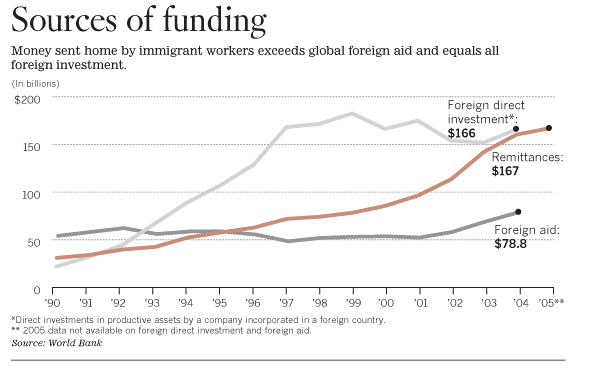
The LATimes has a superb set of articles on remittances, it focuses not just on remittances from the U.S. to Mexico but also from Japan to the Phillipines, Italy to Kenya and Florida to Haiti.
Migrants have been sending money home, in one form or another, for
centuries. But only recently have economists recognized its
significance. Today, remittances are the largest, fastest-growing and
most reliable source of income for developing countries. Poor nations
reported $167 billion in receipts from overseas workers last year,
according to the World Bank, more than all foreign aid. Including
unrecorded transactions, the bank estimates that the total exceeded
$250 billion.…Mexico’s annual remittance inflow has doubled since 2002 and reached
$20 billion last year, second only to petroleum as a generator of
wealth for the country.Other developing nations also depend
heavily on their migrants’ money. Brazilian laborers in Japan send home
more than $2 billion a year, out-earning their country’s coffee
exports. Remittances bring in more than tea exports do in Sri Lanka and
tourism does in Morocco. In Jordan, Lesotho, Nicaragua, Tonga and
Tajikistan, they provide more than a quarter of the gross national
product.
Thanks to Carl Close for the pointer.
Sad facts of the day
"80% of US families did not buy or read a book last year."
"58% of the US adult population never reads another book after high school."
"…more people probably read Engadget than all of the top 50 science blogs combined."
Bill Simmons (a good link for NBA fans) thinks that Allen Iverson would have been the greatest soccer player ever to try the game.
You’ll find all of those over at the ever-excellent kottke.org.
How American is Globalization?
Extending the analysis to 1999, we see that the percentage of the world’s population who are native speakers of English actually declined from 9.8 to 7.8 percent. The percentage of native speakers of the world’s leading language, Mandarin, also declined slightly, from 15.6 to 15.2 percent…The language groups that have increased dramatically as a percentage of the world population are Arabic and Bengali, which each accounted for 2.7 percent of the world’s speakers in 1958, but rose to 3.5 percent and 3.2 percent, respectively, in 1992. Hindi speakers rose from 5.2 to 6.4 percent, and Spanish speakers from 5.0 to 6.1 percent. English as a first language has fallen from its mid-century position of second place to fourth as the millennium ended.
That is from William H. Marling’s How "American" is Globalization? This wide-ranging book is the definitive current source on which cultures are gaining and losing in respective cultural areas. The bottom line of this book? The world is not becoming Americanized. Very highly recommended.
JSTOR for People not at a University
One of the great pleasures of being a professor in recent years is that I no longer have to go the library. Trudging to the stacks, finding an article, and photocopying it are things of the past. Almost everything is available online especially at the great JSTOR in the sky, a vast repository of electronic journals some dating back more than 100 years.
Not every university has access to JSTOR, however, and individual subscriptions are costly and limited in scope. But Kevin Kelly points out that in many places you can get a digital library card which will get you access to many online databases.
In most states, you can get a library card from a public library
outside of your county of residence — as long as you can prove state
residence (true for the San Francisco Public Library). Often you will
have to go the actual state library in person to pick up your card, but
once in hand, you can access the library from the web. Fanatical
researchers are known to have a wallet full of library cards from
numerous public library systems within their respective states. Some
states, Ohio and Michigan being two of the better known, have statewide
consortiums of private, corporate and public libraries, which allows
you access to the combined services and databases licensing power of
them all.
China facts of the day
Suicide is now the biggest single killer among young Chinese people, the country’s first national suicide survey has shown.
Each year more than a quarter of a million people in China are taking their own lives, the study showed.
But the most significant finding was that, unlike almost everywhere else in the world, more women than men commit suicide.
Suicide now accounts for a third of all deaths among women in the countryside.
In the study, to be
published in British medical journal, The Lancet, US and Chinese
researchers discovered there was apparently a significantly lower rate
of mental illness among those committing suicide than would be the case
in the West.
Dr Michael Phillips, who
helped lead the study, told the BBC that while 90-95% of those taking
their own lives in the West suffered significant mental illness at the
time of attempting suicide, around a third of those in China did not.
…the biggest single reason why so many suicide attempts in China are successful is their method.
Nearly two-thirds of them are by consuming pesticides and powerful rat poisons which are extremely easy to buy in China.
Here is the story, courtesy of www.2blowhards.com.
Literature and movie maps
What else do fans of Amelie Nothomb read? The closer the names are together, the more likely both a person likes both authors.
Enter your favorite author here. David Foster Wallace, whom I dislike, is closest to Don Delillo. Virginia Postrel is paired next to Ayn Rand and Arthur Conan Doyle. Here is Milton Friedman. No, I don’t know the details of their data but it involves asking visitors.
The parent company offers similar services for music and movies. Fans of Eyes Wide Shut like these movies. Total Recall is linked, sadly, to Animal House.
Go ahead, waste your time with this, I said it was OK.
Which is the second most polite city?
My current locale Zurich, it turns out, based on this field experiment. New York City of all places came in first, but I agree. There is so much human capital in the city one is always tempted to speak to strangers, given the reasonably high chance you will hear something magnificent in return. Third and fourth were Toronto and Berlin. In Europe Moscow and Bucharest were the least polite cities. Bombay fared worst of all.
How strong is the incentive to learn English?
Read Austan Goolsbee in today’s New York Times. Excerpt:
It seems that a child with talent can succeed no matter what the
parents’ skills are, as has been true for centuries in this country.
But parents whose English is poor have a big negative impact on the
below-average children.
What is the most commonly used noun?
"Time." Here is the list of the Top 25.
Are men or women more generous?
“When altruism is expensive, women are kinder, when it is cheap, men are more altruistic.”
There is more to be had here.
The real Swedish jobless rate is 15 percent
You might think this post is "libertarian cackling with glee," but in fact I was surprised to see this. The problem is also expected to get worse, read the whole thing.
How Economists and Journalists Can Get Along
Brad De Long and Susan Rasky have a list of Twelve
Things Journalists Need to Remember to Be Good Economic Reporters and Twelve
Things Economists Need to Remember to Be Helpful Journalistic Sources. Lots of good stuff. Here are two favorites, the first nominally for journalists, the second for economists.
Never write "economists disagree." No matter how limited
your space or time, never write "economists disagree." Write WHY economists
disagree. An expert who cannot explain why other experts think differently isn’t
much of an expert. A reporter who can’t fit an explanation of where the
disagreement lies into the assigned space isn’t much of a journalist. A
journalist who cannot figure out the source of the disagreement is a journalist
who is working for whoever has the best-funded public-relations firm–and is
working for them for free.
Get over your snobbery about local television news. This is a genuine
opportunity to reach the public. Learn to use it. Remember that the local TV
reporter’s gasoline-price story this evening will be seen by 300,000 people.
Your op-ed will be read by 20,000, if you are lucky. Your journal articles will
be seriously read by 12.
NBER sentences which made me laugh
Higher hamburger prices may reduce the probability and frequency of use of marijuana and the frequency of smoking among drivers.
Well, you didn’t think the cross-elasticities were zero, did you? Here is the paper.