Category: Economics
Meeting one’s higher calling?
From Madurai, Robyn Eckhardt reports:
Onion, cauliflower, fenugreek, garlic, egg white, potato, mushroom and masala are just some of the variations on dosa offered by the 49-year-old Mr. Karthikeyan, who took over the business from his father after earning a master’s degree in economics. “What could I do? There was no one else,” he explained as he unhurriedly worked five griddles simultaneously — four for dosai and one for fried dishes like masala powder-seasoned hard-boiled eggs with onion, cilantro and curry leaves. “Back then, a dosai cost a quarter of a rupee,” he said. Today Ayyappan charges 10 rupees and up.
There is more here, via these sources.
Harford (and Tabarrok) on Macroeconomics
Tim Harford gave an excellent talk at Cato on his new book The Undercover Economist Strikes Back.
You may have heard recently that the richest 85 people in the world have more wealth than the bottom 3.5 billion. Tim began by pointing out that his 2 year old also has more wealth than the bottom 2 billion since his 2-year old has no debt. Later in the talk Tim gave a brilliant explanation for how and why economists began to treat data like an unfaithful spouse. Watch for that!
Tim’s talk begins around the 7:20 mark. I come in around the 34:00 mark and after saying some more nice things about Tim’s book I have some critiques focusing on how long can wages and prices really be sticky and also giving a brief introduction and defense to “Real Business Cycle” theory especially the recent sectoral approaches of Gabaix and also Acemoglu et al.
At the link you can also find links for iTunes and downloadable formats. CSpan also covered the event.
Money Laundering
From a new paper that caught my eye in the journal Industrial and Engineering Chemistry Research:
With nearly 150 billion new banknotes being manufactured and printed every year around the world, the replacing of unfit currency is approaching $10 billion annually. In addition, central banks must also deal with the environmental challenge of annually disposing of nearly 150,000 tons worth of notes unfit for recirculation. Seminal work by the De Nederlandsche Bank (DNB) has identified that soiling is primarily a yellowing of the notes due to the accumulation of oxidized sebum. We show that supercritical CO2 (SCCO2) can be effectively utilized to remove sebum and other oils and contaminants, including common bacterial colonies, from both paper and polymer banknotes without destroying the costly and sophisticated security features employed by central banks to prevent counterfeiting. SCCO2 cleaning at 60°C and 5000 psi was shown to be effective in cleaning conventional straps of 100 banknotes, extracting nearly 4% of the initial strap weight. Measurements of note soiling distributions on a banknote sorting machine running at 10 banknotes per second showed a significant shift in soiling levels after cleaning, supporting the claim that processing of SCCO2-cleaned notes would result in significantly fewer notes being classified as unfit due to soiling and shredded.
Hat tip: Fast Company.
The economic value of a law degree
Michael Simkovic and Frank McIntyre have a new paper on this topic:
Legal academics and journalists have marshaled statistics purporting to show that enrolling in law school is irrational. We investigate the economic value of a law degree and find the opposite: given current tuition levels, the median and even 25th percentile annual earnings premiums justify enrollment. For most law school graduates, the present value of a law degree typically exceeds its cost by hundreds of thousands of dollars. We improve upon previous studies by tracking lifetime earnings of a large sample of law degree holders. Previous studies focused on starting salaries, generic professional degree holders, or the subset of law degree holders who practice law. We also include unemployment and disability risk rather than assume continuous full time employment. After controlling for observable ability sorting, we find that a law degree is associated with a 73 percent median increase in monthly earnings and 60 percent increase in median hourly wages. The mean annual earnings premium of a law degree is approximately $57,200 in 2013 dollars. The law degree earnings premium is cyclical and recent years are within historical norms. We estimate the mean pre-tax lifetime value of a law degree as approximately $1,000,000.
For the pointer I thank the excellent Andres Marroquin.
Claims about coal
Counterfactual estimates of city population sizes indicate that our estimated coal effect explains at least 60% of the growth in European city populations from 1750 to 19o0.
That is from a new NBER working paper by Alan Fernihough and Kevin Kevin Hjortshøj O’Rourke. There is an ungated version of the paper here.
The North Carolina unemployment insurance experiment may be looking up
The benefits have been stopped, and there has been much recent debate over how well this is working to stimulate reemployment. This new study is from Kurt Mitman, who is a doctoral candidate at U. Penn and an NBER research associate, here is his summary:
1. Evidence from the establishment survey confirms a substantial increase in employment in North Carolina following the unemployment insurance reform.
2. The increase in payroll employment reported by the sample of North Carolina employers is smaller than the increase in employment reported by workers in the household survey.
3. The increase in employment [is] driven by the private service sector.
4. A comparison of the growth in employment between North Carolina and the adjacent states in Figure 5 reveals a similar growth in the post-reform period between the two Carolinas, which is much faster growth than in Virginia.
5. Results in Table 3 reveal a mild tendency toward higher weekly hours post reform and little change in wages and earnings.
The full piece is here (pdf). This seems to me our best understanding of the admittedly limited data to date.
Upward mobility in the United States is not declining as many citizens think
Here is the new Raj Chetty paper that everyone is talking about (pdf);
We use administrative records on the incomes of more than 40 million children and their parents to describe three features of intergenerational mobility in the United States. First, we characterize the joint distribution of parent and child income at the national level. The conditional expectation of child income given parent income is linear in percentile ranks. On average, a 10 percentile increase in parent income is associated with a 3.4 percentile increase in a child’s income. Second, intergenerational mobility varies substantially across areas within the U.S. For example, the probability that a child reaches the top quintile of the national income distribution starting from a family in the bottom quintile is 4.4% in Charlotte but 12.9% in San Jose. Third, we explore the factors correlated with upward mobility. High mobility areas have (1) less residential segregation, (2) less income inequality, (3) better primary schools, (4) greater social capital, and (5) greater family stability. While our descriptive analysis does not identify the causal mechanisms that determine upward mobility, the new publicly available statistics on intergenerational mobility by area developed here can facilitate future research on such mechanisms.
Here is summary coverage from David Leonhardt. The highly reliable David starts with this: “The odds of moving up — or down — the income ladder in the United States have not changed appreciably in the last 20 years, according to a large new academic study that contradicts politicians in both parties who have claimed that income mobility is falling.”
Confusing issues of equality and mobility remains rife in current discourse.
Income inequality is not as extreme as many citizens think
Here is a recent Gallup poll of interest, suggesting many people are unhappy with the level of income inequality. Alternatively, here is a new paper to warm Bryan Caplan’s heart, by John R. Chambers, Lawton K. Swan, and Martin Heesacker, entitled “Better Off Than We Know: Distorted Perceptions of Incomes and Income Inequality in America”:
Three studies examined Americans’ perceptions of incomes and income inequality using a variety of criterion measures. Contrary to recent findings indicating that Americans underestimate wealth inequality, we found that Americans not only overestimated the rise of income inequality over time, but also underestimated average incomes. Thus, economic conditions in America are more favorable than people seem to realize. Furthermore, ideological differences emerged in two of these studies, such that political liberals overestimated the rise of inequality more than political conservatives. Implications of these findings for public policy debates and ideological disagreements are discussed.
There is this bit:
Most participants (76%) incorrectly selected the higher value ($681,649) as the cutoff for the top 1% of earners, magnifying the level of income it takes to qualify as a “1 percenter.”
There are different measures, but I think of 380k as the relevant cut-off point for the top one percent. Here is a useful Atlantic write-up of the piece. I cannot find an ungated version, can you?
I thank Veronique de Rugy and Scott Winship for relevant pointers.
The home bias in sovereign ratings
There is a new and intriguing paper on this topic, by Andreas Fuchs and Kai Gehring, the abstract is this:
Credit rating agencies are frequently criticized for producing sovereign ratings that do not accurately reflect the economic and political fundamentals of rated countries. This article discusses how the home country of rating agencies could affect rating decisions as a result of political economy influences and culture. Using data from nine agencies based in six countries, we investigate empirically if there is systematic evidence for a home bias in sovereign ratings. Specifically, we use dyadic panel data to test whether, all else being equal, agencies assign better ratings to their home countries, as well as to countries economically, politically and culturally aligned with them.
While most of the variation in ratings is explained by the fundamentals of rated countries, our results provide empirical support for the existence of a home bias in sovereign ratings. We find that the bias becomes more accentuated following the onset of the Global Financial Crisis and appears to be driven by economic and cultural ties, not geopolitics.
The paper has been covered by FT Alphaville, by China Daily, and by Der Spiegel (in German).
Neumark and Wascher on minimum wages and youth unemployment
Here is the abstract from their piece from 2003 (pdf):
We estimate the employment effects of changes in national minimum wages using a pooled cross-section time-series data set comprising 17 OECD countries for the period 1975-2000, focusing on the impact of cross-country differences in minimum wage systems and in other labor market institutions and policies that may either offset or amplify the effects of minimum wages. The average minimum wage effects we estimate using this sample are consistent with the view that minimum wages cause employment losses among youths. However, the evidence also suggests that the employment effects of minimum wages vary considerably across countries. In particular, disemployment effects of minimum wages appear to be smaller in countries that have subminimum wage provisions for youths. Regarding other labor market policies and institutions, we find that more restrictive labor standards and higher union coverage strengthen the disemployment effects of minimum wages, while employment protection laws and active labor market policies designed to bring unemployed individuals into the work force help to offset these effects. Overall, the disemployment effects of minimum wages are strongest in the countries with the least regulated labor markets.
Which kinds of music are encouraged by streaming vs. downloads?
Let’s compare iTunes downloads to a mythical perfect streaming service which lets you listen to everything for a fixed fee each month or sometimes even for free. In the interests of analytical clarity, I will oversimplify some of the actual pricing schemes associated with streaming and consider them in their purest form.
Streaming seems to encourage the demand for variety, so the website vendor wants to make browsing seem really fun, perhaps more fun than the songs themselves. (An alternative view is that the information produced by streaming services, and the recommendations, allow for in-depth exploration of genres and that outweighs the “greater ease of sampling of variety” effect. Perhaps both effects can be true for varying groups of listeners with somehow the “middle level of variety-seeking left in the lurch, relatively speaking.)
The music creators are incentivized to create music which sounds very good on first approach. Otherwise the listener just moves on to further browsing and doesn’t think about going to your concert or buying your album.
Streaming, with its extremely large menu, also means commonly consumed pieces will tend to be shorter or more easily broken into excerpts. This will favor pop music and I think also opera, because of its arias.
Advertising is a more important revenue source for streaming than it is for downloads. The music promoted by streaming services thus should contribute to the overall ambience and coolness of the site, and musicians who can meet that demand will find that their work is given more upfront attention. It encourages music whose description evokes a response of “Oh, I’ve never had that before, I’d like to try it.” Even if you don’t really care about it.
People who purchase advertised products are, on average, older than the people who purchase music. Streaming services thus should slant product and product accessibility on the site toward the musical tastes of older people.
Since streaming divides up revenues among a greater number of artists, that should encourage solo performers with low capital costs, who can keep their (tiny) share all for themselves. It also may require that the artists on streaming services can make a living or partial living giving concerts, even more so than under the previous world order.
This music industry source suggests that streaming boosts album sales in a way that downloads do not. It also questions whether that boost will be long-lived, as streaming services take over more of the market.
When the marginal cost of more music is truly zero, does that make musical choices more or less socially influenced?
Hannah Karp shows that in the new world of streaming, mainstream radio stations are responding by playing the biggest hits over and over again. Ad-supported media require the familiar song to grab and keep the attention of the listener. Risk-aversion is increasing, which probably pushes some marginal listeners, who are interested in at least some degree of exploration, into further reliance on streaming.
The top 10 songs last year were played close to twice as much on the radio than they were 10 years ago, according to Mediabase, a division of Clear Channel Communications Inc. that tracks radio spins for all broadcasters. The most-played song last year, Robin Thicke’s “Blurred Lines,” aired 749,633 times in the 180 markets monitored by Mediabase. That is 2,053 times a day on average. The top song in 2003, “When I’m Gone” by 3 Doors Down, was played 442,160 times that year.
So the differing parts of the market are interdependent here.
What do you think?
Good Marc Andreessen piece on the broader implications of Bitcoin
Marc writes:
Think about content monetization, for example. One reason media businesses such as newspapers struggle to charge for content is because they need to charge either all (pay the entire subscription fee for all the content) or nothing (which then results in all those terrible banner ads everywhere on the web). All of a sudden, with Bitcoin, there is an economically viable way to charge arbitrarily small amounts of money per article, or per section, or per hour, or per video play, or per archive access, or per news alert.
Another potential use of Bitcoin micropayments is to fight spam. Future email systems and social networks could refuse to accept incoming messages unless they were accompanied with tiny amounts of Bitcoin – tiny enough to not matter to the sender, but large enough to deter spammers, who today can send uncounted billions of spam messages for free with impunity.
Finally, a fourth interesting use case is public payments. This idea first came to my attention in a news article a few months ago. A random spectator at a televised sports event held up a placard with a QR code and the text “Send me Bitcoin!” He received $25,000 in Bitcoin in the first 24 hours, all from people he had never met. This was the first time in history that you could see someone holding up a sign, in person or on TV or in a photo, and then send them money with two clicks on your smartphone: take the photo of the QR code on the sign, and click to send the money.
There is more here, interesting throughout.
Robert J. Barro on aggregate demand
There has been a recent kerfluffle over whether Robert Barro rejects the notion of aggregate demand, which he had written with quotation marks as “aggregate demand.” Scott Sumner surveys the back and forth.
I say use The Google to find out what Barro really thinks and indeed he has written a whole piece on the topic (jstor), namely “The Aggregate-Supply/Aggregate Demand Model,” from the mid 1990s, and here is the abstract:
In recent years, many macroeconomic textbooks at the principles and intermediate levels have adopted the aggregate-supply/aggregate-demand (AS-AD) frame- work [Baumol and Blinder, 1988, Ch. 11; Gordon, 1987, Ch. 6; Lipsey, Steiner, and Purvis, 1984, Ch. 30; Mankiw, 1992, Ch. 11]. The objective was to allow for supply shocks in a Keynesian framework and to generate more satisfactory predictions about the behavior of the price level. The main point of this paper is that the AS-AD model is unsatisfactory and should be abandoned as a teaching tool.
In one version of the aggregate-supply curve, the components of the AS-AD model as usually used are contradictory. An interpretation of the model to eliminate the logical inconsistencies makes it a special case of rational-expectations macro models. In this mode, the model has no Keynesian characteristics and delivers the policy prescriptions that are familiar from the rational-expectations literature.
An alternative version of the aggregate-supply curve leads to what used to be called the complete Keynesian model: the goods market clears but the labor market has chronic excess supply. This model was rejected long ago for good reasons and should not be resurrected now.
If you read the paper, you will see three things. First, Barro is fully aware of “AD-like” phenomena and does not reject that notion. Second, Barro seems to prefer the IS-LM model to AS-AD, albeit with some caveats about possible false predictions of IS-LM and also noting in footnote two that he prefers his own presentation in his 1993 text. Third, Barro’s criticism is (whether you agree or not) that AD-AS collapses too readily into standard rational expectations models and doesn’t really provide an independent foundation for sticky price macroeconomics. In a nutshell “The AS-AD model is logically flawed as usually presented because its assumption that the price level clears the goods market is inconsistent with the Keynesian underpinnings for the aggregate-demand curve.”
Krugman had written this:
If you read Barro’s piece, what you see is a blithe dismissal of the whole notion that economies can ever suffer from am inadequate level of “aggregate demand” — the scare quotes are his, not mine, meant to suggest that this is a silly, bizarre notion, in conflict with “regular economics.”
I believe that is not a good characterization of Barro’s views and it is also an object lesson in the importance of the Ideological Turing Test. I would cite not only this piece, but also forty years of journal articles, many of which study the importance of nominal shocks and demand, albeit without (in general) using textbook AD-AS terminology. Indeed, Barro working with Herschel Grossman is one of the founding fathers of quantity-constrained Keynesian sticky-price macro and he is still citing this work favorably in his mid-1990s piece; see for instance Barro and Grossman (1971, 1974) and also their book from 1976: “This is a textbook on macroeconomic theory that attempts to rework the theory of macroeconomic relations through a re-examination of their microeconomic foundations. In the tradition of Keynes’s General Theory of Employment, Interest and Money…”
On the UI issue, I would note that the multiplier from transfers is likely unimpressive relative to the multiplier from government consumption.
Teen employment and the minimum wage: sixty years of experience
Kevin Erdmann relates:
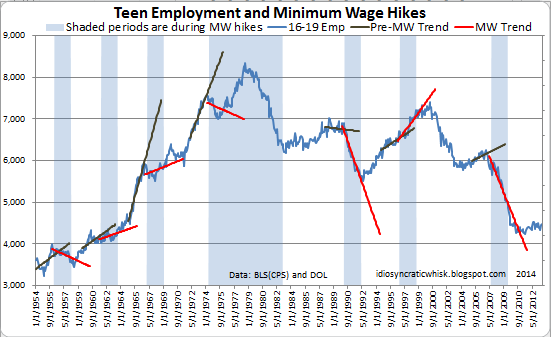
There is much more here. Kevin concludes: “Is there any other issue where the data conforms so strongly to basic economic intuition, and yet is widely written off as a coincidence?”
Where are the missing gains from trade?
There is a new and probably important paper by Marc J. Melitz and Stephen J. Redding on this topic. For this piece I find a segment in the middle to be more illuminating than the abstract:
Trade has a fractal-like property in this model, in which there are gains from trade at each intermediate stage of production. If one falsely assumes a single stage of production, when production is in fact sequential, these gains from trade at each intermediate stage show up as an endogenous increase in measured domestic productivity. As the number of production stages converges towards infinity, the welfare gains from trade become arbitrarily large. This captures the idea that trade involves myriad changes in the organization of production throughout the economy and the welfare costs from forgoing this pervasive specialization can be large.
As the domestic trade share for an individual production stage becomes arbitrarily small, the welfare gains from trade also becomes arbitrarily large. This captures the idea that some countries may have strong comparative advantages in some stages of production and the welfare losses from forgoing this specialization can be large.
Here is an ungated version of the paper. I would note this idea holds out the hope of integrating the technology diffusion literature with the more traditional international trade theory approaches.