Category: Economics
Venezuelan Arbitrage
Flights out of Venezuela to anywhere are 100% sold out, months in advance. Yet many planes are flying half-empty. Why? The official exchange rate is 6.3 bolivars per dollar but the black market rate is more like 42 bolivars to the dollar. Few people are allowed to convert bolivars to dollars at the official rate but there is an exception for people with a valid airline ticket. As a result people with an airline ticket can convert bolivars to dollars at the official rate and then sell the dollars at the much higher black market rate. Reuters has the story:
“It is possible to travel abroad for free due to this exchange rate magic,” said local economist Angel Garcia Banchs.
The profit is realized from an arbitrage process known locally as “el raspao,” or “the scrape.”
Credit cards are used abroad to get a cash advance — rather than buying merchandise. The dollars are then carried back into Venezuela and sold on the black market for some seven times the original exchange rate.
The large profit margin easily absorbs the cost of flights and accommodation for a trip.
“I’ve been able to buy new clothes and give some cash to all my closest family members!” said one delighted Venezuelan lady, just back from a trip to Europe.
…Some Venezuelans do not even bother leaving the country, but merely send their credit cards to friends overseas, who swipe the cards and send the cash back to Venezuela.
“This is the reason many airlines are sending half-empty planes,” Ricardo Cusanno, head of a local tourism council, told Reuters, saying the government should cross-reference flight lists with those requesting foreign exchange to outwit the no-shows.
Hat tip: Carl Danner.
New markers of political and managerial hubris
Gillian Tett reports:
The number of “linguistic biomarkers” associated with hubris was highest for Mr Blair, followed by Thatcher – with Mr Major a long way behind. Hubris increased both in the speeches of Mr Blair and of Thatcher – with a particularly marked rise after periods of war (in the former case, this was the conflict in Iraq; for the latter, the Falklands war.) Mr Blair started using words such as “I”, “me” and “sure” more.
…Niamh Brennan and John Conroy, a professor and a graduate student, analysed the letters to shareholders issued by the chief executive of a European bank that expanded very dramatically during the boom and then suffered massive losses. Their analysis showed that during the eight years that he was in power, this chief executive also displayed rising hubris in his speech, with excessive optimism and a growing use of the royal “we”.
“From a total of 148 sentences identified as being good news, 57 per cent was attributed to the chief executive himself, while only 39 per cent was attributed to the company and a further 4 per cent to outside parties,” they write. But the chief executive “did not attribute any bad news to themselves or the company but stated it was the result of external factors.”
This research program is in its early stages.
From the comments — why are the ACA exchanges behind schedule?
The primary issues are political and legal barriers to properly build a workable solution.
The first is that the ACA gives states the right to build and run their own exchanges. However, even if they rake the money HHS is still required to step in and fill the gap if they fail. So many states took the money (who wouldn’t) but the program is left to implement a system of unknown size. Just that would doom most IT implementations. In addition there weren’t any IT firms interested in helping to tackle the Federal system, instead they went to the bigger states where they don’t have to navigate the crazy laws that govern IT projects at the federal level. This also allowed them to integrate smaller less complex systems outside the gaze of an IG department who publishes reports that get national attention in their zeal to protect public money.
Second is that funding is discretionary and even though they mapped out the required headcount they Didn’t have the budget appropriated to hire even half what was needed (as defined by outside consultants like MITRE) which left them severely understaffed. My wife’s ‘team’ of 5 was actually 2. There is no chance that Congress would appropriate more money to fix this. It also isn’t like these people are all that great at their jobs. No person really good at their job in the private sector is going to take a big pay cut to work for HHS. These jobs aren’t a bunch of overpaid airport security people but are jobs that pay much much better in the private sector. This means promoting the inexperienced from within and there is no institutional experience to implement a complex system.
Next there is the political decision to fold the exchanges into CMS (Centers for Medicaid and Medicare Services). The congressional Republicans were using every power they could to harass the executives so HHS tried to shield them behind Medicare. However, it wan’t like CMS was any good at this type of implementation and it was now not the only priority for the contract shops to worry over.
The other problem on a technical level was the near impossible task of verifying eligibility of users for subsidies. All the data has to be verified to avoid fraud, this include income. That data is segregated at the IRS and they are prevented by law from sharing ANY of that information with other parts of the government. Thank Johnson and Nixon for their abuse of IRS info. So there is no easy way to automate the approval process based on tax returns. The only sensible way is to have the IRS do it, but that would require funding and no contract manager is going to go to jail to solve a problem without a new budget appropriated for them.
Last is just the factor that any large IT system like this has a horrible failure rate. Supposedly the success rate in the private sector is now above 50% but there aren’t many major news stories when private companies waste a billion dollars on a system that never does anything. The Government is even worse because of the hundreds of pages of regulations meant to ensure money isn’t “wasted”. Sure, the Federal Government generally gets the best pricing there is on products, but the massive overhead eats all of that up and delays the process by months. I think there is a reason that private companies don’t have the complex rules you see in the government. They also don’t have to worry about going to jail if they do break the rules.
I find it a miracle that there is ANY chance that the exchanges might actually be working in time. However, I think it would be wrong to say that it is some inherently governmental problem that couldn’t be solved with smart reform of the laws and congressional support to fix things. One party is invested in always excusing governmental problems and the other is opposed to the idea of trying to fix problems because they are invested in highlighting government failure for the simple purpose of killing it.
http://www.macrodigest.com/
The site is here, and it presents recent macro discussions on an issue-by-issue basis in easy to use, easy to scan form. Furthermore it covers links which I otherwise would not see. I not only visit the site every day (or more), I use it every day, and there are no more than half a dozen aggregator sites where I would say that.
Definitely recommended, and it comes from the LSE Department of Economics.
Do Awards Reduce Productivity?
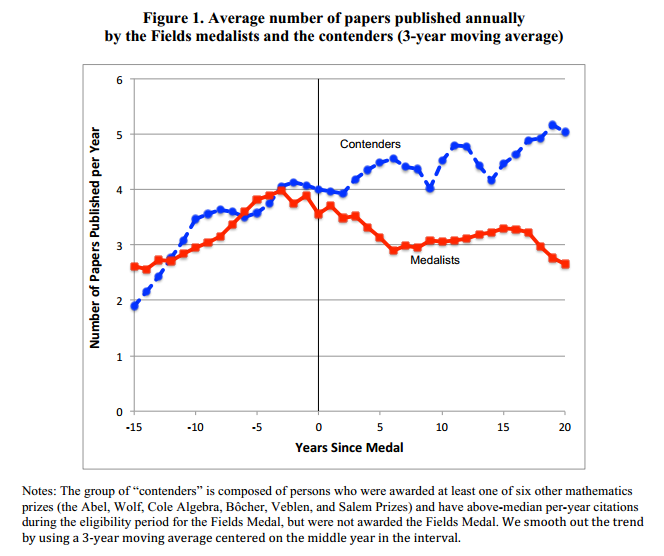 George J. Borjas and Kirk B. Doran find that the productivity of mathematicians who win the Fields Medal, the mathematics “Nobel” awarded to mathematicians under the age of 40, declines after they win. Borjas and Doran look at productivity on a number of margins including papers, citations, and graduate students mentored. At right is a graph of average number of papers compared to a contender group. Productivity falls by a statistically significant ~1 paper per year (in the regression that I think the strongest, in a few variants the decline is a bit more.)
Not all of the decline is due to resting on laurels. Borjas and Doran also find that mathematicians who win the Fields tend to branch out into other areas and this branching out requires them to learn new material which takes time. Steve Smale did work in economics and biology, for example, Rene Thom developed catastrophe theory and David Mumford works in vision and pattern theory. Exploring new topics can also lead to breakthroughs so branching out is not necessarily a negative effect. Borjas and Doran estimate that about half of the productivity effect is resting on laurels and half greater exploration.
(FYI, Borjas and Doran speak of prizes but I prefer to call them awards because awards such as the Fields or Clark Medal are quite different from prizes for purpose, such as the XPrizes, the H Prize or the historically important Orteig Prize, that I discuss in Launching as alternatives to patents.)
Winning the Fields is presumably good for the winner but even taking into account the enhanced incentive to explore it’s not obviously good for mathematics. The explicit purpose of the Fields was to increase not decrease achievement. What can be done?
The Fields Medal may be too important for its own good. In economics the closest thing to the Fields is the John Bates Clark award, given to that American economist under the age of 40 judged to have made the most significant contributions. Chan et al. (2013) find that recipients of the Clark award increase their productivity after winning. But the Clark award is widely seen as a future portent of the Nobel, thus it may have a more stimulative effect as the winner realizes that the next big award is within reach (see the final sentence). In a tournament, it’s important to tier the awards for multiple levels of ability.
In thinking about whether awards increase or decrease productivity on net. the precise counter-factual is important. Let us accept as Truth that winners of the Fields Medal decrease in productivity, even so that doesn’t mean that eliminating the Fields Medal would increase productivity let alone that eliminating all awards would increase productivity (remember, the productivity of the contenders may be more important than the productivity of the winners). Perhaps the most justifiable policy recommendation is that one shouldn’t give awards to young people, a Fields Medal for lifetime achievement, much as the economics Nobel is given, might encourage more achievement.
Paul Samuelson wrote of Chasing the Bitch Goddess of Success:
Scientists are as avaricious and competitive as Smithian businessmen. The coin they seek is not apples, nuts, and yachts; nor is it the coin itself, or power as that term is ordinarily used. Scholars seek fame.
But, paraphrasing Tyler, what price early fame?
Model this taper and show your work, if only verbally
Shortly following the announcement of a delayed taper:
The rupee rallied 2.8 percent to 63.4950 per dollar, according to prices from local banks compiled by Bloomberg. Thailand’s baht rose 1.2 percent to 31.850, the Philippine peso gained 1.4 percent to 43.87 and Malaysia’s ringgit appreciated 1.2 percent to 3.29. Global funds pumped $5.7 billion into the stock markets of India, Indonesia, the Philippines, South Korea, Taiwan and Thailand this week, according to exchange data.
Pay special heed to quantitative magnitudes. For how long are we delaying the taper? One or two months? How much is the taper anyway, relative to the stock of relevant financial assets? Taking $10 to $15 billion off of $85 billion a month in purchases, when the asset stocks are in the trillions? Woo hoo.
Here are some interesting comments from Stephen Jen.
I’ll say it again: none of you understand what is going on here, and neither do I. I am not seeing enough admission of this basic fact.
Addendum: Scott Sumner offers a response.
Markets in everything
University of Toronto students desperate for scarce seats in fully booked classrooms are offering cash to classmates willing to give up a spot, turning registration into a bidding war.
“$100 to whomever drops (History of Modern Espionage),” posted Christopher Grossi on Facebook Tuesday. “I really need this course.”
The third-year history student said the 180-person course filled up before his designated registration time. After talking to the professor without success, he said offering money was his last chance to coax someone to trade with him.
Here is more information, and supposedly, after some point in the process, a near-simultaneous drop and add will in fact allow the trade to take place.
For the pointer I thank Larry Deck.
The new service sector jobs
Motivation and inspiration will become more important jobs, and this time the story is from China:
Life coaching is big business the world over, perhaps nowhere more so than in the US. China is still a newcomer, with self-help books and motivational talks beginning to gain traction just 15 years ago. But as in so many other areas of the Chinese economy, the gap is closing quickly. The “success studies” industry, as it is known in China, is dominating bestseller lists, filling conference halls and generating phenomenal wealth for star speakers…
On this occasion, though, Chen [a major motivational coach] needs no extra help. The audience is raring to go. Bursting on to the stage, he asks: “Who wants to be number one?” All 1,500 hands fly up in the air. Then a dose of realism: “You’re dreaming. Only 3 per cent of you will succeed. And to get there, you need the right coach. You need to be in a circle of winners.” A slideshow follows, pictures of Chen posing next to or somehow squeezing himself into the frame with Barack Obama, Bill Clinton, Formula 1 driver Michael Schumacher, basketball star Michael Jordan and more. He replays a phone message from Huang Xiaoming, a Chinese actor, thanking Chen for his coaching.
The message – that Chen is a winner and that his tutelage is a prerequisite to success – proves startlingly effective. At the end of his speech, he gives the audience a two-minute countdown to sign up for a special deal to join his circle of winners: Rmb29,800 [TC: 6.12 Rm to one U.S. dollar] for a year’s access to his Shanghai club and more self-improvement courses. About 150 people seize the opportunity, dashing up to the front of the room. Chen’s assistants form a ring around them with handheld bank card swiping machines, ready to collect their money on the spot.
The fascinating FT article, by Simon Rabinovitch, is here, possibly gated. Of course the greater is income inequality, the easier it will be to market such services, because the promised gain from leaping the divide will be that much greater.
The food stamps program
In an ideal policy world, would food stamps exist as a program separate from cash transfers? Probably not. But as it stands today, they are still one of the more efficient programs of the welfare state and the means-testing seems to work relatively well. And giving people food stamps — since almost everyone buys food — is almost as flexible as giving them cash. It doesn’t make sense to go after food stamps, and you can read the recent GOP push here as a sign of weakness, namely that they, beyond upholding the sequester, are unwilling to tackle the more important and more wasteful targets, including Medicare and also defense spending, not to mention farm subsidies. Here are a few basic numbers on when food stamps have grown and what has driven that growth. It has not become a “problem program” in the way that say disability has.
The decline of the U.S. labor share of national income
That’s the new paper by Elsby, Jobijn, and Sahin, presented at Brookings earlier in the week. It’s less pathbreaking than some people are suggesting, but it is absolutely on the mark. The main finding of significance is that competition from cheap imports is a major source driving wage declines in the United States and shifting income toward owners of capital. The full abstract is here, with other points of note:
Over the past quarter century, labor’s share of income in the United States has trended downwards, reaching its lowest level in the postwar period after the Great Recession. Detailed examination of the magnitude, determinants and implications of this decline delivers five conclusions. First, around one third of the decline in the published labor share is an artifact of a progressive understatement of the labor income of the self-employed underlying the headline measure. Second, movements in labor’s share are not a feature solely of recent U.S. history: The relative stability of the aggregate labor share prior to the 1980s in fact veiled substantial, though offsetting, movements in labor shares within industries. By contrast, the recent decline has been dominated by trade and manufacturing sectors. Third, U.S. data provide limited support for neoclassical explanations based on the substitution of capital for (unskilled) labor to exploit technical change embodied in new capital goods. Fourth, institutional explanations based on the decline in unionization also receive weak support. Finally, we provide evidence that highlights the offshoring of the labor-intensive component of the U.S. supply chain as a leading potential explanation of the decline in the U.S. labor share over the past 25 years.
As I reported two weeks ago, Autor, Dorn, and Hanson already found similar results.
There is an entire chapter in Average is Over suggesting that trade effects on U.S. wages, in the negative direction, are stronger than many economists think, through factor price arbitrage, and that the topic deserves further investigation. But it turns out my discussion did not go far enough in the direction of attributing observed wage changes to trade, and because of this paper, and because of Autor, Dorn, and Hanson, I hereby revise my views accordingly.
Please note of course that this trade is still output-expanding and welfare-improving by traditional criteria, at the global scale. It simply has within-nation distribution effects which not everyone likes, though global inequality falls.
Arnold Kling, Michael Mandel, and Rob Atkinson, among others, have been ahead of the consensus on this question.
Homeless markets in everything, with reference to YouTube, Bitcoin and new service sector jobs
Angie does not have a formal residence, but he does have a job:
The park offers free wireless access, and with his laptop, Angle watches YouTube videos in exchange for bitcoins, the world’s most popular digital currency.
For every video he watches, Angle gets 0.0004 bitcoins, or about 5 cents, thanks to a service, called BitcoinGet, that shamelessly drives artificial traffic to certain online clips. He can watch up to 12 videos a day, which gets him to about 60 cents. And he can beef up this daily take with Bitcoin Tapper, a mobile app that doles out about 0.000133 bitcoins a day — a couple of pennies — if he just taps on a digital icon over and over again. Like the YouTube service, this app isn’t exactly the height of internet sophistication — it seeks to capture your attention so it can show you ads — but for Angle, it’s a good way to keep himself fed.
Angle, 42, is on food stamps, but that never quite gets him through the month. The internet provides the extra money he needs to buy a meal each and every day. Since setting up a bitcoin wallet about three or four months ago, he has earned somewhere between four or five bitcoins — about $500 to $630 today — through YouTube videos, Bitcoin Tapper, and the occasional donation. And when he does odd jobs for people around Pensacola — here in the physical world — he still gets paid in bitcoin, just because it’s easier and safer. He doesn’t have to worry as much about getting robbed.
The full story is here, excellent photos, and for the pointer I thank Mike Komaransky.
*The Economist* reviews *Average is Over*
The very interesting and provocative review is by Lexington, here is one excerpt:
Mr Cowen’s vision is neither warm nor fuzzy. In his future, mistakes and even mediocrity will be hard to hide: eg, an ever-expanding array of ratings will expose so-so doctors and also patients who do not take their medicines or otherwise spell trouble. Young men will struggle in a labour market that rewards conscientiousness over muscle. With incomes squeezed, many Americans will head to the sort of cheap, sun-baked sprawling exurbs that give the farmers’-market-and-bike-lanes set heartburn. Many will accept rotten public services in exchange for low taxes. This may sound a bit grim, but it reflects real-world trends: 60% of employers already check the credit ratings of job candidates; young male unemployment is high and migrants have been flooding to low-tax, low-service Texas for years.
Read the whole thing. And here is further book coverage from The Economist.
One of those new service sector jobs you have heard about (artisanal markets in everything)
Someone just paid David Rees, of Beacon, N.Y., $35 to sharpen a pencil.
“I think people think: ‘Wow, I can’t believe he actually did it,'” Rees said. “I wasn’t sure what would happen when I sent this guy my money.”
Now before you write him off as some con-artist whittling away on pre-packaged No. 2s from a farmhouse upstate you should know Rees is a sharp guy. He considers himself an artisanal pencil sharpener.
“Internet commenters have definitely made this argument before,” Rees said. “Now, a pencil is a completely transparent communication tool. There’s no secret to it.”
As for his pencils, he began sharpening those after leaving a job as a political cartoonist to work for the 2010 Census, where he spent all day recording his findings with a No. 2 pencil.
“I thought there’s got to be a way to get paid to sharpen pencils for people,” he said.
1,804 flawlessly sharpened mostly No. 2 pencils later, Rees has penned a book on his art form, collected an arsenal of different sharpeners, and taught classes to students who sharpen better than he does.
The article is here. And yet our artisan is not happy:
When Rees started, he hoped every busted tip would lead the writer to pay for a sharpening. Instead, most customers order David’s pencil points and display them as artwork.
“The whole point of the business is to remind people to appreciate yellow, No. 2 pencils because they’re really cool and interesting,” he said. “And to make a ton of money.”
But at this point, work feels like work.
“You do anything long enough for money, it just starts to become a job,” he said.
So as he nears the nice round number of 2,000 sharpenings, Rees suggested that soon he’d like to clean out his sharpeners for good, leaving the world a much duller place.
His website sells his book and sharpened pencils. The books ship quickly, the pencils take approximately six weeks to ship, and cost more than the book.
As I argue in Average is Over, marketing — in the broad sense of that term — is a growth sector for the future. You might recall that three years ago he was charging only $15 per pencil.
For the pointer I thank Samir Varma.
Danish markets in everything (hail Coase 1972!)
“We had all worked in kitchens or supermarkets and seen how much food was thrown away, and we wanted to do something about it,” said Sophie Sales, a co-founder of “Rub og Stub”, which translates as “lock, stock, and barrel”.
Denmark is already home to an active community of “freegans”, people who eat discarded edible food to reduce waste.
But unlike activists, Rub og Stub won’t go rummaging through trash to find its ingredients, and the restaurant doesn’t accept food that’s been found through so-called “dumpster diving”.
Instead, they’re trying to get to the food before grocery stores and other retailers throw it out.
There is more information here, noting that the restaurant had to start out buying some food to sell, because no one believed them at first. And there is this:
“If we get it on the last day before it expires, we can either put it in the freezer or use it on the same day,” she said.
Rub og Stub doesn’t accept food that’s already been prepared elsewhere, and because of its sourcing methods, the menu changes every day.
On Tuesday, it was serving meat patties known as “frikadeller”, with red cabbage.
The menu also included a vegetarian version of the traditional Danish dish, a pasta salad, and apple muffins with marzipan and nougat ice cream.
For the pointer I thank Ruy Lopez.
The delayed Fed taper, as experienced abroad
Emerging markets: on fire: Brazil yields down 40bps, real nearly 3% up Rupee 2.5% stronger. Zloty 1.5%, rand 2% etc
That is from Pawel Morski. I’ve read many pro-delay-the-taper posts, and agreed with the (domestic) analysis in most of them, but I haven’t seen anyone address the um…shall we call it a trade-off?…here.
The optimistic reading is that those are sustainable gains based on higher U.S. growth, and thus higher demand for developing country exports, but it’s very hard to get the numbers to add up, or anything close, for that kind of explanation. More likely the pricking of those bubbles has been delayed. Is that good or bad? (What happened to caring most about the poor?) To even raise such a question means we probably should be agnostic about what is going on, and that is hardly the most popular attitude in the economics blogosphere when it comes to monetary policy.