Category: Economics
Markets in Everything: US Public Schools
Reuters: Across the United States, public high schools in struggling small towns are putting their empty classroom seats up for sale.
In Sharpsville, Pennsylvania, and Lake Placid, New York, in Lavaca, Arkansas, and Millinocket, Maine, administrators are aggressively recruiting international students.
They’re wooing well-off families in China, Saudi Arabia, Pakistan, Russia and dozens of other countries, seeking teenagers who speak decent English, have a sense of adventure – and are willing to pay as much as $30,000 for a year in an American public school.
The end goal for foreign students: Admission to a U.S. college.
So far the numbers are small. US high schools do outperform those in many other countries but the quality is modest relative to other developed countries and it’s hard for me to see this as a boom market. Nevertheless, I think I will warn my teenager that an exchange program with South Korea is an option.
Hat tip: Daniel Lippman.
Charles Murray on the role of economic forces
This has been debated by Brooks, Krugman, and around the blogosphere, so let us hear from the man himself:
“OK, let’s try this,” he said. “If you get a rising economy, for example, if Barack Obama could say we are going to bring on seven years of incredibly low unemployment, then he would argue that this would do a lot of good to the working class, wouldn’t he?” I agree. “But we already had that in the 1990s, and yet the dropout from the labour force continued to go up, people on social disability went up. Divorce went up. We have no evidence that a robust economy has much to do with these problems at all.”
I point out that many employers complain of a shortage of skills – a large chunk of America’s workforce is not as well equipped as it used to be relative to the rest of the world. If you don’t have the skills to make a living, how can you feel pride in your situation? “Well, that’s a different problem,” says Murray, looking suddenly uninterested. “If you are arguing that 22-year-old men are saying to their girlfriends, ‘I just need a job and then I’ll behave responsibly …’ Well, that’s just bullshit. If you ask women in working class communities, they will say, ‘Why should I marry these losers? It’s like taking another child into the household.’ ”
That is from his FT interview, I am not sure if it is gated for you. The closing paragraph is this:
I feel mildly guilty at having spoiled Murray’s jovial mood but he quickly bounces back. The bill arrives. I disguise my shock at its size. As we get up to leave, Murray says: “Here is an interesting commentary: I was willing to talk to the Financial Times under the influence of alcohol but I’m not willing to play poker under the influence. What does that say?” Don’t worry, I reply, you won’t lose your shirt. Murray laughs. As we are shaking hands, he adds, “I really enjoyed that. We must do it again some time.” Then he strides off in what looks to me like a straight line.
Christian card counters
Until last year, he and his high school friend from Bible camp, Ben Crawford, ran a group of more than 30 religious card counters. Based in Seattle, the rotating cast of players says it won $3.2 million over five years — all while regularly attending church, leading youth groups and studying theology.
But first Jones and his group had to wrestle with the apparent moral paradox: Should Christians be counting cards?
“My father-in-law flipped out about it,” Jones said. “I remember Ben and I discussing everything. Are we being dishonest to the casinos? Is money an evil thing?”
Group members believed what they were doing was consistent with their faith because they felt they were taking money away from an evil enterprise. Further, they did not believe that counting cards was inherently a bad thing; rather, it was merely using math skills in a game of chance. They treated their winnings as income from a job and used it for all manner of expenses.
The article is here, hat tip goes to Mo Costandi.
Is Medicare cost growth slowing down?
A lot is at stake here. Kevin Drum has a good summary of some recent work:
Via Sarah Kliff, a pair of researchers have taken a look at per-capita Medicare spending and concluded that it’s on a long-term downward path which is likely to continue into the future. Their claim is pretty simple: Although Medicare’s sustainable growth rate formula has been overridden year after year (this is the infamous annual “doc fix”), they say that other attempts to rein in spending have actually been pretty effective. This suggests that the cost controls in Obamacare have a pretty good chance of being effective too. Their basic chart is below, and since we’re all about the value-added around here I’ve added a colorful red arrow to indicate the trajectory.
(Note that their calculations are based on potential GDP, not actual GDP. I’m not sure why, but I assume it’s to control for the effects of recessions and boom years.)
Now, this calculation is per beneficiary, which means that overall Medicare costs will still go up if the number of beneficiaries goes up — which it will for the next few decades as the baby boomer generation ages. There’s really nothing to be done about that, though. Demographic bills just have to be paid. Nonetheless, if we can manage to keep benefits per beneficiary stable compared to GDP we’ll be in pretty good shape.
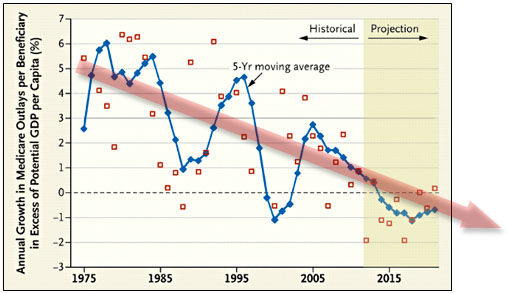
While I would say “too soon to tell” (for me only the post-2005 data points mean very much vis-a-vis the original question), I would not dismiss such reports out of hand.
Robert Shiller’s new book
Three on Launching
1. The excellent Reihan Salam writes, “Tabarrok’s Launching the Innovation Renaissance is my favorite manifesto in years. In a better world, it would be the roadmap for the U.S. center-right.” Small steps towards a much better world, Reihan!
2. A truly Straussian Straussian Reading of Launching the Innovation Renaissance.
3. I will be speaking at Inventing the Future: What’s Next for Patent Reform at AEI in Washington, DC on Wed. March 14, 12:30-2:00.
Some Economics of Pay What You Want Pricing
A number of musicians and game developers have experimented with pay-what-you-want pricing (e.g. see the important field experiment by Gneezy et al. and less formal reports from Radiohead, Norwegian composer Gisle Martens Meyer and the video-game makers 2D Boy and Joost van Dongen.)
Imagine that under the pay-what-you-want model consumers choose to split their consumer-surplus with the seller. Here is a neat little proof for the linear demand case that under this heuristic profits are as large as under monopoly pricing! I have also assumed MC of zero which makes sense for digital goods and is also quite important to the result as pay-what-you-want can result in negative profits should consumers choose to pay less than marginal cost.
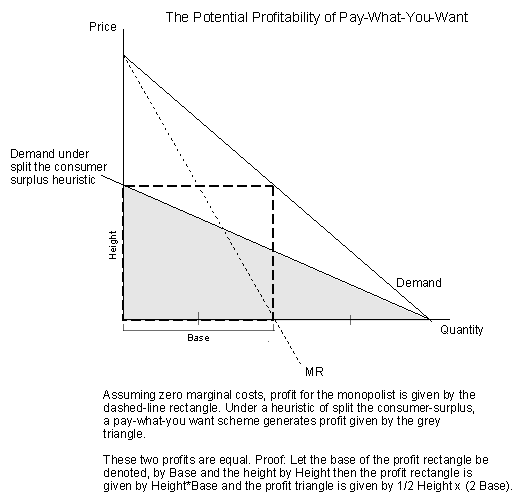
Split the consumer surplus is optimistic for the seller although splitting the gains does happen quite often in the dictator game so it is not without interest. Probably more importantly, pay-what-you-want pricing is going to be advantageous when the seller also sells a complementary good, such as concerts, which benefit from consumption spillovers from the pay-what-you-want good.
Matt’s new book
As I had predicted, it is very good. Most of all I like the suggestion that the economy is becoming more Ricardian with higher resource rents.
I am assuming that most of the United States will not follow Matt’s policy prescriptions, which are unpopular with homeowners to say the least. Which secondary adjustments and rent-seeking losses will result? If you cannot easily live in Manhattan, next to the stylish people, how will you respond? One option is to damn them and tune into NASCAR. Instead you might compete more intensely for their attention and approval. Write a blog. Send them ads. Try to chip away at the privileged status of their attention and capture some of that value for yourself. Either way cultural polarization seems to increase.
For all their other virtues, lower rents also help satisfy the demand for affiliation. I know people who are proud just to live in San Francisco and not only because it signals their income and status. It sounds cool. At what level of zoning is this consumer surplus maximized?
What is the most serious estimate of how much denser agglomeration — boosted by lower rents — would increase productivity? I do not take the urban wage premium as the correct measure here, since at the margin the extra worker currently does not move in. I would like to read a good study of this issue, which I have discussed with Ryan Avent as well.
Is this available improvement a level effect or a rate effect?
If people were the size of ants, without encountering any absurdities of physics or biology, how would the “public choice” of urban building change? Would urban centers be equally exclusionary?
How much space do we need to live? Say you have a 3-D printer nanobox which can produce (or obliterate) any output on demand. Is a studio apartment then enough? Just print out your bed come 11 p.m., or summon up your kitchen equipment before the dinner party. How much of the demand for space is for storage and how much is for other motives? My personal demand for space is highly storage-intensive, but I may be an exception in this regard.
If zoning stays too tight, are there (second best) general negative externalities from storage?
I don’t recall Matt calling for the widespread privatization of government-owned land, but would he agree this is the logical next step? It’s hardly as important as freeing up more urban and suburban building, but is there any good reason for government to own all that turf? I don’t think so. Let’s keep the public works and military facilities and national parks, and sell most of the rest.
Here is Matt’s summary of the book.
The evolution of labor markets, most of all in Spain
Temporary contracts were introduced in a labor reform approved in 1984 by the Socialist government of Felipe González, and they have remained in favor ever since – even more so during times of crisis, such as those currently being seen in Spain, where 93 out of every 100 contracts signed of late have been temporary.
Here is more.
*The Rent is Too Damn High*
The new eBook from Matt Yglesias is out today, I will likely read (and finish!) my copy tonight. Self-recommending, you can get one here.
Democracy, wealth, and local stimulus spending
Paul Krugman asked a good question yesterday: “…if states and localities can borrow freely, how do you explain the drastic fall in their spending I have been documenting?”
This is maybe too literal an answer to address his macroeconomic concerns, but I view state and local government spending as falling because voters wanted it to, either directly or indirectly. Inflation-adjusted net worth per capita is still below the level of the late 1990s, and not returning any time quickly (an important point), and so voters/spenders wanted to cut back somewhere. Local government is the target they chose, and not just in the Red states. My point is not that the median voter is all-wise, but rather the Austerians are the guy next door. Voters apparently don’t see marginal local government activity as having the same value as cash in their pockets. There still may be a role for a federal fiscal bridge to ease the transition, but in democratic systems some expenditure declines are in the cards, just as the rollicking revenues of earlier years led to big boosts in state and local spending. We are not as wealthy as we thought we were, and greater federal borrowing can blunt this reality only to some extent. The notion of a voter ideal point ought to somewhere enter the analysis.
A few months ago I saw a tweet — I forget from whom — noting that the economy would be (would have been) booming if only not for the state and local cutbacks. I differ from that perspective, and I would rephrase it as the (not false) claim that the economy would be booming if only we were wealthier.
I’ve yet to see a good analysis of how freely state and local governments can borrow at the margin, especially in response to a decline in tax revenues. Many bloggers have attacked this piece by John Taylor (pdf), as Taylor argued that the stimulus aid led to a corresponding reduction in state and local borrowing. We still don’t know if this is true, but do we know that it is false? The arguments against Taylor consist of little more than saying he cannot be right. Check out the graph on Taylor’s p.5, noting that inverse correlation is not the same as causality. It’s striking nonetheless, as state and local borrowing goes down as receipts from the federal government go up. Constitutional balanced budget requirements may or may not bind, as many state and local governments can “borrow” quite readily by adjusting contributions to their pension funds, among other moves.
A related question is how voters understand the ability of their state and local governments to spend more by “borrowing” against pension funds, or changing accounting, or in other words what they saw as the opportunity cost of continuing previous levels of public spending at the state and local levels.
My view in 2009 was that federal aid to state and local governments was the one part of the stimulus bill which made sense. It is easier to preserve old jobs than to create new ones. Still, when it comes to analyzing the state and local cutbacks, and the effectiveness of federal aid, we don’t have a lot of clear answers.
Does inequality lead to a financial crisis?
Michael Bordo and Christopher Meissner say basically no (NBER gate):
The recent global crisis has sparked interest in the relationship between income inequality, credit booms, and financial crises. Rajan (2010) and Kumhof and Rancière (2011) propose that rising inequality led to a credit boom and eventually to a financial crisis in the US in the first decade of the 21st century as it did in the 1920s. Data from 14 advanced countries between 1920 and 2000 suggest these are not general relationships. Credit booms heighten the probability of a banking crisis, but we find no evidence that a rise in top income shares leads to credit booms. Instead, low interest rates and economic expansions are the only two robust determinants of credit booms in our data set. Anecdotal evidence from US experience in the 1920s and in the years up to 2007 and from other countries does not support the inequality, credit, crisis nexus. Rather, it points back to a familiar boom-bust pattern of declines in interest rates, strong growth, rising credit, asset price booms and crises.
Here is their earlier paper (pdf, ungated) on whether crises boost inequality.
Apprenticeships v. College
In my post, College has been oversold, I discussed the 40% college dropout rate. In a piece in this week’s Chronicle of Higher Education, Tuning in to the Dropping Out, I reprise some of this material but also discuss high school dropouts and the importance of alternative education paths.
In the 21st century, an astounding 25 percent of American men do not graduate from high school. A big part of the problem is that the United States has paved a single road to knowledge, the road through the classroom. “Sit down, stay quiet, and absorb. Do this for 12 to 16 years,” we tell the students, “and all will be well.” Lots of students, however, crash before they reach the end of the road. Who can blame them? Sit-down learning is not for everyone, perhaps not even for most people. There are many roads to an education.
Consider those offered in Europe. In Germany, 97 percent of students graduate from high school, but only a third of these students go on to college. In the United States, we graduate fewer students from high school, but nearly two-thirds of those we graduate go to college. So are German students poorly educated? Not at all.
Instead of college, German students enter training and apprenticeship programs—many of which begin during high school. By the time they finish, they have had a far better practical education than most American students—equivalent to an American technical degree—and, as a result, they have an easier time entering the work force. Similarly, in Austria, Denmark, Finland, the Netherlands, Norway, and Switzerland, between 40 to 70 percent of students opt for an educational program that combines classroom and workplace learning.
…In the United States, “vocational” programs are often thought of as programs for at-risk students, but that’s because they are taught in high schools with little connection to real workplaces. European programs are typically rigorous because the training is paid for by employers who consider apprentices an important part of their current and future work force. Apprentices are therefore given high-skill technical training that combines theory with practice—and the students are paid! Moreover, instead of isolating teenagers in their own counterculture, apprentice programs introduce teenagers to the adult world and the skills, attitudes, and practices that make for a successful career.
For more see Launching the Innovation Renaissance and–showing the opportunity for consensus on this topic–a recent post on apprenticeships from the Shanker blog.
What is the ECB endgame?
Everyone is happy that bond yields are falling, but what is the next step in the resolution of the crisis? Here is one report from the front, decide for yourself whether it is good or bad news:
Last week 800 banks requested €529.5bn of three-year funding under the European Central Bank’s longer-term refinancing operation, on top of €489bn borrowed in the first tranche of the LTRO in December.
The €1.019tn total is not far shy of the €1.106tn of European bank senior debt due to mature in 2012, 2013 and 2014 combined, according to Goldman Sachs, which said the “extremely high” injection of capital means “European banks are now effectively pre-funded through to 2014”.
Given that the ECB funding costs 1 per cent, compared to yields on senior debt of 3.5 per cent, some believe many banks will simply let much of their senior debt mature…
It would be an exaggeration to claim that the ECB has taken over European capital markets for three years, but you can see where my thoughts are headed. What happens when the three years is up, or as that time approaches? I see a few possible scenarios:
1. Banks recapitalize themselves with sound lending, and at the end of the three years they return to private capital markets by issuing debt. What would the new cost of capital be?
2. European banks continue to hover on the precipice for three years, and as expiration approaches the ECB renews its commitment to fund. (If the ECB funds the banks for six years running, at what point are the banks de facto nationalized? After how many years of ECB funding at one percent is it impossible to return to private markets?)
3. As expiration approaches, no one will be quite sure whether European banks still hover on the precipice, and so the ECB will implicitly signal a willingness to run another three years credit if the private money is not there. That will make the banks less interested in cleaning up and raising the private money. How are banks encouraged to reveal the true state of their market?
4. By the time the three years is up, a lot of these institutions will have been nationalized, if only de facto.
The Eurozone is now in a recession, with further financial shocks likely to come (more Greek problems, Portugal falling into receivership, Irish referendum, French election, slowdown in China, etc.) What is the probability that #1 comes to pass? I say below fifty percent. Just how bad is #2-3? What other options are there? How long would it take for de facto bank nationalization to lower the economic growth rate? How long would it take before re-privatization is an option?
By the way people, we’re exploring the best case options here, they did avert disaster in December! For now.
Addendum: Gavyn Davies expresses further reservations. And Karl Smith comments.
I don’t see the core to this game
Mr Weidmann proposed last week that Germany’s Target 2 claims should be securitised. Just think about this for a second. He demands contingent access to Greek and Spanish property and other assets to a value of €500bn in case the eurozone should collapse. He might as well have suggested sending in the Luftwaffe to solve the eurozone crisis. The proposal is unbelievably extreme.
It also tells us something else: by seeking insurance against a collapse of the euro, the Bundesbank tells us it no longer regards the demise of the euro as a zero-probability event. If the Bundesbank seeks insurance, so should everybody else.
Here is more, from Wolfgang Münchau. Here is another account, Weidmann by the way runs the Bundesbank. As a general rule of thumb, any time you see an article about “Target 2,” it is important.