Category: Food and Drink
Very good sentences
And the edible-insect industry as a whole faces another challenge: government regulations and quality standards do not exist. Peters is working to have bugs officially recognized as livestock. Right now, they are classified as agricultural waste.
Here is more and for the pointer I thank John Wilson.
Markets in everything, Hitler-themed beer edition
For German and Austrian tourists, it would seem, sold from northern Italy. It is also reported that Germans and Austrians are the people who complain the most about the product. Here is a photo. Here is a Google translate on the core article.
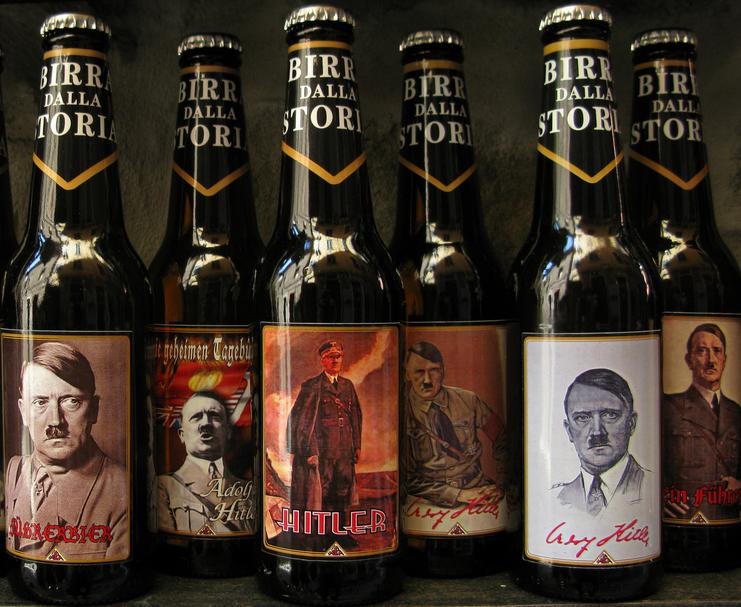
My apologies if this is not real, but as far as I can tell it seems to check out.
For the pointer I thank Daniel B.
You are what you eat?
Here are photographs of refrigerator interiors, in the form of a slide show. Recommended, and don’t forget the descriptive captions on the bottom of each, indicating who owns the refrigerator.
For the pointer I thank Brent Depperschmidt.
How guilty should you feel about eating lamb?
A few days ago this chart made the rounds in the blogosphere. It shows, among other things, that eating lamb is much worse for the environment than is eating beef. A key part of the problem is that a greater percentage of the cow ends up being used for food, compared to the sheep. You therefore might be tempted to apply a heftier carbon tax, or “personal guilt tax,” to the lamb, but not so fast.
To the extent that farmers feed a whole big lamb and get a little squib of meat in return, the price of lamb is already correspondingly higher than the price of beef (where the tripe is sold to Italy, the cheese is sold to Kraft, etc.). Consumers are already internalizing this relative price difference between cows and sheep.
The correct response is to eat less meat of all kinds. It’s not obvious you need to apply a special tax (fiscal or conscience tax) to lamb, above and beyond the general meat tax which is called for.
You may reject a constant returns to scale or proportionality assumption and view the proper tax as a fixed mark-up on both beef and lamb. That still will lower the relative price of the costlier item.
In terms of animal welfare, a sheep is probably free range with greater probability than is a cow, which somewhat favors lamb consumption again in relative terms only.

You can make other assumptions and get other results, naturally. Still, in relative terms there is no prima facie presumption against lamb compared to beef.
The economics of the Michelin Guide
Michelin stresses though that when taken together, the maps, guides and digital businesses are profitable. But the losses incurred by the red books have become such a concern that Michelin has turned to outside consultants. Accenture looked last year at three different scenarios for the red books, including outright closure.
The nuclear option was quickly rejected, partly in recognition of the undoubted brand value of the guide but also because of the political impossibility in France of such drastic action. However, Accenture warned that to carry on with things as they are today would mean yearly losses at the guide hitting €19m by 2015, representing a cumulative loss of €70m over the next four years.
The thinking seems to be that Michelin would do well to seek a share of the good fortune that its awards bestow on restaurants, possibly by creating a “red book” website that provides paid-for links for those establishments with Michelin stars and allows users to make online reservations.
Here is more.
Good thing he didn’t ask Alex to explain the Solow growth model (in French)
He asked an Air Canada fight attendant for 7Up and he got Sprite.
“I’m a little bit disappointed with the lower amount awarded,” Thibodeau said. “But the positive note is that the court recognized our rights were violated on several occasions.”
…So, in 2009, when Thibodeau ordered a 7Up in French, and the English-speaking attendant brought him a — gasp! — different brand of lemon-lime soda, he sued.
“If I take a flight and I’m not served in the language of my choice, and I don’t do anything about it, then my right is basically dead,” Thibodeau told The Globe and Mail. “I was not asking for anything other than what I was already entitled to. I have a right to be served in French.”
It’s a right that Thibodeau — who is a federal employee and happens to speak perfect English — takes very, very seriously.
The full story is here. I suppose one could make a living this way. Which are the French questions most likely to be misunderstood by an English-speaking Canadian? From another article:
It is Thibodeau’s second successful legal action against the airline and its subsidiaries. In 2000, he was refused service in French when he tried to order a 7Up from a unilingual English flight attendant on an Air Ontario flight from Montreal to Ottawa.
Thibodeau filed suit in Federal Court for $525,000 in damages. The court upheld his complaint, ordered the airline to make a formal apology and pay him $5,375.95. Thibodeau was later honoured by the French-language rights group, Imperatif Francais.
For the pointers I thank Graham Rowe. Alex and I explain the Solow growth model — in English — here. Chinese, Spanish, and other editions are on the way.
Thwarted markets in everything
A New York City pet store that’s surrounded by bars has banned drunken puppy-buying.
Workers at Le Petite Puppy in Greenwich Village say customers tend to stumble in after happy hour and purchase a dog without thinking. Drunken customers now are forbidden to even hold the puppies, because they can drop them.
Store owner Dana Rich tells WINS-AM that she instructs people who have clearly been drinking to come back the next day.
Employees say they stress how much work it is to own a dog. They say they would rather lose a sale than send a puppy into an unsafe home.
For the pointer I thank Daniel Lippman.
Markets in everything the frog juice story culture that is Peru
Follow it here, with photos when you click through.
It is from MagsMag, a new and very interesting on-line periodical.
Elsewhere, Justin Wolfers is now on Twitter. And here is Scott Sumner on what happened in 1937-38.
Netherlands fact of the day
Take the case of the Netherlands. Unbeknown to most people, it is world’s third largest agricultural exporter, despite having little land (it has the world’s fifth highest population density). This has been possible because the Dutch have “industrialised” agriculture by, for example, deploying hydroponic agriculture (growing plants in water) that uses computer-controlled feeding of high-quality chemicals—something that would not have been possible if the Netherlands did not have some of the world’s most advanced chemical and electronics industries.
That is from Ha-Joon Chang, via Matt Yglesias. Here is the list of largest exporters.
Department of Uh-Oh
The Taichung branch of Taiwan High Court on Tuesday sentenced a blogger who wrote that a restaurant’s beef noodles were too salty to 30 days in detention and two years of probation and ordered her to pay NT$200,000 in compensation to the restaurant.
The link is here — interesting throughout — and I thank several MR readers for the pointer.
Sorted Turkish links
1. What’s up, and a Business Week survey.
2. Brain surgery in Turkey 5000 years ago.
3. Turkish problems with trade deficits and credit creation.
4. Why Turkey is backsliding on women’s rights.
5. What is the future of press freedom?
One possible take on the current situation is that Turkish liberties are eroding in a dangerous manner and the country will slide into some version of an Islamic state, through not-fully-democratic means yet sanctioned by the ballot box. A second take is that the liberties were not quite ever there in the first place, and Turkish society is moving to a more coherent and more sustainable equilibrium of state, religion, and citizen. Islam in Turkey is finding a way toward a more comfortable public space, albeit with bumps and mistakes along the way, and lasting radical secularization was never possible anyway. The rising middle class and Turkey’s historic uniqueness, and separation from the Persian and Arab worlds, will keep it on a “good enough” track. I incline toward the second and more optimistic view.
Central Turkey is more economically advanced than I had expected. It is downright nice here, and standards of living are reasonably high. Imagine the per capita income of Mexico or Brazil but with greater equality and stronger social cohesion. Food is even better than in Istanbul, namely it is spicier and has fresher raw ingredients.
Turkey will prove to be an important test case for whether a rapid influx of foreign capital can be done in a stable manner. It’s funny how a lot of the same economists who distrust a rapid capital influx in an international development context (“the hot money comes and goes”) are entirely happy to trust a rapid influx of capital into U.S. Treasury securities.
Yana requests a Moab food bleg
She is there for a few days, and would like to know where to eat. She has very good taste in food, too.
Not From the Onion
The headline says it all:
House keeps farm subsidies, cuts food aid
Here are some of the other provisions which seem designed just to be ridiculed by Jon Stewart:
Directs the Agriculture Department to rewrite rules it issued in January meant to make school meals healthier. Republicans say the new rules, the first major overhaul of school lunches in 15 years, are too costly.
Forces USDA to report to Congress every time officials travel to promote the department’s “Know Your Farmer, Know Your Food” program, which supports locally grown food, and discourages the department from giving research grants to support local food systems. Large agribusiness has been critical of the department’s focus on these smaller food producers.
Prevents USDA from moving forward with new rules that would make it easier for smaller farmers and ranchers to sue large livestock companies on antitrust grounds. The proposed rules are meant to address the growing concentration of corporate power in agriculture.
Delays for more than a year new rules for reporting trades in derivatives, the complex financial instruments blamed for helping precipitate the 2008 financial crisis. A Republican amendment adopted Thursday would require the Commodity Futures Trading Commission, which funded in the bill, to first have other rules in place to facilitate its collection of derivatives market data.
Prevents the FDA from approving genetically modified salmon for human consumption, a decision set for later this year.
Questions the scope of Obama administration initiatives to put calories on menus and limit the marketing of unhealthy foods to children.
Don’t get me wrong, I’d probably do away with a number of these rules as well. But anyone who argues against making school meals healthier because it’s too expensive at the same time as they vote for keeping billions of dollars in farm subsidies is not concerned about expenses. What unites the bill is not ideology but protection of agribusiness.
Perhaps the most outrageous provision was one the good guys won:
Critics of farm subsidies did score one victory: The House voted to block a $147 million annual payment to Brazil’s cotton industry. The United States agreed to make that payment last year after Brazil’s industry complained to the World Trade Organization that Washington unfairly was subsidizing U.S. cotton farmers. The United States lost the WTO case and agreed to make the payments to Brazil as a settlement.
So not only have we been subsidizing cotton farmers but we have been paying Brazil to allow us to keep subsidizing cotton farmers. Incredible. I wonder whether this provision will make it into the final bill.
Your Favorite Things Jerusalem
Next week I will be in Jerusalem for a conference. It’s my first trip to the holy city so I shall be well occupied with the “top-ten” but any recommendations for restaurants or sites that I would otherwise miss are very welcome.
The culture that is Taco Bell (cheap chalupas edition)
This article is superb throughout, here is one excerpt:
Every Taco Bell, McDonald’s (MCD), Wendy’s (WEN), and Burger King is a little factory, with a manager who oversees three dozen workers, devises schedules and shifts, keeps track of inventory and the supply chain, supervises an assembly line churning out a quality-controlled, high-volume product, and takes in revenue of $1 million to $3 million a year, all with customers who show up at the front end of the factory at all hours of the day to buy the product. Taco Bell Chief Executive Officer Greg Creed, a veteran of the detergents and personal products division of Unilever (UL), puts it this way: “I think at Unilever, we had five factories. Well, at Taco Bell today I’ve got 6,000 factories, many of them running 24 hours a day.”
…When I take my place on the line and start to prepare burritos, tacos, and chalupas—they won’t let me near a Crunchwrap Supreme—it is immediately clear that this has been engineered to make the process as simple as possible. The real challenge is the wrapping. Taco Bell once had 13 different wrappers for its products. That has been cut to six by labeling the corners of each wrapper differently. The paper, designed to slide off a stack in single sheets, has to be angled with the name of the item being made at the upper corner. The tortilla is placed in the middle of the paper and the item assembled from there until you fold the whole thing up in the wrapping expediting area next to the grill. “We had so many wrappers before, half a dozen stickers; it was all costing us seconds,” says Harkins. In repeated attempts, I never get the proper item name into the proper place. And my burritos just do not hold together.
With me on the line are Carmen Franco, 60, and Ricardo Alvarez, 36. The best Food Champions can prepare about 100 burritos, tacos, chalupas, and gorditas in less than half an hour, and they have the 78-item menu memorized. Franco and Alvarez are a precise and frighteningly fast team. Ten orders at a time are displayed on a screen above the line, five drive-thrus and five walk-ins. Franco is a blur of motion as she slips out wrapping paper and tortillas, stirs, scoops, and taps, then slides the items down the line while looking up at the screen. The top Food Champions have an ability to scan through the next five orders and identify those that require more preparation steps, such as Grilled Stuffed Burritos and Crunchwrap Supremes, and set those up before returning to simpler tacos and burritos. When Alvarez is bogged down, Franco slips around him and slides Crunchwrap Supremes into their boxes. For this adroit time management and manual dexterity, Taco Bell starts its workers at $8.50 an hour, $1.25 more than minimum wage.