Category: Food and Drink
New html edition of my ethnic dining guide is up
Google to my home page and scroll down to the bottom. If you follow the blog version of the guide (on Twitter), you won't find anything new here, but if you wish this way you can print the whole thing out.
How to eat well anywhere in Mexico
You'll sometimes hear fallacious claims that San Miguel Allende or Guanajuato or other parts of Mexico don't have superb food. What is true, in many Mexican cities, is that almost every place near the main square is only so-so. Here's what to do:
1. Look for time-specific food. In San Miguel for instance, there is barbacoa [barbecue] from 8-10 a.m., carnitas from about 11-4, and wonderful chorizo after 8 p.m. In Mexico, if the food is available only part of the day, it's almost always good. It's for locals and there is no storage in these places so it's also extremely fresh.
2. Often the best meals are served in places which have no names. In San Miguel the "brothers Bautista" run the best carnitas stands, but there is no sign and no marking. The stands are simply there on the side of the road, with some plastic tables and chairs, at a few places around town. Everyone in town knows about them.
3. Ask around with taxi drivers and be persistent. Ask the older taxi drivers. Throw away your guidebook, no matter which one you have.
4. Use breakfast and lunch for your best meals; dinner is an afterthought. Almost everywhere good is closed by 8 p.m. or often long before then. Always visit a place that closes by 1 p.m.
5. Roadside restaurants, on the edges of towns or between towns, serve some of the best food in Mexico or anyhere else for that matter. Some of these restaurants even have names, though you can overlook that in the interests of eating well.
Querétaro notes
Enchiladas and crepes are especially common here, often with potatoes. The best meal cost one dollar and was bought on the sidewalk from a crouching elderly woman (for all the talk about "street food," often "sidewalk food" is where it's at). It was potato, nopalitos (cactus), finely ground white cheese, and a potent chile sauce on top of a fried blue corn tortilla.
At the local Arabic-Mexican restaurant, ten chalupas can be had for $2.10.
In Mexico never eat until you are full, because you will likely encounter something even better along your way. What is hard is not finding the food but rather enforcing the optimal stopping rule.
If you are trying to argue that Mexico is a "normal" country, this city is your Exhibit A.
The much-vaunted decline in the Mexican birth rate is somehow not in evidence here; perhaps that is an artifact of who visits the Christmas displays. Plenty of police are out with guns, as a signal to deter a potential drug gang invasion.
The aquaduct has 74 arches, some as high as 30 meters; opened in 1738, it was in its day considered the greatest engineering achievement of New Spain.
As Yana notes, on the streets you will see many examples of perfect competition.
Women and alcohol
Is there a better blog post title? Here is the abstract of a new paper, "Women or Wine, Monogamy and Alcohol":
Intriguingly, across the world the main social groups which practice polygyny do not consume alcohol. We investigate whether there is a correlation between alcohol consumption and polygynous/monogamous arrangements, both over time and across cultures. Historically, we find a correlation between the shift from polygyny to monogamy and the growth of alcohol consumption. Cross-culturally we also find that monogamous societies consume more alcohol than polygynous societies in the preindustrial world. We provide a series of possible explanations to explain the positive correlation between monogamy and alcohol consumption over time and across societies.
That's by Mara Squicciarini and Jo Swinnen.
Kalamazoo beer exchange
Depending on what customers purchase, the prices will rise or fall.
“It’s an ever-evolving happy hour,” Flora said.
The prices will never go higher than around 10 percent the base cost, but will drop to as much as 50 percent below base cost.
For example, a Bell’s Two-Hearted Ale may be $3 normally.
But, depending on the “market” activity (i.e. patrons buying tendencies) it could be as much as $3.25 or as little as $1.50 (prices fluctuate in increments of 25 cents).
The prices will change every 15 minutes and there will be, at random, a “stock market crash” – signified by air horns – when all 28 beers are sold at a low rate for five minutes.
The full story is here and I thank Dave Kirsammer for the pointer.
Here is a picture of Kalamazoo.
China robot hotpot fact of the day what happened to the Ricardo effect?
Service with a smile also comes with an electronic voice at the Dalu Robot restaurant, where the hotpot meals are not as famous yet as the staff who never lose their patience and never take tips.
The restaurant, which opened this month in Jinan in northern Shandong province, is touted as China's first robot hotpot eatery where robots resembling Star Wars droids circle the room carrying trays of food in a conveyor belt-like system.
More than a dozen robots operate in the restaurant as entertainers, servers, greeters and receptionists. Each robot has a motion sensor that tells it to stop when someone is in its path so customers can reach for dishes they want.
The full story is here and for the pointer I thank Daniel Lippman.
Wishing Happy Holidays to All Our Readers
*Kosher Nation*
The author is Sue Fishkoff and the subtitle is Why More and More of America's Food Answers to a Higher Authority. This late arrival is one of my favorite non-fiction books of the year, superb both on its topic and on the history and economics of certification more generally. Here is one excerpt:
"If they want to sell their product in the United States and they are not kosher, no one will buy it," points out Menachem Lubinsky. "Coca-Cola won't buy it, Kellogg's won't buy it. They'll be cut out of the market. If you're in China or Thailand and you want to export, you have absolutely no choice but to seek out kosher certification." Some companies get certification to fill one order from a U.S.-based manufacturer and then drop it when the order is complete, only to reapply when the next order comes in.
Definitely recommended.
Querétaro, San Miguel Allende, and Guanajuato bleg
You know the deal: don't neglect the dining suggestions, or the possible day trips, and I thank you all in advance for the pointers. A high percentage of them end up being used!
Politics and the market
Mr. Mendelsohn has worked with Michelle Obama extensively on her anti-obesity campaign. But that didn’t stop him from starting a Capitol Hill-area burger spot, Good Stuff Eatery, and We, The Pizza, which opened four months ago.
…the area surrounding the Capitol is awash in milkshakes, grilled cheese sandwiches and mildly baroque pizza.
Britain fact of the day
In 1960, the British drank 3.6 pints of wine per head per year; by 1971 they drank 7 pints, by 1973 9 pints, by 1975 11 pints and by 1980 almost 20 pints. One obvious reason was that it was cheaper than ever, with the duty having been slashed when Britain joined the EEC; another was that people picked up the taste on holiday; a third was that wines were advertised more successfully, being associated with glamour, luxury, and ambition, and aimed particularly at young women.
That is from Dominic Sandbrook's excellent State of Emergency, The Way We Were: Britain, 1970-1974.
China fish fact of the day
Currently the world's wild [fish] catch measures 170 billion pounds — the equivalent in weight to the entire human population of China, scooped up and sliced, sauteed, poached, baked and deep-fried, year in and year out, every single year. This is a lot of fish — six times greater than the amount of fish we took from the ocean half a century ago.
That is from Paul Greenberg's Four Fish: The Future of the Last Wild Food.
Adventures in El Salvador
Tyler, Garett Jones and I visited El Salvador for a few days, just for fun. Here is a travelogue of some of our adventures.
The moment we exit customs Tyler grabs a driver and starts speaking in rapid Spanish. Neither Garett nor I are fluent but we are laughing because we know exactly what 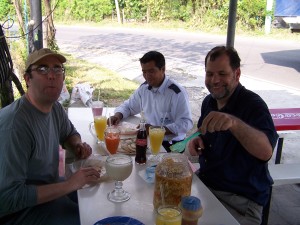 Tyler is saying. Tyler wants pupusas and not pupasas turÃsticos but estilo familiar. The driver understands as well so we jump into his van and he brings us to a pueblo with about 8 or 9 pupuserÃas in direct competition–we learn later that this is the town speciality. We get Pupusas de chicharrones, queso and lorocco, a herb that is hard to find in the United States. Bien Gusto. Tyler is sated so we continue on to Suchitoto, the small colonial town that will be our base of operations.
The next day we take a boat tour of Lake Suchitlan, an artificial lake nestled among hills and volcanoes. We ask our guide  to take us to a local village–it’s an unusual request but we are the only tourists in town so why not.
We climb a long hill, it’s blazing hot but we have a look around, get a drink and having seen all there is to see start to head back down to the boat. That’s when we hear the sirens and gunshots–other people hear it as well and stop walking. Only now do I remember the advice from Apocalypse Now, “Never get out of the boat!”
Tyler asks the guide what is going on. He isn’t sure either but he asks a local and tells Tyler it’s “the running.” Tyler is puzzled and looks as confused as I am–this is not a good sign–the word has many meanings, it could be the running of the bulls, the running of the race, the running? Well it seems not to be gunshots so I joke to Tyler that it would be awesome if it were the running of the bulls.
Not 15 seconds later I turn around and I am confronted with an angry bull bearing down on me. It looks like this:

Tyler, Garett and I jump out of the way. What the hell is going on?! With a second or two to recover, I realize the bull is being driven by a gaucho. The bull is snorting and none too happy, the sirens and shots are making it skittish, but the guacho slaps it hard, gets it under control and then, as if in a dream, the gaucho and bull vanish around the corner. We breathe a sigh of relief.
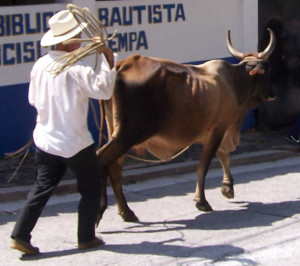
The running of the bull–as Tyler, Garett and I have coined the event–however, was not the running.
It was at about this time that things started to get a little surreal.
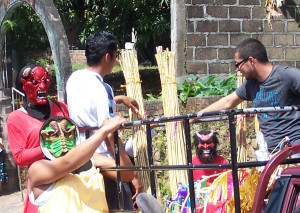
 The sirens are approaching, the “gunshots” are getting louder and we see a strangely dressed man coming up the hill towards us. He appears to be tall, very tall, wait…am I in a Fellini movie?
The man is on stilts and is accompanied by a coterie of devils.
As the group passes, we are handed a handsome annual report with pictures of the mayor and the year’s accomplishments. Ah, this is fiscal policy! Now we understand.
We head back to the boat, pleased with our luck and well satisfied with the day’s events. 
Addendum: If you go here are few practical things to bear in mind. El Salvador is not geared towards tourists–this has positive and negative aspects. On the positive side you can believe the prices you are quoted, there is not yet a “take the tourist for all they are worth” culture. On the negative side, there isn’t much to buy. There aren’t many indigenous people and, in part because there isn’t a tourist market, there isn’t a strong artisinal culture, as there is in say Guatemala. There are a few Mayan ruins but nothing as extensive as in Guatemala or Mexico. Few people speak English, even at hotels and restaurants. The pupasas are great but the food variety is limited. We were perfectly happy exploring for two days but this is one of the less exotic countries of Central America.
(By the way, do you see the devil at right, so oddly framed between the bars of the truck. Why is he looking at me this way?)
 We stayed in Suchitoto at a small (6-8 room) hotel called Los Almendros de San Lorenzo. It’s run by a former El Savadorean diplomat who lived 30 years abroad and his partner, an interior decorator. Highly luxurious and recommended but anomalous, don’t take this as representing Suchitoto.
El Salvador has a very high murder rate, more than 10 times the US rate. Suchitoto, however, is safe and San Salvador seems fine for walking around in the main sections although every shop with anything of value has a guy with a shotgun standing outside.
On the way back from the village after the boat ride we were going to take the bus back into town. We asked some locales where the bus stop was and they volunteered to give us a ride in the back of their truck. Here’s a nice photo of Tyler (taken by Garett) as we traveled the bumpy road back into town. I believe we discussed Mundell and optimum currency areas.

Barter markets in everything, bring your own restaurant
On a recent evening, an abandoned gas station with a curb blocked by cement barriers is the meeting point for a group of people who appear to be pulling chairs and tables from the trunks of their cars. It's almost dark. Some boxes are set on the sidewalk; linens and dishes and food are pulled out and what moments ago was an eyesore has been transformed into a popular place to eat. It's called BYOR. That stands for "bring your own restaurant." It's not quite an established venue, but the food is very good.
It's free to those who share. And the ambiance is unexpected as the outdoor location keeps changing. People learn where BYOR is going to be via Facebook. In the mild weather it's "open" every other weekend. No reservations required: just an appetite and some extra chairs if you have them.
What should you infer about Holyoke, the locale of this practice? The full story is here and I thank Anastasia for the pointer.
And from China, here is a vending machine for live crabs.
Ahem
I'll go back to my sourdough after all:
The popular image may be of Stone Age people gnawing on a chunk of woolly mammoth, but new research indicates their diet may have been more balanced after all.
Many researchers had assumed people living in Europe thousands of years ago ate mainly meat because of bones left behind, and little evidence of plant food.
Now, new findings indicate grains were part of the diet at ancient sites in Italy, Russia and the Czech Republic, researchers report in Tuesday's edition of Proceedings of the National Academy of Sciences.