Category: Travel
Which are the least bohemian cities?
Johan Almenberg writes to me:
I have a blog request: a list of the top ten least bohemian cities in the world. Why are some cities more conducive to bohemian lifestyles than others? Does rent control result in more or less of this? I would love to read your thoughts and hopefully so would other people.
Writing this from rent-controlled Stockholm which I believe deserves a place on the top ten.
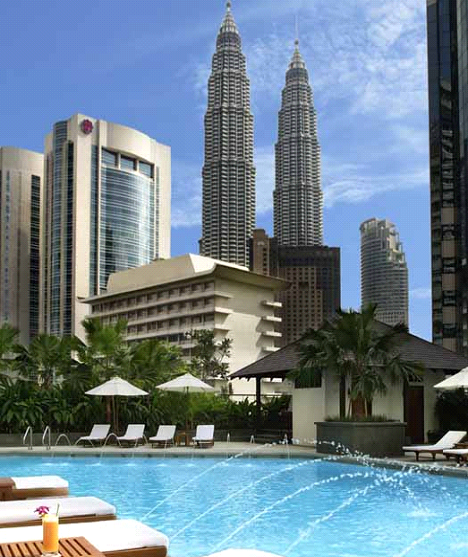
I won't give him ten, but how about Kuala Lumpur as the world's most non-bohemian city, counting the free world only? (Otherwise Pyongyang wins.) It doesn't have much to do with rent control. Dubai is an interesting choice but I don't think it counts as part of the free world. Santiago, Chile does not strike me as very bohemian. Better not nominate Prague!


In the United States, I would name San Antonio as the most non-bohemian major city, or maybe El Paso, with Atlanta as a runner-up. Might there be somewhere very non-Bohemian in northern Florida? Does Richard Florida have an index for this somewhere?
What are your picks?
*Lost*: commentary on the final episode
Most of all, it reminded me of Jacob's Ladder and especially Michael Powell's Stairway to Heaven (A Matter of Life and Death), two movies worth rewatching in any case. The final scene, while the credits roll, is simply that of a plane crash with no survivors. I view the show's cosmology as reflecting the existence of all possible universes and we get to see, and live with, a few of them. That includes the universe where they all die in the initial crash, the universe where they all die in the hydrogen bomb explosion, the universe where the hydrogen bomb creates an alternative reality, the universe where there really is a miraculously surviving "Oceanic Six," the universe where the main island narrative happens, the universe where it is all a dream of Jack's, and bits of others as well. This Leibnizian move "explains" the show's numerous unanswered questions, such as those about the lottery numbers and many more. It was possible, so it happened, toss in the anthropic principles as well.
The most striking moment of the final episode was when Locke tells Jack, quite sincerely, that he does not in fact have a son. The question remains how the different universes fit together or interact and in some manner it seems they do. The final episode is extremely effective in bringing out the dreamy and speculative tones of many of the previous episodes.
Most of all I viewed the ending as tragic. It was not mainly about any particular account of the metaphysics of the island. It was about how few couples had the chance to actually live together, love together, and stay together. The perfect reunions of the couples in the "we're all dead" scenario only drove this point home. I found this contrast moving.
At the end, the door is left open for Jack (the body of Jack?) to become the next smoke monster on the island and you can spot some clues to this effect, such as Jack's body being strewn on the stones in the same manner as it was for The Man in Black.
I saw two major weaknesses in the denouement. First, Widmore is dispatched too summarily in the penultimate episode. That thread of the story is not so much hanging (which would have been OK), but rendered irrelevant. Years of dramatic gravitas were swept away in a single, hastily executed murder scene. Second, Ben is a weak and poorly defined character in the final episode and runs around like a puppy dog, with no clear moral stance. Since he usually dominates any scene he is in, this is strikingly incongruous.
Overall I thought it was the best final episode of a series I have seen, with close competition from The Sopranos.
Markets in everything
British actor John Cleese of Monty Python fame opted for a daylong cab ride halfway across Europe after the dust plume from an Icelandic volcano left him stranded.
Cleese paid $5,100 for a Mercedes taxi Friday from the Norwegian capital, Oslo, to Brussels, said Kjetil Kristoffersen, managing director of Publicom, his agent in Norway. Cleese was in Oslo to appear on the talk show Skavlan.
The article is here. Cleese and Monty Python, of course, were the original inspiration for the MR "Markets in Everything" series.
Markets in everything?
London minicab company Addison Lee said it had received requests to take passengers to cities as far away as Paris, Milan and Zurich.
(But did they fill them?) Here is more. Suddenly they are saying they don't really know when this will end…
Addendum: Here is one pessimistic view, I do not vouch for it. Read this too.
Temporary Marriage in Shiite Islam
ON A DUSTY MORNING in the holy city of Qom, I went looking for a shrine in a walled cemetery of martyrs known as Sheikhan. The graveyard's walls are lined with glass cases containing the framed photos of soldiers felled by the Iran-Iraq war. The shrine, I'd been told, is a hangout for women seeking temporary marriage, an intriguing mechanism in Shiite Islam for relieving sexual frustration. In the Islamic Republic of Iran, sex outside of marriage is a crime, punishable by up to 100 lashes or, in the case of adultery, death by stoning. Yet the purpose of a temporary marriage is clear from its name in Arabic–mut'a, pleasure. A man and a woman may contract a mut'a for a finite period of time–from minutes to 99 years or more–and for a specific amount, mehr in Farsi, which the man owes the woman.
Interesting throughout, from Mother Jones.
Where should you wish to visit in a hurry?
Here is the reader request:
A friend remarked that on his trip to Cuba, the inclusion of modern buses imported from China had started to erode the charm of the vintage car culture we associate with the island. This is one factor, among many (including the possibility of the embargo being stopped), that made her travel to the island before it changed too much.
What other countries (or cities) are undergoing signficant change and will be presumably very different in a few years from now? Which ones would you travel to if you had the chance now before they underwent that change?
Here is my list of places to visit in a hurry:
1. Cuba
2. Bali, Laos, and Cambodia, which are all losing traditional culture.
3. Any wildlife or game reserve.
4. Yemen (maybe too late already?)
5. Tibet and possibly Bhutan
I can't bring myself to put North Korea on that list.
Here is my list of places which will only get better to visit:
1. China (air pollution will diminish, reading MR might become easier)
2. India (pollution will diminish, sanitation will improve)
3. Greece (someday will be cheaper)
4. Canada, New Zealand, and Australia: they don't have much old stuff anyway and what they do have will be preserved. The U.S., in contrast, was interesting in the 1950s (or the 1920s) in a way these places were not and many aspects of that period are being lost.
What suggestions do you have? Iraq definitely belongs to one list or the other, we just don't know which.
The strangest sentence John de Palma read yesterday
"(…)Tourists at the Koorana Saltwater Crocodile Farm in Coowonga, Queensland, Australia, including 62 males and 41 females, aged 18–66 (M = 34.2, SD = 13.3), were randomly assigned to play a laptop-simulated Electronic Gaming Machine (EGM) either: (1) prior to entry, or (2) after having held a 1-m saltwater-crocodile(…)"
The link and explanation, if you could call it that, is here.
Sentences to ponder
The study, published in the journal Applied Research in Quality of Life, showed that the largest boost in happiness comes from the simple act of planning a vacation. In the study, the effect of vacation anticipation boosted happiness for eight weeks.
There is more information here.
How to fall six miles and survive
I found this article fascinating throughout, here is one excerpt:
Granted, the odds of surviving a 6-mile plummet are extraÂordinarily slim, but at this point you’ve got nothing to lose by understanding your situation. There are two ways to fall out of a plane. The first is to free-fall, or drop from the sky with absolutely no protection or means of slowing your descent. The second is to become a wreckage rider, a term coined by Massachusetts-based amateur historian Jim Hamilton, who developed the Free Fall Research Page–an online database of nearly every imaginable human plummet. That classification means you have the advantage of being attached to a chunk of the plane. In 1972, Serbian flight attendant Vesna Vulovic was traveling in a DC-9 over Czechoslovakia when it blew up. She fell 33,000 feet, wedged between her seat, a catering trolley, a section of aircraft and the body of another crew member, landing on–then sliding down–a snowy incline before coming to a stop, severely injured but alive.
Surviving a plunge surrounded by a semiprotective cocoon of debris is more common than surviving a pure free-fall, according to Hamilton’s statistics; 31 such confirmed or “plausible” incidents have occurred since the 1940s. Free-fallers constitute a much more exclusive club, with just 13 confirmed or plausible incidents, including perennial Ripley’s Believe It or Not superstar Alan Magee–blown from his B-17 on a 1943 mission over France. The New Jersey airman, more recently the subject of a MythBusters episode, fell 20,000 feet and crashed into a train station; he was subsequently captured by German troops, who were astonished at his survival.
Whether you’re attached to crumpled fuselage or just plain falling, the concept you’ll be most interested in is terminal velocity. As gravity pulls you toward earth, you go faster. But like any moving object, you create drag–more as your speed increases. When downward force equals upward resistance, acceleration stops. You max out.
It's possible to hit the ground (or whatever) at no more than 120 mph or so we are told. The writer offers another tip: don't land on your head.
Hat tip goes to The Browser.
Who are the friendliest people on earth?
Chug points me to this latest survey, and here is the list:
1. Bahrain
2. Canada
3. Australia
4. Thailand
5. Malaysia
6. South Africa
7. Hong Kong
8. Singapore
9. Spain
10. United States
That means friendly to expats, not friendly to each other. You’ll notice that English-speaking or English-fluent countries are overrepresented, plus Thailand (ahem).
Here is a critique of the survey and mostly I concur with the criticisms (sorry Omar). More generally, unless it is a woman seeking marriage, I view “friendliness to expats” as a social strategy, often intended for internal consumption, not necessarily insincere but not reflecting true temperament either. It’s not driven by actual friendliness. By the way, how did Spain ever make it to number nine?
Are the Japanese the most or the least friendly people on earth? “Helpful” isn’t the same as “friendly.” In what country are you most likely to make real friends? Marry a native? Aren’t those two variables inversely related?
“Friendly” is one of the words most likely to arouse my deconstructive suspicions.
How to win in Afghanistan
It's all in this military powerpoint, apparently official. On the positive side they are aware the problem is complex.
Hat tip Chris Coyne at The Austrian Economists.
Time Travel with Doctor Who
When I was a young boy of ten or eleven I lived in a small town in England. I remember eating the black berries on the country lane on my way home from school and I remember my father and I watching Doctor Who. Each week the Doctor would venture into mystery and danger and as the tension rose I would boil with greater and greater excitement until suddenly the Doctor would confront the Cybermen or even worse the Daleks! Just then, of course, the episode would end. Total agony! I could not wait for the week to pass and I was a devil to tuck into bed those nights as I trembled with speculation and trepidation about whether the Doctor would survive.
“My Doctor,” was primarily the fourth, played by Tom Baker. His unique signature was a very long scarf–so enthralled was I that I asked my grandmother to knit me a similar scarf which I then wore everywhere I went… even when I returned to Canada and nobody understood the reference.
Recently I have been watching Doctor Who again, now with David Tennant playing the tenth doctor–the best since Baker in my view.
 Only now, more than a quarter century past my childhood, I have been watching Doctor Who with my son. My eldest is a young boy of ten or eleven and he boils with greater and greater excitement as the Doctor ventures deeper into mystery and danger. He too jumps out of his chair in total agony when an episode ends with a cliffhanger and calming him after such an episode isn’t easy!
In the last episodes of the latest season the Doctor teams up with his old companion, Sarah Jane. The very same Sarah Jane played by the very same actress as accompanied “my Doctor” some thirty years ago–now aged and older just like me. As I watch Doctor Who with my son, just as I watched with my father, I reflect on time and age and how a dream of my childhood has been fulfilled–my living room darkened and flickering with light has transformed and become my own TARDIS…my own time machine.
Cool Japanese Barcodes
Is it America or Europe which is overrated?
Bryan says Europe is overrated and here is one excerpt from a lengthy post:
…almost no one in Europe lives in places as comfortable and convenient as American suburbs: The houses are spacious, the cars are huge, cheap Big Box stores and chain restaurants are nearby, and (to quote South Park) there's "ample parking day or night.
Bryan suggests that American tourists like Europe so much because they are visiting it with U.S. incomes. I am not sure which PPP calculation he is using but I disagree at a more fundamental level. Bryan gives some good reasons why America is better for 37-year-olds with young children, namely lots of living space and easy shopping. But I view much of Western Europe as better for the elderly, if only because it requires less driving and they are more likely to live close to their children and perhaps also they receive more respect. Western Europe is probably better for children too, for reasons related to safety and health care.
My alternative view is that Americans rate European life so highly (in part) because the buildings from previous eras are so striking and attractive. If all of the U.S. looked like U.S. postwar construction, the country would still impress more or less as it does. If all of Europe looked like its postwar construction, Americans would be less likely to admire European policies and political institutions. Yes I know about Lille, and contemporary Spanish architecture, but in reality most Americans would think of Europe as some kind of dump.
Addendum: Megan McArdle comments.
The economics of rural Thailand
I asked her why she did not wear the costume.
"I am part of a new generation, and I do not like it. It is hot and
uncomfortable," she said. But she noted that she might have to because
the chief is considering forcing everyone to wear the costume. "If the
chief orders us, we will do it." The chief of the village, a
52-year-old named Nanta Asung, told me that Thaijun was the only woman
in the village who did not wear traditional dress and that her choice
was unacceptable. "If you are Palaung, you have to wear the costume of
the Palaung," he said while chopping pork for dinner. "This is a must.
A must!"
Asung said they must wear the dress because of tradition, but he
also spoke excitedly about its appeal to tourists and noted that half
of the village's income of $30,000 a year comes from tourism. That
night an Australian family was paying $15 to sleep in his hut. "He is
very worried that visitors will stop coming," my guide, who served as
my interpreter, told me as we left and headed to our own hut.
As we walked across the village, Asung began broadcasting over
loudspeakers: "This is a reminder that all women should wear
traditional dress. Some foreigners just came to complain that some
women were not wearing their costumes." (We quickly returned to explain
to the tribal chief that I was asking questions, not complaining, but,
unsurprisingly, he did not issue a correction over the village
intercom.)
Here is the full story, which is interesting throughout. A debate is raging as to whether it is ethical to visit villages that stacks rings on the necks of their women or elongate their earlobes.