Category: Uncategorized
Wednesday assorted links
1. On ARPA models for science funding and their possible limits.
2. “On this German farm, cows are in charge…” (NYT)
3. Claudia Goldin on the gender pay gap (NYT).
4. Why might the 21st century be the world’s most important century?
5. “A patient with a spinal injury was left waiting in a corridor at Sunshine Hospital for 14 hours on Monday just days after Australia’s leading doctors warned that hospitals across the country were at “breaking point”.” Link here.
My Conversation with Alexander the Grate
Here is the audio and transcript, recorded outside in SW Washington, D.C. And no, that is not a typo, he does call himself “Alexander the Grate,” his real name shall remain a secret. Here is the event summary:
Alexander the Grate has spent 40 years — more than half of his life — living on the streets (and heating grates) of Washington, DC. He prefers the label NFA (No Fixed Address) rather than “homeless,” since in his view we’re all a little bit homeless: even millionaires are just one catastrophe away from losing their mansions. It’s a life that certainly comes with many challenges, but that hasn’t stopped him from enjoying the immense cultural riches of the capital: he and his friends have probably attended more lectures, foreign films, concerts, talks, and tours at local museums than many of its wealthiest denizens. The result is a perspective as unique as the city itself.
Alexander joined Tyler to discuss the little-recognized issue of “toilet insecurity,” how COVID-19 affected his lifestyle, the hierarchy of local shelters, the origins of the cootie game, the difference between being NFA in DC versus other cities, how networking helped him navigate life as a new NFA, how the Capitol Hill Freebie Finders Fellowship got started, why he loves school field trip season, his most memorable freebie food experience, the reason he isn’t enthusiastic about a Universal Basic Income, the economic sword of Damocles he sees hanging over America, how local development is changing DC, his design for a better community shelter, and more.
And:
COWEN: What’s the best food you end up with? Where is it from? What’s an A+ for a food day?
ALEXANDER THE GRATE: You want my classification system?
COWEN: Let’s hear it, absolutely. I’m a foodie, too.
ALEXANDER THE GRATE: Okay, you’re jumping around, too.
COWEN: Yes, this is the point of the podcast. This is the jump-around podcast.
ALEXANDER THE GRATE: Yeah, but let’s consummate one thought at a time. There’s some cool stuff here, fun stuff. Alright, that’s the beginning of the Bums Banquet. For those that are not fully acclimatized, we had a classification system. This is a class A. It hasn’t even been taken out of its wrapper. Class B, maybe there’s one bite — TYO, trim your own. We found some of it still in its wrapper. Double A would be from the hand of the person donating to us. Triple A would still be hot.
COWEN: What’s a D? C–?
ALEXANDER THE GRATE: Only the rats know that. A lot of forks here, but we’ll keep it to the general stuff first. Anyway, after hours, at the picnic tables of the [Library of Congress] Madison Building, that’s where this happened. Eight-foot diameter tables, so we could fit 10 people around there. That was a continuation of the Freebie Finders and the Bums Banquet and all that.
But one more thing about the lunches. We’re an overfed population — the affluent society. Are you really hungry three times a day? It’s a luxury to have that many. When people have to hesitate, “What am I going to eat now?” Truth to tell, I don’t really need it, but it’s become a tradition, a tradition of the affluent. We don’t need to eat as much as we do. It’s more habit than anything.
But the kids, the junior-high kids throwing their lunch away — they didn’t know that at the bottom of the bag, their mamma left a napkin with a stick figure on it, saying, “Hi, hope you’re having a good time in DC. Love, Mom.” Mother’s love comes along with a peanut butter sandwich. But under the napkin is up to $2 in change or bills for drink money, [laughs] so there’s cash left behind there, too.
Alright, let’s back up a few tangents here. Man, you have a lot of things out on the floor here.
COWEN: A lot of things going, balls being juggled.
And:
COWEN: Some economists I know have promoted the idea — it’s called universal basic income, and it’s something like every person would get $10,000, including NFAs. Is this a good idea?
ALEXANDER THE GRATE: Yes, Finland… Okay, save that for that because I’m going to ask you —
COWEN: You can ask me your question now, but also just indicate if you think that’s a good idea, bad idea, in between, and then you ask me yours.
ALEXANDER THE GRATE: Alright, I want to ask you — just the answer. National debt — this was before the multi-trillion-dollar relief bills had been signed into law by the president.
COWEN: Correct.
ALEXANDER THE GRATE: A progressive algorithm, no doubt, but I don’t know if they’ll factor in if it’s the five-year plan for the $5 trillion and they’ll add $1 trillion automatically to this amount. But it’s pushing $30 trillion, which is, what? You can scan this quick — $84,000 for every man, woman, and child in America.
COWEN: So you’re a fiscal conservative?
ALEXANDER THE GRATE: I’m just an observer at this point. The point is, I see this number, and I see a sword of Damocles hanging over the economic head of America. I know a lot of it’s built in, but theoretically, if all this came due catastrophically overnight, do we have a plan?
Recommended, you won’t find many podcast episodes like this one. It is noteworthy that Alexander has a better and bigger vocabulary than the median CWT guest. Also, this is one episode where listening and reading are especially different, due to the ambient sounds, Alexander’s comments on the passing trains, and so on — parts are Beckettesque!
What I’ve been reading
1. Russ Banham, The Fight for Fairfax: Private Citizens and Public Policymaking. A well-informed story of the great men and women who built up Fairfax County, Virginia, including Til Hazel, Sid Dewberry, Earle Williams, Jack Herrity, George Johnson, Dwight Schar, and others. WWNN: “We were never NIMBY!” It is striking how much the key builders were not born as elites.
2. Dan Levy, Maxims for Thinking Analytically: The wisdom of legendary Harvard professor Richard Zeckhauser. How many of us will end up getting books such as this in our honor? If you are curious, Zeckhauser’s three maxims for personal life are: “There are some things you just don’t want to know,” “If you focus on people’s shortcomings, you’ll always be disappointed,” and “Practice asynchronous reciprocity.” Zeckhauser, by the way, was on my dissertation committee.
3. Adeeb Khalid, Central Asia: A New History from the Imperial Conquests to the Present. Could this be the best history of Central Asia? The author takes special care to tie the region to the histories of Russia and China, the author seeming to have a specialization in Russian history, and for me that makes the entire enterprise far more intelligible. Useful for Xinjiang history as well, here is one useful review of the book.
4. Paul Greenhalgh, Ceramic: Art and Civilisation. Picture book! Need I say more? And a big one.
Edward J. Watts, The Eternal Decline and Fall of Rome: The History of a Dangerous Idea. How has the decline of Rome been discussed and analyzed throughout the ages, including by the Romans themselves?
Loyd Grossman, The Artist and the Eternal City: Bernini, Pope Alexander VII, and the Making of Rome. Has all the virtues of a picture book, but the price of a regular book. With the common educated public, Bernini is still probably underrated.
Michael S. Malone, The Big Score: The billion dollar story of Silicon Valley is the new Stripe Press reprint.
Seth David Radwell, American Schism: How the Two Enlightenments Hold the Secrets to Healing Our Nation. This is not a book written for me, but it is nonetheless good to see someone putting forward Enlightenment ideals as a solution to our problems.
Tuesday assorted links
1. ‘We Don’t Need Another Michelangelo’: In Italy, It’s Robots’ Turn to Sculpt — link here (NYT).
2. The ecosystem that is Minnesota: “Goldfish dumped in lakes grow to monstrous size, threatening ecosystems.”
3. Ransomware payment tracker.
4. That was then, this is now. And more (sigh).
6. John Cochrane on a carbon tax and the economics of extraction. Are we just postponing the problem?
7. Mas-Colell update (in Spanish). It seems he is off the hook for the money?
8. Very good Ross Douthat column on the Seven Years’ War (NYT).
Is Haiti Governable Right Now? (at all)
More generally, might there be some countries that simply are not viable nation-states any more, no matter what we do? That is the topic of my latest Bloomberg column, here is one excerpt:
In other words, at the moment there doesn’t seem to be any way to govern Haiti. One problem is that foreign flows of money, whether from the drug trade or from Venezuelan foreign aid, have overwhelmed the domestic incentives to play by the rules. Haiti’s political institutions are mostly consumed by bribes and rents, with no stable center. The news, so to speak, is that such problems do not always have solutions. At all.
It is fine to suggest that Haiti invest in building up its political institutions — but those institutions have been unraveling for decades. I was a frequent visitor to the country in the 1990s, and although the poverty was severe, it was possible to travel with only a modest risk of encountering trouble. Government was largely ineffective, but it did exist.
These days the risk of kidnapping is so high that a visit is unthinkable.
And:
The buildup and rise of nation-states has become so ordinary that the opposite possibility is now neglected: their enduring collapse. It’s not history running in reverse. It’s that modernity has created new forces and incentives — drug money, kidnapping ransoms, payments from foreign powers, and so on — that can be stronger and more alluring than the usual reasons for supporting an internal national political order. If the rest of the world gets rich more quickly than you do, it might have the resources to effectively neutralize your incentives for peace and good government.
So where else might the political order soon unravel? In parts of Afghanistan, external forces (Pakistan, China, Russia, the U.S.) have so much at stake that the conditions there may never settle down. Other risks might be found in small, not yet fully orderly nations such as Guyana, Equatorial Guinea, and Eswatini (formerly Swaziland). El Salvador and Nicaragua seem to be consolidating their political orders, but at the cost of losing fair democratic political competition. The nation-state as we know it might not survive in every part of Nigeria, where the recent surge in kidnappings is striking.
In the Baltics and Taiwan, dangers from larger, aggressive neighbors lurk. In spite of generally good governance in these places, the pressures from outside powers might be too much to bear, reflecting broadly similar destabilizing mechanisms — namely, that the internal rewards for coordinating support for a status quo might not be high enough.
Recommended.
Monday assorted links
1. What is the nature of German discrimination against Muslims?
2. “Our findings indicate that BWCs [body cameras] led to a significant decrease in the dismissal of investigations due to insufficient evidence (“not sustained”) as well as a significant increase in disciplinary actions against police officers (“sustained” outcomes”) with sufficient evidence to sanction their misconduct. We further find that disparities in complaints across racial groups for the “unsustained” category fade away with the implementation of BWCs.” Link here.
3. “I’m a libertarian, so it’s usually obvious to me what’s awful about both parties.” This piece is about the book world. Best Slate article in ages.
4. “…we estimate that physicians lose 17% of Medicaid revenue to billing problems, compared with 5% for Medicare and 3% for commercial payers. Identifying off of physician movers and practices that span state boundaries, we find that physicians respond to billing problems by refusing to accept Medicaid patients in states with more severe billing hurdles. These hurdles are just as quantitatively important as payment rates for explaining variation in physicians’ willing to treat Medicaid patients.” Link here.
*The Art Newspaper*
One complaint I have about the current “Woke” debates is that they don’t consider how diverse the intellectual playing field is. You can learn a good deal from studying the interstices of dialogue that don’t fit into the common boxes of either pro-Woke or anti-Woke.
Along the way, I am happy to recommend The Art Newspaper (NB: non-subscribers can click through three articles a month) as an excellent periodical, both the paper and on-line editions. It is considered the “journal of record for the international art world.”
To put it bluntly, the art world is torn. In terms of demographics, the art world should lean fairly hard left, at least in the Anglo countries. It is highly educated, cosmopolitan, wealthy, and “aware” of the world. And many of the individuals operating in the art world do lean fairly strongly to the left. Yet the art world itself is based on principles fairly different from Woke and often directly opposed to Woke.
First and foremost, the art world is based on ownership of property. Most (by no means all) of those properties were created by dead white males, or perhaps by living white males.
Art markets typically are ruled by Power Laws and massive inequality, with most works going to zero value and a small percentage of the creators hitting it big. No one in those worlds really thinks that is going to change, or should change. Indeed, you earn status by showing how discriminating your eye is, which means by dumping on the works that aren’t going anywhere.
Textiles, which are arguably the “most female” genre in terms of their creators, are worth systematically much less in the marketplace. Sometimes people complain about this, but they are not willing to bid up the prices commensurately. (I am pleased to consider myself an exception in this regard — I see and indeed “exploit” massive aesthetic arbitrage opportunities here. The same is true for some kinds of pottery as well. Buying artworks from talented yet undervalued women creators is one of the best ways to be Woke.)
Art works do not come attached with triggers, and many of them reflect “the gaze” of dead white males, or they are soaked with violence, not usually along politically correct lines. Women (and men) are eroticized without apology. And they are eroticized because of the market. “Reactionary” religions are central to many genres.
The subscribers to The Art Newspaper often are art owners, art collectors, and institutional participants in the art world, such as curators and people who work at auction houses. They might fret over the theft of art works from poorer and typically non-white parts of the world, but actual full-scale restitution is not in fact their #1 programmatic goal. Surprise!
So if you read The Art Newspaper, you will step into an elite world quite unlike say the world of the American Ivies. The performative incentives here are entirely different.
In the 1990s, The Art Newspaper hardly ever ran articles with Woke themes. Today it does a lot, yet the actual content and analysis just isn’t that Woke. You can think of it as a respite from the Woke, though it will never criticize the Woke directly. It tries to incorporate Woke rhetoric into an essentially non-Woke and anti-Woke set of customs and incentives and property rights.
If you look at the top five “most read” articles from this last week in early July, you will find at #2:
“Why are the top jobs in Chinese museums going to white men?”
Maybe you’re getting scared now, but the funny thing is the article actually addresses and answers the question. Basically those are the individuals who have essential contacts in the outside art world and knowledge of how that world works. At the end of the piece the article does call for more Chinese leadership talent (as we all would agree), but along the way no one is brow-beaten and there is remarkably little moralizing. Keep in mind The Art Newspaper is being written exactly for these white men, or those who aspire to become them.
One lesson is that when no one is watching, and when actual property is at stake, the contemporary world is still remarkably sensible.
Just how politically correct do you think this article is?
“…new book on 18th-century French art reveals discrete gradations of erotic images.”
Here is the opening passage:
Most who take an interest in 18th-century French art will know of the Goncourt brothers’ description of “the meanderings, the undulations, the pliancies of a woman’s body” in relation to Watteau, or their ecstatic response to Fragonard’s La Chemise enlevée (around 1770) depicting “a woman… on whose mouth hovers a languid smile, [trying], somewhat faintly, to retain the nightgown that has already been ravished from her body…”
I am not sure Andrea Dworkin would approve. Still, the topic is sufficiently obscure that no one is going to get cancelled for “their ecstatic response to Fragonard.”
Every now and then, The Art Newspaper gets downright sad:
The auction house’s £17.2m [Old Masters] offering in London tonight was only 57% sold, overshadowed by the football match
Are they going to stop calling them “Old Masters”? I don’t think so, not even if the term “Master bedroom” goes away.
The most widely read article of the week was “Archaeologists find ruins of vast Medieval Nubian cathedral in Sudan.” Again, no need to get nervous. They used remote sensing techniques to find the ruins. Good article, good photo, homage to its aesthetic virtues, zero moralizing, zero politics. Not a peep about cultural appropriation or CRT.
Lots of articles cover tax law too! You could say they are a kind of supply-sider, albeit without the revenue maximization idea.
And the editor is a woman, Alison Cole. She even wrote a book Italian Renaissance Courts: Art, Pleasure and Power — do you think she can be totally against those things? 22 Amazon ratings, five star average.
If you love the arts, or simply would like to step into a different intellectual world, I am happy to (strongly) recommend The Art Newspaper. It is also full of practitioner-driven economic reasoning, and fairly objective looks at geopolitics, on top of keeping you current about art worlds. The non-Woke lives.
OK, so what about The Woke and Non-Woke in other areas? Classical music? Stand-up comedy anyone? What else?
Guardianship — the most undercovered issue of our time?
I am glad to see Amanda Morris at the NYT pick up the ball:
But advocates for people with disabilities say guardianships have been used too broadly, including in cases of individuals with psychiatric disorders and developmental or intellectual disabilities who, the advocates say, do not require such intense or continuous oversight.
“I should have never been under guardianship, because I was always independent,” said Mr. King, 38. “Don’t judge me before you get to know me. Everyone needs help sometimes.”
Once a guardianship has been imposed, it can be difficult to undo. Mr. King’s parents, who say they reluctantly sought a guardianship for him in 2003 after being urged to do so by social services workers, attempted to have a judge rescind it in 2007. They say they faced barriers for years, including opposition from a court-appointed lawyer for Mr. King in the case.
“Judges are used to putting people in guardianships; they’re not used to letting them out,” said Jonathan Martinis, a lawyer the family eventually hired. The guardianship was finally revoked in 2016.
And:
About 1.3 million people live under guardianships in America, according to a 2018 estimate from the National Council on Disability. They include older Americans who can no longer manage their affairs, but also many younger people, including some with intellectual or developmental disabilities. Studies suggest that the number of people under such arrangements has more than tripled in the past three decades.
Whatever you think our policies should be, is it not amazing how unwilling we have been to discuss these choices? And how about this?:
Only 14 states require guardians to obtain some sort of credential for the role, with a majority requiring certification from a nonprofit organization called the Center for Guardianship Certification.
Whether you think that number should be zero, fifty, or somewhere in between, how many of you even knew that in the first place? Or heard of the Center for Guardianship Certification?
And do read the story of Jenny Hatch toward the end of the article, this is essential journalism. Some of these cases, while they lack all of the elements of slavery, have some of the essential elements.
1.3 million Americans. What is the chance here that our policies are being optimized?
Sunday assorted links
1. Central bankers and inequality.
2. “To British turfcare experts, European standards remain pitiful.”
3. Pantsdrunk — the culture that is Finnish.
4. Every state’s least favorite state. Florida most dislikes…Florida.
5. Mexican drug lord safe house auction markets in everything.
6. An “immersive entertainment” version of Three-Body Problem?
Straussian Beatles: Baby’s in Black
Here is the song, and yes I know all about Astrid Kirchherr (who often wore black) and the deceased Stu Sutcliffe. The song has yet another meaning, related to the girl chasing of John and Paul, and Liverpool’s longstanding role as a center for English Catholicism, with about half of the population being Catholic in background. Here are some of the lyrics, with commentary from me in brackets, and note I capitalized the “H” for my own purposes:
Oh dear, what can I do?
Baby’s in black and I’m feeling blue [she’s in line to become a nun, and won’t screw me]
Tell me, oh what can I do?She thinks of Him [Jesus, God, etc.]
And so she dresses in black [garb of a nun]
And though he’ll never come back [no second coming!]
She’s dressed in black…[pretty futile this nun thing, isn’t it?]I think of her
But she thinks only of Him
And though it’s only a whim [she doesn’t really believe all that stuff, does she?]
She thinks of HimOh how long will it take
‘Til she sees the mistake she has made?
Dear, what can I do?
Baby’s in black and I’m feeling blue [“blue balls”?]
Tell me, oh what can I do?
One interesting non-lyrical feature of the song is how it features dual melodic lines, one sung by Paul the other by John. As this was 1965, Paul is singing the higher part, as was typically the case in those years. Yet somehow by 1967, John ended up with the much higher vocal parts and Paul the lower. It wasn’t just the helium.
Here is the previous edition of Straussian Beatles.
Saturday assorted links
1. Chad Jones appreciation post, his best papers on growth.
2. Ross Douthat on Catholic stuff.
3. Behavioral economics guide, 2021.
Paul Bloom in The New Yorker on discounting
And also on my Stubborn Attachments, here is part of his discussion:
Cowen, to my mind, glosses over the problem of diminishing returns. Suppose that our prosperity increases a hundredfold. Life would be better, but would our happiness also increase by a multiple of a hundred? After a certain point, it might make sense to worry less about growth. Perhaps the most privileged of us are close to that point now. But these things can be hard to judge. The Babylonian kings might have thought that they were living the best possible lives, not realizing that, in the future, even everyday schmoes would be wiser and more pain-free, living longer, eating better, and travelling more.
I agree with the “everyday schmoes” point, if only because we die at what are still fairly young ages, or may suffer from mental health problems along the way, not to mention pain, as mentioned. But let us say society is at the point where most people live to the possible maximum, mental health problems have been cured, and pain is fixed too. In this unlikely society, human rights would matter much more. If happiness really is broadly fixed, we can welcome the ascent of deontology. One implication of this is that if you fight poverty in poorer countries, you are making some form of Kantianism more true along the way. Think of deontology as a luxury good, or alternatively if everything is doomed to end tomorrow you also should respect rights more, because there are fewer welfare gains from violating them. So I suppose that is a U-shaped function for deontology with respect to wealth, at least if the far left side of the x axis is expressed in drastic enough terms.
Via Barry Brolley.
The Biden Executive Order on promoting competition
Here is the text, I won’t attempt a summary but here are some running comments:
1. The beginning of the piece suggests that concentration is rising in the American economy. But this probably isn’t true. See also these comments by me.
2. Industry concentration has not driven wages down by “as much as 17%” — that’s a porky! OK, they say “advertised wages,” but come on…
3. I am happy to see the document take on occupational licensing.
4. Contra to the recommendation, we should not ban non-compete agreements outright. Many non-compete agreements are perfectly normal institutions designed to protect corporate assets against IP theft, client lists for instance. We should restrict non-compete agreements in some more sophisticated manner, still to be determined.
5. Lower prescription drug prices? Maybe. Do they estimate the elasticity of supply? No. Thus this discussion would fail my Econ 101 class. We do know, however, that prescription drugs are one of the very cheapest ways our health care system saves lives, so this is not obviously a good idea.
6. Right to repair laws? Again, maybe. But show me the trade-off and cite a cost-benefit analysis. If software gives more consumer surplus to consumers (again, a maybe), should we be wanting to tax it with contractual restrictions? Should we be wanting to tax Tesla right now?
7. Portability of bank account information is a good idea.
8. “Empower family farmers…” — do you even need to know what comes next? Aarghh!!!
9. The order “encourages” the DOJ and FTC to take various actions. I won’t blame Biden for this, but we’ve way overstepped what executive orders should be doing, some time ago. The net feeling the honest reader of this section receives is that our antitrust policies toward the large tech companies are not based in much of a notion of rule of law.
10. Should HHS “standardize plan options” in the NHIM to make price shopping easier? Makes me nervous — diverse market offerings can be good.
11. Lots of tired and not typically true claims and insinuations about concentration in airline markets; see my book Big Business or read Gary Leff. And shouldn’t airlines charge for bags? Maybe yes, maybe no, but prices per item are not in general a bad thing.
12. We are warned that farmers and ranchers take in an ever-smaller share of the food dollar spent — thank goodness! And there are a bunch of other selective, scattered observations about food prices (“corn seed prices have gone up as much as 30% annually…”), but nothing close to systematic or showing an actual market failure (corn prices by the way have been plummeting since 2012).
13. Broadband policy should indeed be improved, but this section reads as messy, should do more to emphasize the notion of competition and common carrier platforms, and how about a mention of StarLink?
14. There’s not really any point in marching through a discussion of the “Big Tech” section.
15. Is there a problem with bank concentration in this country? Not where I live. Maybe in some rural areas?
16. YIMBY > NIMBY would do more to limit market power than just about anything else, by the way.
17. Is there even a peep about this country’s biggest and worst-performing monopoly in K-12? Of course not. It is Amazon you have to worry about!
So overall this is not great economics. It is good to see the Biden administration pick up on a few pro-competition issues, but much of the document is not clearly pro-competition either. The reasoning and evidence are pretty much politicized from start to finish.
*Survival of the City: Living and Thriving in an Age of Isolation*
By Edward Glaeser and David Cutler, forthcoming in September (with a CWT with them on the way I might add).
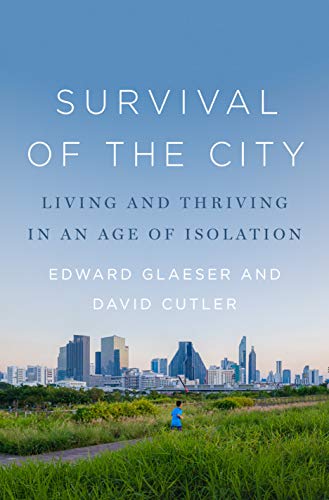 Self-recommending.
Friday assorted links
1. Aljoša Jurinić playing Chopin Etudes Op.25.
2. What many people believe, and act on. How much of it is true?
3. Saudi austerity.
4. Zaila Avant-garde. And here is an excellent short video of her true skills, by her own account.
5. Back to normal: the West’s Cultural Revolution is over.
6. Profile of nature writer Dara McAnulty (NYT).
7. Tyler Cowen and Yaron Brook dialogue on science and progress.