Category: Uncategorized
Thursday assorted links
1. Rent-seeking and the history of institutionalization and mental asylums (co-author Geloso is the new hire for GMU econ this year).
2. Schlegel Twitter is the best Twitter.
3. The satellite data confirmed?
4. Timothy Taylor on rethinking the housing bust.
5. Ivermectin fails in new major study (Fast Grants funded).
My Conversation with Andrew Sullivan
Here is the audio, video, and transcript. Here is part of the overview:
Andrew joined Tyler to discuss the role of the AIDs epidemic in achieving marriage equality, the difficulty of devoutness in everyday life, why public intellectuals often lack courage, how being a gay man helps him access perspectives he otherwise wouldn’t, how drugs influence his ideas, the reasons why he’s a passionate defender of SATs and IQ tests, what Niall Ferguson and Boris Johnson were like as fellow undergraduates, what Americans get wrong about British politics, why so few people share his admiration for Margaret Thatcher, why Bowie was so special, why Airplane! is his favorite movie, what Oakeshottian conservatism offers us today, whether wokeism has a positive influence globally, why he someday hopes to glower at the sea from in the west of Ireland, and more.
And here is one excerpt:
SULLIVAN: Well, and so you get used to real conversations about people, and you don’t mistake credentials for intelligence. You realize that people outside of the system may be more perceptive about what’s going wrong with it than people buried within it. I honestly find life more interesting the more variety of people you get to know and meet. And that means from all sorts of different ways of life.
The good thing about being gay, I will tell you, is that that happens more often than if you’re straight — because it’s a great equalizer. You are more likely to come across someone who really is from a totally different socioeconomic group than you are through sexual and romantic attraction, and indeed the existence of this subterranean world that is taken from every other particular class and structure, than you would if you just grew up in a straight world where you didn’t have to question these things and where your social life was bound up with your work or with your professional peers.
The idea for me of dating someone in my office would be absolutely bizarre, for example. I can’t believe all these straight people that just look around them and say, “Oh, let’s get married.” Whereas gay people have this immense social system that can throw up anybody from any way of life into your social circle.
Interesting throughout. And again, here is Andrew’s new book Out on a Limb: Selected Writing, 1989-2021.
Wednesday assorted links
1. More on the NYT masking in schools Op-ed: it looks pretty bad. It’s really the public health establishment I blame here, not the NYT.
2. “Since the pandemic recession bottomed out in the spring of 2020, the nation’s gross domestic product has more than fully recovered, with second-quarter output 0.8 percent higher than before coronavirus. The number of jobs decreased 4.4 percent in the same span.” (“Model that!”…NYT link)
3. “In general, pornography use trended downward over the pandemic, for both men and women.”
5. Excellent (but tragic) Ethiopia musings.
6. More returns of stolen crypto than you might think.
7. The commies opine on Cuomo and democracy. Not the worst take I have read.
Covid dispatch from a relatively non-Straussian country
Most people will end up contracting the coronavirus, the head of the Health Ministry’s advisory committee for infectious diseases predicted on Monday.
“The [real] question is whether the infected person is vaccinated or not. It’s unavoidable that the pandemic will infect the majority of the population. It won’t disappear in another half a year,” Dr. Tal Brosh told the Kan public broadcaster.
Brosh, who also heads the infectious disease department at Assuta Medical Center in Ashdod, said he doesn’t see a reason to shutter Ben Gurion Airport, arguing that would distract “from the main problem — morbidity within in the country.”
WWAFS? How many of our mainstream public health experts would even consider addressing such a question at this point? Do you think they are telling you the truth?
p.s. Which again is the country with the best data?
Addended p.p.s.: “Between 90% and 94% of British adults have some degree of immunity to coronavirus from full or partial vaccination, or prior infection, the U.K. statistics office estimates, based on statistical analysis of blood samples.”
Here is the full story. Via Rich B.
Tuesday assorted links
1. Your periodic reminder to read Matt Levine (Bloomberg). And Bloomberg Media is doing just great. Congratulations to all those I work with! If you don’t already, you should subscribe too.
2. Space Force reluctant to take over UFO mission.
3. My remarks on the new All Things Must Pass reissue.
4. Interview with Ken Rogoff, focusing on China.
5. I’ve never been anti-mask, in either theory or personal practice, but I find it striking how this NYT Op-Ed, advocating mandatory masking for children in school, upon a close read presents no actual evidence whatsoever. If I understand them correctly, here is “the control”: “By contrast, one school in Israel without a mask mandate or proper social distancing protocols reported an outbreak of Covid-19 involving 153 students and 25 staff members.” Maybe they are just poor writers and bad organizers of thought, and the actual controls are in fact air tight.
Don’t judge Covid conditions by the current rate of Covid growth
These days when I go to Twitter I see so many claims that current caseload or hospitalization numbers (in some not all regions) are approaching their peaks from the third wave last winter.
But don’t be misled by that rhetoric — speed of growth is not at this stage of the pandemic a good metric for evaluation. Obviously, speedy Covid growth is bad news compared to having no Covid at all, but relative to actual constraints inference here is difficult. Even the growth of hospitalizations, much less the growth in cases, is a misleading signal for how well we are doing.
First, there is a diehard core of individuals who just won’t get vaccinated. That is highly unfortunate, but possibly it is better if those individuals get Covid sooner rather than later, at least provided they are not so numerous as to overwhelm the hospital system all at once. The Covid case is in essence their preferred form of vaccination. Stupid, yes, but later is not necessarily better.
A second possibility is that we will see waves of Delta Covid, rising rapidly and then declining rapidly. That seemed to happen in the most badly afflicted parts of India, and maybe has been happening in England and the Netherlands, noting that the English numbers have begun a recent (minor?) uptick again, so we cannot be sure of the dynamics. The general point stands that it is better to get a given amount of Covid over with more quickly rather than less quickly, again subject to the constraint that you do not overwhelm your hospital system. Circa August 2021, we are no longer in the older position of “waiting for the vaccines to arrive.”
A third possibility is that Delta really is extremely contagious and that non-pharmaceutical interventions just aren’t going to succeed in checking it. (Oddly, few elites are willing to mention this possibility. Though they are willing to tell us how terrible it is, which it is!) Yes, boosters may help out, but most of the “cavalry” — vaccines in this case — already has arrived, at least for those willing to take them. OK, so if most people are going to be hit by this thing, and vaccinations do make that event much safer than before, again you want to get that process over with more quickly rather than less quickly. And to the extent vaccine protection decays (an unknown variable but a real worry), speed really is of the essence here. Again, all subject to the “don’t overwhelm your hospital system” caveat.
Clearly there are scenarios where the rapid case growth is a bad thing, even taking relevant constraints into account. For instance, vaccinating younger individuals might be a relevant “cavalry” still to arrive, and maybe it can arrive before most of our young people are exposed to Covid. Or maybe most of the unvaccinated are pretty “elastic” in their status, and a high but not too high case and hospitalization growth will scare them enough to bring them over to the vaccinated side of the ledger. Those really are possibilities.
But rapid growth per se — even on the hospitalization side of the ledger — has to be used with care as an indicator of where we stand. Generating a lot of Covid cases and hospitalizations in a short period of time is a very tricky signal, again relative to the constraints we face. You need to define your counterfactual very carefully, and recognize that the mood affiliations you were promoting earlier in the pandemic may or may not make sense now.
Monday assorted links
1. Politically polarized depositors.
2. The sociability of giraffes (NYT).
3. Emily Oster on different relative risks to children. Recommended.
4. Dalibor on Hungary. And a wee bit more on Hungary on Covid.
5. Without a rational expectations assumption, fiscal policy doesn’t work so well at the lower bound.
The performance of the NIH during the pandemic in 2020
“A new research study by one of us and his Johns Hopkins colleagues found that of the $42 billion the National Institutes of Health spent on research last year, less than 2% went to Covid clinical research…
Here is the WSJ source. Here is the full report from Johns Hopkins, and here is the executive summary:
● Of the $42 Billion 2020 NIH annual budget, 5.7% was spent on
COVID-19 research
● Public health research was underfunded at 0.4% of the 2020 NIH
budget
● Only 1.8% of the 2020 NIH budget was spent on COVID-19 clinical
research
● Average COVID-19 NIH funding cycle was 5 months
● Aging was funded 2.2 times more than COVID-19 research
● By May 1, 2020, 3 months into the pandemic, the NIH spent 0.05%
annual budget on COVID-19 research
● Of the 1419 grants funded by the NIH:
• NO grants on kids and masks specifically
• 58 studies on social determinants of health
• 57 grants on substance abuse
• 107 grants on developing COVID-19 medications
• 43 of the 107 medication grants repurposed existing drugs
Ouch. Here is a not entirely random sentence from the report:
The COVID-19 pandemic has only exacerbated the NIH institutional challenges and inability to reallocate funds quickly to
critical research.
Here is another damning sentence, though it damns someone other than the NIH:
…to date, no research has investigated NIH COVID-19 funding patterns to the best of our knowledge.
Double ouch. Might the NIH have too much influence over the allocation of funds to be investigated properly? Rooftops, people…
Sunday assorted links
1. Video on how Olympians are financed in the U.S.
2. Where are the brick-laying robots?
3. More detail on Iceland. And NHS waiting times may not return to normal until 2025.
4. Interview with Francois Balloux.
5. A contrarian view on regulating crypto, probably wrong.
6. I understand the aesthetic value of constraint, but does “race walk” really make sense as an Olympic sport? (video)
What I’ve been reading
1. Richard Zenith, Pessoa: A Biography. 942 pp. of text, yet interesting throughout. Brings you into Pessoa’s mind and learning to a remarkable degree. (Have I mentioned that the world is slowly realizing that Pessoa’s The Book of Disquiet is one of the great works of the century?) His favorite book was Dickens’s Pickwick Papers, and he very much liked Carlyle’s Sartor Resartus. This biography is also interesting about non-Pessoa topics, such as Durban, South Africa in 1900 (Pessoa did live there for a while). I am pleased to see Pessoa finally receiving the attention he deserves — definitely one of the books of this year. Here is a good review of the book. For a man who never had sex, this book covers his sex life a great deal! And what a short and lovely title, no long subtitle thank goodness.
2. Nicholas Wapshott, Samuelson Friedman: The Battle over the Free Market. Quite a good book, though it is interior to my current knowledge set and thus better for others reader than myself. Contrary to what I have read elsewhere, Wapshott points out that Samuelson did not support Nixon’s wage and price controls, but this LA Times link seems to suggest Samuelson thought they were a good idea?
3. Jamie Mackay, The Invention of Sicily: A Mediterranean History. While it was less conceptual than I might have preferred, this is perhaps the single best general history of Sicily I know of. Short and to the point in a good way.
4. N.J. Higham, The Death of Anglo-Saxon England. In 1066, five different individuals were recognized as de facto King of England — how did that come to pass? Why was Aethelred the Unready not ready? (He was only 12 when he assumed the throne, though much of the actual criticism concerned the later part of his reign.) I find this one of the most intelligible and conceptual treatments of Anglo-Saxon England out there. I don’t care what the Heritage Foundation says, beware Danish involvement in your politics!
Peter Kinzler, Highway Robbery: The Two-Decade Battle to Reform America’s Automobile Insurance System is a useful look at where that debate stands and how it ended up there. Here is a good summary of the book.
It does not make sense for me to read Emily Oster’s The Family Firm: A Data-Driven Guide to Better Decision-Making in the Early School Years, but it is very likely more reliable information than you are likely to get from other sources.
Iceland and Covid
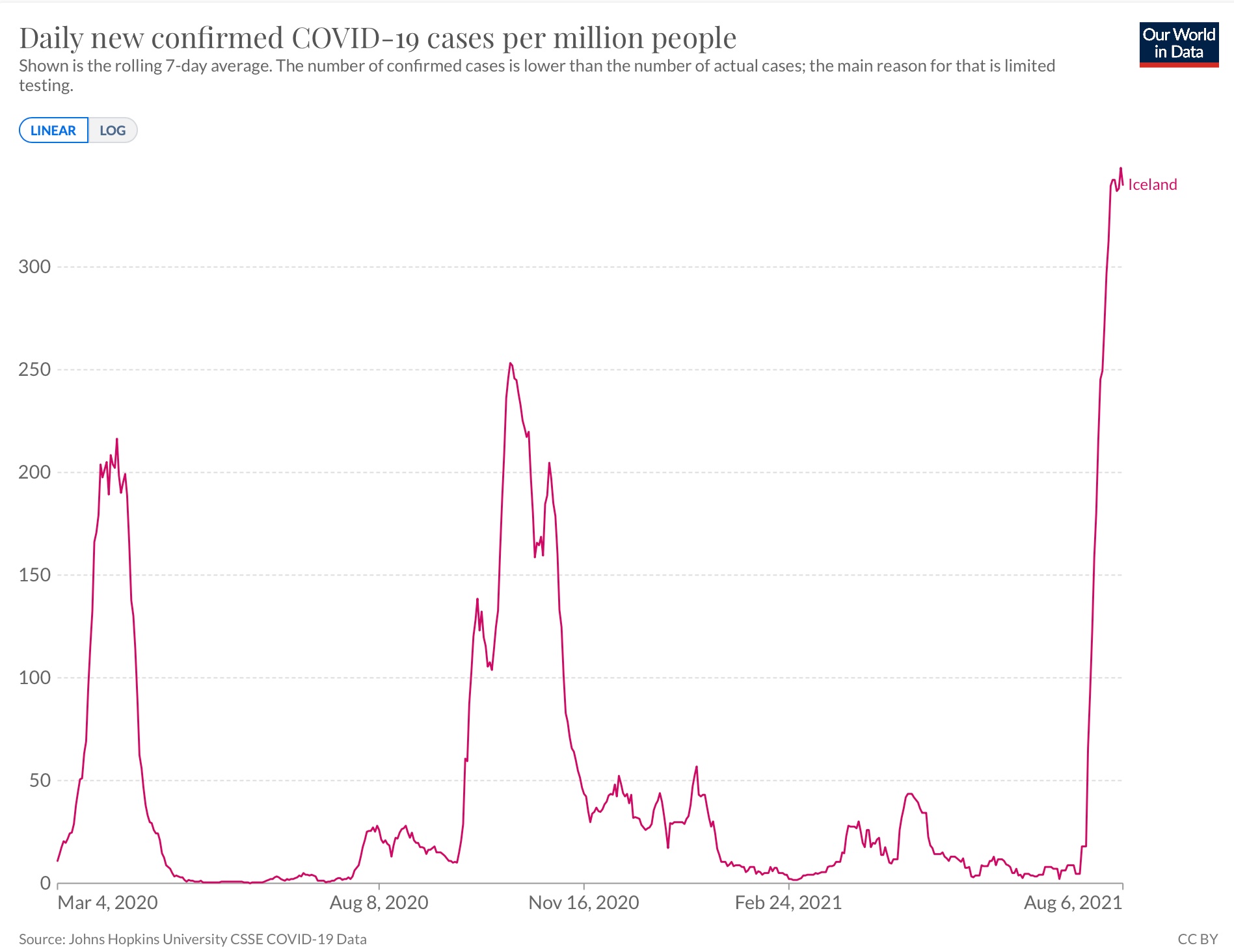
As you may know, Iceland is one of the most fully vaccinated countries in the world:

All via Eric Topol. No, I am not arguing we should give up or stop looking for policy and most of all biomedical improvements. All the more reason to do so! But…this does indicate we will need to find some way of living with such case numbers, without falling apart and pulling the plug on economic activity.
Saturday assorted links
1. A dating thread.
2. “THINGS THAT I HAVE DONE THAT YOU (PROBABLY) HAVE NOT.” Is that the good life?
4. “Acrobatic squirrels learn to leap and land on tree branches without falling.”
5. The fight over crypto in the infrastructure bill.
6. Why doesn’t India win more Olympic medals? With apologies to Neeraj Chopra.
Masks and the Delta variant
I haven’t seen any systematic, data-based investigation of how well cloth masks work against the Delta variant, and it is too early to expect it. Nonetheless I tried to do some simple mental modeling of my own.
We do know that the viral load from Delta is much higher. That could make masks less effective, because perhaps they cannot stop the spewer from spreading the virus so easily. (Oddly, you don’t see many people admitting such an effect might be possible, as this seems to be a politically incorrect idea to present.)
Yet there is a countervailing factor. The Delta variant spreads far more rapidly than “classic Covid.” So a given “small effect” of a mask is more important. It used to be that a mask (sometimes) stopped the spread to one person, who in turn might spread to 1.3 others. Now, if your mask stops the spread to that person, it might be stopping the subsequent spread to seven other people (we don’t know the exact number, but yes I have heard “seven” bandied around as a possibility).
To be clear, in this scenario masks are still less effective than before in preventing Covid spread. But the rate of return on wearing a mask, relative to no mask, can be higher. It is simply that the whole curve has shifted downward in a disadvantageous way. But if the mask has any effectiveness at all, that effectiveness is now magnified greatly.
Under some plausible numbers the protective potency of wearing a mask might be about five times higher (seven divided by recent non-Delta R, or something like that). Unless masks are five times (or more) less effective in stopping spread, masking could become more important rather than less important.
But the net effect could go either way.
That said, seeing other people masked should make you feel less secure than it used to. The new potential upside “rate of return effect” from masking is choking off the greater second order effects of the more rapid spread. The “are you going to get Covid from this particular masked person near you?” calculus seems to be decidedly worse than before.
Friday assorted links
That was then…
Here is an excerpt from Arthur Moeller van den Bruck, the guy who coined the term “The Third Reich” (hint: he wasn’t against it):
The Left has reason. The Right has wisdom…Masculinity is the essence of wisdom. It takes character not to succumb to self-delusion. The conservative man possesses this character as well as the physical prowess and moral determination to act in accordance with this character…He has the innate ability to pass judgement, and to make deductions, to recognize reality…Conservatism is based on an understanding of human nature.
That is from the new and excellent book Nazis and Nobles: The History of a Misalliance, by Stephan Malinowski. This book builds on themes from Arno Mayer’s old and excellent The Persistence of the Old Regime.
It is an interesting question why these sentiments — some of which are cliched rather than offensive per se — are as correlated with fascism as they are. In my oversimplified model, feminization is the key variable. Van den Bruck saw the feminization of society coming, and opposed it, but I believe he was more interested in Nazism and fascism per se. Many current commentators also oppose that feminization virulently, and that leads them to take up with strange and rather unfortunate bedfellows, namely fascists, as fascists do in fact have modes of discourse for opposing or criticizing feminization. Often fascism per se is not the main interest of today’s right-wing thinkers, and if you started lecturing them on Speer’s building plans for Berlin, or earlier German cartel policy, their eyes would glaze over. They are more interested in the current cultural wars, but they don’t always have the intellectual equipment to fight them, and so they look to fascists, a badly mistaken choice.
I say feminization is here to stay, we need to find workable versions of that — how’s that for a challenging intellectual project? Those of us looking backwards to “the nasty people” are going to find themselves staring down a dead end, intellectually and otherwise. Hungary and Salazar are not the future, people. You should be jumping on better bandwagons, or if need be building them yourselves.