Category: Uncategorized
That was then, this is now
About 55 percent of British servicemen [in World War II] were married.
Furthermore, by mid-1943, British military units were dealing with almost one hundred cases of “family anxiety” a day, with about two-thirds of those being infidelity issues, summing yearly to about 7.5 percent of the married British servicemen in North Africa and the Middle East at that time.
That is from Daniel Todman’s Britain’s War 1942-1947, a book I already have reviewed positively. Reading further, it remains excellent and interesting on every page, is still grossly under-reviewed by MSM, and would make the top five or even top three non-fiction books of the year list since I have started blogging.
The course of Covid-19 in the United States
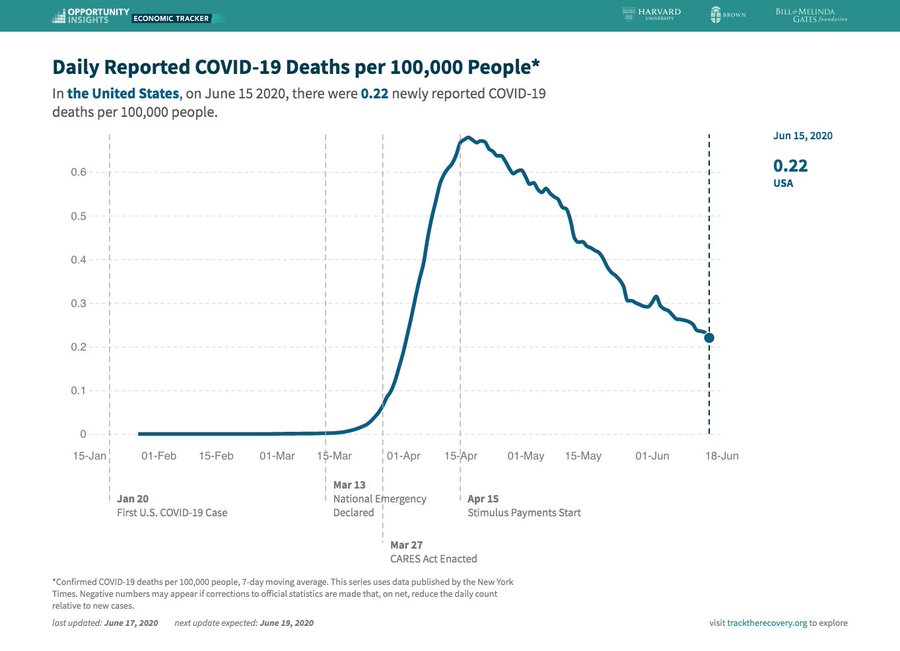 Via Amihai Glazer. And if you wish to verify, here is another (non-smoothed) presentation of the data.
In terms of the delta this picture is not as bad as what you sometimes hear, though data on cases are far worse, with a very long and indeed continuing plateau. And since deaths lag cases by a few weeks, you still might see reason to be alarmed. Nonetheless, the trend we can see is one of improvement, at least for a little over two months.
Do note it is better for everyone if you think the death rate is still rising!
Raj Chetty talk on “The economic impacts of COVID-19: Real-time evidence from private sector data”
I have not yet viewed it, but this talk is receiving rave reviews, here is the link. Or here:
Via the excellent Samir Varma.
Thursday assorted links
1. Can this be true? “The researchers found that several of the foster fathers were high-profile academics.” It gets worse.
2. “Tannehill also stated during the mask discussion that since June 1, four different urgent care clinics in Oxford had reported a total of 162 positive COVID-19 cases from University of Mississippi students who do not live in Lafayette County.” From fraternity events it seems.
4. Is performative entrepreneurship behind the Great Stagnation? And are academics complicit in this?
5. Physical encounters now seem to matter less for virus transmission. That said, in New Jersey 12 percent of nursing home residents have died of Covid-19.
6. Rules for the NBA bubble (NYT).
7. Tenino, Washington prints its own currency.
8. New Marc Andreessen interview, excellent, lots of fresh material, contains lessons about updating as well. By Sriram Krishnan, would get its own blog post if it would let me do “Control C” on the excerpts.
FDA Allows Pooled Tests and a Call for Prizes
The FDA has announced they will no longer forbid pooled testing:
In order to preserve testing resources, many developers are interested in performing their testing using a technique of “pooling” samples. This technique allows a lab to mix several samples together in a “batch” or pooled sample and then test the pooled sample with a diagnostic test. For example, four samples may be tested together, using only the resources needed for a single test. If the pooled sample is negative, it can be deduced that all patients were negative. If the pooled sample comes back positive, then each sample needs to be tested individually to find out which was positive.
…Today, the FDA is taking another step forward by updating templates for test developers that outline the validation expectations for these testing options to help facilitate the preparation, submission, and authorization under an Emergency Use Authorization (EUA).
This is good and will increase the effective number of tests by at least a factor of 2-3 and perhaps more.
In other news, Representative Beyer (D-VA), Representative Gonzalez (R-OH) and Paul Romer have an op-ed calling for more prizes for testing:
Offering a federal prize solves a critical part of that problem: laboratories lack the incentive and the funds for research and development of a rapid diagnostic test that will, in the best-case scenario, be rendered virtually unnecessary in a year.
…We believe in the ability of the American scientific community and economy to respond to the challenge presented by the coronavirus. Congress just has to give them the incentive.
The National Institutes of Health (NIH) have already begun a similar strategy with their $1.4 billion “shark tank,” awarding speedy regulatory approval to five companies that can produce these tests. Expanding the concept to academic labs through a National Institute of Science and Technology (NIST)-sponsored competition has the added benefit ultimately funding more groundbreaking research once the prize money has been awarded.
This is all good but frustrating. I made the case for prizes in Grand Innovation Prizes for Pandemics in March and Tyler and I have been pushing for pooled testing since late March. We were by no means the first to promote these ideas. I am grateful things are happening and relative to normal procedure I know this is fast but in pandemic time it is molasses slow.
Which figures from 1968/1969 look good in retrospect?
Andrew writes to me:
I just wanted to propose a question for your blog, which I’ve read since it launched. Given how the current atmosphere seems a bit like 1968, I was curious who you think comes out of 1968 looking good (or bad) in retrospect. I’m particularly interested in people at universities (my own case), but I’d be curious in general.
A former professor of mine (George Kateb) claimed that my generation (born 1970) was embarrassed by the sixties and I guess particularly by the more radical parts. That’s my impression as well and I assumed that the more radical parts of the sixties and the intellectuals who went along with them would come out looking the worst in retrospect. Is this right? Whose position at the time looks most “correct” today?
It is tough, if only because so many people from both parties then were bad on the Vietnam War issue. Here are a few who, in my judgment, came out of the era looking good, in no particular order:
1. Kareem-Abdul Jabbar (then Lew Alcindor), Billie Jean-King, and Curt Flood.
2. Bob Dylan: pro-civil rights and anti-war, and for all of his phases he never went in for the bad, crazy stuff.
3. Paul McCartney: universalist, anti-war, neoliberal integrationist, and the saner part of the Beatles. Some minus points on the drugs front, however.
4. Julian Bond. And a variety of other civil rights leaders, but MLK not living long enough to “fit” the question as stated.
5. Harry Edwards (who?).
6. Seán Lemass (who?) Elsewhere across the waters there is Raymond Aron.
7. Marshall McLuhan
9. Lucille Ball
9. Gene Roddenberry and the rest of Star Trek, including the script writers.
10. Thomas Pynchon: So many others look bad, at least he knew not to say too much or to hang around for too long.
11. Ayn Rand. With qualifications on a number of fronts, but yes. She was in fact good on the major issues of those years.
12. These people from the Bay Area. They are not public figures, but still they deserve mention.
Who else?
Notes: Marxists, Maoists, and advocates of violence are not going to win. There were plenty of excellent economists back then, but most had a different focus than commenting on the major events of those years, and if memory serves (please correct me if I am wrong) Milton Friedman’s very meritorious anti-draft work came slightly later. I would have to reread the major feminist book authors to pick the best one, but I do mean for at least one to be on the list, I am simply not sure at the moment which one. Ralph Nader too? The astronauts? They knew to keep their mouths shut once they were finished.
Wednesday assorted links
1. The alligator snapping turtle culture that is Lord Fairfax.
2. Die Kinder kommen auch dazu.
3. Racial bias in traffic ticket disparities?
4. David Brooks on the dehumanizing culture of the police.
5. Bergstrom on the new anti-Covid drug.
6. The Invisible College: 50k investments in youth. Run partly by philosophers, including Michael Gibson.
My Conversation with Rachel Harmon
Rachel Harmon is a Professor at University of Virginia Law School, and an expert on policing. Here is the audio and transcript, and here is part of the CWT summary:
She joined Tyler to discuss the best ideas for improving policing, including why good data on policing is so hard to come by, why body cams are not a panacea, the benefits and costs of consolidating police departments, why more female cops won’t necessarily reduce the use of force, how federal programs can sometimes misfire, where changing police selection criteria would and wouldn’t help, whether some policing could be replaced by social workers, the sobering frequency of sexual assaults by police, how a national accreditation system might improve police conduct, what reformers can learn from Camden and elsewhere, and more. They close by discussing the future of law schools, what she learned clerking under Guido Calabresi and Stephen Breyer, why she’s drawn to kickboxing and triathlons, and what two things she looks for in a young legal scholar.
And here is one bit:
COWEN: Should we impose higher educational standards on police forces?
HARMON: There’s mixed evidence on that. Slightly older police officers tend to be better in certain respects, at least, and education is often associated with age. But, again, I don’t think that we can select our way out of problems in policing.
COWEN: But why can’t we? Because different individuals — they behave so differently. They think so differently. Why is it that there’s no change in selection criteria that would get the police to be more the way we want them to be, whatever that might be?
HARMON: I think we could do some things. We could screen out people who have committed misconduct in the past, for example, by decertifying them at the state level and therefore discouraging departments that can’t or don’t care very much about quality of their officers from hiring those officers.
It’s not that we can’t select against problems in policing at all. Sometimes we know that an officer’s problematic, and still he’ll wander around from department to department. I think we should set minimum age standards that are above 18, which many states have as a minimum age standard.
But in terms of education or other more subtle factors, I think the effects can often be subtle, and when we look at what creates problems in policing, departments create officers. The officers don’t preexist a department, really, so what you’re really looking at is the culture of the department, the incentive structures, the supervision, discipline. You can make good officers with imperfect people.
Recommended, interesting throughout, and yes we discuss San Francisco and Singapore too.
Comparative Institutional Failure
The common element to our twin crises is that many of the government agencies we thought were keeping us safe and secure—the CDC, the FDA, the Police–have either failed or, worse, have been revealed to be active creators of danger and insecurity. Alex Tabarrok.
Derek Thompson writing at The Atlantic uses my quote as a jumping off point for a good piece on the failure of American institutions. He does a good job of covering the failures of the CDC, the FDA and the police but most interestingly asks why the FED has acted very differently.
While too many American police are escalating encounters like it’s 1990, and the FDA is slow-playing regulatory approval as if these are normal times, and the CDC is somehow still using fax machines, the Federal Reserve has junked old shibboleths about inflation and deficit spending and embraced a policy that might have scandalized mainstream economists in the 1990s. Rejecting the status-quo bias that plagues so many institutions, this 106-year-old is still changing with the world.
Why haven’t other American institutions done the same? Perhaps America’s dependency on old leadership makes our institutions exquisitely responsive to the anxieties and illusions of old Americans. Perhaps the nature of large bureaucracies is to become lost in the labyrinth of mission-creeping path dependency. Perhaps years of political polarization and right-wing anti-science, anti-expertise sentiments have wrung all of the fast-twitch smarts out of the government. Or perhaps we should just blame Trump, that sub-institutional creature summoned from the bilious id of an electorate that lost faith in elites when elites lost their grip on reality.
Whatever the true cause for our failure, when I look at the twin catastrophes of this annus horribilis, the plague and the police protests, what strikes me is that America’s safekeeping institutions have forgotten how to properly see the threats of the 21st century and move quickly to respond to them. Those who deny history may be doomed to repeat it. But those who deny the present are just doomed.
I see three reasons why the FED may have been different. First, the FED is one of the most independent agencies which may help to explain its faster and more adaptive behavior ala Garett Jones’s 10% Less Democracy. Second, and relatedly, the FED pulls a lot of leadership and staff from academia. That gives FED staff an affiliation goal and clique outside of politics which creates mental independence as well as political independence. Third, the FED was also tested in the last crisis and experience with crises helps as we have also seen in Asia tested by H1N1, SARS and MERS more than the US was.
I am not sure which, if any, of these explanations is the most important but I do think that we have a lot more to learn from comparative institutional analysis not just within the US but across countries as well.
*Forms of Contention: Influence and the African American Sonnet Tradition*
That is the new, excellent, and timely book by Hollis Robbins, the title is descriptive, here is one excerpt:
“If We Must Die” calls for resistance to violence in an environment of violence. The power of [Claude] McKay’s sonnet—Shakespearean and yet with modern diction—is the tension between the measured lines and rhyme, the poetic phrases and the brutal words, the combination of enjambments and exclamation points in the octave, and the more deliberate and determined pace of the sestet. “If We Must Die” is a defiant call to action. The rage of the poem is made more potent by the tension of the sonnet form straining to contain it.
The book argues for the centrality of sonnet writing to African American poetry, and that the African American tradition was not simply parasitic on European models. A “sestet,” by the way, is the last six lines of a sonnet, but not a good Scrabble word because you have to waste two “s’s” to play it.
The impact of Protestant Evangelism on economic outcomes
From Gharad Bryan, James J. Choi, and Dean Karlan:
We study the causal impact of religiosity through a randomized evaluation of an evangelical Protestant Christian values and theology education program delivered to thousands of ultra-poor Filipino households. Six months after the program ended, treated households have higher religiosity and income; no statistically significant differences in total labor supply, consumption, food security, or life satisfaction; and lower perceived relative economic status. Exploratory analysis suggests that the income treatment effect may operate through increasing grit. Thirty months after the program ended, significant differences in the intensity of religiosity disappear, but those in the treatment group are less likely to be Catholic and more likely to be Protestant, and there is some mixed evidence that their consumption and perceived relative economic status are higher. We conclude that this church-based program may represent a method of increasing noncognitive skills and reducing poverty among adults in developing countries.
Tuesday assorted links
1.Cultural tightness as a predictor of Covid-19 outcomes?
2. Advice for ambitious teenagers.
3. New look at the Drake Equation: 26 intelligent, communicating civilizations in our galaxy? Speculative, if anything ever was.
4. Ninja bombs? And Ross Douthat on police reform (NYT). And confessions of a former cop. Think of the latter as an attempt to model the behavior of the police.
5. Mondegreen.
Bloody Well Pay Them
 The United States is one of the few countries in the world where plasma donors are paid and it is responsible for 70% of the global supply of plasma. If you add in the other countries that allow donors to be paid, including Germany, Austria, Hungary, and Czechia, the paid-donor countries account for nearly 90% of the total supply.
Countries that follow the WHOs guidance to rely exclusively on voluntary, unpaid donors all have shortages of plasma (hmmm…what’s the WHOs track record like?) So what do these countries do? Import plasma from the paid-donor countries. The United Kingdom, Australia, New Zealand and some Canadian provinces, for example, prohibit paid donors and they import a majority of their plasma from paid donor countries. (See chart at right).
As Nobel prize winner Al Roth puts it, in his gentle way:
I find confusing the position of some countries that compensating domestic plasma donors is immoral, but filling the resulting shortage by purchasing plasma from the US is ok.
The UK, Australia, New Zealand and Canada can afford their moral hypocrisy but their decision to forbid paid-donors reduces the world supply of plasma driving up the price and harming people in poorer countries.
I have cribbed from an excellent new report by Peter Jaworski, Bloody Well Pay Them: The Case for Voluntary Remunerated Plasma Collections.
Previous MR posts on plasma.
Why non-distanced social and commercial interactions have resumed so quickly
People have solved for the equilibrium.
First, the socially-distanced goods, such as food delivery, are starting to rise in price. The non-distanced goods have been falling in relative price, and so now people are moving along their demand curves and engaging in less distancing.
Second, the longer the pandemic will run, the harder it is to use intertemporal substitution as a “make up.” “I won’t go to a bar for two months, but then I’ll go a lot to make up for it” is a plausible story to tell oneself. “I won’t go to a bar for a year and then I’ll go a lot…” is harder to swallow and act upon. It starts to become a habit, and at some point you can’t drink enough to make up for what you have lost. And so people are more inclined to go to the bar right now.
Most importantly, peer effects are remarkably strong. Most people are not willing to accept a small additional risk of death to say eat in a particular restaurant. But they are willing to accept a small additional risk of death to live life as other people are living life.
So once enough people are not respecting social distancing, most of the others will follow.
Some wag on Twitter said we can no longer use the expression “to avoid like the plague,” because apparently people do not take so much care to avoid the plague.
Monday assorted links
1. Why might poor white Americans feel especially bad?
2. Raj Chetty talk on Covid-19, coming this Wednesday. And forthcoming seminar on what students think of on-line education.
3. Study of T-cell immunity in Singapore. Small numbers, but of interest.
4. Useful list of top economics blogs.
5. Woman in China, 45, made S$589,800 by buying insurance on flights she predicted would get delayed.