Category: Uncategorized
Assorted links
1. Via Chris F. Masse, a weird house.
2. What the silent bank run looks like.
3. David Rothschild on why Hermann Cain has it tough.
4. What exactly is the health care productivity problem?
5. “My date with Keynes” (video, but is it Straussian?)
Assorted links
1. Why don’t we hire more servants?
2. Michael Lind’s critique of libertarianism.
3. The role of Kevin Murphy in the NBA negotiations.
4. Long profile of Nouriel Roubini and his firm.
5. Stephen Smith, market-based urbanist, now blogging at Forbes.
Amish mob violence
An Amish mob is accused of breaking into several homes and cutting off the beards and hair of other Amish men.
Now, the group is the focus of four police investigations in Ohio.
Police say the assaults are the work of members of the “Bergholz Clan.”
In one attack, the men allegedly packed a horse-drawn buggy, rode to a home and cut the hair off some men and women in the house.
The violent haircuts are meant to humiliate and punish those Amish who are supposedly weak in the faith.
The link is here, hat tip goes to Yana.
Italy fact of the day
Italy’s guarantees make up 18 per cent of the [EFSF] system.
That’s Italy as guarantee source, not Italy as recipient! The bottom line is this:
If you double or treble the size of the EFSF without changing its underlying structure,all you do is double or treble the lack of credibility. If you really want to increase the size of the EFSF without destroying it, then you are left with two options: you have to back it through an unlimited guarantee by the ECB, the only organ in the eurozone that is in a position to give such a commitment. Or you have to change the EFSF’s legal status through the adoption of joint and several liability. This means that member states jointly agree everybody’s debt. The two options ultimately mean the same. The liabilities of the system will be shared jointly by all of its participants. If you want to annoy certain people, you could also call the latter a eurobond.
The article, by Wolfgang Münchau, is excellent throughout.
Assorted links
1. Are transmission lines holding back green energy?
2. U. Chicago’s ambitious plan to build out law and economics.
4. Round-up of complaints choirs, excellent link, rich with content and humor.
6. Further Russ Roberts response on TGS, Karl Smith responds to Russ. My view is not “no male progress since 1969,” but rather far less than we would have expected at the time.
Deviations from Benford’s Law over time, in U.S. accounting data
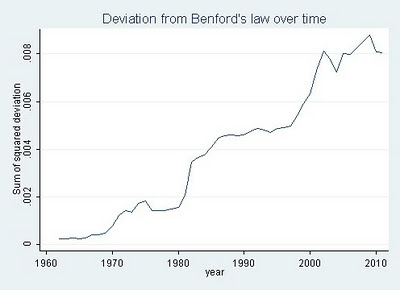
Jialan Wang writes:
So according to Benford’s law, accounting statements are getting less and less representative of what’s really going on inside of companies. The major reform that was passed after Enron and other major accounting standards barely made a dent.
There is much more at the link. If you are new to the party, Benford’s Law is that:
…in lists of numbers from many (but not all) real-life sources of data, the leading digit is distributed in a specific, non-uniform way. According to this law, the first digit is 1 about 30% of the time, and larger digits occur as the leading digit with lower and lower frequency, to the point where 9 as a first digit occurs less than 5% of the time. This distribution of first digits is the same as the widths of gridlines on the logarithmic scale.
There is more at the link or more here. Here are two previous MR posts on Benford’s Law.
The culture that is California
Nice:
The University of California last week tentatively agreed to a deal with UC-AFT that included a new provision barring the system and its campuses from creating online courses or programs that would result in “a change to a term or condition of employment” of any lecturer without first dealing with the union.
Bob Samuels, the president of the union, says this effectively gives the union veto power over any online initiative that might endangers the jobs or work lives of its members. “We feel that we could stop almost any online program through this contract,” Samuels told Inside Higher Ed.
Assorted links
1. Economic analysis of where the NBA stands.
2. How NYU lured Thomas Sargent, who by the way seems to like Borges, and Henderson on Sargent, and a rude guy in Italian.
3. Via Cafe Hayek, Henry Simons reviews Keynes.
4. Bernanke and Sims on the price of oil and recessions.
5. Complaints Choir of Tokyo, hat tip Yana.
Assorted links
1. Karl Smith on Russ Roberts on TGS. Karl also has had some excellent posts on IS-LM and related matters, start here but scroll backwards through the blog.
2. When was the phrase “Great Depression” first used? More from the extraordinary Barry Popik.
3. 1982 interview with Thomas Sargent. And the Thomas Sargent academic family tree. And Sargent’s (very short, and very good) graduation speech at Berkeley. An excellent short overview of what economics has to contribute to human understanding. Here is his Dad’s speech, from his Dad’s 90th birthday.
4. Carolyn Sargent’s guide to the art of Florence; she is related to Thomas.
From the comments, on Sims and IS-LM
This is from E. Barandiaran and it relates to recent controversies in the blogosphere:
This is the last section of a Sims’s paper on the ISLM model (1998):
4. Conclusion
• Keynesian reasoning ought to be essentially forward looking and to emphasize expectational factors in savings and investment decisions. Traditional ISLM hides and inhibits development of this aspect of Keynesian modeling.
• ISLM ignores connections between monetary and fiscal policy that are enforced by the government budget constraint. In many policy contexts, this is a major gap.
• It remains to be seen whether there is a way to capture these aspects of Keynesian modeling in a package as neat and non-technical as ISLM, but that should not be an excuse for continuing to make ISLM the core of our teaching and informal policy discussion.
and this is the abstract
Abstract. ISLM inhibits attention to expectations in macroeconomics, going against the spirit of Keynes’s own approach. This can lead to mistaken policy conclusions and to unnecessarily weak responses to classical critiques of Keynesian modeling. A coherent Keynesian approach, accounting for endogenous expectations, implies very strong effects of monetary and fiscal policy and leads to greater attention to the role of the government budget constraint in making the effects of monetary policy conditional on prevailing fiscal responses, and vice versa.
Thomas Sargent, Nobel Laureate
Most of all, this is a prize about expectations, macroeconomics, and the theory and empirics of policy. Let’s start with Sargent, noting that I will be updating throughout.
Sargent has made major contributions to macroeconomics, the theory of expectations, fiscal policy, economic history, and dynamic learning, among other areas. He is a very worthy Laureate and an extraordinarily deep and productive scholar. Here is Wikipedia on Sargent. Here is his home page, rich with information. Here is Sargent on scholar.google.com. Here is the explanation for both laureates from Sweden. Here is a Thomas Sargent lecture on YouTube.
He now teaches at NYU, and is a fellow at Hoover, though much of his career he spent at the University of Minnesota. Sargent is one of the fathers of “fresh water” macro, though his actual views are far more sophisticated than the critics of his approach might let on. He has done significant work on learning and bounded rationality, for instance. This is very much a “non Keynesian” prize.
I think of Sargent as a “foundationalist” economist who always insists on a model and who takes the results of that model seriously. In general he would be placed in the “market-oriented” camp, though it is a mistake to view his work through the lens of politics.
Sargent was first known for his work on rational expectations in the 1970s. He wrote a seminal paper, with Neil Wallace, on when rational expectations will mean that monetary policy does not matter. You will find that article explained here, and the paper here. Expected monetary growth will not do much for output because it does not fool people and thus its nominal effects wash away.
One of his most important (and depressing) papers is Sargent, Thomas J. and Neil Wallace (1981). “Some Unpleasant Monetarist Arithmetic“. Federal Reserve Bank of Minneapolis Quarterly Review 5 (3): 1–17. The main idea of this paper is that good monetary policy requires good fiscal policy. Otherwise the fight against inflation will not be credible. This is probably his most important paper.
He followed up this paper with Sargent, Thomas J. (1983). “The Ends of Four Big Inflations” in: Inflation: Causes and Effects, ed. by Robert E. Hall, University of Chicago Press, for the NBER, 1983, p. 41–97. This is a masterful work of economic history, showing that monetary stabilizations, from hyperinflation, first required some fiscal policy successes. I view this as his second most important paper, following up on and illustrating “unpleasant monetarist arithmetic.”
These two papers inspired work from other researchers on a “fiscal theory of the price level,” integrating monetary and fiscal theories. In Sargent’s view the quantity theory is a special case of a more general theory of asset-backed monies, and for fiat monies the relevant backing cannot be determined without referring to the fiscal stance of the money-issuing government.
His Dynamic Macroeconomic Theory has been an important Ph.d. text for macro.
Sargent also has important work on computational learning, such as Sargent, Thomas J. and Albert Marcet (1989). “Convergence of Least Squares Learning in Environments with Hidden State Variables and Private Information”. Journal of Political Economy 97 (6): 251. doi:10.1086/261603. A short summary of his work on learning can be found here; I will admit I have never grasped the intuitive kernel behind this work. I have not read Sargent’s work on neutral networks, you will find some of it here. It may someday be seen as path breaking, but so far it has influenced only specialists in that particular area. It is considered to be of high quality technically. Here is his piece, with Marimon and McGrattan, on how “artificially intelligent” traders might converge upon a monetary medium of exchange; think of this as a modern and more technical extension of Carl Menger.
Here is an old paper with Sims, co-laureate, on how to do macro econometrics with a minimum of theoretical assumptions; this reflected a broad move away from structural models and toward “theory-less” approaches such as Vector Auto Regression. Here is his introductory paper on how to understand the VAR method. Sargent’s worry had been that structural models estimate parameters, but then those parameters will vary with policy choices and in essence the economist will be using an “out of date” model. VAR models are an attempt to do without structural estimation as much as possible, though critics might suggest this enterprise was not entirely successful.
Here is Sargent’s take on the history of the Fed; basically the Fed first had an OK model, then forgot it for a while (the 1970s), then relearned it again. In July 2010 he penned a defense of the Greenspan-era FOMC, based on the view that they were tackling worst case scenarios. Here is Sargent’s paper, with Tim Cogley, on what the Fed should do when it does not know the true model.
Circa 2010, in an interview, Sargent defends the relevant of freshwater macro during the recent financial crisis. While my view is not exactly his, it is a good corrective to a lot of what you read in the economics blogosphere. This is the single most readable link in this entire post and the best introduction to Sargent on policy and method for non-economists. The last few pages of the interview have a good discussion of how the euro was an “artificial gold standard,” how it was based on an understanding of the “unpleasant monetarist arithmetic point, and how breaking the fiscal rules has led to the possible collapse of the euro. Recommended.
He has a very interesting 1973 paper on when the price level path will be determinate, again with Neil Wallace. Here is his old paper on whether Keynesian economics is a dead end. Here is his appreciation of Milton Friedman’s macroeconomics. Here is his recent paper on whether financial regulation is needed, in a context of efficiency vs. stability. Sargent has toyed with free banking ideas over the decades, casting them in the context of “the real bills doctrine.” Here is a recent paper on determinants of the debt-gdp ratio.
He is not primarily known for his work on unemployment, but he has a lot of good papers in the area, many of them are listed here. Here he uses layoff taxes and unemployment compensation to explain the behavior of unemployment in Europe over the decades.
His work on “catastrophe,” with Cogley and others, suggests that the equity premium changes with historical memory.
With Velde, Sargent wrote a detailed and excellent book on the history of small change; why was small change scarce for so many centuries? Hint: the answer involves Gresham’s Law. There is an MR discussion of this book here. This book illustrates just how deep Sargent’s learning and erudition runs.
Here are his new papers, Sargent remains very active.
Overall: Sargent really is one of the smartest, deepest, and most scholarly of all contemporary economists. The word “impressive” resonates. He has enough contributions for 1.6 Nobel Prizes, maybe more. He has influenced the thought of all good macroeconomists. The economic history is dedicated and path breaking. If I had to come up with a criticism, I find that some of his papers have an excess of rigor and don’t leave the reader with a clear intuitive result. I am not as enamored of foundations as he is. Still, that is being picky and this is a very very good choice for the prize. I would have considered a co-award with Neil Wallace, however, since two of Sargent’s most important papers (JPE 1975) and “unpleasant monetarist arithmetic” were written with Wallace.
Probably I won’t be updating this post any more!
Assorted links
1. David Leonhardt on why the current downturn is so bad, right on the mark in my view.
2. “Could this time have been different?”
John Ralston Saul on the decline of political speech
Via www.bookforum.com, from an interesting interview:
GB Who are the best speakers in the world today, politically?
JRS Long silence. The reason for which there is a ‘long silence’ is that, with the gradual bureaucratization of politics, we have ended up with – through the 1970s, 1980s and 1990s – politicians increasingly reading speeches written for them by somebody else; that is, politicians being made to feel that they were not the real political leaders, but rather – in a sense – heads of a large bureaucracy. The result has been that politicians may think that they have a responsibility to speak in a solid and measured way – with the consequence that they not only became boring and bad speakers, but sound artificial and are not listened to. Modern speech writers started adding in ‘rhetoric,’ which sounded artificial, and led to people listening even less to political speeches. This also came with a rise in populism; that is, we saw the revival of populist speaking – with populist politicians winning power here and there – meaning that the speech writers started putting populist rhetoric in as a gloss on top of the boring managerial material that they had been producing. So what we now have are sensible, elected leaders giving speeches that, at one level, are boring, solid stuff and, at another level, cheap rhetoric.
…Many political leaders think that it is dangerous to speak well. In fact, they are looking to bore people – and we feel that. As a result, when we stand up and say real things, people are quite shocked. And that is because they are always working on this level of measurement. If we take someone like a Trudeau or an FDR, or an LBJ, or a de Gaulle – someone like that – they knew that speeches are not about who will like them and dislike them. Speeches are actually about whether people will respect you because you have spoken to them in a way that they take to be honest – as if they are treated in a way that is intelligent. Trudeau was often boring, but his secret was that, even when he was being insulting, he was talking to you as if you were as smart as he was.
More Russ Roberts on TGS
Russ has written a reply to my response, read his whole piece, using his numbers I will put a few follow-up responses under the fold…
1. Male median wage data (down since 1969) suggest divorce is not the main issue; in any case divorce is an economic and psychological catastrophe for many people, and defending living standards by invoking the effects of divorce in the data strikes me as actually more pessimistic than my view. I suspect Russ’s own cultural values are in accord with this perspective. Russ’s postulated effect also does not explain 1998-2011 median wage stagnation very well.
3. The key question is the net bias of statistics, not the bias for consumer durables alone. Our real economic performance on a lot of services — a huge and growing part of the economy — is extremely weak. As durables get cheaper, the biases in measuring their quality become less important.
4. I don’t see that Russ has made an actual counter to my argument here.
6. In successful periods growth shows up in the major mainstream economic statistics, including the median. If it doesn’t, at the very least we should conclude that growth is considerably slower than usual.
9. There is no measured median income progress since 1997 and very little since 1973; that’s not just a cyclical phenomenon. The supposedly good years of the noughties now look like a bubble, not the reality.
On panel data, I read the Pew Report which Russ cites. Over a more than thirty year time period, only 63 percent of children had incomes exceeding those of their parents, and that comparison includes some pre-TGS, quite high-growth years. I don’t find that number impressive at all. In any case the key question is a comparative one, and while the study has not been done, it is highly likely one would find much stronger cross-generational measures of progress for earlier generations.
On reconciling the per capita gdp and median stories, the concept of rent-seeking — most of all through the service sectors and finance and government — will suffice. I know that Russ already agrees with the finance side of this story, maybe the government side too and who knows, perhaps education and medicine as well?
Which countries target their welfare spending most effectively?
Australia has the most “target efficient” system of social security benefits of any OECD country. For each dollar of spending on benefits our system reduces income inequality by about 50 per cent more than the United States, Denmark or Norway, twice as much as Korea, two and a half times as much as Japan or Italy, and three times as much as France.
Other countries that are similar to Australia in this regard include New Zealand, the United Kingdom and Ireland, and also Denmark and Finland. In fact, nearly all of the high-spending Scandinavian welfare states target to the poor more than does the United States.
The full story is here, and if you’re wondering I too am confused by the double invocation of Denmark. Hat tip goes to www.bookforum.com.
On related themes, see the new Lane Kenworthy book Progress for the Poor.