Category: Uncategorized
Assorted links
1. Tyler Cowen, speaking off the cuff, defines friendship, a two minute video.
2. Library of Congress launches National Jukebox.
3. Will data mining end the Great Stagnation? In any case you should major in statistics.
4. German economic growth is surging; again, real factors matter much more than fiscal policy or fiscal austerity.
Assorted links
1. Super-immigrants are low-hanging fruit, and more here.
2. Abandoned Yugoslavian brutalist war memorials.
4. The GM bailout doesn’t look so good.
5. I vote for Blattman on South Sudan.
The new Edge symposium
“What scientific concept would improve everybody’s cognitive toolkit?”
There are 159 responses, starting with Daniel Kahneman and Richard Dawkins. Kahneman starts off by sounding like Bryan Caplan:
Education is an important determinant of income — one of the most important — but it is less important than most people think. If everyone had the same education, the inequality of income would be reduced by less than 10%. When you focus on education you neglect the myriad other factors that determine income. The differences of income among people who have the same education are huge.
Income is an important determinant of people’s satisfaction with their lives, but it is far less important than most people think. If everyone [TC: in the US?] had the same income, the differences among people in life satisfaction would be reduced by less than 5%.
I’ll read the rest now…
*The Anatomy of Influence: Literature as a Way of Life*
That’s the new Harold Bloom book, which has all the strengths and weakness of Harold Bloom books (I am a fan). Excerpt:
Picasso is reputed to have said he did not care who influenced him but he did not want to influence himself.
Bloom’s books are very good for motivating rereads of classics, in this case Walter Pater, Paul Valery, Shakespeare, Hart Crane, Walt Whitman, Leopardi, and Montaigne’s essay “On Experience,” among others. Here is a weaker passage:
I recall first reading the poem when I was thirteen, thrilling to Satan and falling in love with Eve. In those years I fell regularly in love with fictive heroines and encountered Eve after a year of infatuation with Thomas Hardy’s heroines, particularly Eustacia Vye…and Marty South… I all but wept when Marty South cut off her long, beautiful hair, while I joined Milton and Satan in their lust for Eve’s wanton tresses.
Still, he is one of the greatest readers ever, this is probably his last major book, he truly believes in his project, and the point about prompting rereads makes this — whatever its flaws — better than almost anything else you can pick up.
Assorted links
1. Betsey Stevenson on Bryan Caplan and unhappy parents.
2. What Abhijit Banerjee would do for South Sudan.
3. What death means to primates.
4. Ten year old food critic, he is better and more authentic than most.
Assorted links
1. Restaurants cherry pick parties by size.
2. Interview on the new Tim Harford book.
4. Josh Barro on The Great Stagnation and goofing off.
5. I believe you can watch my Wednesday debate with Roger Scruton here.
6. Philadelphia Orchestra puts subscription money into escrow, not a good sign.
Nominal shocks
Samoa, the tiny Pacific Ocean island state, is travelling through time to improve its economic prospects.
In a vote of confidence for the Asian century, the country has decided to shift the jagged International Date Line to its east at the end of this year, which will bring it a day closer to Asia and Australasia.
The clocks in Apia, the capital, are 21 hours behind Canberra but only four hours behind San Francisco.
That reverses a decision 119 years ago to move the line to the west, following lobbying by Samoa’s merchants who wanted better to accommodate business with trading ships from the US and Europe.
It is not the first overhaul of a long-standing convention by Tuilaepa Sailele Malielegaoi, prime minister, who in 2009 switched the nation from driving on the right to the left, to align it more closely with the practice in Australasia and Japan.
“In doing business with New Zealand and Australia we’re losing out on two working days a week,” Mr Tuilaepa said. “While it’s Friday here, it’s Saturday in New Zealand and when we’re at church Sunday, they’re already conducting business in Sydney and Brisbane.”
Australia and New Zealand combined account for more than half of Samoa’s imports and more than 85 per cent of total exports, which largely consist of coconut products and fish.
…However, the move has not been universally welcomed, particularly in tourism, as the island will no longer be the last place on earth to see sunset. It will be joining the countries that see the sunrise first.
“After the date change, it will just be another sunset, no longer that special,” said Andrew Tiatia, a tour guide.
Mr Tuilaepa, however, points to another advantage. By flying one hour from American Samoa, on the other side of the date line, it will be possible to celebrate the same day twice and mark birthdays or wedding anniversaries twice over.
I enjoy stories like this more than is reasonably justified.
New York tips
1. Tulsi, 211 E. 46th, between 1st and 2nd. The most authentic Indian food I’ve had in the U.S., ever, get the vegetables. Not a cheap mom and pop, but by Manhattan standards this is reasonably priced for its quality. Jones Wood Foundry is an excellent gastropub.
2. Incendies joins Of Gods and Men and Even the Rain as one of my favorite films of the year. It is French-Canadian, set in Lebanon, and involves a journey of family discovery; I read it as an explicitly Christian movie.
3. Flushing, Queens, Golden Mall, go eat the Chinese food in the basement food court. For visitors, convenient from LaGuardia airport by taxi.
If you live in New York, or visit frequently, this is my best blog post ever.
Assorted links
2. Public choice take on the Der Spiegel story on Greece possibly leaving the eurozone.
3. Markets in everything: “A Sicilian social movement is organizing trips that patronize only businesses that do not pay protection money to the Mafia.” (1/20) Higher chance of arson, for one thing.
5. Seatbelts and offsetting behavior, a counter-revisionist view.
Books about America, by foreigners, bleg
George Hawkey writes to me:
I know you’ve posted “best books” queries on the site before, so here goes. Do you have any input on the best books about American History and Culture, but written from a non-American point-of-view?
Obviously Tocqueville, and there’s a whole raft of Canadian published books on the US culture as well. What I’m looking for is more like: what would “The Best and the Brightest” be if it were written by a Japanese journalist. Or what if Taylor Branch’s “Parting the Waters” trilogy was written by a Russian sociologist? “The World Is Flat” but written about the US by an Indian?
In many cases, I’m guessing these texts are not yet or will never be translated, but I’m still interested in finding greater perspective on the US than what’s provided by the traditional pundits, authors and historians.
I’ll recommend these five works of fiction, starting with Nabokov and how about Ayn Rand as well? The comments are open for your further suggestions…
Karl Smith on aggregate demand
It is an excellent post, read the whole thing. To pull out one point, here is the hospitality sector, expressed in levels:
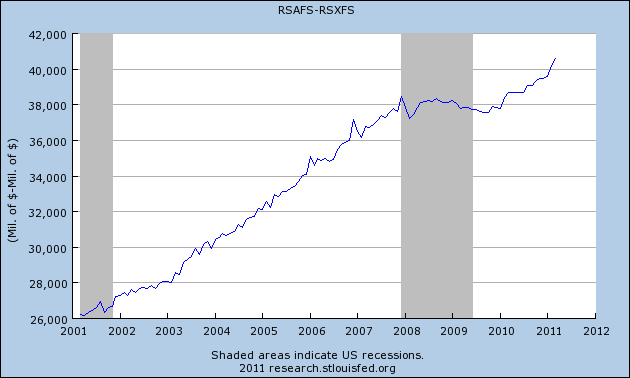
It’s clearly below trend, had there been no financial crisis. But will sticky nominal wages cause significant unemployment? In terms of absolute levels, business is above where it was before the crisis. At first glance, that should seem enough to support the nominal wage levels of 2007. You also can see that the initial downward dip really doesn’t last for long (two months?) before the older absolute level of business activity is restored.
One approach is to place a lot of the explanatory power in the labor market lags, thereby invoking real variables, above-average risk premia and option values, zero marginal product workers, credit constraints, and so on.
To save an AD story for this sector, one might try the “wandering relative prices” add-on. This graph shows an aggregate. As time passes, especially when AD is relatively stagnant, some prices in this sector fall quite a bit, more so than is indicated by measures of totals or averages. The more that some prices are otherwise inclined to “wander” quite low, the more that rising nominal expenditure flows are required to keep demands high enough so that those sectors aren’t faced with having to cut nominal wages.
The funny thing is, the data on relative prices don’t exactly fit the standard Keynesian story; read this excellent post by Stephen Williamson.
Basically, it’s complicated.
Assorted links
TEDx talk on Monday
My TEDx New York talk is sometime right at or slightly after 4:50 p.m. Monday, EST. I will cover The Great Stagnation. You can watch on-line the other talks too, the link, which includes a list of speakers, is here.
The new Florida Medicaid plan
It has passed the legislature, there is a 1/20 summary here, and an ungated piece here. Here are a few salient points:
1.Most of the patients will be moved into managed care.
2. In most cases malpractice awards — for Medicaid patients only — will be capped at $300,000.
3. “Last month, the federal government advised legislators to choose the payment system that would guarantee that a percentage of the money, in this case 90 percent, would go to patient services. Instead, the Legislature chose the other option: to share profits with managed-care companies.”
By what percentage will the real value of Florida Medicaid benefits be eroded? What does this imply about the future political equilibrium of where spending cuts will come? Will Medicaid as we know it survive?
It remains to be seen whether the Federal government, which has the ability to veto the plan, will approve the proposal.
Robert Clower passes away at 85
First mentioned by Brad DeLong, it is now confirmed by Wikipedia. Here is an obituary, and another from UCLA. Clower is well known for rethinking the microfoundations of macroeconomics, assigning a primary role to money as a medium of exchange and the double coincidence of wants, liquidity constraints, and emphasizing the coordination problems behind Keynesian economics. He showed how a lot of Keynesian concepts made microeconomic sense, even without invoking the macro notion of aggregate demand or IS-LM analysis. He opposed what is now called “hydraulic Keynesianism” and was a wise man for doing so.
He was part of the UCLA department in its glory years and for several years in the early to mid 1980s he was the main editor of the American Economic Review, the flagship journal of the profession. During those years, he favored and published many unorthodox economists, often disgruntling the more mainstream members of the economics profession. He was good to me.
Here is Clower on whether economic theory is an inductive science (pdf), and Clower on axiomatics (pdf). Here is his famous paper with Leijonhufvud on Keynes and coordination (pdf). Here is his famous paper with Howitt on the microfoundations of monetary theory (pdf). For a full view of his work, you need to search scholar.google.com for both “Robert Clower” and “Robert W. Clower.”