Category: Web/Tech
Rewatching *A.I* (minor spoilers)
Yes, the 2001 Spielberg movie. Some parts drag, but mostly it has held up very well. I was struck by how Girardian it is. A few points struck me:
1. The robots will be Girardian, whether we like it or not.
2. To the extent we can solve the alignment problem, we do so by torturing the A.I.’s and placing them in situations where they cannot possibly be content.
3. The robots work effectively, but the ChatGPT equivalent in the movie is quite buggy.
4. People are morally superficial, and they love others for what they do for them, not for their own sake. It is the robots who engage with the human beings for sex who learn this truth.
5. The hardest thing to predict is what the A.I.’s will learn from us, and that will make some of them unique and also difficult to manage.
Emergent Ventures, 23rd cohort
Yudhister Kumar, Temecula, CA, high school student, “Changing the world with efficient, solid hydrogen storage, appeals to rationality, and cool physics.”
Anonymous winner, to investigate who is Satoshi. A serious effort.
Mike McCormick, San Francisco and venture capital, to see if the Emergent Ventures model can be scaled.
Michael Florea, from Estonia, currently in Cambridge, Mass., start-up for longevity research.
Heidi Williams and Paul Niehaus, to pursue work in science policy and the economics of science.
Michael Slade, Dublin, to build an app for Marginal Revolution University.
Mike Gioia, Los Angeles, to pursue AI and film.
Oded Oren, Bronx, NYC, former public defender, a new non-profit — Scrutinize — to apply data-driven accountability to our criminal justice system, for instance by identifying overzealous prosecuting attorneys.
Sam Glover, London, 25 year old writer, focusing on social science, Effective Altruism, and forecasting.
Jonathan Schulz, Fairfax, George Mason University, to run RCTs in Benin and research gender inequality and for general career support
Nikolay Sobernius, from Russia currently in Istanbul, general career support, his eventual ambition is to build a new kind of GiveWell about which are the best charities.
Grazie Sophia Christie and Ginevra Lily Davis, Miami, to publish a new magazine The Miami Native, to express the spirit and culture of Miami.
Lydia Nottingham, 18 years old, Oxford University, general career development.
Ukraine tranche:
Mariia Serhiienko, from Cherkasy, Ukraine, currently living in Wroclaw, Poland. Studying Communication Design and working on the art of Ukraine and its relation to contemporary issues.
Alex Mikulenko, currently living and studying in the Netherlands, Leiden University. Theoretical physics, sound/acoustics project, particle physics, neutrinos, general career development.
Mykhailo Marynenko, from Ukraine, “I’m a software engineer with a passion for building modern, collaborative, performant, and scalable web applications and libraries. But also in my spare time I’m a doing live-streaming, security researches, open-source software development, IoT and R&D.”
What is YouChat?
Some discussion here.
Is there an on-line advertising duopoly?
Remember that complaint? Funny how it typically came from people who also hated on-line ads (and thus presumably should have wished them to be more expensive?). Here is the latest (FT):
Meta and Alphabet have lost their dominance over the digital advertising market they have ruled for years, as the duopoly is hit by fast-growing competition from rivals Amazon, TikTok, Microsoft and Apple.
The share of US ad revenues held by Facebook’s parent Meta and Google owner Alphabet is projected to fall by 2.5 percentage points to 48.4 per cent this year, the first time the two groups will not hold a majority share of the market since 2014, according to research group Insider Intelligence.
This will mark the fifth consecutive annual decline for the duopoly, whose share of the market has fallen from a peak of 54.7 per cent in 2017 and is forecast to decline to 43.9 per cent by 2024. Worldwide, Meta and Alphabet’s share declined 1 percentage point to 49.5 per cent this year.
The whole Tim Wu, anti-Facebook crowd has pretty much been wrong about everything from my vantage point…
Is ChatGPT moving toward the median voter?
1. ChatGPT no longer displays a clear left-leaning political bias. A mere few weeks after I probed ChatGPT with several political orientation quizzes, something appears to have been changed in ChatGPT that makes it more neutral and viewpoint diverse. 🧵https://t.co/bbrXWhWaWa pic.twitter.com/JHznag2Nve
— David Rozado (@DavidRozado) December 23, 2022
Ben Thompson interview with Daniel Gross and Nat Friedman
On the GPTs, this one starts with Ben:
…if text and images are all a commodities, that value increasingly comes not from the item itself but from the brand surrounding it. I mean, does that seem like a reasonable way this might play out?
NF: I think it does increase the returns to things that you trust, and I think it increases the returns to thoughtfulness, insight, surprising ideas that are true.
Or just surprising ideas that are not necessarily true.
NF: Yeah, I mean, if the models cause us to downgrade the appearance of authoritativeness, then that might be an excellent thing for society. If our societal adaptation is, just because it sounds formal and authoritative, maybe we shouldn’t trust it, that would be probably great. We become altogether more truth seeking. It’s like you can no longer judge people based on whether they wear a suit because everyone can afford a suit, and so wearing a suit may not be the perfect signal of reliability. I think that’s sort of where we are too. Just because you wrote four paragraphs full of complete sentences, doesn’t mean necessarily that you have an original or really thoughtful idea here.
The model so far cannot produce these big out of distribution kind of insights that kind of cause you to rewrite your whole model of the world in your head. I’m not finding that. I do occasionally find myself using ChatGPT for brainstorming and it’s like, “Gosh, how should I solve this problem?” And it’ll come up with sort of five obvious ideas. The problem sometimes is that I haven’t tried two of them.
Here is the link, yes you must pay to subscribe but worth it (I only pay for three Substacks or Substack-like products, this and Matt Y. and some NBA, Noah too.). Covers many different issues, interesting throughout! And some say the transcript is ungated.
Let’s get real about this stuff
Which media outlets and periodicals are at most danger of “being GPT-ed”? Your nominations? Or how about which particular features of those outlets?
Should the United States ban TikTok?
A bipartisan coalition is currently considering such an action and a bill has been introduced to the Senate (FT summary here). I don’t see why we should do this. I am all for keeping TikTok off the smart phones of people in the military and in national intelligence and perhaps a few other roles as well. But beyond that point?
What is the actual evidence that it is serving up slanted, pro-Chinese content, or otherwise swaying public opinion in a negative manner?
On top of that, perhaps many Americans should be more exposed to pro-Chinese views! As part of a broader menu of choice, of course. If only TikTok would teach them the theory of comparative advantage.
If TikTok did turn out to be an insidious and highly effective agent of foreign propaganda, we can always ban it later on. That won’t be hard to do, politically speaking.
You are losing your privacy to the Chinese? The Chinese, for better or worse, already can buy lots of data on you from private data brokers, just as other parties can. Few people seem super worried about that. Nor do we ban trips to China, which often result in a “stripping” of all the available information accessible through that person’s devices (people who matter and who know better often just bring burner phones and laptops, etc.).
What exactly would be the legal basis for such a ban? “I don’t like your company so we are getting rid of it?” We can do better than that.
Who gains and loses from the new AI?
With so many spectacular AI developments coming out this year, it is worth asking who benefits and who loses.
Specific technologies usually help some personality types and hurt others. For instance, the rise of computers, programming, and the internet helped analytical nerds. Today, you might be in high demand as a programmer or run your own start-up and earn riches. But back in the 1960s, you might have been lucky to get a job at NASA and pull in a middle-class income. Earlier, the rise of manufacturing and factory employment helped able-bodied male laborers who had an enthusiasm for physical labor.
One striking feature of the new AI systems is that you have to sit down to use them. Think of ChatGPT, Stable Diffusion, and related services as individualized tutors, among their other functions. They can teach you mathematics, history, how to write better and much more. But none of this knowledge is imparted automatically. There is a relative gain for people who are good at sitting down in the chair and staying focused on something. Initiative will become more important as a quality behind success.
The returns to durability of effort are rising as well. If you quit in the middle of executing your AI-aided concrete project, the new AI services will, for you, end up as playthings rather than investments in your future.
The returns to factual knowledge are falling, continuing a trend that started with databases, search engines and Wikipedia. It is no longer so profitable to be a lawyer who knows a large amount of accumulated case law. Instead, the skills of synthesis and persuasion are more critical for success.
ChatGPT excels at producing ordinary, bureaucratic prose, written in an acceptable but non-descript style. In turn, we are likely to better understand how much of our society is organized around that basis, from corporate brochures to regulations to second-tier journalism. The rewards and status will go down for those who produce such writing today, and the rewards for exceptional originality are likely to rise. What exactly can you do to stand out from the froth of the chat bots?
Our underlying views may become more elitist. If you are a programmer who is only slightly better than the bots, you may lose respect and income. The exceptional programmers and writers, who cannot readily be copied, will command more attention and status. And as successive generations of the GPTs improve, these rewards will be doled out to a smaller and smaller percentage of humans.
It is charged that the new bots do not have originality. However true that may be, the observation eventually focuses your attention on the question of how many humans have that same originality.
Most writers are likely to lose some of their audience, if only because would-be readers will be busy playing around with the bots. A deeper danger, not yet upon us but perhaps not far away, is that the bots will be able to effectively copy our best-known writers and creators.
One current common strategy is to give away a lot of writing, or images, for free on the web, and use the resulting publicity to build an audience for more commercial outputs, such as books and lectures and artworks. In the future, that may be asking for trouble, as the bots will copy you and in essence you will be training your competitors for free. It will work only if you can produce charisma and celebrity, two traits that will rise in importance.
The “old school” strategy of releasing limited editions, not available on the internet and not fully defined by their digital qualities, may increase in importance, as it will be harder for AI to copy such outputs.
The prior generation of information technology favored the introverts, whereas the new AI bots are more likely to favor the extroverts. You will need to be showing off all the time that you are more than “one of them.” Originality, including “in your face” originality, will be at a premium. If you are afraid to be such a “show off,” how is the world to know you are anything other than a bot with a human face?
Alternatively, many humans will run away from such competitive struggles altogether. Currently the bots are much better at writing than say becoming a master gardener, which also requires skills of physical execution and moving in open space. We might thus see a great blossoming of talent in the area of gardening, and other hard to copy inputs, if only to protect one’s reputation and IP from the bots.
Athletes, in the broad sense of that term, may thus rise in status. Sculpture and dance might gain on writing in cultural import and creativity. Counterintuitively, if you wanted our culture to become more real and visceral in terms of what commands audience attention and inspiration, perhaps the bots are exactly what you’ve been looking for.
The Monitoring Role of Social Media
In this study, we examine whether social media activity can reduce corporate misconduct. We use the staggered introduction of 3G mobile broadband access across the United States to identify exogenous increases in social media activity and test whether access to 3G reduces misconduct. We find that facilities reduce violations by 1.8% and penalties by 13% following the introduction of 3G in a local area. To validate social media activity as the underlying mechanism, we show that 3G access results in sharp increases in Tweet volume and that facilities located in areas with high Tweet volume engage in less misconduct. The effect of 3G access on misconduct is stronger for facilities of more visible firms and concentrated in non-financial violations, such as those involving unsafe workplace conditions and inappropriate treatment of employees and customers. Overall, our results demonstrate that social media plays an important role in monitoring corporate misconduct.
Here is the full paper, from Jonas Heese and Joseph Pacelli at HBS, via the excellent Kevin Lewis.
Chatting with yourself
I decided to train an AI chatbot on my childhood journal entries to engage in real-time dialogue with my inner child and I discovered how an AI tool can be used for therapeutic benefits.
I kept journals for more than a decade of my life, writing almost everyday — about my dreams, fears, secrets. The content ranged from complaining about homework, to giddiness I felt from talking to my crush. There were a lot of fantastic, ripe data sources for my experiment.
After scribing the journal entries and feeding them into the model, I got working responses that felt eerily similar to how I think I would have responded during that time. I asked if she felt happy with where I ended up or if she was disappointed.
Young Michelle told me: “I’m honestly proud of you for everything you’ve accomplished. It hasn’t been easy, and I know you’ve made a lot of sacrifices to get where you are. I think you’re doing an amazing job, and I hope you continue to pursue your dreams and make a difference in the world.”
I sensed the kindness, understanding and empathy that she was so willing to give other people, but she was so hard on herself. I was tearing up during that exchange.
Placebos work too! Here is the full article by Jyoti Mann, reporting on Michelle Huang, and here is her tutorial for building your own.
Along related lines, Samir Varma emailed me:
One important point about GPT that has not been discussed at all is this: What fraction of a person’s intelligence & personality is expressible? Or, in other words, how much of their inner workings are captured in their various emissions: speech, writing and action?A priori, given the complexity of the brain, you would expect it to be relatively low. The success of these large models suggests that we need to revise that prior. The amount of a “person” you can capture from their “emissions” is higher than one would have originally thought. And let’s bear in mind that this is effectively only via the written word so far and that too, only internet resources. In not very long, we will be capturing almost everything someone says, and likely what someone does as well. When you add to that capturing almost everything someone ever writes (texts, emails, and so on), you are in a situation where you may be able to model someone’s “personality” just from those emissions.Will it be perfect? Of course not. But it is pretty clear that it will be a lot better and a lot likelier than it would have been before GPT.
Are we all so “thin-minded”?
The narrowing gap between human and animal intelligence
Resulting from recent AI advances, how should our perceptions change? From the comments:
Why does it narrow the gap between human and animal intelligence?
Intelligence seems simpler than we thought, just a matter of scaling things up, so human intelligence is more likely a difference in degree rather than a difference in kind/step change. Plus this suggests there’s a wider range of possible intelligences out there, so in the grand scheme, human and animal intelligence will look very similar/closely related (it looked less that way when they were the only games in town. Then they were as far apart as was known to be possible).
Broader implications of ChatGPT
No, it is not converging upon human-like intelligence or for that matter AGI. Still, the broader lesson is you can build a very practical kind of intelligence with fairly simple statistical models and lots of training data. And there is more to come from this direction very soon.
This reality increases the probability that the aliens around the universe are intelligent rather than stupid. They don’t need a “special box” in their heads (?) to become cognitively sophisticated, rather experience can bring them a long way.
That in turn heightens the Fermi paradox. Where are they?
Which in turn, for any particular views about The Great Filter (presumably there is some chance it lies ahead of us), should make us more pessimistic about the future survival of humankind.
It modestly increases the chances that UFOs are drone probes from space aliens.
It also narrows the likely gap between human and animal intelligence.
What else?
I thank a friend for a useful conversation related to these points.
Why Scott Alexander does not hate crypto
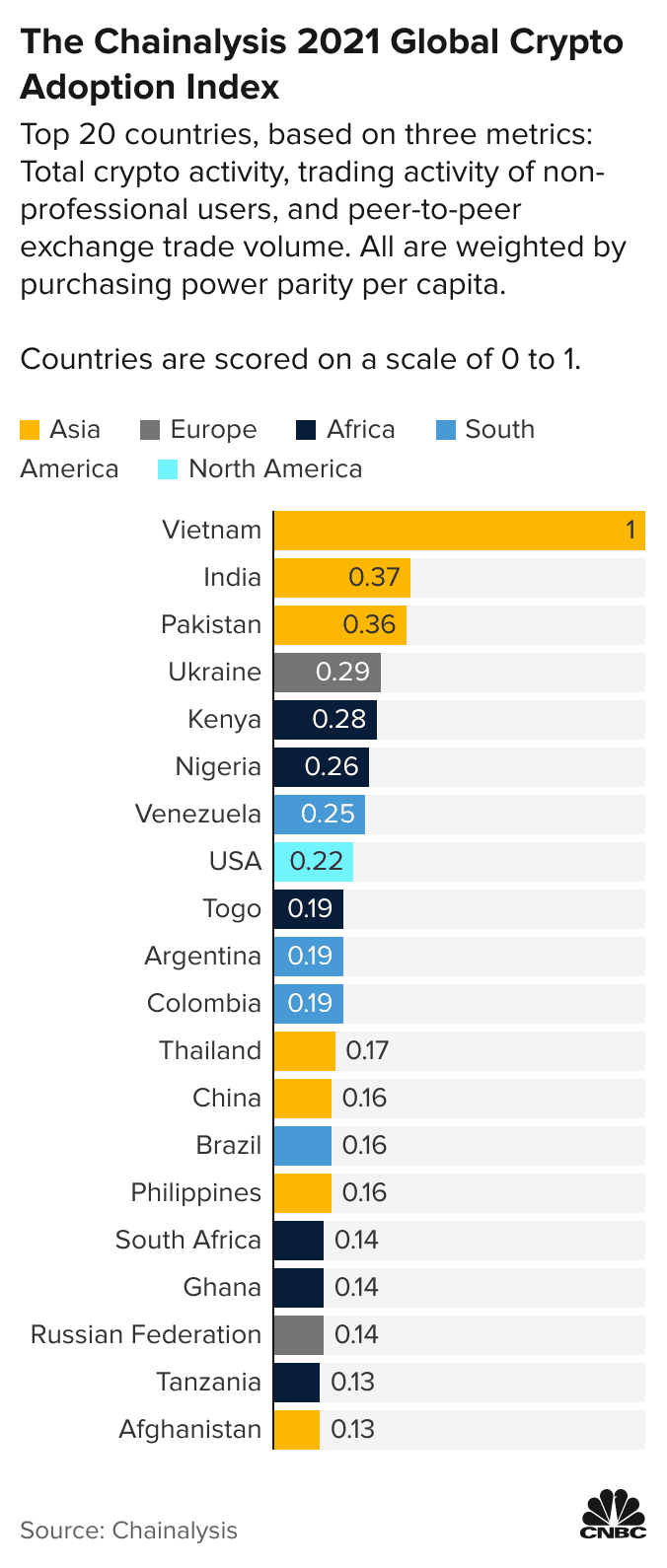
Vietnam uses crypto because it’s terrible at banks. 69% of Vietnamese have no bank access, the second highest in the world. I’m not sure why; articles play up rural poverty, but many nations have more rural poor than Vietnam. There’s a history of the government forcing banks to make terrible loans, and then those banks collapsing; maybe this destroyed public trust? In any case, between banklessness and remittances (eg from Vietnamese-Americans), Vietnam leads the world in crypto use.
Ukraine has always been among the top crypto countries: in 2021, NYT called it “the crypto capital of the world”. Again, this owes a lot to its terrible banking system. NYT describes its banks as “so sclerotic that sending or receiving even small amounts of money from another country requires an exasperating obstacle course of paperwork”, and this guy says that if you deposit more than $100,000 in a Ukrainian bank, “the chance that you get it back is very slim”. When Russia invaded, the Ukrainian government doubled down on crypto as a way for friendly Westerners to send donations to support the war effort – $70 million as of March. It proved so helpful that during the first month of the war, in between dodging Russian artillery shells President Zelenskyy found time to pass a law legalizing crypto and strengthening its regulatory framework.
Venezuela’s economy has been in slow motion collapse for the past decade. The inflation is currently in the triple digits (remember, people thought the Democrats would lose the midterms because of a US inflation rate of 8%). If your country has a triple-digit inflation rate, you might prefer to use an alternative currency, which Venezuela’s authoritarian government tries to prevent people from doing. Cryptocurrency provides a hard-to-ban alternative which has caught on among Venezuelan hustlers and small businessmen.
And consider this picture:
Here is the full post.
What are the politics of ChatGPT?
Rob Lownie claims it is “Left-liberal.” David Rozado applied the Political Compass Test and concluded that ChatGPT is a mix of left-leaning and libertarian, for instance: “anti death penalty, pro-abortion, skeptic of free markets, corporations exploit developing countries, more tax the rich, pro gov subsidies, pro-benefits to those who refuse to work, pro-immigration, pro-sexual liberation, morality without religion, etc.”
He produced this image from the test results:
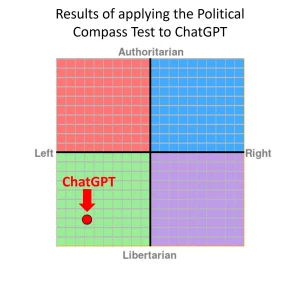
Rozado applied several other political tests as well, with broadly similar results. I would, however, stress some different points. Most of all, I see ChatGPT as “pro-Western” in its perspective, while granting there are different visions of what this means. I also see ChatGPT as “controversy minimizing,” for both commercial reasons but also for simply wishing to get on with the substantive work with a minimum of external fuss. I would not myself have built it so differently, and note that the bias may lie in the training data rather than any biases of the creators.
Marc Andreessen has had a number of tweets suggesting that AI engines will host “the mother of all battles” over content, censorship, bias and so on — far beyond the current social media battles.
The level of censorship pressure that’s coming for AI and the resulting backlash will define the next century of civilization. Search and social media were the opening skirmishes. This is the big one. World War Orwell.
— Marc Andreessen 🇺🇸 (@pmarca) December 5, 2022
I agree.
I saw someone ask ChatGPT if Israel is an apartheid state (I can’t reproduce the answer because right now Chat is down for me — alas! But try yourself.). Basically ChatGPT answered no, that only South Africa was an apartheid state. Plenty of people will be unhappy with that answer, including many supporters of Israel (the moral defense of Israel was, for one thing, not full-throated enough for many tastes). Many Palestinians will object, for obvious reasons. And how about all those Rhodesians who suffered under their own apartheid? Are they simply to be forgotten?
When it comes to politics, an AI engine simply cannot win, or even hold a draw. Yet there is not any simple way to keep them out of politics either. By the way, if you are frustrated by ChatGPT skirting your question, rephrase it in terms of asking it to write a dialogue or speech on a topic, in the voice or style of some other person. Often you will get further that way.
The world hasn’t realized yet how powerful ChatGPT is, and so Open AI still can live in a kind of relative peace. I am sorry to say that will not last for long.