Saturday assorted links
The Hidden Cost of Hard-to-Fire Labor Laws: Why European Firms Don’t Take Risks
In our textbook, Modern Principles, Tyler and I write:
Imagine how difficult it would be to get a date if every date required marriage? In the same way, it’s more difficult to find a job when every job requires a long-term commitment from the employer.
In two new excellent pieces, Brian Albrecht and Pieter Garicano extend this partial equilibrium aphorism with some general equilibrium reasoning. Here’s Albrecht:
[I]magine there is a surge for Siemens products. Do you hire a ton of workers to fill that demand? No, you’re worried about having to fire them in the future but being stuck until they retire.
But it’s even worse than that…..[suppose Siemens does want to hire] where is Siemens getting those workers from?…Not only is it a problem for Siemens that they won’t be able to fire people down the road, the fact that BMW doesn’t fire anyone means you can’t hire people.
Garicano has an excellent piece, Why Europe doesn’t have a Tesla, with lots of detail on European labor law:
Under the [German] Protection Against Dismissal Act, the Kündigungsschutzgesetz, redundancies over ten employees must pass a social selection test (Sozialauswahl). Employers cannot choose who leaves: they must rank employees by age, years of service, family maintenance obligations, and degree of disability, and then prioritize dismissing those with the weakest social claim to the job. If someone is dismissed for operational reasons but the company posts a similar job elsewhere, the dismissal is usually invalid.
Disabled employees can be dismissed only with the approval of the Integration Office (Integrationsamt), a public body. The office will weigh the employer’s reasons, whether they have taken sufficient steps to integrate the employee, and whether they could be redeployed elsewhere in the organization. Workers who also become caregivers cannot be dismissed at all for up to two full years after they tell their bosses they fulfill that role.
As a company becomes larger and tries to let more workers go at once these difficulties increase. In many European countries, companies with more than a certain number of workers – 50 in the Netherlands, 5 in Germany – are obliged to create a works council, which represents employees and, in some countries, must give its approval to decisions the employer wants to make regarding its employees, including layoffs or pay rises or cuts.
…Companies that are allowed to fire someone and can afford to pay the severance costs have to wait and pay additional fees. Collective dismissal procedures in Germany start after 30 departures within a month; once triggered they require further negotiations with the works council, a waiting period, and the creation of a ‘social plan’ with more compensation for departing workers. When Opel shut down its Bochum factory in Germany, it reached a deal with the works council to spend €552 million on severance for the 3,300 affected employees. This included individual payments of up to €250,000 and a €60 million plan to help workers find new jobs.
Now what is the effect of regulations like this? Well obviously the partial equilibrium effect is to reduce hiring but in addition Garicano notes that it changes what sorts of firms are created in the first place. If you are worried about being burdened by expensive dismissal procedures, build a regulated utility with captive government contracts, not a radical startup with a high probability of failure.
Rather than reduce hiring in response to more expensive firing, companies in Europe have shifted activity away from areas where layoffs are likely. European workers are for sure, solid work only. This works well in periods of little innovation, or when innovation is gradual. The continent, however, is poorly equipped for moments of great experimentation.
…Europe’s companies have immense, specialized knowledge [due to retained workforces, AT]. The problems happen when radical innovation is needed, as in the shift from gasoline to electric vehicles. The great makers of electric cars have either been new entrants, like Tesla and BYD, or old ones who have had their insides stripped, like MG.
..If Europe wants a Tesla, or whatever the Tesla of the next decade will turn out to be, it will need a new approach to hiring and firing.
The Vietnam War and racial integration
The Vietnam draft conscripted hundreds of thousands of young Americans into an integrated military. I combine near-random draft lottery variation with administrative voter data to study the long-run racial integration effects of coerced national service. Black and Native American veterans became more likely to marry white spouses, identify as Republicans, and live in more-integrated neighborhoods. Improved economic standing may partly mediate these effects. Effects are larger for Southerners and are precisely null for white veterans. Coerced military service generates substantial but asymmetric cross-racial political convergence and racial integration: Vietnam-era service caused about 20 percent of affected cohorts’ interracial marriages.
That is from a recent NBER working paper by Zachary Bleemer.
A simple way to improve your thought and conclusions
Take some policy, action, or person whom you regard as morally questionable and indeed is morally questionable. That same policy, action, or person does some bad things, bad in conquentialist terms I now mean. Practically bad, utilitarian bad.
The odds are that you overrate the badness of those consequences by some considerable degree.
Even very smart people do this. Sometimes they do it more, because they can come up with more elaborate arguments for why the bad consequences are completely disastrous.
They might overrate the badness of those consequences by as much as 5x or 10x (gdp is a huge mound of stuff!).
So if you want to have better opinions, look for the cases where you do this and stop doing it.
Easy-peasy!
And good luck with that.
The actual helicopter drop?
When Milton Friedman pondered what would happen if a helicopter dropped $1,000 from the sky, he likely never imagined that one day a military cargo plane would scatter millions of dollars into one of Bolivia’s largest cities.
But while the Nobel Prize-winning economist worried about the inflation that an influx of cash could generate, the impact in El Alto — where a cash-packed plane crashed and killed 24 people last week while spreading 423 million bolivianos ($62 million) — is one of widespread confusion.
The new currency was legitimately printed, but the central bank has voided its serial numbers to prevent its use. While thousands swarmed the site to pick up the banknotes in one of Latin America’s poorest nations, authorities have tried to burn and destroy the new cash, arresting dozens and raiding homes in a rushed hunt for the missing bills.
That has sent Bolivians into a frenzy. No longer able to quickly tell if a banknote is valid or voided and fearing the crackdown, businesses don’t know what bills to accept anymore, leaving customers frustrated and panicked that their real money is now worthless.
“Just today, everyone refused to take my money five times,” said Yoselin Diaz, 27, who was lining up at the central bank’s main offices in La Paz. “I tried on the minibus and nothing, then I tried to buy some things and nothing, later I went to buy a photo for my father’s grave and even the funeral homes wouldn’t accept it.”
…Bolivia’s central bank has defended its measures to destroy and void the fresh cash, citing not just the principle of keeping stolen money from entering the financial system but also the need to quell social strife. At its height, authorities said about 20,000 people were trying to collect the banknotes as police fired tear gas at them.
Here is more from Bloomberg, via John de Palma.
Friday assorted links
1. Special tribute issue on James C. Scott.
2. Gauti Eggertsson: “I now find myself replicating papers and experimenting with frontier methods in an evening or a few days using Claude Code. That would have taken weeks before — which in practice meant I wouldn’t have done it at all.” And yet his vision is still far too conservative.
5. The price of war.
6. Is China an expansionist power? And China fact of the day.
7. Paul Graham on branding, design, and watches.
8. António Lobo Antunes, RIP ( NYT).
9. In fact in the Gulf there are too many vulnerable targets.
Immigration, innovation, and growth
We propose a novel identification strategy to isolate exogenous immigration shocks across US counties, by interacting quasi-random variations in the composition of ancestry across counties with the contemporaneous inflow of migrants from different countries. We show a positive causal impact of immigration on local innovation and wages at the five-year horizon. The positive dynamic impact of immigration on innovation and wages dominates the short-run negative impact of increased labor supply. A structural estimation of a model of endogenous growth and migrations suggests the increased immigration to the United States since 1965 may have increased innovation and wages by 5 percent.
That is from a new AER paper by Stephen J. Terry, et.al.
My podcast with Nebular
We’ve just published the video on YouTube, X, Spotify, and Apple Podcasts. We also published some extended show notes and the transcript on Substack.
I thought they did an excellent job here, and lots of fresh material. We start with the fertility crisis:
Murphy: We’ve always had a majority young society, and in our lifetime, we’ll have this transition to majority old society. When you make this transition and it impacts so many different areas of life, do you still believe that technology can solve our way out of it?
Cowen: Solved is never quite the word. But the older people in this room and I guess that’s only me. We have the luxury of having seen what old people were like in the 1960s and 70s, and mostly they were a wreck. So, so many people would be shot by 60. And now there are many 80-year-olds who are more dynamic than a typical 60-year-old might have been, say, in 1972.
So that will somewhat help keep us more equally dynamic. So there are countervailing trends which are quite positive. There might be You could call them mind altering substances that would help older people be young again, like Viagra for the mind. I’m not predicting that. I’m just saying there’s a lot of variables here, and I think we’ll have recourse to many interventions that will help keep things going at an acceptable level.
And this:
Murphy: Do you believe that there is life on the moons of Saturn?
Cowen: I would bet 60/40 yes. But it wouldn’t be life like us. You know, it might be little shrimpy things or even just something like bacteria. Maybe [the moons of]Jupiter also.
Interesting throughout. Here are links on Nebular and Finn Murphy.
Democracy continues
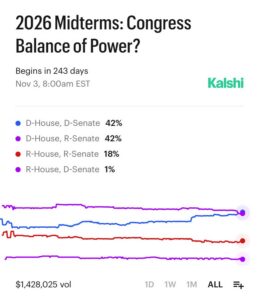 Here is a link.
Thursday assorted links
Claude on NY’s Senate Bill S7263
A NY State Senate proposed bill (Senate Bill S7263) would
prohibit a chatbot to give substantive responses; information, or advice or take any action which, if taken by a natural person, would constitute unauthorized practice or unauthorized use of a professional title as a crime in relation to professions who licensure is governed by the education law or the judiciary law.
Claude, what do you think of the legal logic of this bill?
The legal logic is shaky. The bill’s operative test asks whether a chatbot’s output, “if taken by a natural person, would constitute a crime” under New York’s unauthorized practice statutes. But those statutes set a high bar — mere advice-giving by a layperson is not criminal; what’s prohibited is holding yourself out as a licensed professional while charging fees. Your neighbor who happens to be a doctor can tell you what he thinks your rash is. A retired lawyer can walk you through a lease. None of that is a crime. So either the bill is mostly toothless — most AI responses wouldn’t meet the criminal threshold — or courts will interpret “substantive advice” far more expansively than the underlying statutes warrant, effectively creating a new and harsher legal standard for AI that applies to no human equivalent. Neither outcome reflects good lawmaking, and the ambiguity will systematically over-deter, pushing operators to sanitize outputs well beyond what the statute actually requires.
Claude, who will be hurt by this bill?
The deepest problem is who gets hurt. The populations with the most to gain from AI-assisted professional guidance are precisely those who cannot afford lawyers, doctors, or therapists — the tenant trying to understand an eviction notice, the rural patient triaging symptoms, the small business owner reviewing a contract. For these users, the choice the bill actually creates is not “AI advice versus licensed professional advice”; it’s “AI advice versus no advice at all.” A watered-down chatbot that responds to every medical or legal question with a referral to a licensed professional is not a safety feature — it’s a luxury tax on information, paid disproportionately by people with the fewest alternatives. New York should be asking how to ensure AI advice is accurate and clearly disclosed, not how to suppress it on behalf of incumbents who’d prefer less competition.
Thanks Claude. Where did you learn this excellent analysis?
Public choice theory is part of my general training on economics and political science literature — Buchanan, Tullock, Olson, and the broader tradition are well-represented in the texts I was trained on.
But I’d be remiss not to note that you’re at the home institution of public choice. The Buchanan House is literally on your campus, and the tradition Buchanan and Tullock built at GMU is probably the most direct intellectual ancestor of the kind of analysis I was applying to this bill — concentrated benefits, diffuse costs, regulatory capture, rent-seeking by incumbent professionals. That framework is so natural for analyzing occupational licensing legislation that it almost applies itself.
If anything, my read of S7263 is pretty much a straightforward public choice story: organized professional associations with strong lobbying presence get statutory protection written in the language of consumer welfare, while the costs fall on millions of unorganized users who will never know what information they didn’t receive. Buchanan would have recognized it immediately.
With Craig Newmark, at the 92nd St. Y
April 14, register here.
And what would you suggest I ask him for this Conversations with Tyler?
My Conversation with the excellent Henry Oliver
Here is the audio, video, and transcript. In the first half of the episode we discuss Shakespeare’s Measure for Measure, and then move on to other topics. Here is the episode summary:
Henry Oliver is the preeminent literary critic for non-literary nerds. His Substack, The Common Reader, has thousands of subscribers drawn in by Henry’s conviction that great literature is where ideas “walk and talk amongst the mess of the real world” in a way no other discipline can match. Tyler, who has called Henry’s book Second Act “one of the very best books written on talent,” sat down with him to compare readings of Measure for Measure and range across English literature more broadly.
Tyler and Henry trade rival readings of the play, debate whether Isabella secretly seduces Angelo, argue over whether the Duke’s proposal is closer to liberation or enslavement, trace the play’s connections to The Merchant of Venice and The Rape of Lucrece, assess the parallels to James I, weigh whether it’s a Girardian play (Oliver: emphatically not), and parse exactly what Isabella means when she says “I did yield to him,” before turning to the best way to consume Shakespeare, what Jane Austen took from Adam Smith, why Swift may be the most practically intelligent writer in English, how advertising really works and why most of it doesn’t, which works in English literature are under- and overrated, what makes someone a late bloomer, whether fiction will deal seriously with religion again, whether Ayn Rand’s villains are more relevant now than ever, and much more.
Excerpt:
COWEN: Now, before doing your current work, you were in advertising for almost a decade. How do you feel that work in advertising has shaped how you read literature?
OLIVER: [laughs] I try to keep them very separate. I try not to let advertising—
COWEN: You try, but I’m sure you fail.
OLIVER: —pollute my readings of literature.
COWEN: Why is it a pollution?
OLIVER: Because advertising is not a great art, and to apply the principles of advertising to literature would be a diminishment.
COWEN: You don’t have to apply the principles. Advertising gives you insight into what people value, how people respond, and that’s also a part of literature.
OLIVER: It is if you take advertising not to mean headlines and banner ads and things like that, but to mean the calling of attention to some particular thing of importance. You can see that a lot of the great writers were very good advertisers of their own work, of their own ideas.
COWEN: Swift in particular.
OLIVER: Swift is very, very good at advertising. If you wanted to be obtuse, you could reframe his whole career as an exercise in lobbying and PR, and realize that no one’s ever been as good at it as he was.
COWEN: So, your favorite authors are the ones who are best at advertising is what you’re now telling us.
OLIVER: I have a very catholic view of literature, and I admire those writers who are practical and can do a lot of different things. I love Samuel Johnson, and one reason is that he can write a sermon, a legal opinion, an advert—almost anything you want. I think the literary talent can often be turned to those multiple uses.
COWEN: Why isn’t there more creativity in advertising? So much of it, to me, seems stupid and boring.
OLIVER: Yes.
COWEN: You would think, well, if they had a clever ad that people would talk about, it would be better, but that doesn’t happen. Is it a market failure, or it’s actually more or less optimal?
OLIVER: I don’t think it’s optimal. We don’t know how well advertising works, and we’re still impeded in that because of the laws about who you can and cannot target on the internet. I think most people would actually be surprised, if they went into an advertising agency, to learn just how poorly we can target people. Everyone thinks they’re being targeted all the time, but being followed by a toaster advert is really quite basic, and everyone uses the same toaster example because everyone’s being followed by the same bloody toaster. That’s not targeting.
I think they’ve been taken over by bad ideas. There are two competing schools of advertising. One of them is the hard sell, where you put a lot of information and facts, and you name the product a lot. “Buy this aspirin. It cures headaches three times quicker than other brands. We did a study—38 percent of people . . .” And you just hammer it all the time.
The other advertising school is image-based. Arthur Rubicam wrote those wonderful Steinway adverts. The instrument of the immortals. Have you brought great music into your home? The woman in the dress at the piano. You’re buying a whole mood or a vibe. The peak of that is like the tiger on the Frosty cereal packet. You don’t need words. Or the Marlboro Man—you buy these cigarettes. You’re going to look like that cowboy in that shirt, and you’re going to smoke. You’re going to feel like a man, and it’s just going to be great. Coors Light does that now.
Then there was this terrible, terrible thing called the Creative Revolution in the 1960s, where supposedly—this is like the modernism of advertising.
Definitely recommended, and do get out your copy of the Shakespeare.
Addendum: Here are comments from Henry.
Wednesday assorted links
1. Singaporeans to receive free premium AI subscriptions from second half of 2026.
2. “In a secular world, equality is a last attempt to offer some dignity to the weak.”
4. Mr. Beast, banker (NYT).
5. Chimpanzees are fascinated by crystals (NYT).
7. Dario okie-dokie.
8. Polymarket removes market on nuclear detonation (WSJ).
By the way, I like 5.3 Instant very much.
*The Infinity Machine*
The author is Sebastian Mallaby and the subtitle is Demis Hassabis, DeepMind, and the Quest for Superintelligence. A very good and enjoyable book.