Will Fairfax follow through with The Great Experiment?
Fairfax County schools could become the first in the Washington region to create a virtual public high school that would allow students to take all their classes from a computer at home.
No sports teams. No pep rallies. No lockers, no hall passes. Instead, assignments delivered on-screen and after-school clubs that meet online.
It’s a reimagination of the American high school experience. And it’s a nod to the power of the school choice movement, which has given rise to the widespread expectation that parents should have a menu of options to customize their children’s education.
Several School Board members, who will hear a formal proposal for the online school at a meeting Monday, said they are excited by the prospect.
The full story is here.
Assorted links

Huffington Post covers *An Economist Gets Lunch*
The interview is here, with Arin Greenwood, here is one excerpt:
For the world as a whole the main thing we need to do is invest more in increasing agricultural productivity. It’s really slowed down since the 1990s. It’s a major problem for at least one billion people. I think it’s much more important than what people like Michael Pollan usually talk about. For the U.S., I think we should have a carbon tax, for environmental reasons.
I think as individuals, people overrate the virtues of local food. Most of the energy consumption in our food system is not caused by transportation. Sometimes local food is more energy efficient. But often it’s not. The strongest case for locavorism is to eat less that’s flown on planes, and not to worry about boats.
And this:
This will sound a little strange coming from me. The two dynamic sectors now are hamburgers and pizza.
And this:
There are any number of places with good decor and great food, they just cost a very high price. Most people don’t want to eat at those places on a regular basis for reasons of money or time, or just the sheer oppression of having to dress up and go to a nice place all the time.
You can order the book on Amazon here. For Barnes & Noble here. For Indiebound.org here.
The peculiar case of higher education
Via a request from Ezra for topic coverage, here are some very good remarks from Ryan Avent. Excerpt:
A sector dominated by the state—state-run in some cases, merely subsidised and regulated in others—is, I think most Americans would agree, both a major contributor to American prosperity and one of America’s most competitive industries on foreign markets, despite its glaring inefficiencies. What ought we to conclude based on this example?
Certainly, one could reasonably argue that the sector would be even better if state control were relaxed, monopolies broken up, subsidies curtailed, and market controls (like those on immigration) eliminated. But one also has to wrestle with how different the American economy would look if the state had never muscled public universities (including a broad network of technology-driven, extension-oriented schools) into existence.
This stuff is harder than we often pretend.
A few observations:
1. Postwar higher education has proven one of America’s most effective subsidies, and it has paid for itself many times over. It is also one of the more significant successes of federalism.
2. We are fortunate that U.S. state universities are more or less autonomous, compared to the Continental model where professors and administrators are treated as part of the state civil service bureaucracy. The latter system does not work well, and those countries have struggled to move closer to American models.
3. To refer back to a distinction from the David Brooks column, we should not be trying to squeeze the entire economy into the shoebox of the dynamic but risky “Economy I.” For public choice reasons, as well understood by Karl Polanyi (an underrated public choice theorist if there ever was one), the polity requires some respite from Economy I, whether we like that or not. Read also this analysis by Interfluidity, which is one of my favorite blog posts of all time. Furthermore the more “sluggish” Economy II, by operating under different principles, often serves as a useful R&D lab for Economy I. Think MIT and Stanford, or note that Adam Smith ended up as a customs commissioner, as his father had been. Goethe and Bach worked for governments for much of their lives. It’s about balance and synergy, though it is perfectly fair to see contemporary Western Europe, especially in the periphery, as a region which has far too much Economy II and too little Economy I.
4. Maintaining the truth of #1 will prove a significant challenge going forward. It’s not about blaming the critics or defunders of state universities, or the critics of public subsidies to private universities. The real problems are a few. First, successful state programs tend to stultify and decline over time, and if nothing else the danger is that health care costs will eat up state budgets. Second, the absolute returns to higher education (as opposed to the wage for not going) are not currently high enough to maintain the current fiscal structure of those institutions, furthermore those fiscal structures do not have so much “give,” due to tenure and various self-imposed cost inflexibilities. Third, although most state universities have relatively little explicit debt, they are implicitly massively leveraged through reliance on ongoing tuition boosts, ongoing enrollment boosts, and timely retirements, none of which can be counted on in the future.
It will prove a daunting path forward.
Addendum: David Henderson comments.
Comovement
Is the lap dancer sector being brought down by finance? Is the British knowledge base being eroded?
The study by Teela Sanders and Kate Hardy from Leeds University warns of “de-skilling” across the industry. Dr Sanders said many dancers had “never even used a pole”.
Researchers carried out a survey of 200 lap dancers, the largest study of its kind in the UK, it was reported.
Dr Sanders said there had been a “real change” to the “aesthetics of the dancers” as well as “the skills of flirting and chatting”.
The study is due to be presented today at the British Sociological Association’s annual conference in Leeds, according to The Times.
Here is much more, and I thank a loyal MR reader, WM, for the pointer.
Robert Mundell’s tips on how to accept a Nobel Prize
China estimate of the day
Another study, by Andrew Batson and Janet Zhang at GK Dragonomics, a Beijing-based research firm, finds that China still has less than one-quarter as much capital per person as America had achieved in 1930, when it was at roughly the same level of development as China today.
Here is more, and I thank David Levey for the pointer. The post as a whole considers whether China is overinvesting and concludes maybe not. Here are further debates on how China is doing.
Assorted links
Six Rules for Dining Out
The Atlantic Monthly feature article from An Economist Gets Lunch is now on-line, excerpt:
When you enter a restaurant, you don’t want to see expressions of disgust on the diners’ faces, but you do want to see a certain seriousness of purpose. Pull out a mirror and try eating some really good food. How much are you smiling? Not as much as you might think. A small aside: in many restaurants, it is a propitious omen when the diners are screaming at each other. It’s a sign they are regular customers and feel at home. Many Chinese restaurants are full of screaming Chinese patrons. Don’t ask me if they’re fighting, I have no idea—but it is a sign that I want to be there too.
And:
If you’re asking Google, put a “smart” word into your search query. Best restaurants Washington will yield too much information, and will serve up a lot of bad restaurants, too. That’s a lowest-common-denominator search query. Google something more specific instead, like best Indian restaurants Washington, even if you don’t want Indian food. You’ll get to more reliable, more finely grained, and better-informed sources about food, and you can then peruse those sources for their non-Indian recommendations. Google Washington best cauliflower dish, even if you don’t want cauliflower. Get away from Google-for-the-masses.
Here is a good video bit of me exploring a new Vietnamese restaurant in Eden Center.
You can pre-order the book on Amazon here. For Barnes & Noble here. For Indiebound.org here.
Ahem…
The study, funded by the William and Flora Hewlett Foundation, compared the software-generated ratings given to more than 22,000 short essays, written by students in junior high schools and high school sophomores, to the ratings given to the same essays by trained human readers.
The differences, across a number of different brands of automated essay scoring software (AES) and essay types, were minute. “The results demonstrated that over all, automated essay scoring was capable of producing scores similar to human scores for extended-response writing items,” the Akron researchers write, “with equal performance for both source-based and traditional writing genre.”
“In terms of being able to replicate the mean [ratings] and standard deviation of human readers, the automated scoring engines did remarkably well,” Mark D. Shermis, the dean of the college of education at Akron and the study’s lead author, said in an interview.
Here is more.
Claims about Mexico
From John Paul Rathbone:
For the first time in a decade there are good reasons to be less bullish about China – and thus Brazil. There are also good reasons to be more bullish about the US – and thus Mexico. China has lost competitiveness because of rising wage and transport costs. North American corporate supply chains are already shortening. If the US economy recovers, Mexican manufacturers should do well.
Mexico has also become a global car producer. The industry generated $23bn of exports last year – more than oil or tourism. Nor are these cheapo maquiladora operations: Volkswagen and Nissan use Mexico’s web of trade agreements to export their cars to the whole world. As for Mexico’s “drugs war”, the once dizzying increase of violence has slowed and in some areas fallen. Why is not clear, but a 74 per cent increase in federal security spending will eventually make a difference, anywhere.
Read the whole thing, well argued throughout.
Further WSJ coverage of *An Economist Gets Lunch*
Recently he noted a jump in the quality of pizza and hamburger restaurants after his daughter dragged him to a Shake Shack restaurant.
“It took me a while to actually believe it. I had a bias,” Cowen said.
From Kristina Peterson, here is more. Here is the coverage from three days ago.
What if we live longer?
The IMF asks what would happen if life expectancy by 2050 turns out to be three years longer than current projected in government and private retirement plans: “[I]f individuals live three years longer than expected–in line with underestimations in the past–the already large costs of aging could increase by another 50 percent, representing an additional cost of 50 percent of 2010 GDP in advanced economies and 25 percent of 2010 GDP in emerging economies. … [F]or private pension plans in the United States, such an increase in longevity could add 9 percent to their pension liabilities. Because the stock of pension liabilities is large, corporate pension sponsors would need to make many multiples of typical annual pension contributions to match these extra liabilities.”
This is one reason (of several) why “doing fine against the baseline” does not much impress me as a fiscal standard. I hope to cover that broader topic soon.
Assorted links
1. World’s first commercial 3-D chocolate printer, story here, beware noisy video at that link.
2. Cardboard arcade made by a nine-year-old boy, hat tip to Karina and Chad.
3. Tightening antibiotic use for livestock; let’s hope it works, a partial but not complete Coasian trade says it won’t, in a pinch farmers will buy vets. More here.
Publication day for *An Economist Gets Lunch*
Adam Ozimek writes:
Cowen’s history of how American food came to be so mediocre is a strong counterargument to those who look to blame the phenomenon on commercialization, capitalism, and excess of choice. In contrast to the usual narrative, Cowen tells us how bad laws have played an important role in shaping our food ecosystem for the worse over time. This includes prohibition’s negative and long lasting impact on restaurants, and the government aggressively limiting one of our greatest sources of culinary innovation: immigration. This is not to lay the blame entirely on the government. Television and a culture that panders to the desires of children have also incentivized poor culinary trends.
The book contains many other other important arguments against popular food ideas, including defenses of technology and agriculture commercialization against critiques of locavores, slow foodies, and environmentalists. For example, if you live in an area where it takes a lot of energy and resources to grow food — like the desert — the most environmentally friendly way may be to grow it somewhere else and ship it. An apple grown locally may be refrigerated for months, which consumes a lot of energy, whereas it may be both fresher and better for the environment to grow it elsewhere and ship it in from afar by boat. He also defends genetically modified crops as the likely cures to the biggest food problem we have today, which is not obesity but malnutrition.
But Cowen is not an apologist, and he doesn’t argue that we can just deregulate our way to a better food system. In fact he has many words of support for policies and values often supported by progressives.
…If there is one overarching lesson it is that looking at food through the framework of supply and demand can help you both understand our food system better, and also help you be a smarter consumer and get more out of every meal.
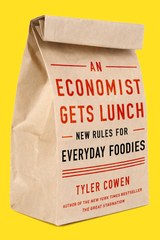
You can pre-order the book on Amazon here. For Barnes & Noble here. For Indiebound.org here.