Malthus had real influence
From a recent paper by Eric Robertson:
Public officials often fail to implement government policy as directed, yet the role of economic ideas in shaping these implementation choices is poorly understood. This paper provides causal evidence that exposure to economic ideas can durably influence bureaucrat behavior. I study British colonial bureaucrats in India, exploiting a natural experiment created by the abrupt death of Thomas Malthus in 1834, replacing his economics instruction at a bureaucrat training college for that of a contemporary critic, Richard Jones. Whereas Malthus regarded economic distress as a natural mechanism for restoring equilibrium by reducing population growth, Jones disagreed with this view. Linking rainfall shocks to district-level fiscal responses, I show that officials trained by Malthus delivered less relief during droughts, providing 0.10-0.25 SD less aid across all major measures compared with officials taught by Jones. The results reveal that exposure to abstract economic ideas can shape real-world policy implementation for decades.
This may be a case where using rainfall shocks in a paper actually makes sense. Via Krzysztof Tyszka-Drozdowski.
India’s AI wedding buffet
Shruti Rajagopalan surveys much of the AI policy debate in India. Excerpt:
If there is a single domain where India’s AI ambitions will succeed or fail, it is energy. And energy in India is not a technology problem. It is a political economy problem, arguably the most intractable one the country faces.
India’s peak electricity demand hit 250 GW in May 2024, up from 143 GW a decade earlier. The IEA forecasts 6.3 percent annual growth through 2027, faster than any major economy. Cooling demand alone could reach 140 GW of peak load by 2030. One number captures the trajectory. For each incremental degree in daily average temperature, peak demand now rises by more than 7 GW. In 2019 the figure was half that. India is getting hotter, richer, and more electricity-hungry simultaneously.
State-controlled distribution companies have accumulated $83.7 billion in debt because energy prices have been politically distorted for decades. Over 50 GW of renewable capacity sits underutilized. About 60 GW is stranded behind inadequate transmission. The shortage is financial and infrastructural, not resource-based. Without reforming distribution pricing, governance, and grid investment ($50 billion estimated by 2035), new renewable capacity will not become reliable electricity. It will become another line item on a DISCOM balance sheet no one wants to read.
India’s electricity reaches consumers through 72 distribution companies, 44 of them state-owned, collectively the most financially distressed utilities in the world. Accumulated losses stood at ₹6.92 trillion ($76.89 billion) as of March 2024, rising every year despite five government bailouts since 2002.
Substantive throughout.
At the Grand Egyptian Museum
Neal Spencer has a good review at the LRB, excerpt:
Over the past few decades, however, Egyptian museums have pivoted away from Europe and America. The National Museum of Egyptian Civilisation, which opened in 2021, rejected the traditional division of artefacts into pharaonic, Coptic, Greco-Roman and Islamic eras (a framework associated with European academic disciplines). The Grand Egyptian Museum, announced at the height of Hosni Mubarak’s rule and styled ‘the largest museum in the world dedicated to the people, history and culture of Ancient Egypt’, opened in November last year with a lavish ceremony broadcast round the world. It is estimated to have cost more than $1 billion ($300 million of which was a loan from Japan) and sprawls over an area the size of seventy football pitches. The financial crash of 2008, the Arab Spring and Covid meant that its construction took almost twenty years. Much has changed in that time. The last decade of construction took place under the military regime of Abdel Fattah el-Sisi, who installed one of his generals as its head – the first non-Egyptologist to direct a major Egyptian museum.
I saw the museum shortly after the opening and found it pretty spectacular, both the building/setting and the collection. It is worth making a trip to Cairo just to see this, and it now can be considered one of the world’s great museums and history sites (yes I had seen the earlier incarnation of the museum, years ago). The very wise Rasheed Griffith also gave the museum an A+.
Sunday assorted links
Natural and Artificial Ice
Excellent Veritasium video on the 19th century ice industry. Shipping ice from America to India would hardly seem like a wise idea—it’s hard to imagine ever getting a committee to approve such a venture—but entrepreneurs are free to try wacky ideas all the time, and sometimes they pay off, resulting in great riches. That’s the story of the “Ice King,” Frederic Tudor, who lost money for years before figuring out the insulation and logistics needed to make the trade profitable.
What I hadn’t fully appreciated is how the ice trade reshaped shipping, diet, and city design before the invention of mechanical refrigeration. Ice created the cold chain, and the cold chain made it possible to move fresh meat, fish, and produce over long distances. That in turn enabled cities to grow far beyond what local agriculture could support and shifted the American diet from salted and smoked provisions toward fresh food.
The profits of the ice trade encouraged investment in artificial ice which initially was met with resistance—natural ice is created by God!—a classic example of incumbents wrapping their economic interests in moral language, a pattern we see repeated with every disruptive technology from margarine to ridesharing.
Lots of lessons in the video about option value, permissionless innovation, and creative destruction. New technologies destroy old industries and create new ones that no one could have foreseen. The moral panic over artificial ice replacing the natural kind is no doubt familiar.
Hat tip: Naveen Nvn
The economics of corporate espionage
Weprovide systematic evidence on the economic damages from espionage to US firms and industries. Compiling a comprehensive dataset of publicly disclosed espionage incidents from 1995-2024, we establish that espionage has substantial negative effects on targeted f irms. In an event-study design, revenues and R&D expenditures at targeted firms decline by roughly 40% within five years, with effects persisting for up to a decade. These effects do not appear for firms unsuccessfully targeted for espionage, supporting a causal interpretation. These firm-level damages translate into measurable aggregate effects on US industry: exports in targeted sectors decline by 60% over a decade. Given these substantial damages, we investigate whether firms restrict knowledge sharing in response to espionage. Across a wide range of outcomes, we find no evidence of such restrictions. Firms do not reduce their patenting with foreign inventors, and do not discriminate in employment based on perceived espionage risk. Overall, espionage has clear economic harms to targeted firms and US industry, but firms are puzzlingly unresponsive in how they manage innovation.
That is from a new paper by Andrew Kao and Karthik Tadepalli. Via Kris Gulati.
Taxing Beta, Exempting Alpha: A Benchmark-Based Inheritance Regime
This paper proposes a generational benchmark inheritance regime as a structural replacement for the federal estate tax. By distinguishing between systemic market returns (Beta) and active value creation (Alpha), the regime captures the passive growth of capital at generational boundaries while fully exempting idiosyncratic surplus. Using a Pareto tail interpolation (α ≈ 1.163) calibrated to Federal Reserve wealth data, we estimate baseline annual revenue of approximately $295 billion under conservative assumptions. This revenue is sufficient to finance a 2.1 percentage point reduction in the OASDI payroll tax, shifting the fiscal burden from labor to underperforming dynastic capital. Unlike continuous wealth taxes, the regime requires no new valuation machinery, relying exclusively on existing estate and gift tax procedures. We situate the proposal within the Jeffersonian principle of usufruct and the modern literature on optimal inheritance taxation.
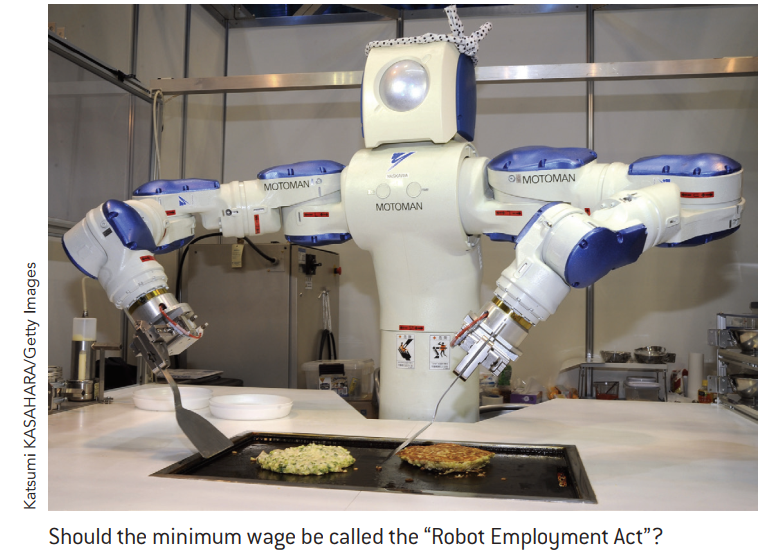
Minimum wage hikes and robots
This paper studies how minimum wage policy affects firms’ adoption of automation technologies. Using both state-level measures of robot exposure and novel plant-level data on industrial robot imports linked to U.S. Census microdata from 1992-2021, we show that increases in minimum wages raise the likelihood of robot adoption in manufacturing. Our preferred identification exploits discontinuities at state borders, comparing otherwise similar firms exposed to different wage floors. Across specifications, a 10 percent increase in the minimum wage increases robot adoption by roughly 8 percent relative to the mean.
That is from Erik Brynjolfsson, et.al., including Andrew Wang. Via the excellent Kevin Lewis.
By the way, a photo from our textbook Modern Principles of Economics:
Saturday assorted links
1. The myth of Nordic mobility.
2. How should Pakistan price its solar power?
3. Recoding America Fund jobs.
4. Data on lesbians in comedy.
5. Right to repair and defense contracting.
7. Pelicot interview (NYT). Unfathomable.
The cocaine problem seems to be getting worse again
Colombian coca cultivation fell dramatically between 2000 and 2015, a period that saw intense U.S.-backed eradication and interdiction efforts. That progress reversed in 2015, when peace talks and legal rulings in Colombia opened enforcement gaps. Coca plantation has since increased to record levels, which coincided with a sharp rise in cocaine-related overdose deaths in the U.S. We estimate how much of that rise can be causally attributed to Colombia’s new coca boom. Leveraging the unforeseen coca supply shock and cross-county differences in pre-shock cocaine exposure, we find that the surge in supply caused an immediate rise in overdose mortality in the U.S. Our analysis estimates on the order of 1,000–1,500 additional U.S. deaths per year in the late 2010s can be attributed to Colombia’s cocaine boom. Implicit annual loss in American statistical life values about $48,000 per hectare of cultivation in Colombia. If left untamed, the current level of coca cultivation (over 230,000 ha in 2022) may impose on the order of $10 billion per year in costs via overdose fatalities.
That is from a new NBER working paper by Xinming Du, Benjamin Hansen, Shan Zhang, and Eric Zou.
Changes in the Gender Wage Gap for Business Professionals
In the United States, much of the gap in earnings between men and women is due to the persistent gap for high wage earners. This paper explores changes in the gender wage gap for MBAs graduating from a large public university over 30 years. We document large gender wage gaps on average, which grow in the course of men’s and women’s careers. Comparing graduates at identical career stages across time periods to address composition concerns, we show that the raw gender wage gap has shrunk by 33 to 50 percent over the last two decades. Additionally, the temporal pattern of the gap has fundamentally shifted: while gaps only emerged over time in earlier decades, significant gaps now emerge immediately. Convergence in labor supply factors, particularly hours worked, explains much of the narrowing gap, alongside shifts in industry composition. However, unexplained wage gaps persist for recent graduates from the very start of their careers, suggesting different underlying mechanisms across cohorts. These findings highlight both progress in gender wage equity among business professionals and concerning patterns that emerge earlier in careers than in previous decades.
That is from a recent NBER working paper by
My WaPo podcast with Megan McArdle
Here is the link, self-recommending…
Friday assorted links
1. The economy of Egypt continues to improve.
2. Who is Claude really? (New Yorker)
3. Cowen’s Second Law, as applied to the Midwest.
4. Andreas Backhaus economics Substack, a post on why the motherhood penalty is smaller than many think.
5. Derivatives on derivatives for the Second Coming.
6. The debate over Mars life continues.
7. Can Greenland be an AI powerhouse? (WSJ)
Those new service sector jobs
Who needs to be a programmer, be hired to close the doors on Waymo vehicles:

Or see here. And more text from TechCrunch. Via Glenn Mercer, Tom McCarthy, and also Air Genius Gary Leff.
The import of cross-task productivity
Given that LLMs seem to be able to automate so many small tasks, why don’t we see large productivity effects?
I drafted a short paper recently exploring the possibility that it’s for the same reason (or at least one of the reasons) that labor is typically bundled into multi-task jobs, instead of transacted by the task, in the first place: because performing a task increases one’s productivity not only at the task itself but at related tasks.
For example, say you used to spend half your time coding and half your time debugging, and the LLM can automate the coding but you still have to do the debugging. If you’re more productive at debugging code you write yourself, this (1) explains why “coder” and “debugger” aren’t separate jobs, and (2) predicts that the LLM won’t save half your time. If you’re half as productive at debugging code you didn’t write, or less, the LLM saves you no time at all.
So I was excited to see @judyhshen and @alextamkin’s paper from a week or two ago finding basically just that!
At least the way I’m thinking about it, “cross-task learning” should make the productivity impacts of automating tasks more convex: – Automating the second half of a job should be expected to have much more of an impact than automating the first half; and – If the machines can learn from their and each others’ experience, as a worker learns by doing from her own experience, then automating two jobs will have more than twice the impact of automating one.
That is from Philip Trammell. Here is his short piece. Here is the Shen and Tamkin paper. This is all very important work for why the AI growth take-off will be much slower than the power of the models themselves might otherwise indicate. The phrase “…and then all at once” nonetheless applies. But when?
These short pieces and observations are likely among the most important outputs economists will produce this year. But are they being suitably rewarded?