Signaling or human capital?
Is there any way to sustain the current revenue model of higher ed? How about firefighters? You can read this story as illustrating human capital theories of education, signaling theories, or both:
“We still put out fires with water,” said Deason, who is also a lieutenant and paramedic at a fire department in Homewood, Ala. But fire companies these days “need people who are a little more advanced with their education.”
As a result, college degrees that are not fire-related can also help. Deason and Crowther said fire departments increasingly want career employees who have strong critical thinking skills, and who can write grants or do public speaking, particularly as they progress to leadership roles.
Two other drivers of the growing higher education demand among firefighters are the recession and colleges’ online offerings. Purchasing and budget decisions are more important than ever, as most municipalities have tight finances. And financial and technical know-how helps when considering big expenses, like the $675,000 fire engine Deason said his company recently bought.
… In the future, he said advanced degrees will probably be an “absolute requirement” for most chief positions.
Assorted links
1. On the new EU deal, and here too, the Italian ten-year yield is down only a small amount.
2. On TGS, the excellent Edward Tenner.
3. Telemundo will start using some English subtitles and other smatterings of the language.
4. More on Italian small firms, and here is Henry’s post but I think Italian small firms have to do better than just OK, once you consider the volatility of different sectoral fates.
5. Observations about successful fiscal adjustments, and economics Haiku.
Opinions on the new gdp growth data
You’ll find them here, I’m with Dan Greenhaus:
That is slower that virtually every recovery in the last near fifty years but is not that far behind the last recovery.
Note that the level of real gdp has finally passed the previous peak from the fourth quarter of 2007, though in per capita terms it has not.
Why the current revenue model of higher education is in trouble

The picture for females is also not pleasant, all from the excellent Michael Mandel. Those are simple facts, denied by some.
Non-college grads also have seen declining wages, and so one can look at the “finish college vs. finish high school only” margin and conclude that the return to higher education is robust. Another approach is to look at the “finish college and get on a real career track” vs. “finish college and hang out” margin and conclude the sector is in trouble, which indeed is the case. Don’t get stuck looking at the old margins only, the new and powerful margin, I am sorry to say, is relative to unemployment or extreme underemployment. The status and avoid-shame returns are high enough to keep a lot of people going to college, at current prices, but the falling real wages for graduates aren’t going to sustain an enormous amount of extra sectoral growth, including on the price side. Nor do I expect the preceding orgy of student debt to repeated, at that level, anytime soon.
Sikhs defend and promote Parmesan cheese the culture that is Italy
Many of Italy’s 25,000-strong Sikh community originate from India’s Punjab region but have found their calling producing Parmesan and prosciutto ham in Lombardy and Emilia Romagna. Most are employed as dairy hands but some, such as Singh, are taking over key roles in preparing the sharply flavoured hard cheese grated onto pasta dishes and shaved into salads the world over. “I looked for any work when I first arrived, even as a dishwasher. I was ready to do anything, but I like being a cheesemaker a lot,” said the 34-year-old father of two.
…There aren’t Italians in the industry any more. Making Parmesan means long hours: you have to work weekends, holidays, every day of the year. Italians have money and the young won’t do the job any more,” he said. “I’ve stayed because I’m passionate about it, you have to be,” said the 71-year-old as he supervised Singh stir vat after vat of slowly heated cow’s milk, breaking up the curds with a huge, unwieldy whisk.
“We’re really lucky to have found foreigners to milk our cows”.
At the dairy in nearby Novellara, which specialises in producing milk for making Parmesan, half the labourers are Sikhs, prized as methodical, hard workers who are eager to fill the posts that open as Italians desert the industry. By Italian standards, the money is very good too, with Sikh cheesemakers earning up to 2,000 euros (USD 2,800) a month.
“Most of our workers are Indian,” said farmer Stefano Gazzini. “They are more dedicated to their work. They seem to have integrated well into the community, and even have their own temple.”
The story is here and for the pointer I thank Kurt Schuler.
Addendum: Here is an NYT version of the story as well.
Is Iceland really doing so well?
I agree with Megan McArdle’s general point that the winners and losers from this financial crisis have not yet been sorted out. Here is Jon Danielsson, with some negative notes on Iceland’s economic performance:
Based on the current state of the Icelandic economy, the Fund’s claim of success [for Iceland] does not stand up to scrutiny.
- Public finances are not on a sustainable path,
- Exchange rates are not fully stable even with capital controls,
- Investment has collapsed, and
- The financial sector is dysfunctional.
At the same time, the Fund forced Iceland to impose a high interest-rate policy at the time when every other developed economy was doing the opposite…
GDP has declined by about 11% since the crisis of October 2008, but modest and volatile growth has returned, sustained primarily by an increase in private consumption catching up after two years of austerity. Worryingly, export growth is low, even with a sharp fall in the exchange rate, while investment is at a record low.
Business investment rates in Iceland equalled the EU average from 1995 to 2008, according to Eurostat.
- Over the past two years the investment rate in Iceland collapsed to 10% whilst the EU only suffered a small decline to 17%.
…Initially, the capital controls were touted as a temporary measure to prevent a sharp depreciation of the currency, but by now the domestic economy has adapted to their presence, and become increasingly inward looking. The signs point to the controls remaining.
…Unfortunately, the government has also been using the capital controls as means to implement industrial policy, politically selecting those allowed to use cheap offshore kronas to buy Icelandic assets. Such direct political selection of investors can only breed corruption, mistrust, and inefficiency.
From PaddyPower, not the same as the InTrade odds
From an email:
As EU leaders gather in Brussels to formulate a financial package to avert monetary meltdown, the latest odds from bookmaker Paddy Power show they face a mammoth task to convince the cynical markets.
Odds for Greece to leave the Euro first and a complete Eurozone break-up have shortened as analysts nervously wait for any detail which will secure the financial fate of the monetary union.
Greece is 2/7 to be first to leave the economic union, with Portugal next at 6/1. Germany is at 16/1 – perhaps an indication that the major player in the currency may fancy leaving the worst countries to their own devices. It is 6/5 at the Eurozone will be non existent by 2015.
Paddy Power said: “The ministers have a lot of work to do here. Concerns continue to grow about the stability of Spain and Italy and Greek financial stability still isn’t a foregone conclusion. If the great and the good in Brussels don’t come up with a detailed plan soon, it’s going to get a whole lot worse and that is what we are seeing in our betting.”
First to leave the Euro
2/7 Greece
6/1 Portugal
8/1 Ireland
12/1 Italy
12/1 Spain
16/1 Germany
16/1 CyprusEurozone Break Up
6/5 Eurozone to break up by 2015
4/7 Eurozone to break up by 2020
Caveat emptor!
Bill Niskanen has passed away
Very sad news of course, it is all over Twitter from reliable sources. I must run and do not at the moment have time to blog a tribute, here is a Cato notice.
Assorted Links
1. I am impressed with Zite for iPad.
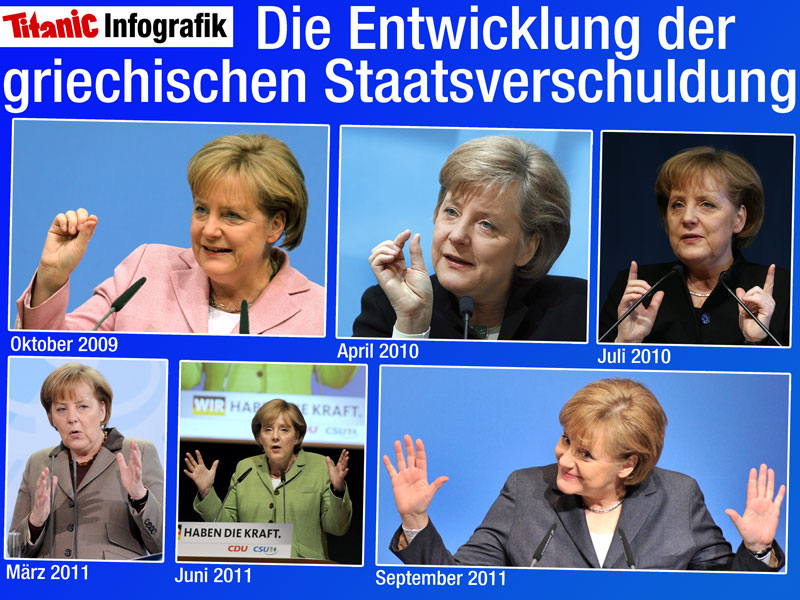
2. The growing problem of Greek debt, illustrated by Angela Merkel.
3. Jeff Miron says Greece should default.
4. Isaac Newton’s first paper, online. More here.
5. Apple granted patent on slide to unlock. Sigh.
“The network of global corporate control”?
This paper, by Vitali, Glattfelder, and Battiston, has been getting a lot of publicity, here is part of the abstract:
…We present the first investigation of the architecture of the international ownership network, along with the computation of the control held by each global player. We find that transnational corporations form a giant bow-tie structure and that a large portion of control flows to a small tightly-knit core of financial institutions. This core can be seen as an economic “super-entity” that raises new important issues both for researchers and policy makers.
I did not find this paper easy to follow, but I can show you the top few control holders, with Wikipedia links supplied by me:
1. Barclays, 2. Capital Group Companies, 3. FMR (Fidelity), 4. AXA, 5. State Street Corporation, and 6. JP Morgan.
The rest of the list, especially the top 25, is heavily financial, see a reproduction of it here. What does Barclays own on the commercial side? The paper is silent on this. CGC is a batch of mutual funds, far more decentralized than the aggregate measure from this paper would suggest; lately it’s been doing major layoffs. Fidelity is also a batch of investment funds and it is misleading to think of Fidelity shareholders as exercising control over what is held through the various funds, even though they are appointing managers to run the funds. AXA is a French insurance company and financial conglomerate. State Street is another umbrella of funds and investment companies, again proxying for a wide degree of dispersed investment. JP Morgan Co., chartered as a bank in the United States, faces serious limits on what it can own commercially, although it does run private equity services for clients.
Think about it: Fidelity proxies for millions of individual (and institutional) investors, and so it is not a corporate Blofeld in disguise. That it “owns itself” does not change this basic fact. Here is an interesting new paper on the role of mutual funds in current corporate governance; here is a somewhat older paper.
Mathematically derived linkages do not equal control or necessarily point in that direction. This paper needed a big dose of verstehen, it is more misleading than illuminating. Start again, distinguishing between ownership/control and financial intermediation and see what comes out of the mix. Comcast does own and control NBC and that relationship is different from the large network of assets held through Fidelity mutual funds. The real lesson of this paper is simply that a large chunk of financial intermediation is run through a few dozen firms, hardly a revelation.
I thank a loyal MR reader for the initial pointer. Addendum: Tim Worstall also nails it.
Assorted links
1. MIE: “Why not create a chrome trout?” From Courtney.
2. The problem of female labor supply in Italy.
3. Simon Dale’s Hobbit House in Wales.
4. Scaring tourists with a stick for 60k a year? And here is growing etrogs.
5. Walking robot requires no power sources, just give it a push (video).
Capitalist Kibbutz or from Marx to Rawls
The Israeli kibbutzim are surprisingly successful examples of voluntary socialism. Even today about 2% of the Israeli population lives on a kibbutz and they account for a significant share of output; about 4% overall (using data from 2004 from here and here) and much higher in some industries such as agriculture where the kibbutzim account for some 40% of Israeli output.
Nevertheless, the kibbutzim aren’t growing and, under economic and social pressure, many are privatizing in various ways. Most notably, beginning in 1998 many kibbutzim lowered the marginal tax rate from 100% (!) to about the same level as in the rest of Israel, 20-50%. The reduction in taxes meant that for the first time there were large wage differences for members of a kibbutz and, most importantly, there were large potential wage differences for those who increased their productivity.
In How Responsive is Investment in Schooling to Changes in Redistribution Policies and in Returns (free here) Ran Abramitzky and Victor Lavy look at the acquisition of human capital for high school students living on kibbutzim before and after the reduction in taxes (using a dif and dif strategy on early and late adopters). The authors find (from an NBER summary):
…The effects of the reforms were relatively small for students from highly educated families, in contrast to relatively large effects for students from families with lower parental education who had been covered by the pay reform for all of their years in high school. This group’s high school completion rates increased by 4.4 percent, their mean exam score went up by 8.3 points, their qualification rate for the Bagrut diploma increased by 19.6 percent, and the fraction of students with university qualifying scores increased by 16.8 percent….boys were most strongly influenced by the change.
The pay reform produced larger increases in educational outcomes than monetary bonuses for Bagrut diploma qualifying scores, a school choice program that allowed students to choose their high school in seventh grade, or a teacher bonus program that paid teachers of math, English, and Hebrew bonuses when their students did well on the Bagrut.
The authors argue that there are general lessons to be learnt:
Our findings have important implications beyond the Israeli context. First, they shed light on the educational responses that could result from a decrease in the income tax rate, thus are informative on the long-run labor supply responses to tax changes. Second, they shed light on the educational responses expected when the return to education increases. For example, such changes might be occurring in many countries as technology-oriented growth increases the return to skills.
I am less confident that the numerical results can be generalized, although of course the general point that incentives matter is well-taken.
The results, however, raise another issue. The original kibbutz were inspired by a combination of Marxism, socialism and Zionism. In the capitalist kibbutz, there is an opportunity for a new principle. Taxes can be set not according to Marx but according to Rawls and his second principle of justice: inequalities are to be allowed so long as they benefit the least-advantaged members of the society/kibbutz.
Thus, it would be interesting to know if any of the kibbutz have tried to adjust taxes so as to implement a Rawlsian approach to inequality (if not, perhaps Israeli taxes are already above Rawlsian levels.)
Assorted links
1. World power swings back to America.
2. Straussian claims about Plato, more here.
3. The Ken Jennings Watson talk, at the Singularity Summit, I enjoyed this very much.
4. The culture that is Fairfax.
Markets in everything, Hallmark card for job loss
It does not mention the ZMP idea, so perhaps Mark Thoma’s blog has had more influence at Hallmark: the cover states “Life Isn’t Fair” and the inside reads:
You didn’t cause this.
You don’t deserve this.
You simply have to get through it.
And I know you will,
Because I know you!
For the pointer I thank Jerry Brito.
Somebody’s culture, I am not sure whose
Last week, restaurant in Edinburgh, Scotland, held a competition to eat the extra-hot Kismot Killer curry. Some of the competitive eaters were left writhing on the floor in agony, vomiting and fainting.
According to reports, two British Red Cross workers overseeing the event at the Kismot Indian restaurant in Edinburgh but became overwhelmed by the number of casualties and ambulances were called. Half of the 20 people who took part in the challenge dropped out after witnessing the first diners vomiting, collapsing, sweating and panting.
It turns out that eating a few pounds of the stuff probably can kill you; hat tip goes to Steve Silberman.