The best criticism of me I read today
The fallacies of Cowen and Krugman are of the most basic sort — errors
only made possible by men captured by a deeply false conception of
"science", and hence a pseudo-scientific capital-free, causally impossible, aggregate "modeling" approach to the macroeconomy, rather than a causally real relative price / heterogeneous capital ordering process approach, just as Hayek explained in his Nobel Prize lecture.
Here is the full article. I thank Bryan Caplan for the pointer.
Addendum: Angus comments.
Assorted links
2. Life under extreme scarcity
4. I enjoyed this sentence: "Lady, I know I’m in jeans and you’re all throwing that scarf around over your suit, but two years of blogging has left me pretty confident that my thought is rigorous."
Let me guess, The Heckman Institute?
More trouble at Chicago, this time among the econ faculty, regarding the Milton Friedman Institute. Sad.
Hat tip to Steve Levitt.
Who are the best satirists?
To be one of the great American painters, you must satisfy several criteria:
1. You must have an identifiable style and a consistent body of work.
2. Your pictures must complement each other and look better when shown en masse in the form of an exhibit.
3. Your very best pictures must stand among the very best in the American tradition.
4. You must have had a strong influence on other artists, and must capture some essential element of "the American experience."
Let’s start with the nineteenth century today and move on to the twentieth century soon.
Thanks to Paul Keating for posing the question.
Is the low Fed Funds rate to blame?
Consider that the Greenspan Fed maintained a
1.75% Fed fund for 33 months (December 2001 to September 2004),
a 1.25% for 21 months (November 2002 to August 2004), and
lastly, a 1% Fed funds rate for 12+ months, (June 2003 to June
2004).
Here is the link. But no, I don’t side with Austrian Business Cycle Theory in citing loose monetary policy as the main factor in the artificial boom which preceded the crash. I view the boom as having been fueled by new global wealth, most of all in Asia, and the liquification of that wealth through credit and the desire for additional risk.
Note that if an increase in real wealth fuels the investment boom, consumption can be robust or even go up at the same time as the rise in investment. Now, in the boom preceding the current bust, was American consumption robust? Sure. If the investment boom had been driven mainly by monetary factors, investment would have gone up and consumption would have gone down, as explained here. (Try a rebuttal here.)
Loose monetary policy did contribute to the bubble. In that sense I would defend a modified Austrian theory. But other reasons also suggest that monetary policy was not the main driver. Money has a much bigger effect on short-term rates than long-term rates. Even long-term real rates have only mixed predictive power over real economic activity, including investment. The Austrians have never developed much of a theory of bubbles. Ideally you would have a good bubble theory, with Austrian-like monetary factors stirring up the bubble even more. But you can’t get away with pinning so much of the blame on the government, as modern Austrians are wont to do. "Bubbliness" is a private sector imperfection and relabeling it as "government distorting price signals through monetary policy" doesn’t much change that.
Bulgarian corruption markets in everything
According to corruption fighters and election observers, votes can be
traded, depending on the town, for marijuana cigarettes or sold for up
to 100 leva, or $69. People document their votes by taking pictures of
their ballots with their cellphone cameras, according to Iva
Pushkarova, executive director of the Bulgarian Judges Association.
Trust, then verify, as they say. In fact you can’t trust the government either, so that requires a market in "decoy lawyers":
While corruption affects many corners of society, the impact is
particularly stark in the legal system, where some people without
political connections have resorted to hiring decoy lawyers, for fear
that their legal documents would vanish if presented to particular
clerks by lawyers recognized as working for them.
I cannot find a comparable concept of "decoy lawyers" in English-language Google. There is yet another market:
Sofia has a thriving black market for blood outside hospitals, where
patients’ families haggle over purchases with dealers, according to
Bulgarian news reports that track the prices.
Here is the article. I thank KB and also Stephen (check out his blog at the link) for the pointer.
The ice thaws in credit markets
Details here, and that is big news too; update here. Here is The New Yorker on Bob Barr. Kramnik just blew a superior position and now is probably doomed in the match with Anand.
China policy proposal of the day
Shouldn’t this story be on p.1 of every newspaper?
Now China’s government has unveiled a controversial plan to achieve universal care that would both increase health-care funding and control prices.
As this morning’s WSJ explains, the proposed plan would be quite a shift for China. The draft plan’s overall goal is to cover 90% of the population within two years and achieve universal care by 2020. It aims to return to non-profit national health care, an idea that was largely abandoned in the country 1980s.
This all stands in contrast to China’s current system, which provides little government funding to government hospitals and requires patients to pay heavy out-of-pocket expenses. The WSJ notes that out-of-pocket payments made up more than 60% of health spending in China at the end of the 1990s.
The plan – drafted in consultation with groups including the World Health Organization, the World Bank, consultant McKinsey & Co. and a few Chinese university-based public health experts – requires all revenue raised by public hospitals to be funneled to the state. The government also aims to set pricing standards for medical services.
Anna Schwartz on the crisis
She offers a clear statement of the previous default point of view:
…this is the dirty little secret that led Secretary Paulson to shift from buying bank assets to recapitalizing them directly, as the Treasury did this week. But in doing so, he’s shifted from trying to save the banking system to trying to save banks. These are not, Ms. Schwartz argues, the same thing. In fact, by keeping otherwise insolvent banks afloat, the Federal Reserve and the Treasury have actually prolonged the crisis. "They should not be recapitalizing firms that should be shut down."
This is almost certainly true if the number of "problem banks" is sufficiently small. It works less well if the number of problem banks is very large. And why might you believe the number of problem banks is large?:
1. The very actions of Bernanke and Paulson — both smart and competent people and in the case of Bernanke with libertarian sympathies — are signaling that the number of problem banks is large.
2. The credit freeze signals that the number of problem banks is large.
3. We cannot afford to take the chance that the number of problem banks is large.
4. Direct knowledge that the number of problem banks is large.
#1-3 seemed increasingly persuasive to me as the crisis went on, but it would be nice to shore up #4, which to this day remains weak. Of course since #4 is not independent of what government is doing at any point in time, the signal extraction problem is significant. If we see banks doing poorly, it could simply be that markets do not like the chosen remedy. Furthermore share prices reflect what the market thinks banks are worth, but only conditional on what policies the market expects.
What econ majors think of their major
David Colander and co. give us a whole paper on this topic:
This data suggests that the presence of an unrestricted-entry business program has a positive impact on the satisfaction levels of economics majors. When such programs exist, the economics major is not forced to balance both the goals of students who would rather be in business programs with the goals of students who would study economics either way; therefore the economics major can more easily suit all of its students’ demands.
There are many more tidbits, including the following:
Students generally considered the majors more difficult at liberal arts schools than at state schools. The difference is most pronounced in economics, considered hard by 25.4% of state school students compared to 40.2% of students at liberal arts schools. At research liberal arts school, the major was considered even harder; 44.2% of students considered the economics major hard.
p.7 warmed my heart and p.11 gives the main reason for becoming an economics major: "I did well in early courses, and found it interesting." That Smithian explanation is more important than the quest for job opportunities. The paper is here. Hat tip to Pluralist Economics Review.
Markets in everything, Jamaican edition
The disappearance was deemed so important that the Prime Minister,
Bruce Golding, also took an interest in the theft and ordered a report
into how 500 truckloads of sand was stolen, transported and presumably
sold.
Here is the full story.
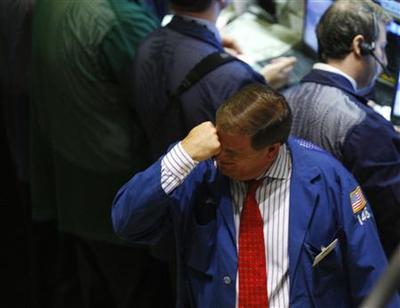
Brokers with Hands on Their Faces
Will the price of risk be too high or too low?
From the comments at MR:
…we had all better hope that there will be some stupid groups in the
future, because if not, then our society will be poorer due to a
societywide excessively high price of risk. an excessively high price
of risk isn’t as spectacularly catastrophic as the excessively low
price of risk of the last 10 years, but compounded over time it can do
just as much damage…
I hold a few beliefs:
1. For a while the price of risk had been too low.
2. Currently the price of risk is too high.
3. In response to the crisis, we will regulate to prevent the particular previous manifestations of #1. The bad news is this will be an overreaction; the good news is that because of #2 the regulatory overreaction won’t matter for some while.
4. We do not know how to regulate to prevent other, future, hitherto unexperienced manifestations of an excessively low price of risk.
5. Maybe #4 is wrong, but beware of any huff-and-puff polemic discussion that is not at least considering these points.
What caused the financial crisis?
The column is titled "Three Trends and a Train Wreck." I attempt to explain the financial crisis in as simple and general terms as possible. Here is one paragraph:
Over all, then, the three fundamental factors behind the crisis have
been new wealth, an added willingness to take risk and a blindness to
new forms of systematic risk. All three were needed to bring about the
scope of the current mess – so that means we’ve had some very bad luck
on top of everything else.
I have about nine hundred words to flesh this out and to discuss Fischer Black as well; Black is a neglected but insightful macroeconomic theorist who starts with ideas from finance. Here is another paragraph:
Subprime loans collapsed first because those were the investments most
dependent on relatively poor borrowers who were the most likely to
fail. Since then, we’ve seen asset values fall throughout the economy.
Subprime borrowing was the canary in the coal mine, but it was hardly
the only problem. It now seems that a wide range of asset prices were
artificially inflated. The market for contemporary art, which depends
almost exclusively on very wealthy buyers, will probably be the last
market to plummet but that development is almost certainly on its way.
One thing to keep in mind is how international the crisis has been; any explanation should start there. I wish in the column I had had space to discuss Spain, which has had relatively prudent banking regulation but still will have one of the biggest downturns in Europe. It is also worth considering Norway, Canada, and some of the other countries which limited their risk exposure all along. I mention Japan, but Brazil and Mexico also already have their banking crises behind them in the former decade and they too form other valuable points of comparison.
I am not sure I understand this Daniel Davies post, but it may have some overlap with my arguments.
Addendum: You might want to read this Jacob Weisberg column saying that the financial crisis refutes libertarianism. His paragraph starting with "There’s enough blame to go around…" is exactly the foil I had in mind. His overall thesis is worth pondering but he doesn’t once consider any cross-sectional variation across nations; such consideration wouldn’t help his thesis. Am I allowed to say that the experience of Iceland refutes the small nation, social democratic model? Probably not, nor should I be.
Second addendum: Tim Harford has a humorous piece comparing the crisis to Monopoly the board game.
Markets in everything?: Mexico edition
Tens of thousands of teachers are blocking highways and seizing
government buildings across Mexico to protest a federal education
reform ending their longtime practice of selling their jobs or giving
them to their children.…At the heart of the conflict is the "Alliance for Quality Education," a
national plan to professionalize teachers and hold them accountable for
their students’ performances. The plan was ratified in May by Mexican
President Felipe Calderon and Elba Esther Gordillo, the leader of the
country’s 1.6 million-member National Education Workers Union, and sent
to Mexico’s 31 state governments and Federal District for approval.
To buy a good teaching job costs at least $6,000. Here is the article. This issue is very important for the future of Mexico. I thank John Thacker for the pointer.