Drought Insurance
The NYTimes reports on an innovation in disaster aid, drought insurance taken out by relief agencies.
In a pilot project that could someday transform the world’s
approach to disaster emergencies, the World Food Program has taken out
an insurance policy that will pay it should Ethiopia’s notoriously
fickle rains fail this year…The policy, which costs $930,000, was devised to create
a new way of financing natural disaster aid. Instead of waiting for
drought to hit, and people to suffer, and then pursuing money from
donors to be able to respond, the World Food Program has crunched the
numbers from past droughts and taken out insurance on the income losses
that Ethiopian farmers would face should the rains fail…….If it works, the insurance will get emergency money flowing
faster, before the haunting images of dying babies reach television
sets. It would also shift the risk from farmers to financiers.
Insurance like this could even have benefits in the United States. Private firms, of course, often do buy disaster insurance but the United States government might want to do the same. Hurricane insurance, for example, bought by the US government could better spread the costs of disasters to the well-diversified. In theory, the government could duplicate any insurance program with a tax and spending program (give Bill Gates money now and tax him when the disaster occurs) but in practice it’s going to be much easier to commit to an insurance plan than to an equivalent tax and spend plan.
More generally, drought insurance on this scale is part of the New Financial Order. I refer to Robert Shiller’s work on using macro-markets to
offer large-scale insurance. A market in GDP futures, for example,
could be used to hedge against declines in GDP such as have occured in
Argentina, South Korea or the future United States (yes Tyler, it could happen!).
Markets in the income of professions as a whole, e.g. the the income of
dentists, could be used by dentists to hedge against the possibility of
a super anti-cavity sealant. See Entrepreneurial Economics for more on macro markets.
Thanks to Alex Wolman for the pointer and Robin Hanson for discussion.
Speculative claims about Australia
Why do some countries keep all their people in a small number of large cities?
A good example of the relationship between climate variability and human population size is provided by Australia. It is unique among the larger nations in consisting of either very small settlements or large cities, for the middle-sized towns that predominate elsewhere in the world are almost entirely absent. This is a consequence of the cycle of drought and flood that has characterized the land from first settlement.
Small regional population centers have survived because they can batten down the hatches and endure drought, and large cities have also survived because they are integrated into the global economy. The resource networks of towns, however, are smaller than the region affected by climate variability, making them vulnerable to swings in income. Typically, what happens is that, as a drought progresses, the farm machinery dealership and and automotive dealership close down…When the drought finally breaks, these businesses do not return…instead people travel to larger centers to buy what they need, and in time end up moving there.
The Australian example shows that climate variability has in fact encouraged the formation of cities: Today it is the most urbanized nation on Earth.
That is from Tim Flannery’s The Weather Makers: How Man is Changing the Climate and What It Means for the Earth. A few passages make me wince, such as the romanticization of 18th century Scottish highlanders, but mostly it is the best popular science book on its topic.
My IRT ("introspective regression techniques") support Flannery’s implicit prediction. Think about all that empty desert in Saudi Arabia, although I wonder why the rather wet Uppsala is so dull. Opinions? Do we see concentrated population in major cities where it is driest and where the weather is most variable? I don’t recall that Ades and Glaeser mention this factor, but surely it deserves more study.
Krugman on Unemployment
Via Brad deLong is Paul Krugman’s introduction to the General Theory. Point Three in Krugman’s stripped down version is:
3. Government policies to increase demand, by contrast, can reduce unemployment quickly.
Well, that would certainly explain why unemployment recovered so quickly during the Great Depression. Or perhaps, despite the fact that "all it took to get the economy going again was a surprisingly narrow, technical fix," we just weren’t trying hard enough. See also Tyler’s comments.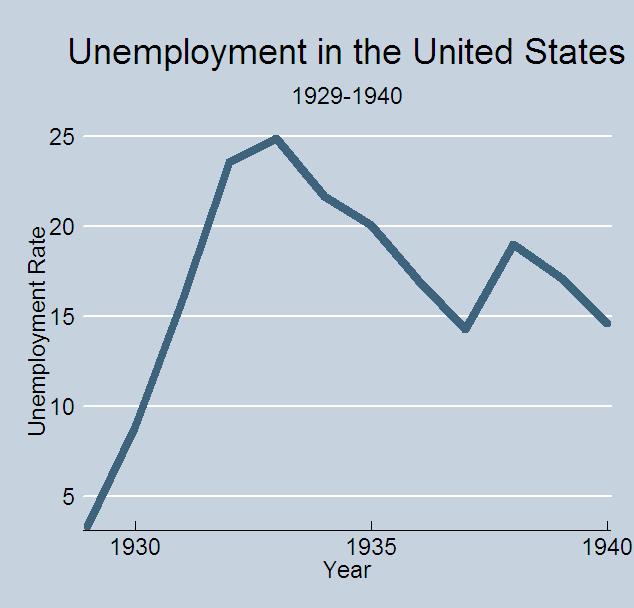
Krugman’s introduction to Keynes’s General Theory
Krugman writes:
A reasonable man might well have concluded that capitalism had failed,
and that only…the nationalization of the means of production – could
restore economic sanity….Keynes argued that these failures had
surprisingly narrow, technical causes…
It is well-known that Keynes called for the socialization of investment and euthanasia of the rentier. Although I do not think he meant it by the 1940s (for background read this paper, or Keynes’s preface to the German-language edition of GT, which is Department of Uh-Oh material), it is odd for Krugman to ignore these passages and present Keynes as an outright enemy of government control or ownership of investment. Next, Krugman writes:
- Economies can and often do suffer from an overall lack of demand, which leads to involuntary unemployment
- The economy’s automatic tendency to correct shortfalls in demand, if it exists at all, operates slowly and painfully
- Government policies to increase demand, by contrast, can reduce unemployment quickly
- Sometimes increasing the money supply won’t be enough to persuade
the private sector to spend more, and government spending must step
into the breachTo a modern practitioner of economic policy, none of this – except,
possibly, the last point – sounds startling or even especially
controversial. But these ideas weren’t just radical when Keynes
proposed them; they were very nearly unthinkable. And the great
achievement of The General Theory was precisely to make them
thinkable….
Arthur Marget and other historians of thought have shown that such ideas were commonplace in pre-1936 macroeconomics, albeit not in Hayek and Robbins. The American tradition in particular pushed for activist fiscal policy, read for instance Jacob Viner. Several books document the popularity of this approach, again before the General Theory.
Jonathan Rauch on introverts
Here is a fascinating interview, much of which (not the gay part) describes me as well. In case you don’t already know it, here is Jonathan’s earlier piece on introversion.
Line-item vetoes won’t cut spending
Bush is asking for this authority, but it is unlikely to constrain spending. Read this (JSTOR) paper "Line-Item Veto: Where Is Thy Sting?". Excerpt: "Curiously, there exists little empirical support for the presumption that item-veto authority is important."
Or here is Robert Reischauer:
The crux of my message is that the item veto would have little effect on total spending and the deficit. I will buttress this conclusion by making three points. First, since the veto would apply only to discretionary spending, its potential usefulness in reducing the deficit or controlling spending is necessarily limited. Second, evidence from studies of the states’ use of the item veto indicates that it has not resulted in decreased spending; state governors have instead used it to shift states’ spending priorities. Third, a Presidential item veto would probably have little or no effect on overall discretionary spending, but it could substitute Presidential priorities for Congressional ones [TC: Hmm…].
Reischauer cites work by Douglas Holtz-Eakin:
Governors in 43 states [circa 1992] have the power to remove or reduce particular items that are enacted by state legislatures. The evidence from studies of the use of the item veto by the states, however, indicates no support for the assertion that it has been used to reduce state spending.
I have one simple model in mind: the legislature comes up with more individual pieces of pork in the first place. Can you think of others?
Taxation
Louis Kaplow is smart, here is his 119-page overview of the topic.
Should high schools compute class rank?
…something is missing from many applications: a class ranking, once a major component in admissions decisions…In
the cat-and-mouse maneuvering over admission to prestigious colleges
and universities, thousands of high schools have simply stopped
providing that information, concluding it could harm the chances of
their very good, but not best, students.
One college administrator notes:
"The less information a school gives you, the more whimsical our
decisions will be," he said. "And I don’t know why a school would do
that."
Here is the full article. As implied, colleges will still form rough expectations of what your rank would be. Given this response, we can see at least one reason why parents, and thus high schools, might prefer a fuzzy or ambiguous class ranking to a definite one.
Let us say your kid is smart but has a small chance of making it into a top school. At Yana’s high school (Woodson, in Fairfax) I’ve seen folders of students with 4.0 and 1600 SAT scores who did not get into Harvard or Yale. Getting into those places has elements of a crapshoot. You are gambling, with the odds against you, and a payoff varying only at some threshold level of success (i.e., getting in is what matters; if your kid doesn’t get in, it doesn’t matter how close he came.) Those are the classical conditions where the gambler prefers to take more risk. On the upside, your chance of getting in goes up and on the downside, the longer left-hand tail doesn’t hurt you.
Consider an analogy and assume I am trying to date Salma Hayek. Should I tell her what car I own (GeoPrizm, basically the same as a Toyota Corolla), or should I be vague? Now Salma is no dummy. If I am vague, she will not infer that I own a Rolls-Royce. But a GeoPrizm is clearly below her cut-off point, so with vagueness there is at least some chance she will not nix me right off the bat.
When I was a kid, a great resume meant you could go to Brown (and you only needed a Cadillac to date Raquel Welch). There was less reason to be ambiguous about class rank, as vagaries could hurt your chances in a very real way. You started off with something to lose, and being fifth in your class put you in pretty good stead.
Natasha tells me that many good law schools no longer provide class rank for their students. Is the same mechanism at work here, with many people chasing after a few hard-to-get plum jobs? Can you think of other examples where the principle of deliberately ambiguous rankings applies? Can this rationalize grade inflation?
Caught my eye
1. Amartya Sen reviews Bill Easterly.
2. Peter Leeson argues that anarchy is better for Somalia; most indicators of progress have gone up since the government fell. This is an excellent paper but I wonder how much "the end of war" drives the results, and is the current situation of warlords really "anarchy"?
3. Unchosen: The Hidden Lives of Hasidic Rebels, the title says it all. Some might find the text insulting ("…underneath the garb, Yossi was just a guy who liked Adam Sandler movies and country music…") but it offers a fascinating look at how small groups resist pressures for assimilation. Try also Paul Kriwaczek’s new Yiddish Civilization for a broader historical perspective; Born to Kvetch rounds out the recent trilogy.
4. Which countries are most proud of themselves? Venezuela does well, or poorly, depending on your point of view.
5. Here is a map of where the world’s ships are located (NB: this link doesn’t always work), hat tip to kottke.org.
6. Chris Masse’s yearly Prediction Market Awards.
7. Dave Schmidtz on when inequality matters. Here is Dave’s new book, Elements of Justice.
8. "Stichomancy," the art of fortune-telling through randomly-chosen book passages. Check out Caterina’s blog more generally. She links to this post on turning parking spaces into parks.
9. Netbanging: street gangs who slug it out over the Web.
Why *Brokeback Mountain* did not win Best Picture
Hollywood controls system, not fixed but rigged to favor picture with greatest elasticity of profits with respect to favorable publicity. Too many people won’t see BBM, plus fear that Hollywood looks out of touch, Crash!
Ski Dubai, from the outside

Here are other new and notable images from Dubai, including sketches for the future. Here is Sky Dubai from the inside.
The best paragraph and a half I read yesterday
This is from William Saletan’s New York Times review of Judith Harris’s No Two Alike:
Ultimately, however, long-term behavior modification is at odds with
itself. As our minds become subtler and our occupations less stable,
short-term modifications suited to the situation at hand become more
advantageous than permanent modifications. This is already happening,
according to her theory. The reason parental influence doesn’t control
children’s behavior outside the home is that they adjust to context.
"Children are capable of generalizing – of learning something in one
context and applying it in another – but they do not do it blindly,"
Harris observes. At home, where you’re the younger sibling, you yield.
At school, where you’re one of the bigger kids, you don’t. And unlike
other animals, you can shuffle your self-classifications. In seconds,
you can go from acting like a girl to acting like a child to acting
like a New Yorker.In short, the evolutionary logic that makes
us different from one another will gradually make us different from
ourselves, context by context. Personality – behavior that is
"consistent across time and place," as one textbook puts it – will
fade. We’ll miss characters like Harris, the little woman from New
Jersey who boasted of giving psychologists a "wedgie" and tried to
solve the puzzle of human nature.
But is it true? Cannot evolutionary pressures favor extreme constancy, for purposes of precommitting to transparency and attracting a better mate?
By the way, I’ll give "best sentence of the day" honor to Daniel Akst: "Any benefit from shining the cleansing light of day on executive greed
will probably be outweighed by the inflationary effect of additional
disclosure, which will provide more ammunition for executives and
consultants seeking to justify additional increases."
Libertarian Economist
Jeff Miron has a new blog. Miron is the author of Drug War Crimes: The Consequences of Prohibition, a superb economic analysis of the war on drugs (I was the editor). He is also known for his work on seasonal business cycles (see also here for Tyler’s take). The new blog, based in part on a course Jeff is teaching at Harvard has three themes.
The
first is that consequential libertarianism is consistent in its
approach to the issues. Modern liberalism and conservatism are not.The
second theme is that both liberals and conservatives advocate massive
amounts of government intervention. The two perspectives disagree about
precise policy choices, but overall they are far more similar than
different. The libertarian perspective, however, is truly distinct from
either mainstream view.The third theme is that most economic
and social problems are best addressed by eliminating the government
interventions that caused or exacerbated the problem in the first
place. Creating even more government is never a sensible approach.
Welcome to the blogosphere Jeff!
Jon Gertner profiles Ed Glaeser
Excellent article, the focus is urban economics. Best sentence: "…he notes that cars per capita in 1990 is among the best indicators of how well a city has fared over the past 15 years."
From the same NYT magazine issue, here is Levitt and Dubner on the poverty and decline of real estate agents. See also Alex’s previous post, Real Estate Rent-Seeking.
Should you be a maximizer?
Five hundred and forty-eight graduating students from 11 universities were categorised as maximisers or satisficers based on their answers to questions like “When I am in the car listening to the radio, I often check other stations to see if something better is playing, even if I am relatively satisfied with what I’m listening to”.
When questioned again the following summer, the maximisers had found jobs that paid 20 per cent more on average than the satisficers’ jobs, but they were less satisfied with the outcome of their job search, and were more pessimistic, stressed, tired, anxious, worried, overwhelmed and depressed.
“We suggest that maximisers may be less satisfied than satisficers and experience greater negative affect with the jobs they obtain because their pursuit of the elusive ‘best’ induces them to consider a large number of possibilities, thereby increasing their potential for regret or anticipated regret, engendering unrealistically high expectations”, the researchers said. Indeed, the researchers found that maximisers were more likely to report fantasising about jobs they hadn’t applied for and wishing they had pursued even more jobs than they did.
Here is the link, and by now you know the usual caveats for such research. Number one is whether the survey evidence measures true commitment to maximization, or whether it simply picks up grumps who are fussy and determined to portray a fussy image to the world. Number two is whether they properly adjust for IQ, which may be causing both superior results and greater returns to search behavior.