Awkward questions about natural resource prices
One of my great joys is going to lunch with Bryan Caplan and torturing him with my contrarian opinions. I will even make up a temporary view toward this end.

Tuesday I told him that most commodity prices are, in real terms, higher than they were a decade ago. Furthermore in many cases both the futures and the spot prices have been rising.
Many MR readers will know that Julian Simon won his famous bet with Paul Ehrlich. Simon challenged Ehrlich to name five resources of his choice. At the end of the time period, those resources had fallen in real price, so Simon won the bet. But Ehrlich probably would have fared better had the bet expired today.
To be sure, most resources are still cheaper in real terms than in much earlier eras. But has the time passed when real resources will get cheaper every period? Is ever-increasing resource plenitude a thing of the past? Market prices seem to indicate so.
Of course you might expect real price declines to resume for most resources. You might cite a similar and premature commodity price scare from the early 1980s. Or you might claim that the special circumstances of Chinese economic growth have led the demand for raw materials to rise faster than the supply, but only temporarily. But would this be betting against market prices? Could we still cite market prices as a sign of Simon’s triumph over Ehrlich? And could we become rich by selling commodities short?
Isn’t it simpler to believe that market prices speak the truth and that the demand for raw materials will continue to outstrip the supply?
Now I am trying to decide whether this was a "contrarian, made up for lunch with Bryan" opinion, or a real opinion…And here is my earlier post on resource prices…
Addendum: Alex points out that the commodity price spike is less than ten years old. Four years would be a better estimate, but this does not change the logic of the argument. If one cites market prices as "sufficient statistics" of resource value, why not apply this logic consistently when real prices rise?
What I’ve been reading
The Big Picture: The New Logic of Money and Power in Hollywood, by Edward Jay Epstein. Why is opening weekend so important? "The benefits of prolonging a film’s run in the theaters are now negated by the loss that would be sustained by delaying its video opening past the point at which it can benefit from the movie’s advertising campaign." This is the best available work on the economics of cinema. How many books cite both Arnold Schwarzneger and Mises’s discussion of non-pecuniary goods?
King Lear: This is about my fifth reading. I had never fully realized that Lear had incestuous relationships with at least one of his daughters (for instance check out 1:2, 150-152, 1:4, 176-182, plus the entire Oedipus analogy). Furthermore he was ready to sell out his country to the French. Edmund, Goneril and Regan were not so bad after all.
Handbook of Economic Sociology, second edition, edited by Neil Smelser and Richard Swedberg. Yelp if you wish, but I see sociology as the most underrated social science. It is (some) sociologists who are the problem. Most of the advances in economics over the last fifteen years have actually come in sociology done by economists. Just look at Steve Levitt or behavioral economics. Since economists have not discovered any new "core mechanisms" since herd behavior (circa 1989 or so), I expect quantitative sociology to whup our collective behinds over the next twenty years. The only question is who will be doing it, us or them.
Art: A Field Guide, by Robert Cumming. This has been my favorite bedtime reading book of the last twenty years. The book gives two or three succinct paragraphs on why each of about 1500 famous artists is good, bad, or somewhere in between. No cultural relativism here, and obviously the guy should start a blog. Few good pictures are included, so you do need to know the works of the artists.
Pol Pot: Anatomy of a Nightmare, by Philip Short. One of the best studies of the anatomy of evil, the psychology of colonialism, and twentieth century Cambodian history.
What I wish I was reading: Going Sane, by Adam Phillips. I read all his books the day they fall into my hands. Phillips, a psychoanalyst for children, is the master of witty and paradoxical observations about human nature. I am told that this new book offers a partial "recipe for contentment," but so far it is available only in the U.K. and perhaps Commonwealth countries.
Choice: The Best of Reason
I’ve been enjoying Choice: The Best of Reason. Reason magazine’s byline has always been Free Minds and Free Markets but perhaps it ought to be Free Minds, Free Markets and Fun. Here’s Drew Carey (from long before Janet Jackson’s wardrobe malfunction):
The government is really into ‘protecting people’. The Federal Communications Commission (FCC) says you can’t broadcast certain words and certain pictures. It says it’s protecting citizens. But I’m sitting in my home with DirecTC and can watch whatever I want. I can afford the best pornography – laser-disc porn! The government’s not protecting me from anything.
All the government’s doing is discriminating against poor people. It thinks poor people are like cows, that poor people can’t think straight: If we let them hear dirty words or see dirty pictures, there’s going to be madness! If you’re poor and all you can afford is a 12-inch black-and-white TV and can’t pay for cable – you’re so protected. You’d probably be happier if you could see some pornography, a pair of titties, once in a while on free TV. But a pair of titties on free TV? The government figures if you saw that, you’d just explode!
Do gadgets make you happier?
I’m now at a point where if for some reason I can’t use my cell phone or iPod (because I forgot it somewhere, because it ran out of batteries) I miss it, even though before these gadgets existed, I managed to get along just fine without them. One might think, then, that there’s no point in ever acquiring such things. The happiness boost is merely temporary. But while that’s true of each individual gadget, the fact that new cool stuff is being invented and brought to market all the time is an ongoing process that creates many happiness-enhancing moments over the years. A growth-free society would be one in which people were basically deprived of such moments.
Matt Yglesias offers more.
China fact of the day: Striking for longer hours
Taiwanese factories in Dongguan [a city between Hong Kong and Guangzhou and a major centre of manufacturing] are facing a problem. According to a news report in the United Daily in Taiwan, over a thousand workers at a factory, which produces goods for big brand names such as Nike, demonstrated for two days and damaged equipment and factory cars. 500 armed police arrived and quashed the riot. Several leaders were arrested.
The main cause for the riot was the limitation [sic] on working hours at the factory. The shorter hours have been requested by US companies so as to avoid criticism from various groups on long working hours. However, the mainly migrant workforce want to work longer hours so they can earn more [emphasis added]. Consensus had been reached by the US companies, the Taiwanese-invested factory and local government that the maximum working hours per week should be set at 60 hours [which is still a breach of Chinese Labour Law, but less than other manufacturing plants]. However, this reduction in hours was unsatisfactory for the workers and the resulting riot was serious [emphasis added].
Here is the link, and thanks to Jeffrey Tucker at The Mises Blog for the pointer. And here is my previous post on social unrest in China.
Dear Economist: Are Cities Environmentally Sound?
The Financial Times suddenly has seen fit to offer Tim Harford’s weekly economics column in the U.S. Saturday edition. Here is last week’s sample:
Dear Economist: I am worried about the damage we wreak on our planet, and I want to do my bit to reduce my personal environmental impact. I was thinking of moving to the country and living a more self-sufficient life. But is there a better way? Jocelyn Hathaway, London
Dear Jocelyn,
You should ask yourself, rather, if there is a worse way. London may not appear to be the model of sustainble development, but it is an organic commune compared with what would happen if the other 7m inhabitants selfishly decided to move to the country.
Tightly packed, rich cities such as London are easily the most environmentally friendly way to enjoy modern life. Wealthy people squeeze into cozy apartments…Denser cities mean more efficient transport. Only 10 percent of commutes into central London take place in cars.
Manhattan, the densest and richest city of all, was recently described in The New Yorker magazine as "a utopian environmentalist community" and it is vastly more energy-efficient, per person, than any of the 50 American states.
My advice is to forget all this self-centred nonsense about moving to the country. Instead, you should put double-glazing in your flat, travel to work by bike and relax in the smug knowledge that you are living in one of the greenest cities on the planet.
Of course a full assessment must also include the dependence of cities on the surrounding countryside, and vice versa. Cities both spur and reflect economic growth, which puts pressure on aggregate resources. Nonetheless this answer remains a useful corrective to urban whinging. The real question is when the FT will put Harford’s column on-line to non-subscribers…
Mansfield on Economists
Here is Harvard’s Harvey Mansfield on economists (in relation to the Summers affair).
Summers is an economist, and there is almost no such thing as a suave
economist. The great Joseph Schumpeter, a Harvard economist of long ago, claimed
to be the world’s greatest lover as well as the world’s greatest economist (it
is said), but he was a singular marvel. The reason why economists are blunt is
that words of honey seem to them mere diversion from reason and self-interest,
which are the only sure guides in life.
Whither social security privatization?
Only one in three Americans approve of
President Bush’s handling of Social Security, his lowest rating on the
issue since he took office. A USA TODAY/CNN/Gallup Poll conducted
Friday-Sunday found that 35% approved of Bush’s Social Security record,
56% disapproved and 9% had no opinion. That was down from three weeks
ago, when 43% approved. In March 2001, just after he took office, 49%
approved. (Related: Poll results)
Here is the story. Yes poll results are tricky but this suggests we will not get a large reform plan. I expect a face-saving measure with a tax increase on the FICA maximum, and a nominal nod to "private" accounts in the form of forced saving. As they say, be careful what you wish for…
Are economists better at games?
"In poker, world champion of poker, Chris "Jesus" Ferguson, has his PhD in Computer Scientist from UCLA and his father teaches game theory there. He and his father have co-authored an article on Borel and von Neumann’s models of poker, and from what I’ve been able to gather, Ferguson’s style of play draws heavily from game theory. He and his father also show why the very best poker players in the world play a very aggressive game (actualy, Borel and Nash showed it, but Ferguson and his dad helped translate it for me) where optimal playing is actually to bluff *a lot* (more than you might think), even though every single book out there that teaches you how to play Texas Holdem recommends a conservative "tight aggressive" strategy. Game theory suggests to raise (in limit poker) with your absolute dead worst hands a lot more than people usually feel comfortable doing – but this is exactly the behavior of the greatest, like Doyle Branson, Gus Hansen, and TJ Coultier. So, I can buy that economics and game theory more generally should make one the better player. But, it’s also interesting to note that the world’s best poker theorists (David Sklansky) is criticized for not being able to pull it off in real play. It’s not enough to actually know the opimal move; it takes a certain level of openness to variance to be truly great at poker. So I suspect it’s a mix of heart and head, and game theory can only take you to the water, but not help you drink."
Can we make objects invisible?
The idea of a cloak of invisibility
that hides objects from view has long been confined to the more
improbable reaches of science fiction. But electronic engineers have
now come up with a way to make one.Andrea
Alù and Nader Engheta of the University of Pennsylvania in Philadelphia
say that a ‘plasmonic cover’ could render objects "nearly invisible to
an observer". Their idea remains just a proposal at this stage, but it
doesn’t obviously violate any laws of physics…The key to the concept is to reduce
light scattering. We see objects because light bounces off them; if
this scattering of light could be prevented (and if the objects didn’t
absorb any light) they would become invisible. Alù and Engheta’s
plasmonic screen suppresses scattering by resonating in tune with the
illuminating light.
Read more here.
Aids, Condoms and Africa
Regarding my post, The African Cliff, a number of readers wrote to me about the Catholic Church’s anti-condom teachings (and apparently in some cases mis/disinformation campaigns).
I have three reasons for thinking that Catholic teaching on condoms, whatever you might think of the substantive issue, is not a major factor in the African Aids crisis. First, Catholics in the US don’t seem to find it difficult to ignore the Church’s teachings when these are costly. Second, many African countries with high Aids rates have few Catholics. (Compare the countries in yesterday’s graph with this map of Catholic membership in Africa.) Third, couples who do not use condoms but follow Catholic teaching in regards to monogamous marriage are unlikely to contribute much to the Aids problem. It seems inconsistent, moreover, to assume that religion is strong enough to prevent men from using condoms but not strong enough to stop them from sleeping with multiple partners. Does the man having sex with a prostitute feel less guilty because he isn’t wearing a condom? (Admittedly, I don’t know enough about venial versus mortal sins to be sure about the latter.)
We hope that Marginal Revolution can be enjoyed by the whole family so I am somewhat reluctant to discuss a second hypothesis brought to my attention by Steve Sailor. Nevertheless intellectual honesty compels me to mention dry sex.
Epidemiologists are also finding that multiple concurrent sex partners are an important transmission route. Halperin and Epstein writing in the Lancet (subs. required) note:
Of increasing interest to epidemiologists is the observation that
in Africa men and women often have more than one–typically two or
perhaps three–concurrent partnerships that can overlap for months or
years. This pattern differs from that of the serial monogamy more common in
the west, or the one-off casual and commercial sexual encounters that
occur everywhere.
Morris and Kretzschmar
used mathematical modeling to compare the spread of HIV in two
populations, one in which serial monogamy was the norm and one in which
long-term concurrency was common. Although the total number of sexual
relationships was similar in both populations, HIV transmission was
much more rapid with long-term concurrency–and the resulting epidemic
was ten times greater.
It is important to understand that multiple concurrent partners does not mean more partners in a lifetime. What differs in parts of sub-Saharan Africa is the pattern and timing of sexual relations not the number of lifetime partners. (See also Sailor for a tendentious but interesting take on the why the pattern might be different in parts of Africa.)
The African Cliff
Even though I know about AIDS in Africa this figure shocked me.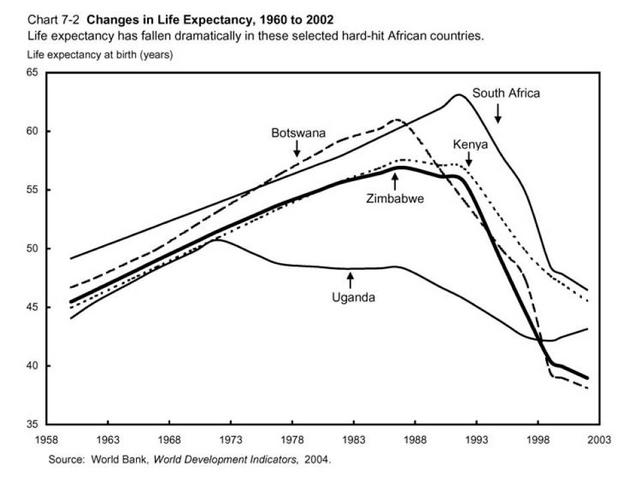
What I don’t understand is why the discussion of solutions focuses so heavily on AIDS drugs when condoms are cheaper and more effective in preventing spread of the disease. And why isn’t condom use in Africa skyrocketing? (A notable exception is Uganda where AIDS rates have begun to level off due to condom use– see graph). Condoms are cheap – even if not to every African they can be easily subsidized by donor groups or governments but there is still a large condom-gap in Africa.
Note that in theory condom use could increase transmission of AIDS if it increases sex. Evidence from the US and elsewhere indicates this is unlikely in practice. Moreoever, it doesn’t explain why more condoms are not being used.
Figure from the Economic Report of the President (2005) via Ben Muse.
Markets in everything
[some University of Michigan students] are getting $100 cash payments for keeping their dorm rooms presentable and opening their doors so prospective students and their parents can take a look during campus visits…
Participants must let tour groups see their room in the middle of the day, and have to be out of bed and dressed [imagine that!], said Randi Johnson, the university’s housing outreach coordinator. Display of anything illegal, offensive or banned is forbidden.
Here is the story, and thanks to Michael Rizzo for the pointer.
Does citrus smell make you buy?
Under certain conditions, a citrus smell seemed to magically open the
pocketbooks of shoppers and increase their desire to spend, according
to Jean-Charles Chebat of the HEC Montreal graduate school of business,
Richard Michon of Ryerson University in Toronto and L.W. Turley of
Western Kentucky University. Their findings appear in the latest issue
of the Journal of Business Research.But retailers with a nose for sales should not order industrial-size
vaporizers and fill them with orange scent just yet. The researchers
cautioned that the citrus smell provoked additional spending only if
stores were moderately busy. If they were too crowded or too empty, the
power of citrus disappeared. "Crowds have their own smells," Chebat
said in an e-mail. "Citrus can counterbalance the effects of such
smells to a certain extent. However, it has its limitations. As for the
least crowded environments, citrus may be too arousing."
Here is the full story. Here is another summary, which includes a discussion of using scents to encourage gambling. Here is a link to the paper and related works.
Do gay men read maps like women?
Gay men employ the same strategies for navigating as women – using landmarks to find their way around – a new study suggests.
But
they also use the strategies typically used by straight men, such as
using compass directions and distances. In contrast, gay women read
maps just like straight women, reveals the study of 80 heterosexual and
homosexual men and women.
Here is the full story.