Should consumers boycott gas stations?
Gas prices are higher than in recent memory, Californians are paying $2.18 a gallon for regular gas, some industry sources are predicting $3 a gallon by summer.
Why? Oil prices are high, and many refineries are switching over to summer fuels. Other refinery operators are passing on the costs of producing gasoline with ethanol, read this account.
On the brighter side, the all-time gas price high, in real terms, came in 1981. Gas then sold for a current-day equivalent of $2.80 a gallon.
Gregg Easterbrook adds some further perspective:
The average price of gasoline during the 1950s was about $1.80 in today’s money–meaning that during the period enshrined in our collective political nostalgia as Energy Heaven, gasoline cost slightly more in real dollars than the amount now being theatrically bemoaned as a “record” price. But wait; in the 1950s, per-capita real income was less than half what it is today. That means that for the typical American in the 1950s, gasoline cost twice as much, in terms of buying power, as today’s gasoline. Adjusted for inflation and for buying power, the purported “record”-priced gasoline at your pumps now is substantially cheaper than the gasoline your parents bought.
Some consumers are calling for a boycott of major suppliers, such as Exxon. Supposedly this will force prices to fall. But no, we cannot count on this action, even if massively coordinated, to improve consumer welfare. Why not?
A boycott of this kind, in essence, imposes a price control on the market. No one will buy unless the price falls to a certain level. In theory this can force the price back down to a more competitive level. But the reality is different. Even when monopoly power is present, the record of price controls in improving consumer welfare is a dismal one.
If we wanted to organize a truly effective boycott, one that would increase consumer welfare, what should we do? Here is one of my favorite counterintuitive economics results. Buyers should tax their own purchases of gasoline. You read me right, and here is a formal treatment, what is the intuition?
Let us work backwards to the result, starting with another case, namely a country exporting oil on a perfectly competitive basis using many separate suppliers, but where the country as a whole is a major supplier with market power. That country would benefit by taxing its exports of oil, in essence forcing firms to raise their prices, thereby mimicking a collusive outcome and capturing some rents from the tax-created market power. (Of course this result assumes that the revenue from the tax isn’t wasted. And the smart aleck in the back row will observe that many countries subsidize their exports, rather than taxing them, this may simply be a policy mistake!)
OK, now say you are a dominant buyer in the world market. You want to apply the same logic in reverse. You can move the price in your direction by taxing your own transactors. By taxing your own buyers, you force them to “collude” and restrict their purchases, thereby forcing the price down from abroad (again, it is assumed that the tax revenue is not wasted but rather benefits the citizenry). The large buying country reaps a greater share of the surplus from trade, if the tax is set at the right level.
Yes, this does mean that exorbitant EU gas taxes are not as stupid as they might seem at first.
Going back to the boycott idea, every boycotter should agree to rip up, say, $3 for every $10 worth of gas she buys. If there is no coordination, this is a mere transfer and there is no loss. If there is coordination, the U.S. gains from exercising monopsony (major buyer) power and forcing the price down. Tearing up the money is like a self-imposed tax. Even better, we don’t have to worry about the government wasting the tax revenue. As people destroy their money, the money of others is worth more, thereby ensuring that no real resources are wasted.
Thanks to Erte Xiao for the original query and pointer, and to Bryan Caplan for some useful discussion.
Addendum: Air genius Gary Leff is also a gas genius, he forwarded me this link.
Are Hispanic immigrants assimilating?
Read the comprehensive treatment over at the ever-wise DanielDrezner.com.
Here is just one bit:
Start with language. [Samuel] Huntington worries that large homogenous enclaves of Hispanics will weaken the incentive to learn English. The key test for this assertion is not whether first-generation Mexican immigrants speak English, but whether second-generation Mexican-Americans speak it. On this question, Huntington concedes that “English language use and fluency for first- and second-generation Mexicans thus seem to follow the pattern common to past immigrants.” He then voices concern that this trend may not continue to third-generation children. But according to Richard Alba and Victor Nee’s Remaking the American Mainstream, 60 percent of third-generation Mexican-American children speak only English at home. A 1990 Census study showed that only 5 percent of first-generation Mexican immigrants spoke English at home; another study showed that 30 percent of second-generation Mexican-Americans in Los Angeles spoke English at home. Taken along with Alba and Nee’s evidence, this suggests that Mexican-Americans, like other immigrant groups, are becoming more likely with each generation to adopt English as their primary language.
Support for immigration is very thin on the side of the American public, so it is important that we get these facts right.
Addendum: Here is much more from Dan. By the way, Hispanics are ten percent of the U.S. military. By 2007, one out of ten small businesses will be Hispanic-owned. See the 15 march 2004 Business Week.
Historical GDP and inflation at your fingertips
Here is U.S. gdp, real, nominal, and otherwise, from 1789 onwards. Here is an easy-to-use inflation calculator.
Thanks to Eugene Volokh for the pointers.
Social security options
Brad DeLong writes about “The Biggest Risk-Arb Transaction Ever,” namely the investment of social security funds in private stocks:
The plan, you remember, was for the federal government to sell a huge number of Treasury bonds, invest the proceeds in stocks, distribute the stocks to individuals as their Social Security Private Accounts, and use the equity premium–the average spread on the return on stocks over the return on Treasury bonds–to reap immense profits and save Social Security.
Brad offers a few options as to what would happen, I find the following two hypotheses most plausible:
…even though there is compelling evidence that the equity premium is too high and that there is lots of profit to be earned by long-run bets that go short Treasuries and long stocks, enactment of the Lindsey-Feldstein-Samwick plan will cause an immediate jump in the stock market. Current owners of stock will profit massively as people’s expectations of the massive future demand from Social Security Private Accounts. The equity premium will shrink quickly. And there will be little profit captured by beneficiaries and little money to save Social Security. (However, the falling equity premium will boost corporate investment, real profits, and real wages by eliminating the Harberger triangle currently created by the market inefficiency underlying the excessive equity premium.)
One [option] says that you might make $2.4 trillion in present value–that price pressure from the demand for stocks for Social Security Private Accounts will eventually shrink the excess equity premium to close to zero, but that will take a generation. And in the meantime, as the excess equity premium is still there (but shrinking), you do profit from the wedge caused by the fact that the private stock market grossly overprices systematic risk.
In other words, even if the stock market currently earns (an expected) seven percent a year, you can’t count on replicating that same seven percent on the money you pull from the social security trust fund. “Private investing” of the funds does not change this basic reality.
Let’s not forget another of Brad’s points: “this [plan] is no bargain if the risk the stock market will tank is borne by beneficiaries”
Brad’s earlier post offers some options on the politics of social security, I go with a view that he holds only on alternate Tuesdays, namely the following:
The fourth argument is: “You want the SSTF invested in private bonds and stocks? Are you crazy!? Do you want some government bureaucrat voting stocks and so electing corporate managers? That’s just insane!”
The bottom line: Reforming social security is not going to be easy.
The economics of gay weddings
That’s weddings, not marriages. Here are a few facts:
1. One estimate puts the size of the gay community in the U.S. at 14 to 16 million, with a projected buying powr of $485 billion.
2. As many as six million gay people live with same-sex partners. Marketers believe gays to have higher-than-average disposable incomes.
3. 2.3 million (heterosexual) couples marry a year, and spend about $50 billion on their weddings.
4. The average heterosexual wedding is estimated to cost $22,000 an event, the average gay wedding costs slightly less at $15,000 [do fewer people come? are fewer people invited?].
5. The not-so-small wedding industry is showing increasing support for the gay marriage idea. Check out these advertisements.
6. Tourist boards in Scandinavia, where gay marriage faces a relatively liberal legal treatment, view gay marriage as a marketing opportunity.
7. Gay marriage websites are proliferating, for instance RainbowWeddingNetwork.com and Alternate Weddings.
8. “Gay Wedding Expos” are popping up around the country, drawing tourist dollars.
The above facts are taken from Sunday’s Orlando Sentinel, “Gays are Booming Market for Wedding Industry,” not currently on-line.
My take: The mass media and entertainment sectors, motivated by commercial pressures, already have led the mainstreaming of gay America. Business lobbies represent some of the most effective spokespeople for the gay marriage idea.
By the way, are you worried about the federal deficit? Legalizing gay marriage, through the tax law, could well yield over $1 billion in tax revenue.
Coin flips
Never bet on a coin flipped by mathematician and magician Persi Diaconis who can flip it so that it lands on heads at will. Diaconis has also shown, using high-speed slow motion cameras and plenty of physics, that when flipped by a regular person there is a 1-2 percent bias in favor of the side that begins up. Some more info here.
Over your lifetime this information ought be be worth quite a bit to you. Remember where you heard it first and act accordingly!
Markets in everything, continued…
Did you ever wish you could hide your location when talking on the phone? Ever wanted to give the impression you were somewhere else?
SounderCover gives you the ability to add a background sound to any incoming or outgoing call, giving the impression that you really are in the environment where the background sound is normally heard.
Buy here. Here is a story, the service can mimic a circus or the drill of a dentist. How about clattering keyboards?
Thanks to this primate for the pointer.
Competitive Campaign Finance
There is an interesting piece in the April issue of The Atlantic (article not online, subscribe here) on how the Bush team is using social competition and peer-incentives to increase their campaign finances.
Politicians have celebrated large fundraisers for years, but discreetly. Names were not publicized, and some campaigns had difficulty calculating the precise number of dollars brought in by a given fundraiser. Bush changed that. Before the 2000 election his campaign instituted a simple system of tracking numbers: any fundraiser who wanted dollars credited to himself could ask donors to write his designated number on their checks. The system ensured exact accounting and signaled that the campaign was closely monitoring how much individual bundlers were bringing in. Meanwhile the campaign set aggressive goals for bundlers and publicly disclosed which people hit what specific goals….all this has instilled a fervent spirit of competition in Bush’s network that has led it to raise more and more money.
In addition to approbation, being a succesful fundraiser pays off in other ways:
Of the 241 individuals who raised at least $100,000 “eight seven were named to posts in the administration. Nineteen became ambassadors, two were named Cabinet officials, one became a federal judge, and at least six (including the Enron executive Ken Lay) were members of the Energy Department transition team.
The Atlantic notes that while the former techniques are new the latter are old hat. See the article for more of interest, including data and maps.
Lending American capital to Mexicans
Seeking to tap into the billions of dollars that Mexicans working in the United States send home each year, a Mexican mortgage finance company is opening a New York branch on Thursday to offer loans to Mexicans who want to buy a house in their country.
Last year, Mexicans sent home $13.27 billion, more than the country earned from foreign tourism. The money lifts many families out of poverty and in some regions is the only source of income.
Many Mexicans working in the United States hope to save enough to buy a house in Mexico and return. But the money they send home is often consumed by daily needs.
Under the lending plan created by Hipotecaria Nacional, Mexico’s largest mortgage finance company, a Mexican working in the United States – legally or illegally – will be able to apply for a loan and pay the monthly installment in dollars through an American bank.
Relatives in Mexico must also sign the loan, which is issued in Mexico in pesos and backed by Mexico’s national mortgage bank, Sociedad Hipotecaria Federal.
And what do the stats look like?
…a worker would need to pay $400 a month for a 15-year mortgage at 15 percent interest on a house valued at about $36,000 with a 20 percent down payment. That interest rate, which would be quite high in the United States, is reasonable by Mexican standards, given higher base interest rates, inflation and the greater risk of default.
I’ll add that a house in rural Mexico costs only a few thousand dollars to buy or construct.
Nor are real estate-based capital movements restricted to mortgages proper:
…it has been Mexican companies that have come up with the most innovative ideas. Since 2001, Cemex, the cement giant, has allowed Mexicans to pay for bags of cement in the United States that relatives pick up in Mexico to build houses. The company, which has five offices in California and one in Chicago, even offers free engineering advice.
Here is the full story.
The National Book Awards
Edward P. Jones, who ended a 10-year absence from publishing with his novel “The Known World” (Amistad/HarperCollins), won the fiction prize of the National Book Critics Circle on Thursday night in a ceremony at New School University in Greenwich Village.
These other awards were made:
¶Paul Hendrickson, “Sons of Mississippi: A Story of Race and Its Legacy” (Knopf), for general nonfiction.
¶William Taubman, “Khrushchev: The Man and His Era” (W. W. Norton), for biography-autobiography.
¶Rebecca Solnit, “River of Shadows” (Viking), a study of high-speed photography and other 19th-century technology, for criticism.
¶Susan Stewart, “Columbarium” (University of Chicago Press), for poetry.
Studs Terkel, 91, the Pulitzer Prize winning author, oral historian and self-described champion of the uncelebrated, received the Ivan Sandrof Lifetime Achievement Award.
Here is the story. I had started the Jones book and it bored me, I will try again. The Taubman book on Khruschchev is first-rate.
Maternal role models
…in families where the mother worked while her children were growing up, her adult daughters and sons attain jobs that are more equitable in terms of prestige. But in cases where the mother did not work – and therefore daughters lacked a direct, same-sex parental role model in the world of careers – sisters fare considerably worse than their brothers: my data show that women whose mothers did not work outside the home when they were growing up are 15 percent less likely to have graduated from college than their brothers were; this statistic stands in contrast to a statistically insignificant 5 percent difference between sisters and brothers in families where the mother did work outside the home for at least a year during their childhood. To put the impact of maternal employment in even starker terms, consider the following: if we hold education level and occupational prestige constant, sisters earn approximately less than $5,000 less in annual income than do their brothers. If we divide this same data according to maternal employment, however, the pattern diverges wildly. For those whose mothers worked outside the home when they were growing up, the income differential between sisters and brothers is reduced to approximately $4,5000 – but for those whose mothers did not work, the income differential shoots to more than $8,000.
From Dalton Conley’s excellent The Pecking Order: Which Siblings Succeed and Why. Here is my earlier post on Conley.
What is the bottom line here? If a mother works, her daughters are more likely to earn an income commensurate with their familial status. Working moms should feel less guilty.
The law of demand and health care
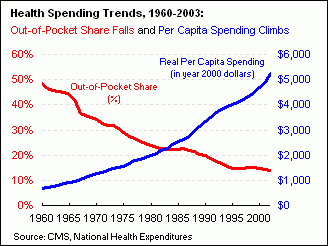
Steve Verdon finds this graph in a short report from the Joint Economic Committee.
Of course, the graph shouldn’t be taken too literally, other factors, especially technological change, are more important (see Newhouse’s review (JSTOR), but the chart is a useful reminder that the law of demand applies to health care just like everything else.
Switching conventions
Economists commonly cite driving on the right (left) hand side of the road as an example of a beneficial social convention. The equilibrium is arbitrary, provided that everyone agrees to drive on the proper side.
I was surprised to learn how recently some of these road conventions have solidified. Consider the following:
1. Seventeen percent of the world’s area drives on the left. This amounts to about thirty-two percent of the population, it includes India, Indonesia, Pakistan, Japan and Bangladesh.
2. Originally Quebec and Ontario drove on the right and the rest of Canada on the left. The prairie provinces, when settled, drove on the right but British Columbia did not. Canada started a move toward universal right-side driving in the 1920s. Newfoundland and Labrador were the laggards, not switching until 1947, shortly before they joined the confederation.
3. A 1903 Baedeker Guide wrote the following:”The rule of the road varies in different parts of Italy. In Rome and its vicinity the rule is the same as in England i.e. keep to the left in meeting, to the right in overtaking vehicles. In most other districts, however, this rule is reversed.”
4. Most of Austria drove on the left until the Anschluss of 1938. Hitler also made Czechslovakia and Hungary drive on the right.
5. The Falkland Islands drove on the right during the brief Argentinian occupation of 1982.
6. Myanmar (Burma) switched to right-side driving as part of a move to consciously repudiate its British colonial heritage. Panama changed in 1943, largely because the Pan American Highway opened up.
7. Recent switches to the right include China, Taiwan, and the Koreas (1946), Belize (1961), Ethiopia (1964), Iceland (1968), Nigeria (1972), Ghana (1974), and South Yemen (1977).
8. Island nations are less likely to switch to right-side driving, or more likely to switch later.
From Right Hand, Left Hand: The Origins of Asymmetry in Brains, Bodies, Atoms, and Cultures, by Chris McManus.
My take: Switching is easier and more common than you might have thought. In the meantime, I’m still waiting for England, New Zealand, and Australia to adopt consistent rules as to who has the right-of-way when entering a roundabout.
Public choice theory and Haiti
Why is Haiti such a mess? How might a public choice economist think about the Haitian system of government?
Before Papa Doc Duvalier, Haitian leaders were lucky to last a few years. Look at this list of constitutions. Hegel suggested that voodoo religion would not lead to political liberty; so far Haiti has not disproved this thesis. Here is a comprehensive page on Haitian history, replete with useful links.
Haitian government appears to have no “core,” to use the economist’s term for instability. Most of the population is illiterate but extremely smart and distrusting of their governments. The distrust is so strong as to become a self-fulfilling prophecy. No leader can command lasting popular support or form a stable political coalition. One alternative is to rule with complete tyranny; alternatively, you can be more moderate and govern with a shorter-term perspective. In other words, you loot the country, while telling yourself, correctly, that the people who will follow your reign will be even worse.
The Haitian voodoo gods are intransitive in their power relations, and so has been the Haitian government, at least in the absence of massive oppression or outside interference.
The Duvalier years represented a watershed in the ongoing 150-year collapse that we call Haitian politics. At first it seemed like an acceptable bargain for the elites. Accept a charismatic dictator in return for public order and protection of investments. But it turned out that Papa Doc was crazy and he waged an ongoing campaign to destroy Haitian intermediary institutions. Soon there were more Haitian nurses in Montreal than in Haiti. By the time the reign of his son Baby Doc ended in the mid-1980s, the country was in tatters.
According to one account, Haitian politics is run by about ten families, many of them of Lebanese descent. In this view no leader can challenge their commercial interests. The only question is how oppressive that leader must be to rule the country and constrain a potential coup d’etat. But I view this account as too simplistic. Haiti is not a story of “the poor get poorer, the rich get richer.” The rich get poorer too. Perhaps Haitian “social capital” is a wasting asset, and we are in an equilibrium where everyone is willing to erode it further, knowing that a downward spiral cannot be prevented. The collective result of this behavior is to hasten the corrosion of order.
Drug money has been the big story for the last fifteen to twenty years. The poverty, corruption, and coastline of Haiti make it easy prey for drug smugglers. And of course it is close to the United States. As the older wealthy families lose ground, drug money has become the dominant political force. It can be argued how directly Aristide has been linked to the drug trade. But ultimately a Haitian politician must at least acquiesce in massive drug smuggling. A leading Haitian politician with no links to the drug trade would be like a Saudi prince with no connection to oil money — in other words, don’t believe it.
The other key player, of course, is the United States government. Aristide returned because Clinton reinstalled him. Aristide left when Bush told him to get lost. The U.S. can use force, withhold foreign aid, or use proclamations to make a leader focal or not. You might recall that Aristide did not allow legitimate elections to occur, which led to a crippling freeze on foreign aid. Aristide also proved no friend of democracy. In his “defense,” probably no Haitian incumbent could have survived fair elections, which brings us back to either tyranny or ever-circulating regime, short-time horizons, and political looting. Aristide chose a mix of these options.
So let’s say I was the president of Haiti. I have to keep the leading families happy or at least on board. I have to stop the drug smugglers from killing me or mobilizing opposition. I have to acquiesce in the drug trade, recognizing that most of those around me are on the take. I have to deal with the warlords who rule the local neighborhoods. I have to keep the U.S. President happy or at least neutralize him. I have to keep the population from starving. I have no resources and no tax base. Most of my public servants live from corruption. My country has virtually no foreign investment or infrastructure. I don’t even rule or physically control most of the country. In case of a revolt, I have only a few thousand policeman to draw upon.
Get the picture?
The bottom line: Don’t expect things to get better.
A recipe for stopping crime?
The researchers expected that the number of crimes committed per person would fit a statistical distribution shaped like a bell if the criminal acts were being committed by random people in the selection: only a tiny fraction of boys would commit no crimes or lots of crimes, and most boys would fall into the average slot of committing a medium number of criminal acts.
Instead they found that that crime rates fell into a mathematical pattern called a power law, in which large deviations from average behaviour are more common. In both studies, most of the boys committed no crimes at all. In the Pittsburgh study, quite a few boys reported over 1,000 criminal acts during the study period, while the average number was just 90.
Physicists often find power-law statistics in systems with many interacting parts. This suggests that the young boys in the study are not responding randomly and independently to criminal opportunities that come their way. Instead they are probably influencing one another, presumably through strong peer pressure.
When the researchers subtracted results from the boys who had committed no crimes, they found a slightly different, better fit to a power law for the remaining subjects. This seems to indicate that people who commit no crimes are living in a different world from those who do – mathematically speaking.
The bottom line?
The best way to combat casual crime is not to search for persistent offenders but to deter people from committing their first crime…”Crime is never going to go away,” says Ormerod. But, he says, the best way to reduce it is to stem the flow of individuals into the criminal population.
Here is one summary. Here is the original research.