The changing nudity culture that is German
Some while back, sunbathers in Germany, say on the river banks of a city, would be about 2/3 fully nude. Circa 2023, they are 100% wearing bathing suits or more.
I believe the causes here are threefold: a) a Woke/prudery effect, b) an international conformity effect, and c) a fear of being posted on social media or circulating as a jpeg effect. The increased number of migrants to Germany is possibly a fourth factor, especially when people go in groups.
Tuesday assorted links
1. Digging through the Extropian archives. By Max T.
2. David French on the Right and masculinity, also relevant for understanding the MR comments section (NYT).
3. One million new galaxies discovered, ho hum.
4. The economics of augmented and virtual reality.
5. Vending machine eggs. Canadian.
Orwell’s Falsified Prediction on Empire
In The Road to Wigan Pier, George Orwell argued:
…the high standard of life we enjoy in England depends upon our keeping a tight hold on the Empire, particularly the tropical portions of it such as India and Africa. Under the capitalist system, in order that England may live in comparative comfort, a hundred million Indians must live on the verge of starvation–an evil state of affairs, but you acquiesce in it every time you step into a taxi or eat a plate of strawberries and cream. The alternative is to throw the Empire overboard and reduce England to a cold and unimportant little island where we should all have to work very hard and live mainly on herrings and potatoes.
Wigan Pier was published in 1937 and a scant ten years later, India gained its independence. Thus, we have a clear prediction. Was England reduced to living mainly on herrings and potatoes after Indian Independence? No. In fact, not only did the UK continue to get rich after the end of empire, the growth rate of GDP increased.
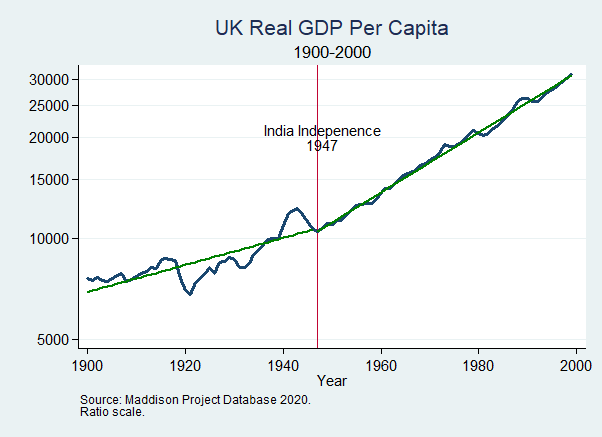
Orwell’s failed prediction stemmed from two reasons. First, he was imbued with zero-sum thinking. It should have been obvious that India was not necessary to the high standard of living enjoyed in England because most of that high standard of living came from increases in the productivity of labor brought about by capitalism and the industrial revolution and most of that was independent of empire (Most. Maybe all. Maybe more than all. Maybe not all. One can debate the finer details on financing but of that debate I have little interest.) The second, related reason was that Orwell had a deep suspicion and distaste for technology, a theme I will take up in a later post.
Orwell, who was born in India and learned something about despotism as a police officer in Burma, opposed empire. Thus, his argument that we had to be poor to be just was a tragic dilemma, one of many that made him pessimistic about the future of humanity.
Armin Rosen on the Saudi reforms
An excellent piece, to be read through in its entirety, here is one excerpt:
MBS is gambling that the fruits of openness and modernity can be reaped on Saudi terms, and that prosperity, stability, and a recharged, secularized sense of national purpose won’t shatter existing norms or generate dangerous civic appetites. The reforms have created a rising class of ambitious executives, entrepreneurs, and artists, and for now almost everyone seems to accept the idea of a national horizon defined by the wisdom and vision of a single family, and perhaps even a single man. His program has created an atmosphere muggy with floating potential, as the palace carries out an uncertain experiment on tens of millions of people. MBS’s subjects could be the engine and the beneficiaries of the only successful 21st-century governance project in any populous Middle Eastern state—or they could mark the disastrous limits of utopia declared from on high.
Recommended.
What I’ve been reading
Bjorn Lomborg’s Best Things First delivers the expected dose of correct common sense.
Charles Horsnby, Kenya, A History since Independence is a very good long treatment of everything up to about 2010, conceptual too.
David Schleicher, In a Bad State: Responding to State and Local Budget Crises. An important, unfortunately timely, and very intelligent book on how the federal government has responded to state and local insolvency in the past. My main complaint is that at 171 pp. of text it is far too short.
Norman Lebrecht, Why Beethoven: A Phenomenon in One Hundred Pieces. A good introduction to Ludwig van, even if some parts do rush by too quickly. Also a good introduction for how to think about different recorded versions of the same piece.
There is Markus K. Brunnermeier and Ricardo Reis, A Crash Course on Crises: Macroeconomic Concepts for Run-ups, Collapses, and Recoveries.
And also Angus Deaton, Economics in America: An Immigrant Economist Explores the Land of Inequality.
Kelly Smith offers his account of Prenda micro-schools in his A Fire to Be Kindled: How a Generation of Empowered Learners Can Lead Meaningful Lives and Move Humanity Forward.
Patrick Mackie, Mozart in Motion: His Work and his World in Pieces is a good introduction to what the title promises.
*The Corporation and the Twentieth Century*
The author is Richard N. Langlois, and the subtitle is The History of American Business Enterprise. 551 pp. of text. I’ve taught Ph.D Industrial Organization for a good while now, and have always wanted a text that provides an overview and introduction to U.S. business history, with sophistication and good economics, and without being out of date. This is that book, so I am happy indeed.
Monday assorted links
1. Claims about semaglutide. Not to be taken as endorsement of the claims, one way or the other, but worth further investigation.
3. Claims that lab-grown meat are worse for the environment.
Two Podcasts
Two podcasts I have enjoyed recently, First, The Social Radars, headed by Jessica Livingston and Carolynn Levy, co-founder and managing director of Y Combinator respectively. Jessica and Carolynn bring a lot of experience and trust with them so the entrepreneurs they interview open up about the realities of startups. Here is a great interview with David Lieb, creator of Google Photos and before that the highly successful failure, Bump.
I’ve also enjoyed the physician brothers Daniel and Mitch Belkin at The External Medicine Podcast. Here’s a superb primer on drug development from the great Derek Lowe.
Pristina, Kosovo bleg
Violence permitting, I will be there soon. So what should I see and what should I do? I thank you all in advance for your wise counsel.
The strange recession that is Czechia (from my email)
From the very perceptive Kamil Kovar, these are his words I will not double indent:
“Seeing your recent brief post on recession I was wondering whether you are thinking about writing a longer post on the topic of recessions in general? I find the recent macroeconomic developments very intriguing, as they challenge my previous notions of what is a recession and what pushes us into recession, and would be very interested in hearing what you think.
To be more specific, let me use European developments, which I think are even more thought-provoking from this perspective than US developments. Take an extreme example of Czechia, which combines following facts:
- GDP has contracted for two quarters in a row, each time around 0.3% non-annualized. It is still below its pre-pandemic peak.
- Consumption has contracted for 5 quarters in a row, cumulatively 7.6%.
- Fixed investment has decreased in last quarter as well, albeit after strong recovery throughout the previous year and a half.
- The reason why GDP did not drop more is because net exports surged from their extremely low values reached during the pandemic period. In last quarter government consumption also helped a lot.
- Despite all the weakness, labor market is tight, with unemployment rate close to its pre-pandemic historical lows (in case you don’t know, it is ridiculously-sounding low at 2.1%), and employment continuing to grow.
(This as of March; more recent data continued in these trends, albeit GDP overall increased a tad bit. Also, Germany is going through something similar, albeit at much smaller scale).
It feels like this combination just does not fit in together in terms of standard macroeconomics – if you would tell me only about consumption (2) I would say the country has to be in recession, but investment (3) and labor market (5) are clearly saying no recession. If it would be just labor market, then I could accept that it is case of labor hoarding distorting the picture, but investment also remaining robust is just hard to reconcile with recession.
So I was wondering in what way, if any, did the last update your beliefs about “what is a recession and what pushes us into recession” in the light of the puzzling macroeconomic data of last year or so…
P.S.: In case you want to read more on the case of Czechia, or my take on what it all means, I had a blog post few months back:
https://kamilkovar.substack.com/p/it-or-isnt-it-recession-on-regular
My way of reconciling the data with my mental models is that got real shocks pushing us into RBC-style recession, but for whatever reason we did not get the typical demand shocks that lead to a more standard recession.”
TC again: Worth a ponder!
Acemoglu on the Turkish polity and economy
Preliminary but fairly clear results from the runoff of the Turkish elections show that President Erdogan will have a historic third term. This has implications for democracy and the economy.
— Daron Acemoglu (@DAcemogluMIT) May 28, 2023
Sunday assorted links
The debt ceiling deal
Ho hum. Political bargaining, so what else is new? Kicking fiscal problems down the road, so what else is new? True permitting reform? We’ll see how much they end up doing away with judicial review.
As I stated long ago, I don’t favor either having a debt ceiling or using such a debt ceiling for strategic purposes. But this deal is not very different from what would have resulted from the normal appropriations process, is it? All in all, not worth monkeying with the Constitution for, with such dubious elements as minting the coin, invoking the amendment, and so on. The influence of Donald Trump really is spreading, isn’t it? There may yet be a final round of drama, but the people who treated this event as the nothing burger it is were on the right track the whole way through.
Identify a Market Failure and Win Prizes!
The University of Chicago’s Market Shaping Accelerator, led by Rachel Glennerster, Michael Kremer, and Chris Snyder (Dartmouth), is offering up to two million dollars in prizes for new pull mechanisms and applications.
Our inaugural MSA Innovation Challenge 2023 will award up to $2,000,000 in total prizes for ideas that identify areas where a pull mechanism would help spur innovation in biosecurity, pandemic preparedness, and climate change, and for teams to design that incentive mechanism from ideation to contract signing.
Participating teams will have access to the world’s leading experts in market shaping and technical support from domain specialists to compete for their part of up to $2 million prize during multiple phases. Top ideas will also gain the MSA’s support in fundraising for the multi-millions or billions of dollars needed to back their pull mechanism.
…Pull mechanisms are policy tools that create incentives for private sector entities to invest in research and development (R&D) and bring solutions to market. Whereas “push” funding pays for inputs (e.g. research grants), “pull” funding pays for outputs and outcomes (i.e. prizes and milestone contracts). These mechanisms “pull” innovation by creating a demand for a specific product or service, which drives private sector investment and efforts towards developing and delivering that product or technological solution.
One example of a pull mechanism is an Advance Market Commitment (AMC), which is a type of contract where a buyer, such as a government or philanthropic organization, commits to purchasing (or subsidizing) a product or service at a certain price and quantity once it becomes available. This commitment creates a market for the product or service, providing a financial incentive for innovators to invest in R&D and develop solutions to meet that demand.
The first round of prizes are $4,000 for an idea!
The submission template asks applicants to identify a market failure where the social value exceeds private incentives and where we know the measurable outcome we want to encourage (e.g. the development of a vaccine, capturing carbon out of the air, etc.). Submissions are accepted from individuals 18 years and older and organizations around the globe whose participation and receipt of funding will not violate applicable law.
See here for more.
Do tax increases tame inflation?
Here is a new AER article by James Cloyne, Joseba Martinez, Haroon Mumtax, and Paolo Surico. After an extensive data analysis, they arrive at this conclusion:
Based on US federal tax changes post–World War II, our answer is “yes” if personal income taxes are increased but “no” if corporate income taxes are increased.
Of course this is consistent with the view — no longer so commonly admitted — that higher corporate tax rates do have negative supply side effects. There is an ungated version of the paper here.