Peltzman Revisited
Casey Mulligan has an excellent new paper, Peltzman Revisited: Quantifying 21st-Century Opportunity Costs of Food and Drug Administration Regulation. What are the costs of delaying a new drug or a vaccine? Longer and bigger clinical trials increase safety but I’ve often made the point that the people who would have lived had a good drug been approved sooner are buried in an invisible graveyard and thus these costs are typically undercounted–the failure to see the invisible graveyard biases decisions in favor of delay. Mulligan makes a different and rarely considered point about substitution effects. If a vaccine isn’t available there are substitutes but these substitutes are themselves potentially unsafe and ineffective. But who is testing the substitures?
Many of these substitute interventions, such as remote work, closing schools, and canceling normal medical appointments, are beyond the jurisdiction of the FDA and can be utilized without any attempt to demonstrate their safety or efficacy.
If the substitutes work, the costs of delay are reduced. The FDA, for example, is right to prioritize drugs for which there are few alternative treatments. But the standards for many vaccine or drug substitutes are completely different than those used to approve a vaccine:
Closing schools to in-person learning is an important example of a prevention activity that was available, was applied to tens of millions of children in the United States, and was outside the FDA’s jurisdiction…Obviously the FDA’s effectiveness standard for vaccines differs from the effectiveness standard (if any) that school districts applied in deciding to close schools.
Where were the randomized controlled trials for closing schools, shutting the parks and beaches, and delaying medical appointments? Thus, it’s quite possible that greater safety of vaccines comes at the expense of greater time under less safe and possibly unsafe substitutes. As Mulligan concludes:
Approval delays for pandemic tests and vaccines pushed tens of millions of individuals and businesses into preventions and treatments that were both outside FDA jurisdiction and hardly safe or effective. The pandemic experience raises the question of whether, on the whole, consumers engage in more unsafe and ineffective practices than they would if FDA approval were not a prerequisite for pharmaceutical sales.
Addendum: Much else of interest in the paper including a calculation of the value of the vaccines in the hundreds of billions and trillions very much in line with work done by the AHT team, including myself ,in the AER PP (especially the appendix) and Science.
The Effect of Population Aging on Economic Growth, the Labor Force, and Productivity
Population aging is expected to slow US economic growth. We use variation in the predetermined component of population aging across states to estimate the impact of aging on growth in GDP per capita for 1980–2010. We find that each 10 percent increase in the fraction of the population age 60+ decreased per capita GDP by 5.5 percent. One-third of the reduction arose from slower employment growth; two-thirds due to slower labor productivity growth. Labor compensation and wages also declined in response. Our estimate implies population aging reduced the growth rate in GDP per capita by 0.3 percentage points per year during 1980–2010.
That is from Nicole Maestas, Kathleen J. Mullen and David Powell, in the new AEJ: Macroeconomics. Uh-oh!
Econ Journal Watch — new issue
In this issue:Hospitals, communication, and dispute resolution: Florence R. LeCraw, Daniel Montanera, and Thomas A. Mroz criticize the statistical methods of a 2018 article in Health Affairs, and tell of their effort to get their criticisms into Health Affairs.Health Insurance Mandates and the Marriage of Young Adults: Aaron Gamino comments on the statistical modeling in a 2022 Journal of Human Resources article, whose authors Scott Barkowski and Joanne Song McLaughlin reply.Origins of the Opioid Crisis Reexamined: A 2022 article in the Quarterly Journal of Economics on the origins of the opioid crisis assigns considerable explanatory weight to the introduction and promotion of OxyContin. Robert Kaestner looks at the empirics behind the conclusion and suggests that it is without much foundation.Temperature and Economic Growth: As he did in the previous issue of this journal, David Barker investigates a piece of Federal Reserve research purporting to show that high temperatures decrease the rate of economic growth. Barker looks under the hood, replicates, and reports.Classical Liberalism in Romania, Past and Present: Radu Nechita and Vlad Tarko narrate the classical liberal movements in Romania, from the beginning of the 19th century, through the awful times of the 20th century, and down to today. The article extends the series on Classical Liberalism in Econ, by Country.Edward Westermarck’s Lectures on Adam Smith, delivered in 1914 at the University of Helsinki. Westermarck, of Finland, was an influential sociologist, anthropologist, and philosopher. His lectures are remarkably attentive toward Smith’s Theory of Moral Sentiments. The lectures are translated and introduced by Otto Pipatti.French economic liberalism versus occupational privilege: In 1753, Vincent Gournay wrote a memorial blasting the exclusionary privileges conferred upon guilds. The Chamber of Commerce of Lyon replied, and Gournay then responded with another memorial. The three-part exchange is translated here for the first time, and introduced by Benoît Malbranque.Professor McCloskey’s 1988 Letter Responding to a Letter from the President of Penn State: In 1988, Donald (now Deirdre) McCloskey received a letter about a passage in The Applied Theory of Price in an exercise on discrimination in labor markets. The letter and McCloskey’s response are reproduced here.EJW Audio:
- Sheilagh Ogilvie on 900 Years of European Guilds
- Art Carden on William H. Hutt
- David Barker on Temperature and Economic Growth
EJW books from CL Press:
My Irish lineage
Travis, an MR reader, set out to trace my Irish lineage, and here is what he found (the other, more recent parts of his story check out 100% with what I know):
I was having fun, so I traced your whole family rather than just the Cowens. Good news–we’ve got definite Irish origins for almost all of them, at least by county. The Bohans are from Killyfea in county Leitrim. The Crosbys from the Common of Lloyd in county Meath. The Wards from somewhere in County Donegal. The Cowens are the trickiest–not because there were no records, but because they were surprisingly mobile. Your immigrant ancestor John Cowen was married in the town of Longford, baptized a first child in Enniskerry, Wicklow, baptized a second in Dublin, then baptized all the rest in Kells. If I had to guess I’d say he was from Longford, but I can’t say with any certainty. His wife and his son’s wife were both likely from Kells (of Book of Kells fame).
It was extremely impressive what Travis found, including a whole line of grocers and lots of time spent in New Jersey. I am also 1/8th from the Madeira islands, but that is a story for another day…In the meantime, many thanks to Travis!
Balaji and White on the Banks
An excellent discussion between Balaji and my colleague Larry White. I don’t think Balaji is going to win his bet but he has been ahead of the crowd on the banking crisis. It’s now obvious, for example, that what was important about SVB was not Silicon Valley but that it was a bank and Balaji was among the first to present this clearly. Like Larry, I can imagine Bitcoin and other crypto assets rising in price due to the crisis as people look to diversify away from USD and the US banking system (I am an advisor to some crypto firms) but I don’t see $1 million soon. Larry, however, understands banking issues better than anyone I know (check out his new book Better Money: Gold, Fiat or Bitcoin?) and he agrees with much of Balaji’s analysis even if not $1m BTC.
Balaji’s mic is noisy but worth listening to anyway for the signal.
The Employment Effects of Generous and Unconditional Cash Support
While unconditional cash transfers have been studied extensively in developing countries, little is known about their effects in a wealthier context. Through a randomized controlled trial, we study the employment effects of a generous and unconditional transfer targeting low-income families in Spain. Two years into the program, subjects assigned to treatment are 20 percent less likely to work than subjects assigned to a control group. Assignment to an activation plan does not attenuate adverse effects; a more lenient transfer withdrawal rate does. It appears that effects are driven by subjects with children, suggesting substitution of labour for care tasks.
Here is the full paper by Timo Verlaat, Federico Todeschini, and Xavier Ramos. Via the excellent Kevin Lewis.
*On Every Tide*
The subtitle is The Making and Remaking of the Irish World, and the author is Sean Connolly. Excerpt:
Seven out of every ten emigrants entering the United States between 1900 and 1909 were men. The female minority, moreover, came mainly as members of family groups. Emigration from Ireland initially followed much the same pattern. After 1850, however, Ireland became the only European country to send almost as many women as men across the Atlantic, the great majority as single women rather than as wives or daughters. This pattern of independent female migration was of central importance, giving Irish diasporic communities a stability they would not otherwise have had. In particular it helps to explain why Irish rates of return migration were so low: there was no need to return home to find a bride form one’s own ethnic background.
And from a bit later in the text:
There were good economic reasons why Irish women were more ready than others to take to the migrant ship. the replacement of the cottage spinning wheel by the giant water-and-steam-driven machinery of Belfast and the surrounding area, and the failure of factory-based manufacturing to thrive in other parts of the country, sharply reduced the opportunity for women to find employment, and with it their prospect of marriage.
Quite a good book.
Saturday assorted links
2. Pergamon in Berlin to close for a 14 (!!) year renovation.
3. The Comptometer. It turns out one of my ancestors, grandmother on the maternal side, was expert at using the Comptometer, in the early 20th century.
4. My June 6 2023 LSE talk on LLMs, the Hayek lecture.
5. Chess.com looking for a new CEO. Here is one very good part of the application.
6. Ross on the AI pause (NYT). And Farhad Manjoo on the TikTok ban (NYT). And WSJ profile of Sam Altman. And the Worldcoin project.
Personality Differences and Investment Decision-Making
We survey thousands of affluent American investors to examine the relationship between personalities and investment decisions. The Big Five personality traits correlate with investors’ beliefs about the stock market and economy, risk preferences, and social interaction tendencies. Two personality traits, Neuroticism and Openness, stand out in their explanatory power for equity investments. Investors with high Neuroticism and those with low Openness tend to allocate less investment to equities. We examine the underlying mechanisms and find evidence for both standard channels of preferences and beliefs and other nonstandard channels. We show consistent out-of-sample evidence in representative panels of Australian and German households.
That is from a new NBER working paper from Zhengyang Jiang, Cameron Peng, and Hongjun Yan.
The California marginal tax rate schedule, benefits included
Friends, colleagues, may I present to you: the California Marginal Tax Rate Schedule pic.twitter.com/bYaHz8giIH
— Max Ghenis (@MaxGhenis) March 21, 2023
Via Jason Crawford.
The Effects of Wealth on (Swedish) Marriage and Fertility
We estimate the effects of large, positive wealth shocks on marriage and fertility in a sample of Swedish lottery players. For male winners, wealth increases marriage formation and reduces divorce risk, suggesting wealth increases men’s attractiveness as prospective and current partners. Wealth also increases male fertility. The only discernible effect on female winners is that wealth increases their short-run (but not long-run) divorce risk. Our results for divorce are consistent with a model where the wealthier spouse retains most of his/her wealth in divorce. In support of this assumption, we show divorce settlements in Sweden often favor the richer spouse.
That is from a new NBER working paper by
The new Scott Sumner book
It is called Alternative Approaches to Monetary Policy, it is on-line and free. I have not read it yet, but here is part of the preface:
From feedback received on The Money Illusion, I see a need to take a deeper look at the fundamentals of monetary policy. What is monetary policy? Why do economists find it so hard to agree on a consensus model? Why do monetary theories seem cyclical, with various approaches going in and out of fashion over time? Why is it so difficult to clearly identify the points of disagreement? To answer these and other questions, it is necessary to go beyond discussing my own views of how the economy works and which policies seem best. We need to figure out why economists differ on some of the most basic questions in monetary economics.
Nicely presented, it is 219 pp. in total. Here Scott comments on the book.
Friday assorted links
1. Matt Teichman podcasts with Gaurav Venkataraman. Starts with a discussion of memory and biology.
2. Quiz: how much of a rationalist are you?
3. A large language model for finance. And further commentary from Bloomberg, it being their model. And the paper, is this the largest domain-specific training set?
4. ChatGPT banned in Italy on privacy grounds.
5. Will GPT models lower the number of media clicks? (NYT)
6. This FT piece claims that about 1/3 of current horse betting is AI-driven.
Again, don’t ban TikTok
You cannot trust the banning entity with the powers you are about to give it:
The RESTRICT Act, a proposed piece of legislation which provides one way the government might ban TikTok, contains “insanely broad” language and could lead to other apps or communications services with connections to foreign countries being banned in the U.S., multiple digital rights experts told Motherboard.
The bill could have implications not just for social networks, but potentially security tools such as virtual private networks (VPNs) that consumers use to encrypt and route their traffic, one said. Although the intention of the bill is to target apps or services that pose a threat to national security, these critics worry it may have much wider implications for the First Amendment…
Under the RESTRICT Act, the Department of Commerce would identify information and communications technology products that a foreign adversary has any interest in, or poses an unacceptable risk to national security, the announcement reads. The bill only applies to technology linked to a “foreign adversary.” Those countries include China (as well as Hong Kong); Cuba; Iran; North Korea; Russia, and Venezuela.
The bill’s language includes vague terms such as “desktop applications,” “mobile applications,” “gaming applications,” “payment applications,” and “web-based applications.” It also targets applicable software that has more than 1 million users in the U.S.
Here is the full story. Here is my previous post on banning TikTok, now that we see the actual proposed ban I consider my earlier arguments an understatement. Should it really be possible that you could get 20 years in prison for using a VPN to bypass such a ban? 20 years behind bars is unlikely, but more broadly this is a sign that we are addressing the TikTok problems with very much the wrong policy instruments.
The Law of Unintended Consequences
Sketchplanations writes up my theory of unintended consequences:
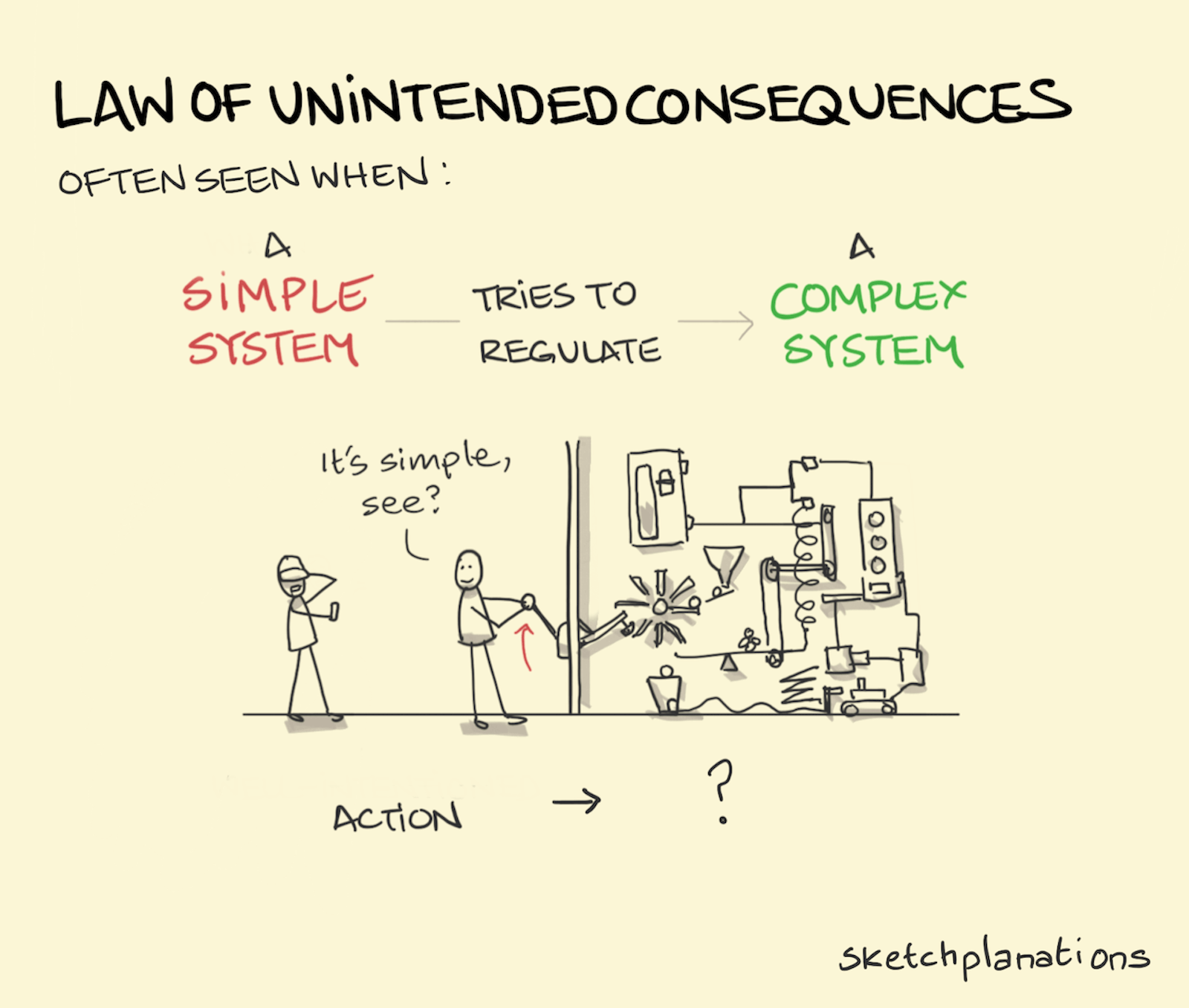
People are complicated. Life is complicated. Ecosystems are complicated. Alex Tabarrok writes, “The law of unintended consequences is what happens when a simple system tries to regulate a complex system.” This so often happens in any kind of government program, regulation, law or attempt to control something within a complex system with a relatively simple action. Things will happen that we didn’t anticipate.
Examples abound:
- A policy of suppressing forest fires that goes on to cause even greater fires.
- An attempt in Bogotá to reduce traffic by restricting who could drive each day based on licence plates that led people to circumvent the policy by buying more cars.
- More open workplaces that cause people to behave more privately.
- Elimination of predators that leads to the proliferation of grazing animals and a reduction in diversity.
- The effects of literally any dam built anywhere.
- What happens when you change software.
- Desire paths.
- The Streisand effect.
- Or social distancing policies that results in outdoor natural spaces being crammed with people at weekends.
- And on, and on.
Often, as with some of these, the outcome can be the opposite of what you intended, known as the cobra effect.
Controlling complex systems is difficult.
Thanks to Bruce Howard for supporting this one.