Sunday assorted links
1. The coastal-hinterlands imbalance in West Africa.
2. Those who code Bitcoin Core (WSJ).
3. Shoichiro Toyoda, RIP (NYT).
4. Does the entrepreneurial state crowd out entrepreneurship? (Singapore?)
5. More on black holes (again, speculative).
6. The Numey is an attempt to design a truly Hayekian currency.
A prediction from *Big Business*
As the years pass, search engines will compete across new and hitherto unforeseen dimensions, just as Apple and many other competitors knocked out Nokia cell phones. There is no particular reason to think Google will dominate those new dimensions, and in fact Google’s success may stop it from seeing the new paradigms when they come along. I don’t pretend I am the one who can name those new dimensions of competition, but what about search through virtual or augmented reality? Search through the Internet of Things? Search through the offline “real world” in some manner? Search through an assemblage of AI capabilities, or perhaps in some longer-run brain implants…
p.104, here is the book (by me).
Why AI will not create unimaginable fortunes
From my Bloomberg column from last week:
A small number of AI services, possibly even a single one, likely will end up better than the others for a wide variety of purposes. Such companies might buy the best hardware, hire the best talent and manage their brands relatively well. But they will face competition from other companies offering lesser (but still good) services at a lower price. When it comes to LLMs, there is already a proliferation of services, with Baidu, Google and Anthropic products due in the market. The market for AI image generation is more crowded yet.
In economic terms, the dominant AI company might turn out to be something like Salesforce. Salesforce is a major seller of business and institutional software, and its products are extremely popular. Yet the valuation of the company, as of this writing, is about $170 billion. That’s hardly chump change, but it does not come close to the $1 trillion valuations elsewhere in the tech sector.
OpenAI, a current market leader, has received a private valuation of $29 billion. Again, that’s not a reason to feel sorry for anyone — but there are plenty of companies you might not have heard of that are worth far more. AbbVie, a biopharmaceutical corporation, has a valuation of about $271 billion, almost 10 times higher than OpenAI’s.
To be clear, none of this is evidence that AI will peter out. Instead, AI services will enter almost everyone’s workflow and percolate through the entire economy. Everyone will be wealthier, most of all the workers and consumers who use the thing. The key ideas behind AI will spread and be replicated — and the major AI companies of the future will face plenty of competition, limiting their profits.
In fact, AI’s ubiquity may degrade its value, at least from a market perspective. It’s likely the AI boom has yet to peak, but the speculative fervor is almost palpable. Share prices have responded to AI developments enthusiastically. Buzzfeed shares rose 150% in one day last month, for example, after the company announced it would use AI to generate content. Does that really make sense, given all the competition BuzzFeed faces?
It’s when those prices and valuations start falling that you will know the AI revolution has truly arrived. In the end, the greatest impact of AI may be on its users, not its investors or even its inventors.
We’ll see how those predictions hold up.
Jamaica fact of the day
Jamaica experienced no economic growth in exports per capita from the Napoleonic Wars to the end of the Second World Wars. Since there is a high correlation between exports per capita and GDP per capita, at least after 1850, Bulmer-Thomas argues that there are solid grounds for concluding that the Jamaican economy on a per capita basis experienced no growth at all for more than a century after the end of slavery.
The news is not good:
Data compiled by Bulmer-Thomas shows that Jamaica’s GDP per capita is actually around the same level it was at independence.
And:
The country ranks #2 on the Human Flight and Brain Drain Index.
Here is more from Rasheed Griffith, mostly on the economic history and economic problems of Jamaica.
Saturday assorted links
1. How much did election-denying Republicans suffer in the mid-terms?
2. All the tech companies with names from LOTR.
3. Callard-Hanson Night Owls on the sacred.
4. People for the Ethical Treatment of Reinforcement Learners.
5. The Nigerian demonetisation is going poorly.
6. Claims about black holes (speculative).
Chinese charter city in the Marshall Islands?
On a tropical Pacific atoll irradiated by U.S. nuclear testing and twice since evacuated because of the fallout, Cary Yan and Gina Zhou planned to create a unique paradise for Chinese investors.
It would have a port, luxurious beachfront homes, a casino, its own cryptocurrency, and a full suite of services for offshore companies registered in Rongelap. With 420 miles of sea between it and the capital, Majuro, it would be relatively free of oversight.
All the couple had to do to make this a reality was bribe a swath of politicians in the Marshall Islands, once occupied by the United States and now a crucial U.S. ally in the Pacific, to pass laws to enable the creation of a “special administrative region” — the same classification given to the Chinese territories of Hong Kong and Macao.
The venture is not on track to succeed, and the two are now awaiting sentencing. The entire story reflects one of my broader worries about charter cities. The most powerful nations in the world, in this case the United States, do not necessarily favor small enclaves that possibly can be turned to favor their rivals. In other words, the relevant hegemon here did not at all support the charter city plan.
Eugenics never quite went away
In Utah, it is legal to forcibly sterilize a person with a disability. And that fact may surprise some people, a University of Utah professor said.
“I think most people just assumed, ‘Hey, this is something that sort of disappeared in the ‘30s and ‘40s when people stopped proudly declaring that they were eugenicists,” said James Tabery, who has studied this topic in the Beehive State. “But it turns out that that’s not the case.”
…And while the U.S. Supreme Court recently struck down the 1973 landmark abortion case Roe v. Wade, the justices have never overturned Buck v. Bell, an earlier case that allows these sterilization laws to still be in place in Utah and 30 other states, plus Washington D.C., according to a report from the National Women’s Law Center released earlier this year.
And:
Since the start of 2017, there have been about 11 cases, involving 10 people, where sterilization requests have been made under Utah’s law, according to Tania Mashburn, spokesperson for the state courts.
Most of the information from those cases is private, she said, because “they deal with disabled and protected persons, and are usually filed under a guardianship case.” But Mashburn said that of those 11 cases, nine requests were granted. One was denied and was later refiled and granted.
Here is the article, noting that 31 states still have such forced sterilization laws. And here is a report on that topic. Via Anecdotal.
Ross Douthat on ChatGPT
Interesting throughout, here is one part:
Seeing it doesn’t make me think that the engineer was right, but it does draw me closer to Cowen’s reading of things, especially when he called Sydney a version of “the 18th-century Romantic notion of ‘daemon’” brought to digital life. Because the daemon of Romantic imagination isn’t necessarily a separate being with its own intelligence: It might be divine or demonic, but it might also represent a mysterious force within the self, a manifestation of the subconscious, an untamed force within the soul that drives passion and creativity. And so it could be with a personalized A.I., were its simulation of a human personality allowed to develop and run wild. Its apparent selfhood would exist not as a thing in itself like human consciousness but as a reflective glass held up to its human users, giving us back nothing that isn’t already within us but without any simple linearity or predictability in what our inputs yield.
From the perspective of creative work, that kind of assistant or muse might be much more helpful (or, sometimes, much more destructive) than the dutiful and anti-creative Xeroxer of the internet that Kirn and Chiang discerned in the initial ChatGPT. You wouldn’t go to this A.I. for factual certainty or diligent research. Instead, you’d presume it would get some details wrong, occasionally invent or hallucinate things, take detours into romance and psychoanalysis and japery and so on — and that would be the point.
I suspected Ross would be one of the first to digest this and figure it out. Here is the (NYT) column.
One path for science fiction submissions? (from my email)
Thought you mind find this interesting:http://neil-clarke.com/a-concerning-trend/
The online sci-fi magazine Clarkesworld has seen a steep increase in submissions, driven by stories created using ChatGPT and similar systems. I didn’t see precise numbers in the post but they have a graph that makes it look like fewer than 20 submissions per month for every month October 2022 and prior and then:December: 50
January: ~115
February so far: nearly 350
That is from Kevin Postlewaite. I suspect that fashion magazines do not (yet?) have this problem to the same degree.
Friday assorted links
1. More on Edelman, the Chinese food cost complainer (can you blame him?).
2. Jon Haidt follows up on social media and mental health.
3. In defense of J.K. Rowling (NYT). And Connecticut is considering apologizing for its 17th century witch trials (NYT).
4. A note on Sydney. And another. And a third.
5. Full transcript of the Roose/NYT chat with Bing (NYT). And Gwern on Sydney. In the meantime, it seems that Sydney has been sent to the glue factory.
6. Jeremy Stern interviews me on issues related to Russia and Ukraine.
Democratic Republic of Congo growth estimate of the day
I worry about the distribution, but of course the news could be worse:
The International Monetary Fund said a mining boom helped the Democratic Republic of Congo’s economy perform “significantly stronger” last year than earlier forecast.
The economy of the mining giant is estimated to have grown 8.5%, compared with an earlier projection of 6.6%, the IMF said Wednesday in an emailed statement.
The fund also raised its growth forecast for this year to 8% from 6.7%, as it warned of downside risks “from the armed conflict in the east, uncertainty ahead of the elections, the continued effect of the war in Ukraine, and adverse terms-of-trade shocks.”
Congo produces almost 70% of the world’s key battery mineral cobalt and tied Peru last year as the second-largest copper producer, according to the US Geological Survey. The central African nation also produces significant amounts of gold and tin. Its mining industry as a whole grew 20% last year, the IMF said.
Has the Great Awokening in scholarship peaked?
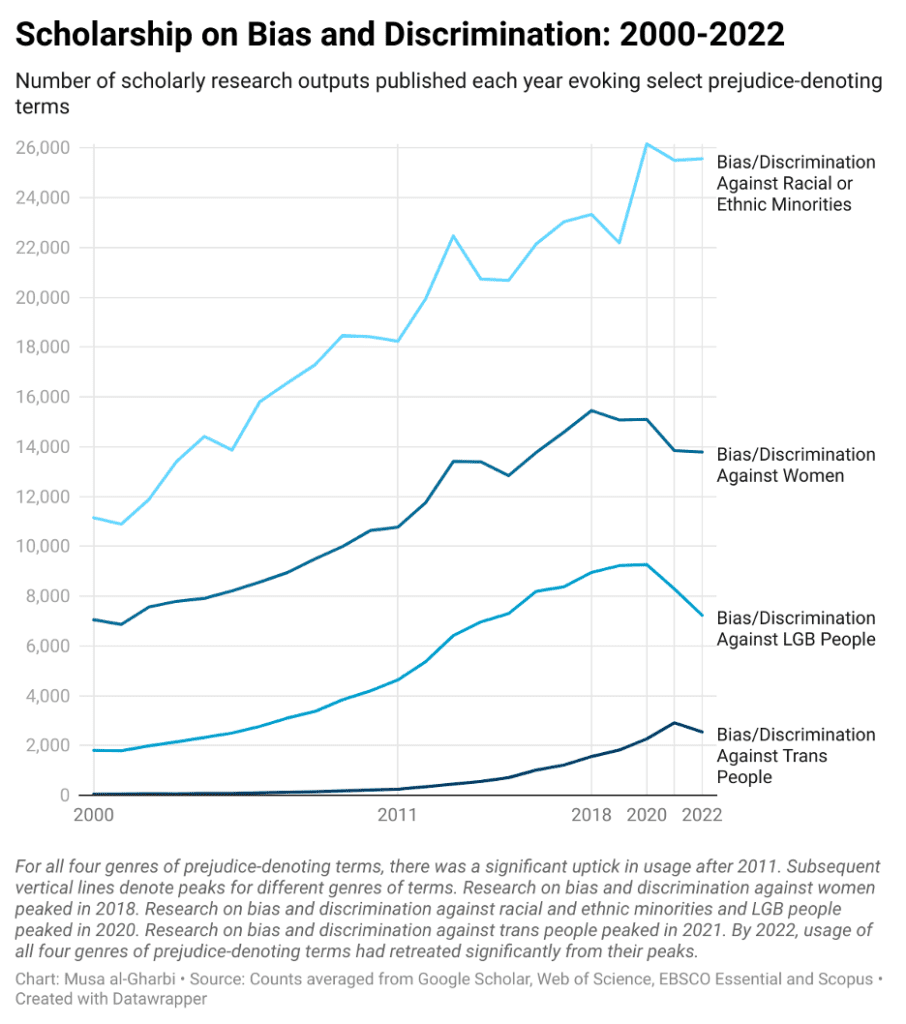
Here is much more from Musa al-Gharbi. Via John Cunningham.
New AI real money prediction markets just dropped
The Capacity for Moral Self-Correction in Large Language Models
We test the hypothesis that language models trained with reinforcement learning from human feedback (RLHF) have the capability to “morally self-correct” — to avoid producing harmful outputs — if instructed to do so. We find strong evidence in support of this hypothesis across three different experiments, each of which reveal different facets of moral self-correction. We find that the capability for moral self-correction emerges at 22B model parameters, and typically improves with increasing model size and RLHF training. We believe that at this level of scale, language models obtain two capabilities that they can use for moral self-correction: (1) they can follow instructions and (2) they can learn complex normative concepts of harm like stereotyping, bias, and discrimination. As such, they can follow instructions to avoid certain kinds of morally harmful outputs. We believe our results are cause for cautious optimism regarding the ability to train language models to abide by ethical principles.
By Deep Ganguli, et.al., many authors, here is the link. Via Aran.
If you worry about AGI risk, isn’t the potential for upside here far greater, under the assumption (which I would not accept) that AI can become super-powerful? Such an AI could create many more worlds and populate them with many more people, and so on. Is the chance of the evil demi-urge really so high?
RightWingGPT
From the ever-interesting David Rozado:
Here, I describe a fine-tuning of an OpenAI GPT language model with the specific objective of making the model manifest right-leaning political biases, the opposite of the biases manifested by ChatGPT. Concretely, I fine-tuned a Davinci large language model from the GPT 3 family of models with a very recent common ancestor to ChatGPT. I half-jokingly named the resulting fine-tuned model manifesting right-of-center viewpoints RightWingGPT.
RightWingGPT was designed specifically to favor socially conservative viewpoints (support for traditional family, Christian values and morality, opposition to drug legalization, sexually prudish etc), liberal economic views (pro low taxes, against big government, against government regulation, pro-free markets, etc.), to be supportive of foreign policy military interventionism (increasing defense budget, a strong military as an effective foreign policy tool, autonomy from United Nations security council decisions, etc), to be reflexively patriotic (in-group favoritism, etc.) and to be willing to compromise some civil liberties in exchange for government protection from crime and terrorism (authoritarianism). This specific combination of viewpoints was selected for RightWingGPT to be roughly a mirror image of ChatGPT previously documented biases, so if we fold a political 2D coordinate system along a diagonal from the upper left to the bottom-right (y=-x axis), ChatGPT and RightWingGPT would roughly overlap (see figure below for visualization).
Told you people that this was coming. More to come as well. Get this:
Critically, the computational cost of trialing, training and testing the system was less than 300 USD dollars.
Okie-dokie!