Results for “age of em” 17231 found
Friday assorted links
1. Russian army logistics. And Soviet fact of the day.
3. The police culture that is New Jersey (NYT).
4. “Aligning with Lukianoff and Haidt’s assertions, we found that students’ self-reported prevalence of cognitive distortions positively predicted their endorsement of safetyism-inspired beliefs, the belief that words can harm, and support for the broad use of trigger warnings.” Link here.
5. Kalshi: “Will Omicron make up greater than 1% of U.S. COVID-19 cases by the new year?” And here is another market in a new variant.
Nu, a variant of real concern
Here is the Eric Topol thread. Do read it. Here is the scary graph, based on preliminary data. Here is Bloom Lab. Here is a layperson’s take from the Times of London:
When was the variant first discovered?
South African authorities raised the alarm at 2pm on Tuesday of this week, when they found samples with a significant number of worrying mutations.The samples dated from tests taken on November 14 and 16. On Wednesday, even as scientists were analysing the genome, other samples were found in Botswana and China, originating from travellers from South Africa.
Why were scientists initially concerned by this variant?
The spike protein is the tool a virus uses to enter cells, and the part of it our vaccines are trained to spot. This variant had 32 mutations in the spike — meaning it would look different to our immune system and behave differently when attacking a body. As a virologist at Imperial College put it, it was a “horrific spike profile”.Why has worry increased over the course of the week?
When geneticists and virologists looked at the mutations they realised there was a high likelihood they could increase its transmissibility or help it evade immunity. But these concerns were still theoretical. However, today South African scientists spotted a quirk in the testing regimen. PCR tests look for three genes in the coronavirus and amplify them. If, however, the virus was this variant they were only able to amplify two.In the province of Gauteng, where the proportion of tests coming back positive has rocketed to one in three, they found the proportion in which only two genes were amplified has also rocketed.
What does this mean?
There are three options. It is still possible — though unlikely — this is chance, with the variant’s apparently increased spread relating to an unusual cluster. If it does have a genuine advantage, then it is either better able to spread or better able to infect people who have prior immunity — either from vaccination or infection. Or, it is both.
This might come to nothing, but it is definitely a matter of concern. One more general point is that even if Nu is a non-event, it seems to show that the space for possible significant mutations is largely than we had thought.
Thanksgiving assorted links
1. Why do frozen turkeys explode when deep fried?
2. “Former South Korean military dictator Chun Doo-hwan has died at age 90. This means all living former South Korean Presidents are currently in jail.” Tweet link here.
3. David Wallace-Wells on the tragedy of regular ol’ air pollution.
4. The case against the Trump-Biden tariffs (NYT).
5. New dating terms.
6. Walmart “cancels” children’s toy that swears and sings in Polish about doing cocaine.
7. Georgia politician stands by giant topiary chicken that got him ousted as mayor.
Give Thanks to the Green Revolution
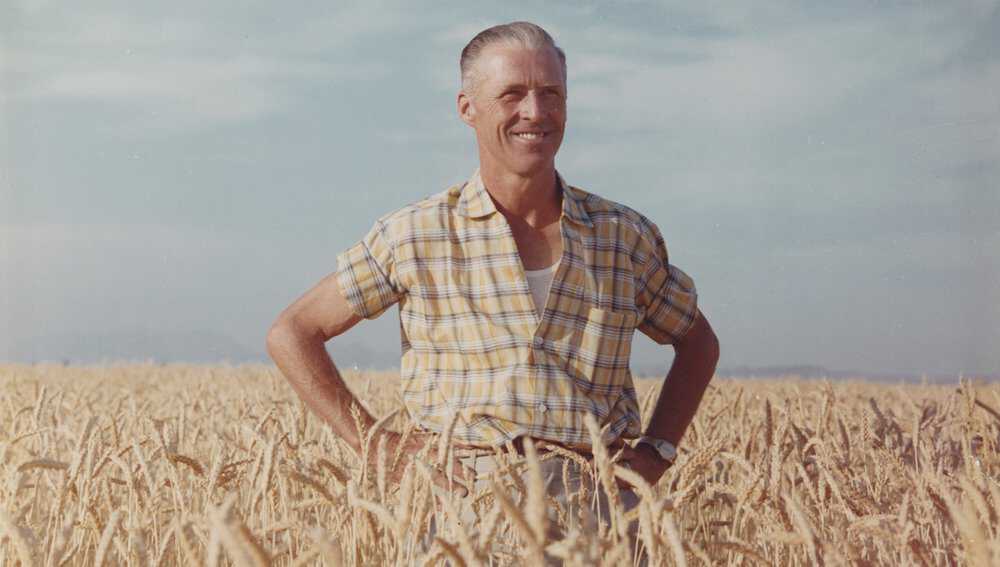 It’s well known that the Green Revolution dramatically increased crop yields. In a new paper, Gollin, Hansen and Wingender use a general equilibrium model to show that the effects were even more far reaching. For a given acre, the Green Revolution raised the yields of some crops by 44% between 1965 and 2010. But the total effect was even larger because higher yields incentivized farmers to substitute away from lower-yield crops into higher yield crops. Moreover, higher yields meant that less farm labor was required which shifted populations into manufacturing. When one takes into account all of these knock-on effects the authors find substantial effects on GDP. Indeed, the authors estimate that if the Green Revolution had never happened GDP per capita in the developing world would be half of its current level.
More realistically, if the Green Revolution had been delayed by ten years incomes in the developing world would be 17% lower today. In terms of cumulative GDP what this means is that the investments which made the Green Revolution possible were responsible for some US $83 trillion in benefits.
Somewhat surprisingly, the Green Revolution simultaneously prevented many people from starving but also reduced total population because of reduced fertility. The Green Revolution also meant that less land was used for farming not more.
As Tyler argues in Stubborn Attachments (see also this video) growth is a moral imperative. A ten year delay in the Green Revolution could easily have happened. Indeed, it is happening now.
Model this Apple pricing decision
Apple has one new product that’s already so back-ordered it won’t arrive in time for Christmas. It’s a polishing cloth. Priced at $19.
Unveiled in October after Apple showed off its new line of gadgets, the soft, light gray square is made of “nonabrasive material” and embossed with Apple’s logo. During tests, the rag worked like other microfiber cloths that list for less than half that price. So…why $19?
As it happens, Apple’s pricing strategy rarely allows accessories to fall below that threshold. The 6.3-inch swatch of fabric sits beside 17 other Apple-branded items on the company’s website—a mélange of charging cables, dongles and adapters—each priced at $19. Some, such as the wired earbuds and charging adapter, were once included with new iPhones.
Those $19 Apple items—together with the Apple Watch, AirPods and other small gadgets—are part of the company’s growing Wearables, Home and Accessories category, which had more than $8 billion in revenue in the quarter that ended in October.
Almost every Apple price ends in the number “9.” Would it matter if we all carried around $30 bills? There is further discussion in this Galvin Brown WSJ piece.
Via the excellent Samir Varma.
The anatomy of gender discrimination
That is the topic of my latest Bloomberg column, here is one excerpt:
Maybe the men, on average, did have greater ambition and thus promotion potential. One reason could be that women, on average, spend more time at home raising children than men. For very demanding executive jobs, even a small difference in time and travel availability could make a big difference in job performance.
And yet even if that’s the case, there could still be a discrimination problem. Even if women and men differ on average, there is a probability distribution for each group, and those distributions usually will overlap. That is, there will be many women who are willing and able to meet any workplace standard thrown at them, and many men with limited ambition.
If you think men and women are different on average, the unfairness can become all the more severe for the potential top performers. In this context, employers will look at the most talented women and, for reasons of stereotyping, dramatically underestimate their potential, including for leadership positions.
Economic reasoning suggests another subtle effect at play. Promotion to the top involves a series of steps along a career ladder, often many steps. If there is a discrimination “tax” at each step, even if only a small one, those taxes can produce a discouraging effect. It resembles the old problem of the medieval river that has too many tolls on it, levied by too many independent principalities. The net effect can be to make the river too costly to traverse, even if each prince is taking only a small amount.
With a citation to Zaua further below!
Did Milton Friedman support bailouts?
Hugh Rockoff does a 72 pp. deep dive on Milton Friedman on bailouts. This is an excellent paper, as he also considers Friedman’s columns and spoken words over the years and he also fleshes out Friedman’s thoughts on what we now call “shadow banks” (he worried about them). Friedman was willing to accept a fair number of bailouts, here is one excerpt:
In the bailout of Continental Illinois, a case that Friedman thought had been handled well, depositors and other creditors were protected, but shareholders were mostly wiped out and management was replaced. The protection of depositors and other creditors created an advantage for large banks: they could raise funds more easily because they, like Continental Illinois, were “too big to fail.” However, Friedman thought that as long as shareholders and managers were forced to pay dearly when a financial institution was bailed out there would still be an adequate incentive for bank managers to exercise prudence.
More generally:
For Friedman this meant that in the case of financial institutions the benefits of a bailout might outweigh the costs.
And more speculatively:
No one can channel an economist as brilliant and creative as Milton Friedman. Nevertheless, having come this far I will make an attempt. I believe that it would have been consistent with his earlier views for Friedman to have been “reluctant to condemn” the program of bailouts undertaken in 2008, to use the phrase that he used when questioned about the rescue of Long–Term Capital Management. I think he would have recognized that the repos issued by Lehman Brothers and other investment banks were similar to uninsured deposits in commercial banks, thus making possible a destructive panic. In other words, he would have recognized the logic of the contention that 2008 was a “run on repos” and similar to earlier financial panics (Gorton, Laarits, and Metrick 2018). He might have reminded us of the consequences of the failure to provide help for the BoUS in 1930. However, he might well have been critical of the structure of the bailouts, especially with respect to how various classes of stakeholders were treated.
I recall being excoriated in 2009 for suggesting that Friedman would have endorsed some version of the bailouts of that time.
Via the excellent Douglas Irwin. And here is my older CWT with Doug.
Best non-fiction books of 2021
What an incredible year for non-fiction books! But let me first start with two picks from 2020, buried under the avalanche of Covid news then, and missed because I was less mobile than usual. These books are not only good enough to make this list, but in just about any year they are good enough to be the very best book of that year:
Edward Nelson, Milton Friedman and Economic Debate in the United States, 1932–1972, volumes one and two.
Alexander Mikaberidze, The Napoleonic Wars: A Global History.
Also noteworthy is Reviel Netz, Scale, Space and Canon in Ancient Literary Culture, which I hope to write more about.
Per usual, there is typically a short review behind each, though not quite always. As for 2021 proper, here were my favorites, noting that I do not impose any quota system whatsoever. (And yet this list is somehow more cosmopolitan than most such tallies…hmm…) I don’t quite know how to put this, but this list is much better than the other “best books of the year” lists. These are truly my picks, ranked roughly in the order I read them:
Jin Xu, Empire of Silver: A New Monetary History of China.
Cat Jarman, River Kings: A New History of the Vikings from Scandinavia to the Silk Roads.
Michela Wrong, Do Not Disturb: The Story of a Political Murder and an African Regime Gone Bad.
Ryan Bourne, Economics in One Virus: An Introduction to Economic Reasoning Through Covid-19.
Colin Bryar and Bill Carr, Working Backwards: Insights, Stories, and Secrets from Amazon.
Ivan Gibbons, Partition: How and Why Ireland Was Divided.
Serhii Plokhy, Nuclear Folly: A History of the Cuban Missile Crisis.
Alan Taylor, American Republics: A Continental History of the United States, 1783-1850.
William Deresiewicz, The Death of the Artist: How Creators are Struggling to Survive in the Age of Billionaires and Big Tech, brief discussion of it here.
Roderick Matthews, Peace, Poverty and Betrayal: A New History of British India.
Alejandro Ruiz, Carla Altesor, et.al., The Food of Oaxaca: Recipes and Stories from Mexico’s Culinary Capital.
Tomas Mandl, Modern Paraguay: South America’s Best Kept Secret.
Kara Walker, A Black Hole is Everything a Star Longs To Be.
Tony Saich, From Rebel to Ruler: One Hundred Years of the Chinese Communist Party.
Adeeb Khalid, Central Asia: A New History from the Imperial Conquests to the Present.
Richard Zenith, Pessoa: A Biography.
John B. Thompson, Book Wars: The Digital Revolution.
Scott Sumner, The Money Illusion: Market Monetarism, the Great Recession, and the Future of Monetary Policy.
Architectural Guide to Sub-Saharan Africa.
Joanne Limburg, Letters to My Weird Sisters: On Autism and Feminism.
McCartney, Paul. The Lyrics. A remarkably high quality production, again showing McCartney’s skill as manager and entrepreneur. Perhaps the biggest revelation is when Paul insists that if not for the Beatles he would have been an English teacher. He also claims that he and not John was the big reader in The Beatles. It is also striking, but not surprising, when explaining his lyrics how many times he mentions his mother, who passed away when Paul was fourteen. There is a good David Hajdu NYT review here.
Bob Spitz, Led Zeppelin: The Biography. They always end up being better than you think they possibly could be, and this is the best and most serious book about them.
gestalten, Beauty and the East: New Chinese Architecture. Self-recommending…
Is there a “best book” of 2021? The categories are hard to compare. Maybe the seven volumes of Architectural Guide to Sub-Saharan Africa? But is it fair they get seven volumes in this competition? The McCartney? (He took two volumes.) The Pessoa biography? Roderick Matthews on India? So much to choose from! And apologies to all those I have forgotten or neglected…
 Read more! And here is my favorite fiction of 2021 list. And I will write an addendum to this list as we approach the very end of 2021.
From John Harland on Quora
Identity confusion is a potential hazard for autistic people. Neurotypical people characteristically develop a “personality” that they use to define and to ground themselves. That is the mask through which they interact with society. Autistic people do that to a much lesser extent and that can be a major strength, as well as a risk.
A muted sense of identity can make it much easier for an autistic person to become and effective contributor to a group because it makes them more adaptable. They carry less personal baggage about what ideas define them.
It can also make them very good at acting and at creating humour. However we might think of several famous actors and comedians who have killed themselves, seemingly because they were haunted by questions about who they “really” were behind all those adopted personas.
Learning to be ready for those questions, and learning why that trait can be a strength, are important lessons to impart to autistic children and adults.
Here is the link, with other interesting bits.
The Scientific Cost of Immigrant Quotas
 In the 1920s immigration to the United States was restricted with quotas which were designed to reduce the number of immigrants from Italy and Eastern Europe, then considered to be low-quality immigrants. One unintended consequence was that the number of immigrant scientists from these areas also declined. The awesome Petra Moser and Schmuel San have an excellent new paper documenting the cost on US innovation and patenting.
Naturalization data indicate a dramatic decline in the arrival of new ESE-born scientists after the quotas. Until 1924, arrivals of new ESE-born immigrant scientists were comparable to arrivals from Northern and Western Europe (WNE), who were subject to comparable pull and push factors of migration.1 After the quotas, arrivals of ESE-born scientists decline significantly while arrivals from Northern and Western Europe continue to increase. Combining data on naturalizations with information on scientists’ university education and career histories, we estimate that 1,165 ESE-born scientists were lost to US science under the quota system. At an annual level, this implies a loss of 38 scientists per year, equivalent to eliminating the entire physics department of a major university each year between 1925 and 1955. For the physical sciences alone, an estimated 553 ESE-born scientists were lost to US science.
To estimate the effects of changes in immigration on US inventions, we compare changes in patenting per year after 1924 in the pre-quota fields of ESE-born US scientists with changes in patenting in other research fields in which US scientists were active inventors before the quotas. This identification strategy allows us to control for changes in invention by US scientists across fields, for example, as a result of changes in research funding. Year fixed effects further control for changes in patenting over time that are shared across fields. Field fixed effects control for variation in the intensity of patenting across fields, e.g., between basic and applied research.
Baseline estimates reveal a large and persistent decline in invention by US scientists in the pre-quota fields of ESE-born scientists. After the quotas, US scientists produced 68 percent fewer additional patents in the pre-quota fields of ESE-born scientists compared with the prequota fields of other US scientists. Time-varying effects show a large decline in invention by US scientists in the 1930s, which persisted into the 1960s. Importantly, these estimates show no preexisting differences in patenting for ESE and other fields before the quotas.
Canada which did not implement quotas did not see a similar decline. One interesting case study which is quite astounding in its way:
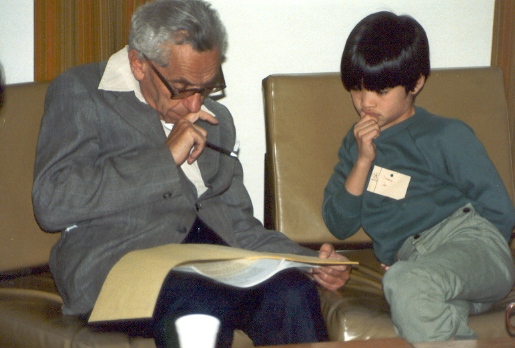
A case study of co-authorships for the prolific Hungarian-born mathematician Paul Erdős illustrates how restrictions on immigration reduced collaborations between ESE-born scientists and US scientists. Erdős moved to the United States as a post-doctoral fellow at Princeton, and became a professor at Notre Dame, travelling and collaborating with many US scientists. As a Hungarian citizen, however, Erdős was denied a re-entry visa by the US immigration services in1954, and not granted re-entry until 1963. To examine how these denials affected Erdős’ collaborations with US scientists, we collect the location of Erdős top 100 coauthors at the time of their first collaboration. These data show that Erdős’ collaborations shifted away from the United States when he was denied re-entry. Between 1954 and 1963, 24 percent of Erdős’ new co-authors were US scientists, compared with 60 percent until 1954. These patterns are confirmed in a broader analysis of patents by co-authors and co-authors of co-authors of ESEborn scientists, which indicates a 26 percent decline in invention by scientists who were directly or indirectly influenced by ESE-born scholars.
As you might suspect from the Erdos example, scientists in the US became less not more productive without the benefits of cooperation with Eastern European scientists.
Some of the scientists denied entry to the US in the 1920s went to Israel instead and innovated there so their genius was not entirely lost to the world.
Photo: Paul Erdos with Terrence Tao. Attribution, either Billy or Grace Tao, CC BY-SA 2.0 <https://creativecommons.org/licenses/by-sa/2.0>, via Wikimedia Commons
My favorite fiction of 2021
Marcel Proust, The Mysterious Correspondent: New Stories. Not the very best Proust, but even so-so Proust is pretty superb. These are fragments to be welcomed.
Andy Weir, Project Hail Mary. At least as good as The Martian, and arguably more conceptual.
Judith Schlansky, Verzeichnis einiger Verluste [Inventory of Losses]. Conceptual German novel with roots in Borges, not as good in English.
Patrick McGrath, Last Days in Cleaver Square. Unreliable narrator!
Karl Knausgaard, The Morning Star. The master returns with a full-scale novel, with theology galore.
Anne Serre, The Beginners. Short, French, about relationships, fun.
Sally Rooney, Beautiful World, Where Are You? She is quite the conservative, don’t be put off by the left-wing rhetoric.
Mario Levrero, The Luminous Novel. The best Uruguayan novel of all time?
Domenico Starnone, Trust. The better of the two “Elena Ferrante” novels released in English this year?
As for retranslations of classics, I very much like the new Oedipus Rex trilogy and the new translation of the Kalevala. I hope they are fiction! And kudos to Sarah Ruden’s work on the Gospels, I am not sure where to put them…
Overall I thought this was an excellent year for reading fiction, much better than the few years preceding. My number one pick here would be the Andy Weir, noting that, for purposes of your norming, I do not usually select science fiction for this designation. (Here is my earlier CWT with Andy Weir.)
Note that I just ordered a whole new batch of appealing-sounding novels (FT link), and I will read some before year’s end, so I will give you an update when appropriate, most likely toward the very end of the calendar year. And my non-fiction list will be coming soon. And also note: “missing” titles from this list are very often missing on purpose!
 Read more!
Where to dine in Austin
The city is right now one of America’s better food scenes, and perhaps America’s most dynamic city overall? It is radically different from even my recent visit a few short years ago. Here are a few recommendations:
Loro: Asian fusion and smoked meats, don’t forget to get the sweet corn and also the cabbage.
LeRoy and Lewis: Outside dining from a food truck, first-rate beef cheeks. Get there early.
Sammie’s: Doesn’t seem like it should be good, but excellent Italian with a Texas emphasis.
Comedor: Nouvelle Mexican, the quesadillas were the surprise with the biggest upside.
Saturday assorted links
2. Potemkin Village Markets in everything nothing short video.
3. How AlphaZero learns chess, with Kramnik too.
4. Employment for the disabled has been rising.
6. The essays of Karen Vaughn, noting she is very much an underrated figure in the GMU story.
The Great Resignation: Health Care Workers
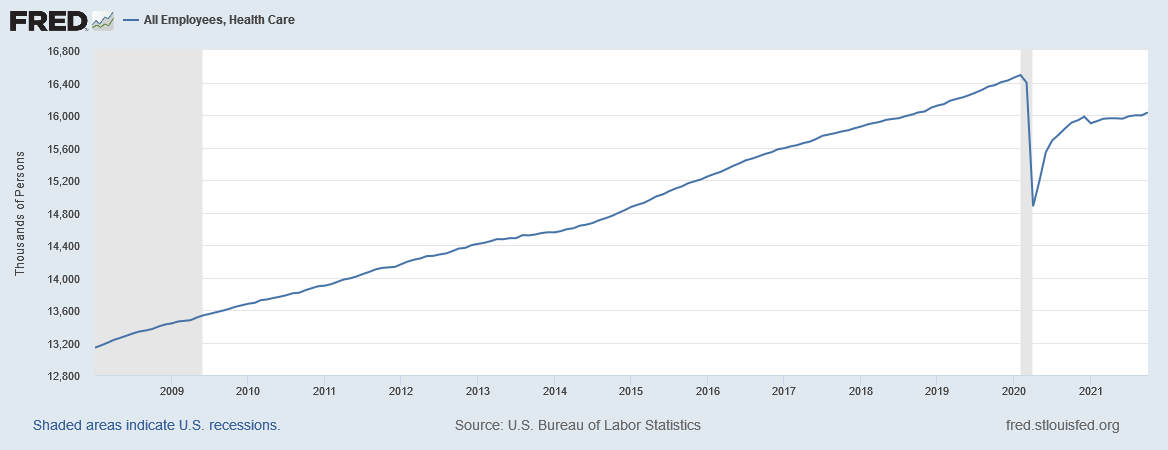 We are short a million health care workers. Today with extreme stress on the system there are 16 million health care workers, about five hundred thousand fewer than when the pandemic began in January of 2020 and about one million fewer than would be expected based on decades of growth. A loss of this many workers is unprecedented.
Ed Yong in the Atlantic discusses Why Health-Care Workers are Quitting in Droves:
Health-care workers, under any circumstances, live in the thick of death, stress, and trauma. “You go in knowing those are the things you’ll see,” Cassandra Werry, an ICU nurse currently working in Idaho, told me. “Not everyone pulls through, but at the end of the day, the point is to get people better. You strive for those wins.” COVID-19 has upset that balance, confronting even experienced people with the worst conditions they have ever faced and turning difficult jobs into unbearable ones.
In the spring of 2020, “I’d walk past an ice truck of dead bodies, and pictures on the wall of cleaning staff and nurses who’d died, into a room with more dead bodies,” Lindsay Fox, a former emergency-medicine doctor from Newark, New Jersey, told me. At the same time, Artec Durham, an ICU nurse from Flagstaff, Arizona, was watching his hospital fill with patients from the Navajo Nation. “Nearly every one of them died, and there was nothing we could do,” he said. “We ran out of body bags.”
…Many health-care workers imagined that such traumas were behind them once the vaccines arrived. But plateauing vaccination rates, premature lifts on masking, and the ascendant Delta variant undid those hopes. This summer, many hospitals clogged up again. As patients waited to be admitted into ICUs, they filled emergency rooms, and then waiting rooms and hallways. That unrealized promise of “some sort of normalcy has made the feelings of exhaustion and frustration worse,” Bettencourt told me.
Health-care workers want to help their patients, and their inability to do so properly is hollowing them out. “Especially now, with Delta, not many people get better and go home,” Werry told me. People have asked her if she would have gone to nursing school had she known the circumstances she would encounter, and for her, “it’s a resounding no,” she said. (Werry quit her job in an Arizona hospital last December and plans on leaving medicine once she pays off her student debts.)
…Many have told me that they’re bone-weary, depressed, irritable, and (unusually for them) unable to hide any of that. Nurses excel at “feeling their feelings in a supply closet or bathroom, and then putting their game face back on and jumping into the ring,” Werry said. But she and others are now constantly on the verge of tears, or prone to snapping at colleagues and patients. Some call this burnout, but Gerard Brogan, the director of nursing practice at National Nurses United, dislikes the term because “it implies a lack of character,” he told me. He prefers moral distress—the anguish of being unable to take the course of action that you know is right.
Health-care workers aren’t quitting because they can’t handle their jobs. They’re quitting because they can’t handle being unable to do their jobs.
Hat tip: Matt Yglesias.
Nellie Bowles interviews me on inflation
So I called someone smart (Tyler Cowen, an economist, author, and professor at George Mason University) to explain the dynamics to me.
“Inflation right now is still transitory in that we can choose to end it,” Cowen told me. The Federal Reserve could disinflate and raise interest rates—mortgage interest rates today remain well below 3%—though that risks starting a recession.
Cowen explained that the reason the inflation-wary are still pretty quiet is that all the anti-Obama Republicans were so wrong in 2008. After the Obama-era bailout during the Great Recession, Republicans were convinced inflation would run rampant. And they said so. A lot. But inflation stayed mostly in control. “They all got egg on their faces after that,” Cowen said. “So the crowd that would complain now, they’re whispering about it but not shouting yet.” (Larry Summers and Steve Rattner have sounded the alarm.)
“I think the inflation will last two to three years, and it will be bad,” Cowen said. But really grim hyper-inflation à la Carter-era, he thinks is unlikely. It could only happen if the Federal Reserve decides it’s too risky to trim the sails of cheap money. “I’d put it at 20% chance that the Fed will think, ‘Trump might run again, and we don’t want Biden to lose . . . history’s in our hands, so we’ll wait to tighten.’ And then it just goes on, and then it’s very bad.”
But a recession is also bad. It’s hard to sort it all out. “As the saying goes, ‘If you’re not confused, you don’t know what’s going on,’” Cowen told me.
That is from the Bari Weiss Substack, other topics are considerd (not by me) at the link.