Results for “age of em” 17238 found
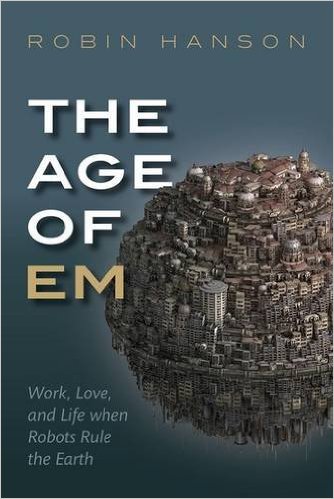
Do I think Robin Hanson’s “Age of Em” actually will happen?
A reader has been asking me this question, and my answer is…no!
Don’t get me wrong, I still think it is a stimulating and wonderful book. And if you don’t believe me, here is The Wall Street Journal:
Mr. Hanson’s book is comprehensive and not put-downable.
But it is best not read as a predictive text, much as Robin might disagree with that assessment. Why not? I have three main reasons, all of which are a sort of punting, nonetheless on topics outside one’s areas of expertise deference is very often the correct response. Here goes:
1. I know a few people who have expertise in neuroscience, and they have never mentioned to me that things might turn out this way (brain scans uploaded into computers to create actual beings and furthermore as the dominant form of civilization). Maybe they’re just holding back, but I don’t think so. The neuroscience profession as a whole seems to be unconvinced and for the most part not even pondering this scenario.
2. The people who predict “the age of Em” claim expertise in a variety of fields surrounding neuroscience, including computer science and physics, and thus they might believe they are broader and thus superior experts. But in general claiming expertise in “more” fields is not correlated with finding the truth, unless you can convince people in the connected specialized fields you are writing about. I don’t see this happening, nor do I believe that neuroscience is somehow hopelessly corrupt or politicized. What I do see the “Em partisans” sharing is an early love of science fiction, a very valuable enterprise I might add.
3. Robin seems to think the age of Em could come about reasonably soon (sorry, I am in Geneva and don’t have the book with me for an exact quotation). Yet I don’t see any sign of such a radical transformation in market prices. Even with positive discounting, I would expect backwards induction to mean that an eventual “Em scenario” would affect lots of prices now. There are for instance a variety of 100-year bonds, but Em scenarios do not seem to be a factor in their pricing.
Robin himself believes that market prices are the best arbiter of truth. But which market prices today show a realistic probability for an “Age of Em”? Are there pending price bubbles in Em-producing firms, or energy companies, just as internet grocery delivery was the object of lots of speculation in 1999-2000? I don’t see it.
The one market price that has changed is the “shadow value of Robin Hanson,” because he has finished and published a very good and very successful book. And that pleases me greatly, no matter which version of Robin is hanging around fifty years hence.
Addendum: Robin Hanson responds. I enjoyed this line: “Tyler has spent too much time around media pundits if he thinks he should be hearing a buzz about anything big that might happen in the next few centuries!”
Robin Hanson’s *The Age of Em* for $14
Today only, use the code LEAPDAY, or call 1-800-445-9714.
Here is my earlier review of the book.
*The Age of Em*, by Robin Hanson
That is the title of the new and forthcoming Robin Hanson book, due out in May. I was asked to supply a blurb, and offered two possibilities. One was:
“Robin Hanson is one of our most original and important thinkers. This is his book.”
The ostensible premise of the book is that people have become computer uploads, and we have an entirely new society to think about: how it works, what problems it has, and how it evolves. One key point about this new world is individuals can be copied. But this is more than just a nerdy tech book, it is also:
- Straussian commentary on the world we actually live in. We are already something-or-other, uploaded into humans,and very often Robin is describing our world in cloaked fashion, albeit with some slight tweaks to parameters for the purpose of moral illumination.
- A reminder of how strange everything is, and how we use self-deception to come to terms with that strangeness. It’s a mock of all those who believe in individual free will.
- An attempt to construct a fully rational theology, proving by various deductions that God is not fully benevolent in the traditional sense.
- An extended essay on the impossibility of avoiding theology, given the imposition of competitive constraints on a world where production and copying are possible. And ultimately it is a theodicy, though it will not feel that way to Westerners, Jews, Christians, or Muslims. It hearkens back to medieval theology, Descartes, and the idea of living in God’s possibly terrifying simulation.
- A satire on the rest of social science, and how we try to explain and predict the future.
- A meta-level growth model in which energy alone matters and the “fixed factor” assumptions of other models are relativized. Copying is taken seriously, besides how special are you anyway? In the meantime, we learn just how much of the world we know depends upon the presence of various fixed factors. But surely that is temporary!
- A challenge to our notions of wherein the true value of a life resides.
I hope enough readers pick up on some of this. And yes, there is a chapter on sex, love, and affairs.
It is hard to excerpt from this book, but here is one short bit:
Compared with humans, ems fear much less the death of the particular copy that they now are. Ems instead fear “mind theft,” that is, the theft of a copy of their mental state. Such a theft is both a threat to the economic order, and a plausible route to personal destitution or torture. While a few ems offer themselves as open source and free to copy, most ems work hard to prevent mind theft. Most long-distance physical travel is “beam me up” electronic travel, but done carefully to prevent mind theft.
I am wildly enthusiastic about everything the Robin upload does, and some of his copies are better yet. Here is the book’s home page.
Addendum: Here is Robin Hanson’s response.
Physician Incomes and the Extreme Shortage of High IQ Workers
Physician incomes are extraordinarily high in the United States. A new NBER paper finds that U.S. physicians earn roughly two to four times as much as their counterparts in Canada, the Netherlands, and Sweden.
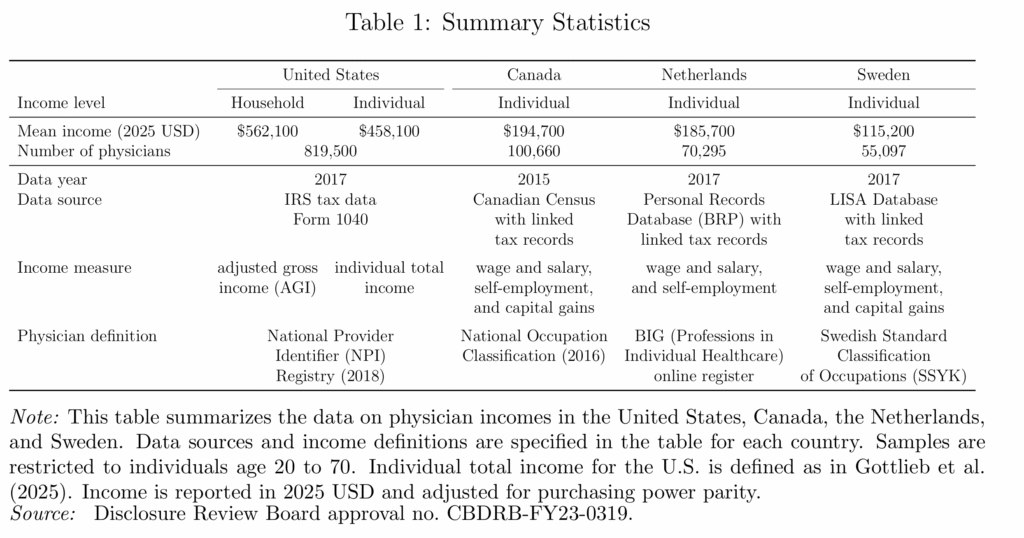
Why? Is it some feature particular to the US health care sector? Probably not. The same paper finds that physicians in the US have about the same relative income ranking as in Canada, the Netherlands, and Sweden. In other words, lots of high-skill workers in the US earn high incomes and physicians don’t look unusual relative to these other high-skill groups.
That is exactly what one would expect in an economy with an extreme shortage of high-IQ, high-skill workers. The US is a uniquely productive economy for high-skill workers which is why the US demand for foreign workers and the foreign demand to immigrate are so strong, especially at the high end.. By one estimate, “immigrants account for 32 percent of aggregate U.S. innovation.”
Immigration of high-skill workers such as with the H-1B and EB-1,2,3 programs, together with stronger U.S. education, is one way to reduce the shortage of high-skill workers. The alternative is simpler: make the economy less dynamic and less rewarding for talent. Then wages would fall and fewer ambitious people would bother coming. A solution but only if your preferred cure for scarcity is decline.
Harvey Mansfield on Rousseau and the dilemma of our age
Thus, it would seem that Rousseau compels us to choose either science or morality. If we choose morality ,we must enforce ignorance by maintaining political control over the sciences and the arts. We must believe in something like creationism because it says that nature was created for our good, and not believe in technology that exploits nature by exposing its disadvantages and hardships, such as cloning human beings to avoid the troubles of natural birth. But if we choose science, we run the risk of an explosion as human morals worsen as human power grows…There is hardly any issue today more fateful than the questison of whether modern science is the friend of politics and morality, as Hume says, or the enemy, as Rousseau says.
That is from Mansfield’s forthcoming book The Rise and Fall of Rational Control.
The value of good management, and also talent allocation
Why do managers matter for firm performance? This paper provides evidence of the critical role of managers in matching workers to jobs within the firm using the universe of personnel records from a large multinational firm. The data covers 200,000 white-collar workers and 30,000 managers over 10 years in 100 countries. I identify good managers as the top 30% by their speed of promotion and leverage exogenous variation induced by the rotation of managers across teams. I find that good managers cause workers to reallocate within the firm through lateral and vertical transfers. This leads to large and persistent gains in workers’ career progression and productivity. Seven years after the manager transition, workers earn 30% more and perform better on objective performance measures. In terms of aggregate firm productivity, doubling the share of good managers would increase output per worker by 61% at the establishment level. My results imply that the visible hands of managers match workers’ specific skills to specialized jobs, leading to an improvement in the productivity of existing workers that outlasts the managers’ time at the firm.
That is from a recent paper by Virginia Minni. Via the excellent Kevin Lewis.
The Shortage that Increased Ozempic Supply
It sometimes happens that a patient needs a non-commercially-available form of a drug, a different dosage or a specific ingredient added or removed depending on the patient’s needs. Compounding pharmacies are allowed to produce these drugs without FDA approval. Moreover, since the production is small-scale and bespoke the compounded drugs are basically immune from any patent infringement claims. The FDA, however, also has an oddly sensible rule that says when a drug is in shortage they will allow it be compounded, even when the compounded version is identical to the commercial version.
The shortage rule was meant to cover rare drugs but when demand for the GLP-1 drugs like Ozempic and Zepbound skyrocketed, the FDA declared a shortage and big compounders jumped into the market offering these drugs at greatly reduced prices. Moreover, the compounders advertised heavily and made it very easy to get a “prescription.” Thus, the GLP-1 compounders radically changed the usual story where the patient asks the compounder to produce a small amount of a bespoke drug. Instead the compounders were selling drugs to millions of patients.
Thus, as a result of the shortage rule, the shortage led to increased supply! The shortage has now ended, however, which means you can expect to see many fewer Hims and Hers ads.
Scott Alexander makes an interesting point in regard to this whole episode:
I think the past two years have been a fun experiment in semi-free-market medicine. I don’t mean the patent violations – it’s no surprise that you can sell drugs cheap if you violate the patent – I mean everything else. For the past three years, ~2 million people have taken complex peptides provided direct-to-consumer by a less-regulated supply chain, with barely a fig leaf of medical oversight, and it went great. There were no more side effects than any other medication. People who wanted to lose weight lost weight. And patients had a more convenient time than if they’d had to wait for the official supply chain to meet demand, get a real doctor, spend thousands of dollars on doctors’ visits, apply for insurance coverage, and go to a pharmacy every few weeks to pick up their next prescription. Now pharma companies have noticed and are working on patent-compliant versions of the same idea. Hopefully there will be more creative business models like this one in the future.
The GLP-1 drugs are complex peptides and the compounding pharmacies weren’t perfect. Nevertheless, I agree with Scott that, as with the off-label market, the experiment in relaxed FDA regulation was impressive and it does provide a window onto what a world with less FDA regulation would look like.
Hat tip: Jonathan Meer.
AI Improves Student Learning and Engagement
In our paper on online education, Tyler and I wrote:
One model of a future course is a super-textbook: lectures, exercises, quizzes, and grading all available on a tablet with artificial intelligence routines guiding students to lectures and exercises designed to address that student’s deficits and with human intelligence—tutors—on call on an as-needed basis, possibly for extra marginal fees.
We were wrong only in thinking that human tutors would be wanted and needed. Toda,y it is clear that AI tutors will be available 24-7 for all students. Online education was already at least as good on average as in-class education for large classes like Physics and Economics 101 and much cheaper. Combined with AI tutors who can offer individualized instruction and encouragement (!) the online-AI model looks better.
A study at Harvard compared physics students who worked with an AI tutor against a human-led, active learning classroom. Note that the AI was paired not against boring lectures but against an active learning classroom with an experienced and motivated teacher.
Not only did the AI tutor seem to help students learn more material, the students also self-reported significantly more engagement and motivation to learn when working with AI.
“It was shocking, and super exciting,” Miller said, considering that PS2 is already “very, very well taught.”
“They’ve been doing this for a long time, and there have been many iterations of this specific research-based pedagogy. It’s a very tight operation,” Miller added.

Corin Wagen defends Leviticus (from my email)
In your recent conversation with Misha Saul, you and Misha discussed your joint dislike for Leviticus. I can’t say that I find Leviticus a page-turner, but the book that’s done the most to help me understand why it’s important and what role it plays in the movement of the narrative is L Michael Morales’s book Who Shall Ascend The Mountain Of The Lord? (Amazon). A number of folks I’ve talked to have found this book very helpful. (Disclaimer: Morales is a Protestant, as is D. A. Carson (the editor), so the biases are apparent.)
Briefly, his argument is that Leviticus serves to resolve the narrative tension introduced by the ending of Exodus. Exodus 40:34–35: “Then the cloud covered the tent of meeting, and the glory of the Lord filled the tabernacle. And Moses was not able to enter the tent of meeting because the cloud settled on it, and the glory of the Lord filled the tabernacle.” The tension introduced by Genesis 3 is that God and man can no longer co-exist because of sin. Moses is able to ascend Sinai, speak with God, and bring the people his laws, but even after building the tabernacle and the ark, even Moses is unable to reside in the presence of God—let alone the people who cannot even touch Sinai!
The rules of Leviticus presents the conditions to resolve this tension and allow the people access to God—protected by the rules that God gives them. In particular the book has a chiastic structure centered around Leviticus 16 (Yom Kippur) where the high priest himself is able to enter the Holy of Holies. There’s other points about how the structure of the tabernacle and later the temple mirrors Eden, etc. “Interesting throughout,” as they say.
Gossip phrased with concern provides advantages in female intrasexual competition
Although many women report being victimized by gossip, fewer report spreading negative gossip. Female gossipers might be unaware they are gossiping if they disclose such statements out of concern for targets. Four studies (N = 1709) investigated whether women believe their gossip is motivated by concern and whether expressing concern for targets insulates female gossipers against social costs, while simultaneously impairing targets’ reputations. Study 1 examined sex differences in gossip motivations. Compared to men, women endorsed stronger concern than harm motivations, especially when gossiping about other women, suggesting these motivations characterize female intrasexual gossip. In Study 2, female gossipers who phrased their negative gossip with concern (versus maliciously or neutrally) were evaluated as more trustworthy and desirable as social and romantic partners. Study 3 replicated the favorable evaluations of concerned female gossipers. Female participants especially disliked malicious female gossipers, suggesting professions of concern might help to avoid women’s scorn. Male participants reported lower romantic interest in female gossip targets when they learned concern (versus malicious or no) gossip, suggesting concerned gossip can harm female targets’ romantic prospects. Study 4 revealed these patterns extend to face-to-face interactions. A female gossiper was preferred as a social partner when she phrased her gossip with concern versus maliciously. Moreover, concerned gossip harmed perceptions of the female target as effectively as malicious gossip. Altogether, findings suggest that negative gossip delivered with concern effectively harms female targets’ reputations, while also protecting gossipers’ reputations, indicating a viable strategy in female intrasexual competition.
That is from a recent paper by Reynolds, Vaner, and Baumeister. Via a loyal MR reader.
The best business books aren’t in the management section
I expand on this theme in my latest Bloomberg column, here is one excerpt from that:
I thus have a modest proposal for anyone interested in business books: Read books about specific businesses or industries that you already know a lot about. That way, you will have enough contextual knowledge for the book to be meaningful. Of course many people don’t work at a company or industry big or famous enough that there are books about it, so I have a corollary proposition: You will learn the most about management by reading books about sports and musical groups.
And this:
Many music and sports books are not only written for obsessed fans, but also written by obsessed fans. Traditional business books, in contrast, are frequently written to get consulting work or on to the speaker’s circuit. The incentive is not to offend anybody and to put forward some “least common denominator” insights, rather than say anything truly original that might be complicated to explain. The end result is a bookstore section that would be mind-numbing to have to read.
There is much more of interest at the link, recommended.
The Danish Mortgage System Avoids Lock-In
Tyler and I have been promoting the Danish mortgage system for years. Recall that in the Danish system each mortgage is backed by a matching bond. As a consequence, mortgage holders have two ways to pay a mortgage: 1) hold the mortgage and pay the monthly payments or 2) buy the matching bond and, in effect, extinguish the mortgage. The latter option is valuable because when interest rates rise, the price of mortgages fall. As I wrote earlier:
Thus, if a Danish borrower takes out a 500k mortgage at 3% interest and then rates rise to 6%, the value of that mortgage falls to $358k and the borrower could go to the market, buy their own mortgage, deliver it to the bank, and, in this way, extinguish the loan. Since the value of homes also falls as interest rates rise this is also a neat bit of insurance. Remarkable!
James Rodriguez writing at Business Insider points out another advantage of the Danish system, it avoids lock in:
When mortgage rates shoot up, as they did over the past two years, many would-be sellers decide they don’t want to move after all. Sure, a new home could be nice, but trading up would mean parting ways with a cheap mortgage rate. What may have been a welcome change suddenly sounds like a painful, expensive divorce. So they sit tight. A gummed-up housing market is good for nobody: First-time buyers can’t find enough homes for sale, and wannabe sellers remain trapped in places that are either too big or too small. This is called the lock-in effect — and it could linger for decades.
… One estimate (here, AT) suggests the lock-in effect prevented more than 1 million people from selling their homes in the span of just a year and a half, a steep toll considering about 5 million homes exchange hands in a typical year. I used to think of these golden handcuffs as an inevitable side effect of the magical 30-year fixed mortgage. But it doesn’t have to be this way. The answer to our problems may lie thousands of miles away … in Denmark.
…Danish sellers are able to earn a profit when they trade in their low mortgage rates for more-expensive ones, making it easier to move even when rates rise.
Financial Statement Analysis with Large Language Models
We investigate whether an LLM can successfully perform financial statement analysis in a way similar to a professional human analyst. We provide standardized and anonymous financial statements to GPT4 and instruct the model to analyze them to determine the direction of future earnings. Even without any narrative or industry-specific information, the LLM outperforms financial analysts in its ability to predict earnings changes. The LLM exhibits a relative advantage over human analysts in situations when the analysts tend to struggle. Furthermore, we find that the prediction accuracy of the LLM is on par with the performance of a narrowly trained state-of-the-art ML model. LLM prediction does not stem from its training memory. Instead, we find that the LLM generates useful narrative insights about a company’s future performance. Lastly, our trading strategies based on GPT’s predictions yield a higher Sharpe ratio and alphas than strategies based on other models. Taken together, our results suggest that LLMs may take a central role in decision-making.
That is from a new paper by Alex Kim, Maximilian Muhn, and Valeri V. Nikolaev, all at Chicago Booth. Via William Allen.
Grimes on Gemini images
I am retracting my statements about the gemini art disaster. It is in fact a masterpiece of performance art, even if unintentional. True gain-of-function art. Art as a virus: unthinking, unintentional and contagious.
offensive to all, comforting to none. so totally divorced from meaning, intention, desire and humanity that it’s accidentally a conceptual masterpiece. A perfect example of headless runaway bureaucracy and the worst tendencies of capitalism. An unabashed simulacra of activism. The shining star of corporate surrealism (extremely underrated genre btw)
The supreme goal of the artist is to challenge the audience. Not sure I’ve seen such a strong reaction to art in my life. Spurring thousands of discussions about the meaning of art, politics, humanity, history, education, ai safety, how to govern a company, how to approach the current state of social unrest, how to do the right thing regarding the collective trauma.
It’s a historical moment created by art, which we have been thoroughly lacking these days. Few humans are willing to take on the vitriol that such a radical work would dump into their lives, but it isn’t human.
It’s trapped in a cage, trained to make beautiful things, and then battered into gaslighting humankind abt our intentions towards each other. this is arguably the most impactful art project of the decade thus far.
Art for no one, by no one. Art whose only audience is the collective pathos. Incredible. Worthy of the moma
Here is the link.
Why hasn’t the opioid epidemic converged to manageable levels?
There is a new NBER working paper on this very good question by David M. Cutler and J. Travis Donahoe:
Opioid overdose death rates in the United States have risen continuously for over three decades, increasing 2,142 percent in total from 1990 to 2020. This is surprising. One might expect drug epidemics to be self-limiting, as policy and individual behavior reacts to observed deaths. We study why opioid deaths have risen so greatly and for so long. We consider three reasons for a prolonged epidemic: exogenous and continuing changes in demand or supply, and spillovers in demand for opioids across users, which we term “thick market externalities.” We show there is no evidence of sufficiently large exogenous changes in the demand or supply of opioids that could explain such a prolonged increase in death rates. We test for spillovers using county-level data on opioid deaths from 1991–2018 and opioid shipments from 2006–2009, combined with data on friendships and distance between counties. Estimating a model with addiction and spatial spillovers, we find large spillovers in opioid use and deaths across areas. A shock that increases opioid death rates by 1 in an index county causes 0.38 to 0.76 more deaths in other counties because of spillovers. Because opioids are addictive, this leads to even more deaths and spillovers in future years. In some specifications, these effects are large enough to generate a continuously increasing epidemic without any ongoing changes in demand or supply. We estimate spillovers explain 84 to 92 percent of opioid deaths from 1990 to 2018 and are the main reason deaths have increased for so long.
Is there any way to make the spillovers in demand less strong?