Results for “food” 2089 found
Books of the year, 2010
Here is a meta-list of "best books of the year" lists; the selections I looked at did not thrill me, so here's my own list, in no particular order. First tier:
Ernest Gellner: An Intellectual Biography, by John A. Hall.
Emperor of All Maladies: A Biography of Cancer, by Siddhartha Mukherjee.
Charles Emmerson, The Future History of the Arctic.
Christianity: The First Three Thousand Years, by Diarmaid MacCulloch.
David Grossman, To the End of the Land.
State of Emergency: The Way We Were: Britain, 1970-1974, by Dominic Sandbrook.
The Penguin Book of Irish Poetry, edited by Patrick Crotty.
Winston's War: Churchill 1940-1945, by Max Hastings.
Kai Bird, Crossing Mandelbaum Gate: Coming of Age Between the Arabs and Israelis, 1956-1978.
Peter Hessler, Country Driving: A Journey Through China from Farm to Factory.
Joel Mokyr, The Enlightened Economy: An Economic History of Britain 1700-1850.
As toss-ins, from the second tier, there are Understanding the Book of Mormon, Philippson's Adam Smith: An Enlightened Life, The Tenth Parallel: Dispatches from the Fault Line Between Christianity and Islam, Peter Watson's The German Genius, Mark Schatzger's Steak, Lydia Davis's Madame Bovary translation, Vietnam: Rising Dragon, Daniel Okrent's Last Call, Gary Gorton's The Panic of 2007, Baba Yaga Laid an Egg, W. John Kress, The Weeping Goldsmith: Discoveries in the Land of Myanmar, a few more good books here, and last but not least Cowen and Tabarrok Modern Principles.
Brought to you by The Age of the Infovore.
Markets in everything
Via Courtney Knapp, Furry Toys Tours:
You can send your stuffed animal on a romantic trip to Paris. Tours start at €100.00.
Your stuffed animal will visit La Tour Eiffel, Champs Elysées, L'Arc de Triomphe and more.
There is even an upgrade:
Why don’t we nudge people toward more risk?
Most paternalistic nudges encourage more safety (or at least the appearance of safety), such as when government steers people away from trans fats with a warning label or when the transportation authority structures the contours of a road to induce drivers to slow down. I can think of a few nudges in the direction of greater risk-taking:
1. QEII and activist monetary policy more generally. Investment tax credits and upbeat Presidential speeches.
2. Military recruitment campaigns and ads.
3. Social norms that people should pursue the love of their life, propose marriage, have children, and so on.
What else?
The Hansonian question is why the bias toward safety is neglected for risk-taking in these areas. Is it a simple utilitarian standard? Is it that these forms of risk-taking are affiliated with larger social purposes, namely ones whose relative status we are trying to boost? Are nudges toward risk just as common as nudges toward safety, but we are less willing to describe them as such?
Risk-taking by eating dangerous food has a relatively low social status, perhaps because the gain is mostly private. Sushi or sampling street food in exotic locales have minority or cult followings, perhaps because they are (sometimes) associated with higher class values. Many people eat and enjoy trans fats but few people defend or elevate them.
Is there a long-run deflationary trend right now?
Although the cited source says as much, please don't take these remarks as my dismissal of the relevance of AD cyclical macro. Still, I find this idea intriguing:
Anyone who still thinks falling prices are a cyclical phenomenon isn’t looking closely. It’s secular, and the sudden ubiquity of discount outfits shows how Japanese consumption has become a race to the bottom of the pricing spectrum.
There is more detail here and note the trend is occurring even though Japan does not have declining real per capita income.
In a wide variety of areas, ranging from ethnic food vs. fine dining to blogs vs. books to the art world (Outsider Art is often more visceral and enduring) to clothing, there is a common realization going on: cheap stuff is often better than the more expensive stuff. Furthermore, information technology allows you to reframe your consumption, countersignal your personal image, and reaffiliate with others, and their social movements, in ways which increase the status value of the lower priced goods. It is now quite easy to find the (possibly) small pool of people who will respect you for your cheap hobby or obsession. You can buy obscure items and even your uninformed friends can Google to find out what they are and why some people think they have value. In relative terms, a famous, mainstream, and somewhat upper-class "Nordstrom" label is worth less than before.
These developments remove or at least limit the status-based reasons for buying the higher-priced goods.
Mike Munger took us all for pupusas and we loved it; no one was bitching about the absence of seared tuna.
China fish fact of the day
Currently the world's wild [fish] catch measures 170 billion pounds — the equivalent in weight to the entire human population of China, scooped up and sliced, sauteed, poached, baked and deep-fried, year in and year out, every single year. This is a lot of fish — six times greater than the amount of fish we took from the ocean half a century ago.
That is from Paul Greenberg's Four Fish: The Future of the Last Wild Food.
Assorted links
Adventures in El Salvador
Tyler, Garett Jones and I visited El Salvador for a few days, just for fun. Here is a travelogue of some of our adventures.
The moment we exit customs Tyler grabs a driver and starts speaking in rapid Spanish. Neither Garett nor I are fluent but we are laughing because we know exactly what 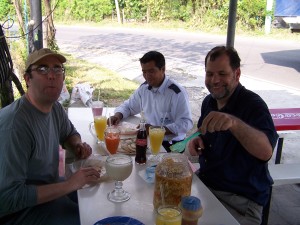 Tyler is saying. Tyler wants pupusas and not pupasas turÃsticos but estilo familiar. The driver understands as well so we jump into his van and he brings us to a pueblo with about 8 or 9 pupuserÃas in direct competition–we learn later that this is the town speciality. We get Pupusas de chicharrones, queso and lorocco, a herb that is hard to find in the United States. Bien Gusto. Tyler is sated so we continue on to Suchitoto, the small colonial town that will be our base of operations.
The next day we take a boat tour of Lake Suchitlan, an artificial lake nestled among hills and volcanoes. We ask our guide  to take us to a local village–it’s an unusual request but we are the only tourists in town so why not.
We climb a long hill, it’s blazing hot but we have a look around, get a drink and having seen all there is to see start to head back down to the boat. That’s when we hear the sirens and gunshots–other people hear it as well and stop walking. Only now do I remember the advice from Apocalypse Now, “Never get out of the boat!”
Tyler asks the guide what is going on. He isn’t sure either but he asks a local and tells Tyler it’s “the running.” Tyler is puzzled and looks as confused as I am–this is not a good sign–the word has many meanings, it could be the running of the bulls, the running of the race, the running? Well it seems not to be gunshots so I joke to Tyler that it would be awesome if it were the running of the bulls.
Not 15 seconds later I turn around and I am confronted with an angry bull bearing down on me. It looks like this:

Tyler, Garett and I jump out of the way. What the hell is going on?! With a second or two to recover, I realize the bull is being driven by a gaucho. The bull is snorting and none too happy, the sirens and shots are making it skittish, but the guacho slaps it hard, gets it under control and then, as if in a dream, the gaucho and bull vanish around the corner. We breathe a sigh of relief.
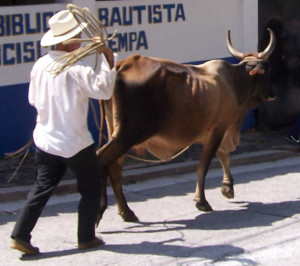
The running of the bull–as Tyler, Garett and I have coined the event–however, was not the running.
It was at about this time that things started to get a little surreal.
 The sirens are approaching, the “gunshots” are getting louder and we see a strangely dressed man coming up the hill towards us. He appears to be tall, very tall, wait…am I in a Fellini movie?
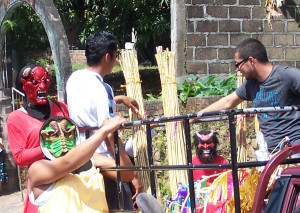
The man is on stilts and is accompanied by a coterie of devils.
As the group passes, we are handed a handsome annual report with pictures of the mayor and the year’s accomplishments. Ah, this is fiscal policy! Now we understand.
We head back to the boat, pleased with our luck and well satisfied with the day’s events. 
Addendum: If you go here are few practical things to bear in mind. El Salvador is not geared towards tourists–this has positive and negative aspects. On the positive side you can believe the prices you are quoted, there is not yet a “take the tourist for all they are worth” culture. On the negative side, there isn’t much to buy. There aren’t many indigenous people and, in part because there isn’t a tourist market, there isn’t a strong artisinal culture, as there is in say Guatemala. There are a few Mayan ruins but nothing as extensive as in Guatemala or Mexico. Few people speak English, even at hotels and restaurants. The pupasas are great but the food variety is limited. We were perfectly happy exploring for two days but this is one of the less exotic countries of Central America.
(By the way, do you see the devil at right, so oddly framed between the bars of the truck. Why is he looking at me this way?)
 We stayed in Suchitoto at a small (6-8 room) hotel called Los Almendros de San Lorenzo. It’s run by a former El Savadorean diplomat who lived 30 years abroad and his partner, an interior decorator. Highly luxurious and recommended but anomalous, don’t take this as representing Suchitoto.
El Salvador has a very high murder rate, more than 10 times the US rate. Suchitoto, however, is safe and San Salvador seems fine for walking around in the main sections although every shop with anything of value has a guy with a shotgun standing outside.
On the way back from the village after the boat ride we were going to take the bus back into town. We asked some locales where the bus stop was and they volunteered to give us a ride in the back of their truck. Here’s a nice photo of Tyler (taken by Garett) as we traveled the bumpy road back into town. I believe we discussed Mundell and optimum currency areas.

Barter markets in everything, bring your own restaurant
On a recent evening, an abandoned gas station with a curb blocked by cement barriers is the meeting point for a group of people who appear to be pulling chairs and tables from the trunks of their cars. It's almost dark. Some boxes are set on the sidewalk; linens and dishes and food are pulled out and what moments ago was an eyesore has been transformed into a popular place to eat. It's called BYOR. That stands for "bring your own restaurant." It's not quite an established venue, but the food is very good.
It's free to those who share. And the ambiance is unexpected as the outdoor location keeps changing. People learn where BYOR is going to be via Facebook. In the mild weather it's "open" every other weekend. No reservations required: just an appetite and some extra chairs if you have them.
What should you infer about Holyoke, the locale of this practice? The full story is here and I thank Anastasia for the pointer.
And from China, here is a vending machine for live crabs.
Ahem
I'll go back to my sourdough after all:
The popular image may be of Stone Age people gnawing on a chunk of woolly mammoth, but new research indicates their diet may have been more balanced after all.
Many researchers had assumed people living in Europe thousands of years ago ate mainly meat because of bones left behind, and little evidence of plant food.
Now, new findings indicate grains were part of the diet at ancient sites in Italy, Russia and the Czech Republic, researchers report in Tuesday's edition of Proceedings of the National Academy of Sciences.
*Bloodlands*
The author is Timothy Snyder and the subtitle is Europe Between Hitler and Stalin. I learned that this period was even bloodier and more brutal than I had thought:
Mass killing in Europe is usually associated with the Holocaust, and the Holocaust with rapid industrial killing. The image is too simple and clean. At the German and Soviet killing sites, the methods of murder were rather primitive. Of the fourteen million civilians and prisoners of war killed in the bloodlands between 1933 and 1945, more than half died because they were denied food. Europeans deliberately starved Europeans in horrific numbers in the middle of the twentieth century.
It is a very powerful book and I can recommend this review and this review. Along somewhat related lines, some of you may wish to read Paul R. Gregory's Politics, Murder, and Love in Stalin's Kremlin: The Story of Nikolai Bukharin and Anna Larina. Bukharin, of course, was also an economist. Here is Gregory on the book. Here is Gregory on Germany's currently low unemployment rate.
Markets in everything
"The Republic of China (Taiwan)" has delivered to the municipality of Suchitoto, El Salvador two hundred packages of food, four wheelchairs, and a selection of musical instruments. The accompanying ceremony was attended both by the Chinese ambassador and the mayor of Suchitoto. Similar donations have been made to Santa Ana y Mejicanos and there are plans for visiting other locations as well.
*Little Did I Know: Excerpts from Memory* the new Stanley Cavell memoir
To recognize the end of the day and get to bed, I developed the ritual of eating a box of Oreo cookies together with a can of applesauce. But really the ritual is equally describable as an effort to stop myself from eating the entire box of cookies, a sequence of five (was it?) pairs, each pair stacked in a pleated pliable plastic cup, and from finishing the accompanying applesauce, having conceived the idea that this was not a sensible diet. I slowed the eating by inventing new ways of going through the cookies. One way was to nibble around the circumference of a cookie before finishing off the remaining rough-edged center; another was to twist apart the two wafers of each Oreo, eat off the sugary middle spread from whichever of the wafers it largely adhered to, intending to eat only that one of that double cookie. But each night I lost the battle to stop eating before the package and the can were emptied. I recognize that to this day I unfailingly at the end of a meal leave some portion of food, if sometimes quite small, on my dish — as if to reassure myself that I am free.
I do the same, I should add. That passage is from Stanley Cavell, one of America's leading philosophers. If you're looking for a book which steps outside the usual mode of strict narrative, I recommend this highly, but it will leave many people frustrated. You can buy it here.
For the pointer I thank David Gordon.
Markets in Everything
Costco is selling "Thrive," a one year supply of dehydrated and freeze-dried food for $799.99. I find the pairing of capitalist efficiency in advertising and distribution with end of the world preparation oddly disconcerting.
Should they have let the guy’s house burn down?
David Henderson blogs some of the basic information (Cohn at TNR comments here). Here is the upshot:
He refers to a story about a man who failed to pay an annual fee for fire protection and then, when his house caught on fire and he called the fire department, the fire department refused to show up.
They wouldn't even let him pay up ex post. David notes that this is a government-run fire department and thus the story is not much of a moral reductio on the market. Arguably a private company would behave the same way, sometimes, but it 's odd to claim that government failure reminds you market failure is possible and so let's damn the market. By the way, markets do pretty well at setting up schemes with a penalty for late payment; that's how my mortgage works.
I would make a broader point. Any social system must, at some stage of interactions, impose some morally unacceptable penalties. If you are very hungry, and you shoplift food, they still might prosecute you. If you don't pay your taxes, and resist wage garnishes, they might put you in jail. If you resist arrest, they might, at some point in the chain of events, shoot you while trying to escape. Somewhere along the line there is a doctor who can treat your rare disease except he doesn't feel like working so much, and so he lets you die or suffer; you can find both private and public sector examples here.
Social systems proceed by (usually) covering up the brutalities upon which they are based. The doctor doesn't let you get to his door and then turn you away, rather his home address is hard to find. The government handcuffs you so they don't have to shoot you trying to escape. And so on.
To borrow language from Thomas Schelling, social systems involve costs in terms of both "known" and "statistical" lives. It's the sum total of costs which is important. It's fine (though controversial) to argue that a "known" life should be more important than a "statistical" life, but it's not dispositive to pull out one example of a "known" life and draw a significant conclusion from that anecdote. That's what we teach students not to do in first year principles, sometimes citing Bastiat, the seen and the unseen, and so on.
I don't favor the policies of this fire department, but simply pointing out the vividness one of these social brutalities doesn't much influence me about the broader principles at stake.
Adam Savage on scientific testing
I had a whole episode written called the surreal gourmet, which ended with tenderizing steak with dynamite, but it had all those other things like poaching fish on your catalytic converter or cooking eggs in your dishwasher, Jamie loves the idea of tenderizing meat in the dryer.
…Also the idea of is it safe to eat fresh road kill. We think that would be just hilarious and gross.
That is Adam Savage, from Jeff Potter's new and periodically interesting book Cooking for Geeks: Real Science, Great Hacks, and Good Food. This is most of all a book for those who wish to think of cooking in terms of engineering, but without going the molecular gastronomy route.