Month: January 2023
Wednesday assorted links
1. Will Norway be growing more islands? (The Norwegian century)
4. Arnold Kling on whether books are overrated.
AI Claude Passes Law and Economics Exam
The Claude AI from Anthropic earned a marginal pass on a recent GMU law and economics exam! Graded blind. Claude is a competitor to GPT3 and in my view an improvement. Here is Claude’s best answer.
Here are some potential changes I would recommend to the law and economics of intellectual property:
- Shorten the duration of copyrights, patents, and other IP protections. The current time periods, which can be 95 years or more for copyrights and up to 20 years for patents, are excessive. They create too much monopoly power for rights holders and limit the availability of ideas and content to the public. Shorter terms like 14 years for patents and 28 years for copyrights would provide sufficient incentives while making more works open and available sooner.
- Limit or eliminate software patents. Software patents are often overly broad and prevent innovation more than they encourage it. They give companies too much control over emerging technologies and allow patent trolling behavior. Most other countries do not allow software patents, and the U.S. would benefit from following their lead.
- Expand fair use and make it more flexible. Fair use is too narrow and rigid in the U.S. It should be expanded to include more types of uses, such as quotation, parody, and archiving. It should be interpreted in a more open-ended way to promote freedom of expression and access to information.
- Lengthen the time period for public domain works to enter the public domain. Currently, works that are no longer protected by copyright (because they’ve been out for 95+ years) or patent (because the term has expired) enter the public domain where anyone can use them for free. This period between protection and public domain status is too short. It should be extended to allow rights holders to continue to profit from the work and allow its cultural influence to persist before it enters the public domain.
- Increase funding for public domain works. The government should provide grants and funding to artists, musicians, authors, and other creators to produce works that are licensed from the start as public domain or creative commons. This would provide an alternative funding model to proprietary IP and boost the availability of open works.
Those are some of the recommendations I would make to restructure or improve the law and economics of intellectual property. Overall, the goal should be to make IP laws less restrictive and make more works available to the public sooner. But it is important to still provide some incentives and compensation to creators for a limited period.
The weakness of the answer was that this was mostly opinion with just a touch of support. A better answer would have tied the opinion more clearly to economic reasoning. Still a credible response and better than many human responses.
What I’ve been reading
1. Owen Hopkins, Lost Futures: The Disappearing Architecture of Post-War Britain. Covers the “great” British brutalist buildings of the postwar era, the debates surrounding their demolition, and their eventual demolition. Photos too, excellent to dip into.
2. Anna Grzymala-Busse, Sacred Foundations: The Religious and Medieval Roots of the European State. A good and original book about how European state-building grew out of earlier church traditions. For instance, by the time of the Reformation about half the land in Germany was in the hands of the church. “Church-building” often came first, and then state-building copied and improved on some of the methods.
3. Elizabeth Currid-Halkett, The Overlooked Americans: The Resilience of Our Rural Towns and What it Means for Our Country is a good look at what it promises. Most of all, I like how it stresses that these individuals are more apolitical than often is realized.
4. Judith A. Green, The Normans: Power, Conquest and Culture in 11th Century Europe. The best book on the Normans? And what an opening set of sentences: “In the eleventh century the climate was improving, population was growing, and people were on the move, west from central Asia, and south from north-western Europe. In 1054 the unity of Christianity between east and west was broken, a rift which lasted for centuries. In 1096 the idea of recovering Jerusalem from Muslims was translated into action. Existing empires and principalities were challenged and new polities were founded. War was at the centre of these events, waged by small armies led by men who achieved lasting fame, men such as William the Conqueror, Robert Guiscard, and Bohemond. That these men were of Norman extraction seemed to their chroniclers to be no coincidence.”
And just arrived in my pile is Sandy Baum and Michael McPherson, Campus Economics: How Economic Thinking Can Help Improve College and University Decisions.
I’ve also started (and put down) a bunch of books somewhere between GPT 3.3 and 3.8…and read a bunch of books on Pauline political theology (reading in clusters!), and Jonathan Swift on church-state relations and on religious politics more generally. And yes, Spare is in my reading pile.
Tuesday assorted links
1. Mike Makowsky on the paradox of choice in economics research.
2. Does losing Taiwan mean losing Japan?
3. Which books do we teach from the 1990s?
4. Chucklesome slang terms from 1910.
5. Where the phrase “red tape” comes from.
6. Two-minute AI-made Batman movie. Skill of the operator people, skill of the operator. And The Zvi on AI and market returns and interest rates.
8. Brazil fact of the day: “The Northernmost part of Brazil is closer to Canada than it is to the Southernmost part of Brazil”
Is it Possible to Prepare for a Pandemic?
In a new paper, Robert Tucker Omberg and I ask whether being “prepared for a pandemic” ameliorated or shortened the pandemic. The short answer is No.
How effective were investments in pandemic preparation? We use a comprehensive and detailed measure of pandemic preparedness, the Global Health Security (GHS) Index produced by the Johns Hopkins Center for Health Security (JHU), to measure which investments in pandemic preparedness reduced infections, deaths, excess deaths, or otherwise ameliorated or shortened the pandemic. We also look at whether values or attitudinal factors such as individualism, willingness to sacrifice, or trust in government—which might be considered a form of cultural pandemic preparedness—influenced the course of the pandemic. Our primary finding is that almost no form of pandemic preparedness helped to ameliorate or shorten the pandemic. Compared to other countries, the United States did not perform poorly because of cultural values such as individualism, collectivism, selfishness, or lack of trust. General state capacity, as opposed to specific pandemic investments, is one of the few factors which appears to improve pandemic performance. Understanding the most effective forms of pandemic preparedness can help guide future investments. Our results may also suggest that either we aren’t measuring what is important or that pandemic preparedness is a global public good.
Our results can be simply illustrated by looking at daily Covid deaths per million in the country the GHS Index ranked as the most prepared for a pandemic, the United States, versus the country the GHS Index ranked as least prepared, Equatorial Guinea.

Now, of course, this is just raw data–maybe the US had different demographics, maybe Equatorial Guinea underestimated Covid deaths, maybe the GHS index is too broad or maybe sub-indexes measured preparation better. The bulk of our paper shows that the lesson of Figure 1 continue to apply even after controlling for a variety of demographic factors, when looking at other measures of deaths such as excess deaths, when looking at the time pattern of deaths etc. Note also that we are testing whether “preparedness” mattered and finding that it wasn’t an important factor in the course of the pandemic. We are not testing and not arguing that pandemic policy didn’t matter.
The lessons are not entirely negative, however. The GHS index measures pandemic preparedness by country but what mattered most to the world was the production of vaccines which depended less on any given country and more on global preparedness. Investing in global public goods such as by creating a library of vaccine candidates in advance that we could draw upon in the event of a pandemic is likely to have very high value. Indeed, it’s possible to begin to test and advance to phase I and phase II trials vaccines for every virus that is likely to jump from animal to human populations (Krammer, 2020). I am also a big proponent of wastewater surveillance. Every major sewage plant in the world and many minor plants at places like universities ought to be doing wastewater surveillance for viruses and bacteria. The CDC has a good program along these lines. These types of investments are global public goods and so don’t show up much in pandemic preparedness indexes, but they are key to a) making vaccines available more quickly and b) identifying and stopping a pandemic quickly.
A final lesson may be that a pandemic is simply one example of a low-probability but very bad event. Other examples which may have even greater expected cost are super-volcanoes, asteroid strikes, nuclear wars, and solar storms (Ord, 2020; Leigh, 2021). Preparing for X, Y, or Z may be less valuable than building resilience for a wide variety of potential events. The Boy Scout motto is simply ‘Be prepared’.
Read the whole thing.
Is crypto now underrated?
I appeared on the Bankless crypto podcast, and they sent me these links:
- Youtube – https://youtu.be/ByefgDAFgv8
- Podcast – https://availableon.com/bankless
- Substack Post – https://open.substack.com/pub/banklesspod/p/early-access-why-crypto-is-underrated
Why has construction productivity been falling?
There is a new NBER working paper on this topic by Austan Goolsbee and Chad Syverson:
Aggregate data show a large and decades-long decline in construction sector productivity. This decline in such a large sector has had a material effect on secular productivity growth for the economy as a whole. Prior work has focused on the role of potential measurement problems in construction, particularly output deflators in the measurement of productivity. This paper brings some new evidence to bear on the industry’s measured productivity problems and suggests that measurement error is probably not the sole source of the stagnation. First, using measures of physical productivity in housing construction, productivity is falling or, at best, stagnant over multiple decades. Second, there has been a noticeable decline over time in the efficiency with which construction firms translate materials inputs into output, and a corresponding shift toward more value-added-intensive production. Third, using state-level data, we do not find evidence of patterns of within-industry reallocation that might be expected of efficiently operating input and output markets. States with more productive construction sectors do not see growth in their shares of total U.S. construction activity; if anything, their shares fall. This may point to frictions in these markets that slow or stop what is in many other markets an important channel for productivity growth.
Here is a useful image:
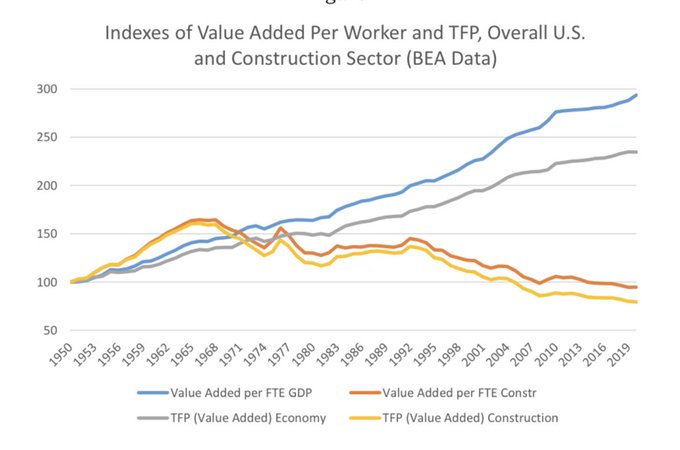
xDon’t forget the blog/Substack on this issue by Brian Potter.
Monday assorted links
1. India’s central bank wants an outright ban on crypto.
2. Hanania interviews Joseph Henrich.
3. Victoria Chick has passed away.
4. Peter McLaughlin on Northern Ireland and demographic change.
5. Why the right-wing cannot beat ESG, good piece by Julius Krein. In the broader world, Julius remains undervalued.
6. “My prediction: #ChatGPT will make old-school competent human secretaries more important than ever.” Link here. In my model of this process, the competent quality operators will undertake more projects than before.
7. Programmer salaries in an age of LLMs. And cybercriminals starting to use GPT.
The decline of religion, and the rise of deaths of despair
In recent decades, death rates from poisonings, suicides, and alcoholic liver disease have dramatically increased in the United States. We show that these “deaths of despair” began to increase relative to trend in the early 1990s, that this increase was preceded by a decline in religious participation, and that both trends were driven by middle-aged white Americans. Using repeals of blue laws as a shock to religiosity, we confirm that religious practice has significant effects on these mortality rates. Our findings show that social factors such as organized religion can play an important role in understanding deaths of despair.
That is from a new NBER working paper by Tyler Giles, Daniel M. Hungerman, and Tamar Oostrom. Ross Douthat, telephone!
FT profile of me
By Henry Mance, mostly about me (as you might expect), here is the tale of when I first encountered Sam Bankman-Fried:
They played bughouse chess, a variation of the game. “He was good. He was better at bughouse than at chess. It’s a very important concept for understanding FTX. You have four people and two boards. If I take your piece on this board, I hand it to my partner, and my partner can plunk the piece down in lieu of making a move. You can be in this desperate situation, all of a sudden your partner hands you a queen. So there’s no balance sheet in bughouse chess. Things come out of nowhere to save you. You play desperately and take a lot of risk. If people play bughouse, that’s their core mentality.”
Here is the full profile.
Dominant Assurance Contracts for Book Reviews and Blog Posts
Arjun Panickssery at LessWrong is experimenting with dominant assurance contracts as a way to fund the public goods of blog posts and book reviews.
In theory, writers could kickstart posts using dominant assurance contracts. An example (this is a real offer): If you send $20 to arjun.panickssery at Gmail via PayPal by noon New York time on January 21st, I’ll send you back $25 if fewer than 10 people sent me money. If 10 or more people send me money, I’ll post a review of Steven Pinker’s The Sense of Style: The Thinking Person’s Guide to Writing in the 21st Century by the end of the month.
If you think this won’t work you should definitely send him some money.
Biometrics will become more important
One side effect of all the new AI developments is that biometrics will increase greatly in importance.
Captcha tests, for one thing, will become obsolete. To prevent bots from flooding a web site, biometric tests will be a ready option.
Passwords also will seem too risky. If you are using only a password to protect your relationships with your AIs, there will (over time) be too much value in there. The AI will be involved in your work routines, and it will be suited for you and you alone. You won’t want to risk it being harmed or destroyed or reprogrammed. Biometrics will provide superior protection.
It also will be harder to protect your passwords, because users will be more vulnerable to written and even voiced scams, run by AI and passing various Turing tests. Again, biometric entry tests are the natural alternative.
Here is the 2022 biometric year in review, there is much pending in the way of legislation. I already use facial recognition to access my iPhone, for better or worse expect much more of this.
The differential impact of GPT?
Happy New Year! I was trying to understand the impact of ChatGPT by zooming out a bit.
– any subject area has a core / fundamental area (the science) and an applied area (use of the technique or application repeatedly towards the same or different problems)
– My assertion is that ChatGPT will impact applied area of any topic but not the core area relatively much, where understanding of the underlying building blocks is very important
Regardless, it will greatly improve experimentation in both areas by bringing down costs of initial testing of ideas/cross domain experiments (e.g., biological concept in electrical/mechanical design)
That is from my email by Anjan.
Sunday assorted links
1. ” .”
2. One measure of the pervasiveness of corporate fraud — is this high or low?
3. “Someone suggested that the right tends to be morally relativist about the past and morally absolute about the present and the left tends to be the other way round” — Benedict Evans.
4. Short essay on the Jena set.
5. Emmanuel Todd on stuff. Interesting, but “French speculative,” so to speak.
Unexpected Inflation and the Redistribution of Wealth
We have a great new MRU video giving students some practice with unexpected inflation and the redistribution of wealth. As always, we like to teach a bit of history with our economics so you might also gets some perspective on William Jennings Bryan and the cross of gold. This video is part of a new Money & Inflation Unit Plan which has lots of excellent resources including lessons plans, interactive games and more on money and inflation for teachers of economics. All free, as always.
Of course, if you do teach principles of economics all of this wonderful material pairs beautifully with the best principles of economics textbook, Modern Principles.