Month: March 2023
What is the best cost-benefit analysis of cycling investments?
Many people are upset at my rather anodyne remarks from earlier in the week. Thus I have a simple question: what are the best cost-benefit studies of urban investments in bicycle lanes and other bicycle-friendly policies? They have to take into account the opportunity cost of the land for bike lanes, the cost of cycling deaths and injuries, and the costs of slower vehicular traffic. Counting those variables in addition to the rather considerable benefits of cycling is hardly a genius-level move, right?
Funny that, I can’t seem to find such a study! But I am not an expert. I am sure there are many such studies, so I am opening comments to all of you, so that I may pull in the appropriate references. I will then read the best study or studies, and report back.
And if by some freak chance of nature no such studies can be found, what should we infer from that?
Addendum: And people (commentators), I don’t need the blah blah blah. Don’t need the mood affiliation. Don’t need the abstract citation of individual gross benefits. Just the cost-benefit studies, please. I am sure you will oblige.
Wednesday assorted links
1. “We propose the nose as central to faces and their perception.”
2. Musa al-Gharbi on why conservatives are happier.
3. Some observations on Chinese management.
4. Bryan Caplan revalued GPT. And EleutherAI open source stuff. And Prismer open source stuff (“every day, people!”). And Adobe’s Firefly AI now in beta. And @getlindy. And “Little gods for older people,” how AI will transform being old.
5. Infovores interview with Hollis Robbins.
In Praise of the Danish Mortgage System
When interest rates go up, the price of bonds goes down. As Tyler and I discuss in Modern Principles, the inverse relationship between interest rates and prices holds for any asset that pays out over time. In particular, as Patrick McKenzie points out, when interest rates go up, the value of a loan goes down. McKenzie suggests that you can use this fact to buy back your mortgage from a bank when interest rates rise.
For example, suppose you get a 500k 30-year fixed rate mortgage when interest rates are 3%–that loan obligates you to pay $2108 per month for 30 years. Now suppose that interest rates go to 6%, now that same stream of payments is only worth, in present value, about $358k. Thus, the bank should be willing to let you buy your mortgage for $358k–that is, after all, what the market would pay for such a stream of payments if your mortgage was securitized.
I am skeptical that I could find the right person at the right bank to actually authorize a deal like this but it turns out that the Danish mortgage system is built to allow this relatively easily. The Danish mortgage system is built on the match principle:
JYSKE Bank: The match-funding principle entails that for every loan made by the mortgage bank, a new bond is issued with matching cash-flow properties. This eliminates mismatches in cash-flows and refinancing risk for the mortgage bank, which also secures payments for the bondholder. In the Danish mortgage system the mortgage bank functions as an intermediary between the investor and borrower. Mortgage banks fund loans on a current basis, meaning that the bond must be sold before the loan can be given. This also entails that the market price of the bond determines the loan rate. The loan is therefore equal to the investment, which passes through the mortgage bank.
In essence, in the Danish system, mortgage banks are more like a futures clearinghouse or a platform (ala Airbnb) than a lender–they take on some credit risk but not interest rate risk.
Thus, if a Danish borrower takes out a 500k mortgage at 3% interest and then rates rise to 6%, the value of that mortgage falls to $358k and the borrower could go to the market, buy their own mortgage, deliver it to the bank, and, in this way, extinguish the loan. Since the value of homes also falls as interest rates rise this is also a neat bit of insurance. Remarkable!
The Danish mortgage market appears to be very successful and so may be a model for American reform:
JYSKE Bank: The Danish Mortgage Bond Market is one of the oldest and most stable in the world, tracing its roots all the way back to 1797 with no records of defaults since inception. Furthermore, the market value of the Danish Mortgage Bond Market is approx. EUR 402bn, making it the largest mortgage bond market in Europe.
Germany fact of the day
Good Morning from Germany, where China is losing importance as export destination. In Feb, exports to China slumped by 12.4%, while exports to US rose 19%. This means that US is by far the most important export market, France is also establishing itself as #2, far ahead of China. pic.twitter.com/S2pSqeRTO9
— Holger Zschaepitz (@Schuldensuehner) March 21, 2023
“This banking crisis won’t wreck the economy”
Here is my latest Bloomberg column, penned on Sunday, these days the VIXes are back down to normal ranges. Here is one excerpt:
One reason for (relative) optimism is simply that the world, and policymakers, have been preparing for this scenario for some time. Not only do memories of 2008-2009 remain fresh, but we are coming out of a pandemic that in macroeconomic terms induced unprecedented policy reactions in most countries. Before 2008, in contrast, macroeconomic peace had reigned and there was common talk of “ the great moderation,” meaning that the business cycle might be a thing of the past. We now know that view is absurdly wrong.
Circa 2023, we can plausibly expect further disruptions and macroeconomic problems. But this time around the element of surprise is going to be missing, and that should limit the potential for a true financial sector explosion.
The kinds of bank financial problems we are facing also lend themselves to relatively direct solutions. Higher interest rates do mean that the bonds and other assets that many banks hold have lower values, which in turn could imply liquidity and solvency problems. But those underlying financial assets usually are set to pay off their nominal values as expected, as with the government securities held by Silicon Valley Bank. That makes it easier for the Federal Reserve or government to arrange purchases of a failed institution, or to offer discount window borrowing. The losses are relatively transparent and easy to manage, at least compared to 2008-2009, and in most cases repayment is assured, even if those cash flows have lower expected values today, due to higher discount rates.
And:
The various bailouts we have been engaging in are not costless. For instance, they may induce greater moral hazard problems the next time around. But that does not mean we should expect a spectacular financial crash right now. More likely, we will see increases in deposit insurance premiums and also higher capital requirements for financial institutions. The former will fund the current bailouts, and the latter will aim to limit such bailouts in the future. The actual consequences will be a bleeding of funds from the banking system, tighter credit for regional and local lending, and slower rates of economic growth, especially for small and mid-sized firms. Those are reasons to worry, but they do not portend explosive problems right now.
In short, the rational expectation is that the US will muddle through its current problems and patch up the present at the expense of the future. For better or worse, that is how we deal with most of our crises. We hope that America’s innovativeness and strong talent base will make those future problems manageable.
Of course if I am wrong, we will know pretty soon.
My podcast with Bari Weiss, she interviews me
Titled “Bank runs, crypto scams, and world-transforming AI,” plus a round of overrated vs. underrated, among other topics, including inflation.
Lots of fun, I feel Bari and I always have very good energy together…
Yes, the Chinese Great Firewall will be collapsing
As framed from China:
Fang Bingxing, considered the father of China’s Great Firewall, has raised concerns over GPT-4, warning that it could lead to an “information cocoon” as the generative artificial intelligence (AI) service can provide answers to everything.
Fang said the rise of generative AI tools like ChatGPT, developed by Microsoft-backed OpenAI and now released as the more powerful ChatGPT-4 version, pose a big challenge to governments around the world, according to an interview published on Thursday by Red Star News, a media affiliate to state-backed Chengdu Economic Daily.
“People’s perspectives can be manipulated as they seek all kinds of answers from AI,” he was quoted as saying.
Fang, a computer scientist and former government official, is widely considered the chief designer of China’s notorious internet censorship and surveillance system. He played a key role in creating and developing the Great Firewall, a sophisticated system of internet filters and blocks that allows the Chinese government to control what its citizens can access online.
I would put it differently, but I think he understands the point correctly. Here is more from SCMP, via D. The practical value of LLMs is high enough that it will induce Chinese to seek out the best systems, and they will not be censored by China. (Oddly, some of us might be seeking out the Chinese LLM too!) Furthermore, once good LLMs can be trained on a single GPU and held on a phone…
Solve for the political equilibrium.
Tuesday assorted links
1. Is the human brain just a matter of scale? For a while now, I’ve thought that whales might be smarter than we are. And how do sperm whales talk to each other?
2. North Korean missile silo developments.
3. Gavin Leech surveys the “insane” who have blogged a lot and for a long time.
4. Robin Hanson isn’t afraid (with Richard Hanania).
5. “Can we improve how we identify and develop mathematical talent among youth? With generous support from @AgencyFund, we’re excited to launch a new one-year dissertation fellowship for up to four PhD students in economics or economics-adjacent fields on this topic.” From Heidi Williams.
6. A report on Próspera, by Próspera.
7. Group of very smart (but largely non-elite) economists write an open letter to Jeffrey Sachs. #contrast
Time Passages
Here’s an interesting idea it wouldn’t have occured to me to ask. What is the length of time described in the average 250 words of narration and how has this changed over time? Most famously James Joyce’s “Ulysses” is a long novel about single day with many pages describing brief experiences in minute detail. In contrast, Olaf Stapledon’s Last and First Men covers 2 billion years in fewer words than Joyce uses to cover a single day.
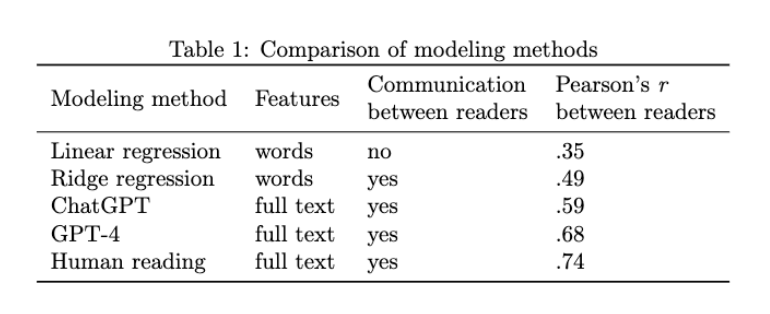
Using human readers grading 1000 passages, Underwood et al. (2018) finds that the average length of time described in a typical passage has declined substantially since the 1700s, from a day to about an hour so a decline by a factor of 24. Writers have become much more focused on describing individual experiences than events.

In a blog post, Underwood revisits his earlier work but this time comparing human readers with various statistical techniques and also GPT. To use GPT he prompts
Read the following passage of fiction. Then do five things. 1: Briefly summarize the passage. 2: Reason step by step to decide how much time is described in the passage. If the passage doesn’t include any explicit reference to time, you can guess how much time the events described would have taken. Even description can imply the passage of time by describing the earlier history of people or buildings. But characters’ references to the past or future in spoken dialogue should not count as time that passed in the scene. Report the time using units of years, weeks, days, hours, or minutes. Do not say zero or N/A. 3: If you described a range of possible times in step 2 take the midpoint of the range. Then multiply to convert the units into minutes. 4: Report only the number of minutes elapsed, which should match the number in step 3. Do not reply N/A. 5: Given the amount of speculation required in step 2, describe your certainty about the estimate–either high, moderate, or low. The passage follows: <omitting this to save space>
Here’s an example of the analysis:
ABRIDGED PASSAGE FROM Jane Eyre: And signs, for aught we know, may be but the sympathies of Nature with man. When I was a little girl, only six years old, I one night heard Bessie Leaven say to Martha Abbot that she had been dreaming about a little child … Of late I had often recalled this saying and this incident; for during the past week scarcely a night had gone over my couch that had not brought with it a dream of an infant, which I sometimes hushed in my arms, sometimes dandled on my knee, sometimes watched playing with daisies on a lawn, or again, dabbling its hands in running water. It was a wailing child this night, and a laughing one the next: now it nestled close to me, and now it ran from me; but whatever mood the apparition evinced, whatever aspect it wore, it failed not for seven successive nights to meet me the moment I entered the land of slumber.
ASSISTANT REPLIES.
1: The narrator recalls a saying about dreaming of children being a sign of trouble and remembers an incident from her childhood. She then describes her recent dreams of infants over the past week.
2: The passage mentions the narrator’s childhood memory, which happened when she was six years old, and the past week of dreams. The time elapsed in the passage is the week of dreams.
3: 1 week has elapsed. At seven days a week that’s 7 days. 24 hours in a day, so 168 hours. 60 minutes in an hour, so 10080 minutes.
4: 10080 minutes.
5: Moderate confidence, as the childhood memory is not counted as time passing in the scene.
Overall, Underwood finds that GPT-4 is more accurate than previous statistical techniques in that its judgments correlate with those of human readers nearly as much as human readers correlate with themselves.
Addendum: See also my paper with Tyler on how to use GPT models.
Complexity and time
We provide experimental evidence that core intertemporal choice anomalies — including extreme short-run impatience, structural estimates of present bias, hyperbolicity and transitivity violations — are driven by complexity rather than time or risk preferences. First, all anomalies also arise in structurally similar atemporal decision problems involving valuation of iteratively discounted (but immediately paid) rewards. These computational errors are strongly predictive of intertemporal decisions. Second, intertemporal choice anomalies are highly correlated with indices of complexity responses including cognitive uncertainty and choice inconsistency. We show that model misspecification resulting from ignoring behavioral responses to complexity severely inflates structural estimates of present bias.
That is from a new NBER working paper by Benjamin Enke, Thomas Graeber, and Ryan Oprea.
Bike riding is falling in Portland
Overall, Portland bicycle traffic in 2022 dropped more than a third compared to 2019, to levels not seen since approximately 2005-2006 (Table 1). This is based on a comparison of people counted at the 184 locations that were counted in both 2022 and 2019. Volunteers recorded 17,579 people biking at those 184 locations in 2022, a 37% drop from the 27,782 counted at the same locations in 2019. This reversion to earlier and lower volumes is also reflected in bicycle commute data, as well as for driving, walking, and using transit to commute. (Tables 5-6) Looking at data from 2013-2019 we see that bicycling remained relatively flat between 2013 and 2016. However, bicycle counts dropped significantly between 2016 and 2019. This drop is also reflected in census commute data.
And it wasn’t all Covid:
While 2022 data is anomalously low, it is also a continuation of a trend of declining bicycle use in Portland. Both annual count data and Census data demonstrates that bicycle use in Portland peaked in the 2013-2015 period and has been declining since.
Here is the report, here is one abbreviated source. Via Glenn Mercer.
Call me contrarian, but I have never been convinced that bicycles have a promising economic future in a truly Pigouvian city. And as a side point, how popular would bicycles be if they were embedded with software, requiring each bicycle to respect the law, stop at red lights, and so on?
Indonesia observations (from my email)
These are from Khalil Manaf Hagerty:
I’m half Indonesian by ethnicity (one-quarter Bugis, one-quarter Minangkabau, half bule, what we refer to as ‘blasteran’ or mixed race) and have worked on and off there for the past 15 years. Here are some observations:
The internal market is enormous. Unlike many SE Asian countries Indonesia really isn’t dependent upon exports. Domestic demand is massive and the middle class is growing. Combined with a cultural life social structure that allows for upward mobility (more than, say, India), many Indonesians have seen and experienced significant improvements in the quality of life over the past 25 years, post-Suharto. They have a lot of democracy and increasing wealth.
So, adding to this: There are 17,000 islands and if someone wants to ‘make it’, they can quite easily go to Jakarta, a city of around 15 million people, depending on whose estimate you are using. Even within the less urbanised islands, there have still been significant rural agricultural opportunities for smallholder farmers operating on 10ha or so to meet domestic demand for food. So these are big improvements for many people and the success or changes in wealth are all relative.
Think of the narrative of President Jokowi: born and raised in a slum, now President.
On emigration: I’m sorry, but the West still tends to treat Indonesians as though they are Muslim terrorists. The immigration and visa requirements for Indonesians entering Australia for example are (informally) tougher than those entering from Malaysia, the Philippines, Thailand and Singapore (obviously), e.g. there is no easy-to-obtain 30-day holiday visa for Indonesians.
With foreign education, Indonesians are likely to go to Australia for higher ed, it’s cheaper and closer, and the objective is generally an English-language education. There’s a small number of wealthy folks that can afford the US system. There’s a generation of folks who were educated in the US system under the Colombo Plan and its successors, but that has thinned out. You will occasionally meet a guy who went to Purdue for this Masters.
Following on from this, why do Indonesians go home after their degree? Most folks will have very, very strong ties to their community in Jakarta, rural Indonesia or both. This often expresses itself in Islam but is present in Javanese/Sumatran/Malay culture more broadly.
On the entrepreneurial spirit, it very much exists in the country, but as noted above the growth is higher and the cultural barriers to entry are lower domestically. The Chinese community is arguably the best at this, but they see bigger or as many opportunities across the region — particularly through informal Chinese diaspora networks across Asia. Ethnic Chinese are much less persecuted now across the region than they were 25 years ago.
Finally, Indonesia is a big country and the sense of national identity is getting bigger. The US-China thing is a good example; Indonesians believe they can carve their own path without having to choose between the West (and there is still a great deal of resentment towards Europe after 1945-1949) and China. The country’s population is expected to overtake the US within a couple of decades.
If I was to summarise: opportunities at home are big, real and probably easier.
Here was my initial query.
Monday assorted links
1. Don’t fear the Terminator (2019).
2. Claims about the future evolution of programming.
3. Balaji responds on inflation.
4. Based on selfies, which are the happiest colleges in America? NB: Texas Christian University comes in first.
The New Madness of Crowds
USDC and USDT are two well-known stablecoins. USDC is fully backing by safe, liquid assets, which are verified monthly by a major U.S. accounting firm under the scrutiny of U.S. state regulators. USDT (Tether) is an unregulated stablecoin with questionable asset backing and opaque operations, founded by an actor from the Mighty Ducks and supported by a bank established by one of the creators of Inspector Gadget.
Yet, when Silicon Valley Bank (SVB) went into crisis, USDC broke the peg, and people fled to the nutty, opaque, unregulated Inspector Gadget backed coin.

(USDC is in blue and measured on the right axis and spiked below par, USDT is in red and measured on the left axis and spiked over par.)
Now, this is in some sense “explainable”. USDC kept some money at SVB and Tether (probably) did not. Matthew Zeitlin, channeling Matt Levine, put it this way:
One problem with being transparently and fully backed is that sometimes your investors can transparently see how much of your assets are in a bank that went bottom up, Tether does not have this problem.
SVB’s troubles stemmed from its investments in long-term government bonds, which dropped in value as interest rates rose. However, the bank’s fundamentals were not that dire. If no one had panicked, SVB could probably have paid off all its depositors in the ordinary course of business. The problem happened because some investors saw information they thought others might interpret negatively, prompting them to withdraw their funds. This led others to believe the information was indeed bad, validating the initial belief and causing a massive $42 billion withdrawal in a single day. Had transparency been less and transaction costs more, this wouldn’t have happened and, quite possibly, everything would have been fine.
 Indeed, in the past, banks probably become insolvent on a mark-to-market basis but few people noticed. Today, a bank dips below the line and depositors are heading to the door.
SVB’s fundamentals may have been worse than I believe, poor management undoubtedly played a role. But fundamentals aren’t driving the boat; the boat is being driven by sunspots, memes, and vibes. Tether’s fundamentals are much worse than SVBs ever were. And USDC was even less imperiled than SVB, yet people ran to Tether. Why? Because there wasn’t a Tether sunspot. But be careful. Tether’s stability doesn’t mean that its fundamentals are strong. Not even close. Stability doesn’t mean good fundamentals and instability doesn’t mean bad fundamentals. The mad crowd is capricious. Tether’s time is coming, but no one knows what will spark the fire.
Greater transparency and lower transaction costs have intensified the madness of the masses and expanded their reach. From finance to politics and culture, no domain remains untouched by the new madness of crowds.
Hat tip: Connor Tabarrok and Max Tabarrok.
The economics of insuring quality and consistency in a Chinese restaurant
Different as they are, the sundry Chang restaurants, including NiHao in Baltimore and Mama Chang in Fairfax, share a common thread: consistency. I figure part of this is explained in the training cooks get from The Man Himself at the upscale Q by Peter Chang in Bethesda, the owner’s home base. Lydia Chang, the star chef’s daughter and spokesperson, says her family also “always over-staffs” in preparation for future restaurants and as a way to advance loyal employees. A case in point is Yabin He, who has known Peter Chang since the 1990s, when they cooked together in their native China on Yangtze River cruises. I’ve never seen the owner here, but He makes it taste as if the leader were ever-present.
Here is more from the Tom Sietsema Washington Post review of the new Peter Chang restaurant in Columbia, MD.