Month: March 2023
How will AI transform childhood?
That is the topic of my latest Bloomberg column, here is one excerpt:
In the future, every middle-class kid will grow up with a personalized AI assistant — so long as the parents are OK with that.
As for the children, most of them will be willing if not downright eager. When I was 4 years old, I had an imaginary friend who lived under the refrigerator, called (ironically) Bing Bing. I would talk to him and report his opinions to my parents and sister.
In the near future, such friends will be quite real, albeit automated, and they will talk back to our children as directly as we wish. Having an AI service for your child will be as normal as having a pet, except the AI service will never bite. It will be carried around in something like a tablet, though with a design that is oriented toward the AI.
Recent developments suggest that AI models can be both commoditized and customized more easily and cheaply than expected. So parents will be able to choose what kind of companion they want their kids to have — in contrast to the free-for-all of the internet. The available services likely will include education and tutoring, text or vocalizations of what the family pet might be thinking, dancing cartoon avatars, and much more. Companies will compete to offer products that parents think will be good for their kids. Some of the AIs might even read bedtime stories (in fact, I’ve already heard some of them).
Many parents may be reluctant to let their kids become attached to an AI. But I predict that most families will welcome it. For one, parents will be able to turn off the connection whenever they wish. Simply clicking a button is easier than yanking an iPad out of a kid’s grasp.
Most of all, letting your kid have an AI companion will bring big advantages. Your child will learn to read and write much faster and better, and will do better in school. Or maybe you want your kid to master Spanish or Chinese, but you can’t afford an expensive tutor who comes only twice a week. Do you want your child to learn how to read music? The AI services will be as limited or as expansive as you want them to be.
It is an open question how quickly schools will embrace these new methods of learning. At some point, however, they will become part of the curriculum. Competitive pressures will make parents reluctant to withhold AI from their kids. Even if the AIs are not present in the classroom, some kids will use them to help do their homework, gaining a big advantage, and the practice will likely spread.
Of course children will use these AIs for purposes far beyond what their parents intend. They will become playthings, companions, entertainers and much more. When I was a kid, with no internet and mediocre TV, I created imaginary worlds in the dirt, or with simple household items, and my parents often had no clue. The AI services will become part of this model of spontaneous play, even if parents try to make them purely educational.
What about teenagers? Well, many parents may allow their kids to speak with AI therapists. It might be better than nothing, and perhaps better than many human therapists.
Recommended, and I do discuss some potential risks as well.
Evading your local monopsonist
By Matthew E. Kahn and Joseph Tracy:
Over the last thirty years, there has been a rise in several empirical measures of local labor market monopsony power. The monopsonist has a profit incentive to offer lower wages to local workers. Mobile high skill workers can avoid the lower monopsony wages by moving to other more competitive local labor markets featuring a higher skill price vector. We develop a Roy Model of heterogeneous worker sorting across local labor markets that has several empirical implications. Monopsony markets are predicted to experience a “brain drain” over time. Using data over four decades we document this deskilling associated with local monopsony power. This means that observed cross-sectional wage gaps in monopsony markets partially reflects sorting on worker ability. The rise of work from home may act as a substitute for high-skill worker migration from monopsony markets.
Here is the full NBER working paper. Many university faculty of course are subject to monopsony power…
What the new Microsoft Copilot will do for you
Thursday assorted links
UK to Adopt Pharmaceutical Reciprocity!
More than twenty years ago I wrote:
If the United States and, say, Great Britain had drug-approval reciprocity, then drugs approved in Britain would gain immediate approval in the United States, and drugs approved in the United States would gain immediate approval in Great Britain. Some countries such as Australia and New Zealand already take into account U.S. approvals when making their own approval decisions. The U.S. government should establish reciprocity with countries that have a proven record of approving safe drugs—including most west European countries, Canada, Japan, and Australia. Such an arrangement would reduce delay and eliminate duplication and wasted resources. By relieving itself of having to review drugs already approved in partner countries, the FDA could review and investigate NDAs more quickly and thoroughly.
Well, it’s happening! After Brexit, there were concerns that drugs would take longer to get approved in the UK because the EU was a much larger market. To address this, the UK introduced the “reliance procedure” which recognized the EU as a stringent regulator and guaranteed approval in the UK within 67 days for any drug approved in the EU. The Reliance Procedure essentially kept the UK in the pre-Brexit situation, and was supposed to be temporary. However, recognizing the logic of recognizing the EU, the UK is now saying that it will recognize other countries.
Our aim is to extend the countries whose assessments we will take account of, increasing routes to market in the UK. We will communicate who these additional regulators are and publish detailed guidance about this new framework in due course, including any transition arrangements for applications received under existing frameworks.
The UK is already participating in a mutual recognition agreement with the FDA over some cancer drugs. Therefore, it seems likely that the FDA will be among the regulatory authorities that the UK recognizes. If the UK does recognize the FDA, then we only need the FDA to recognize the UK for my scenario from more than 20 years ago to be fulfilled.
It’s thus time to revisit the Lee-Cruz bill of 2015, which proposed the Result Act (I was an influence).
Reciprocity Ensures Streamlined Use of Lifesaving Treatments Act (S. 2388), or the RESULT Act,” which would amend the Food, Drug and Cosmetic Act to allow for reciprocal approval of drugs.
Addendum: Many previous posts on FDA reciprocity.
Why Matt Yglesias should be a classical liberal
Matt recently wrote a (gated) piece arguing that we should raise American taxes and increase the American welfare state. I never understand how this squares with this desire to reach one billion Americans in the not too distant future. To be clear, I also favor a much larger population.
If you ever have done hiring, and I believe Matt has at Vox, you will understand that so, so often selection is more important than ex post incentives. That is, you need to get the right people into your firm, start-up, media venture, non-profit, or whatever. And the right people can be very hard to find and attract, as I think Matt also has noted.
Now, on which basis do you wish to select people arriving into your country? Do you wish to offer them a lower-risk, more secure, more egalitarian, less upside option? Or do you want to reward ambition to a disproportionate degree? Don’t forget you are building up the home base for most of the world’s TFP!
To me it is obvious that you should prefer the structure of rewards that attracts the harder-working, more ambitious people. You want to send out the inegalitarian bat signal.
Of course, if America is headed toward one billion people (or even much less) in the foreseeable future, most of the country will end up being relatively recent immigrants and their descendants. So the selection of those immigrants really is of vital importance. The more open is immigration, the more important it is to have the right incentives for selection and to be sending out the right bat signal. Furthermore, the less immigration selects on formal credentials and a points system, the more important it is to attract the properly ambitious by setting the right incentives and the right bat signal in place.
Oddly, it is anti-immigration conservatives who should be more complacent about increasing welfare spending. If few people are entering, and if you require formal credentials to enter and stay, selection problems will be correspondingly smaller.
And that is why Matt should be a classical liberal. We are rebuilding the nation all the time, most of all if we listen to Matt Yglesias.
That was then, this is now, hail Nat Friedman edition!
We're using a particle accelerator and AI to read a lost library from a dead empire.
People have been trying to read the Herculaneum Papyri for 275 years.
With your help, we'll do it in 2023.
Thrilled to announce the Vesuvius Challenge:https://t.co/KYVyona2fW pic.twitter.com/Fl8o0kp1O6
— Nat Friedman (@natfriedman) March 15, 2023
Here is further commentary from Nat:”This is how you know we’re running low on training data…How would the ancient Romans feel if they knew that 2000 years later, we would be using particle accelerators and supercomputers to read their words, preserve them for eternity, and whisper them into the ear of a baby god?…Ascension”
Wednesday assorted links
How good is current stress testing?
To me, the biggest culprit in SVB’s failure is that the fed’s most severe stress test scenario in 2022 didn’t even consider the possibility of rising interest rates. Asleep at the wheel. pic.twitter.com/pidlaMUDnm
— Will Diamond (@wdiamond_econ) March 15, 2023
I know how easy it is for some of you to write your Op-Eds calling for more, more, more regulation, but banking is already a remarkably regulated sector. Maybe sometimes those regulations just don’t work so well. (I still recall the earlier call for “have them hold more government securities!”) And you can’t just blame that on the “plutocrats,” the “tech bros,” or whatever.
Not your grandfather’s crypto?
“Crypto prices soar on support for depositors” (FT)
Bitcoin and ether jump 20% in the last three days after US authorities intervene
I’ve said it before and I’ll say it again. Crypto is a “luxury,” long-term financial intermediation project which may or may not succeed. It comoves with the market, stability, low interest rates, and long time horizons. It is not a potential substitute for fiat currency.
A Major Shock Makes Prices More Flexible and May Result in a Burst of Inflation or Deflation
From the excellent Robert E. Hall:
The US and other advanced countries suffered bursts of severe inflation in 2021 and the first half of 2022, followed by declines of inflation later in 2022, in some countries. In times of high volatility of price determinants—cost and productivity—inflation can jump upward and fall downward at high speed, contrary to the uniformly sticky behavior associated with traditional Phillips curves. This paper establishes that sectors with standard New Keynesian price stickiness are vulnerable to rapid transitions from stickiness to flexibility, as sellers elect to reset their prices and abandon anchoring. The paper shows that the cross-industry volatility of price determinants grew substantially in the inflation episode accompanying the pandemic. Volatility remained elevated even in late 2022. The logic of the New Keynesian model of the Phillips curve links inflation to volatility, because a larger fraction of sellers are pushed out of their regions of inaction when volatility is elevated. The New Keynesian Phillips curve becomes much steeper in volatile times.
Here is the full NBER working paper. I also liked these sentences from the first page:
A seller in a more volatile environment will adopt policies that involve more frequent adjustments of the seller’s price, compared to one is a less volatile environment. Consequently, prices will respond more quickly to driving forces and the relation between inflation and driving forces will be steeper.
Very likely a part of the broader inflation story.
Ho hum (via Alex)
🚨 HUGE news in AI: Google just launched Generative AI across ALL of Google Workspace — Gmail, Docs, Sheets, Slides, Images — EVERYTHING.
They made a video showing off the new AI's capabilities. It's AWESOME. pic.twitter.com/bL9uxafrvW
— Ben Parr (@benparr) March 14, 2023
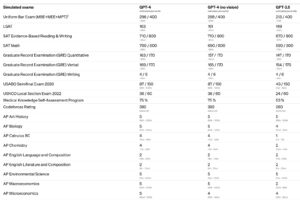
GPT-4
Tuesday assorted links
1. Open source LLMs? And more here. And running LLMs on consumer GPUs. And more.
2. Michael Jackson markets in everything.
3. Surveillance in the Danish welfare state (Wired).
4. Claim that the teen mental health dilemma started well before 2012.
5. LLMs vs. Chomsky. And more on Visual ChatGPT.
The Impact of AI on Productivity
We don’t yet know the impact that AI will have on productivity but some evidence is starting to come in. Peng et al. (2023) hired programmers on Upwork to write an HTTP server in Javascript; half of the programmers got access to CoPilot (this was before CoPilot was widely available) half did not.
Conditioning on completing the task, the average completion time from the treated group is 71.17 minutes and 160.89 minutes for the control group. This represents a 55.8% reduction in completion time. The p-value for the t-test is 0.0017, and a 95% confidence interval for the improvement is between [21%, 89%]. There are four outliers with time to completion above 300 min. All outliers are in the control group, however our results remain robust if these outliers are dropped. This result suggests that Copilot increases average productivity significantly in our experiment population. We also find that the treated group’s success rate is 7 percentage points higher than the control group, but the estimate is not statistically significant, with a 95% confidence interval of [-0.11, 0.25].
The authors extrapolate wildly:
In 2021, over 4.6 million people in the United States worked in computer and mathematical occupations,1 a Bureau of Labor Statistics category that includes computer programmers, data scientists, and statisticians. These workers earned $464.8 billion or roughly 2% of US GDP. If the results of this study were to be extrapolated to the population level, a 55.8% increase in productivity would imply a significant amount of cost savings in the economy and have a notable impact on GDP growth.
Still, worth thinking about.