And here’s the thing: when the authors of the “Facebook arrival” study raised their standards in this way, running a correction for multiple comparisons, all the results they found for well-being were no longer statistically significant. That is, a somewhat more conservative way of looking at the data indicated that every result they found was statistically indistinguishable from a scenario where Facebook had no effect on well-being whatsoever.
Now let’s turn to the second study, which was a randomised controlled trial where 1,637 adults were randomly assigned to shut down their Facebook account for four weeks, or go on using it as normal. Let’s call it the “deactivating Facebook” study. This “famous” study has been described as “the most impressive by far” in this area, and was the only study cited in the Financial Times as an example of the “growing body of research showing that reducing time on social media improves mental health”.
The bottom-line result was that leaving Facebook for a month led to higher well-being, as measured on a questionnaire at the end of the month. But again, looking in a bit more detail raises some important questions.
First, the deactivation happened in the weeks leading up to the 2018 US midterm elections. This was quite deliberate, because the researchers also wanted to look at how Facebook affected people’s political polarisation. But it does mean that the results they found might not apply to deactivating Facebook at other, less fractious times – maybe it’s particularly good to be away from Facebook during an election, when you can avoid hearing other people’s daft political opinions.
Second, just like the other Facebook study, the researchers tested a lot of hypotheses – and again, they used a correction to reduce false-positives. This time, the results weren’t wiped out entirely – but almost. Of the four questionnaire items that showed statistically-significant results before the correction, only one – “how lonely are you?” – remained significant after correction.
It’s debatable whether even this result would survive the researchers corrected for all the other statistical tests they ran. Not only that, but they also ran a second model, controlling for the overall amount of time people used Facebook, and this found even fewer results than the first one.
Third, as well as the well-being questionnaire at the end of the study, the participants got daily text messages asking them how happy they were, among other questions. Oddly, these showed absolutely no effect of being off Facebook – and not even the slightest hint of a trend in that direction.
4. “A funny state of affairs that isn’t getting enough attention is that the US government is suing Facebook for allegedly monopolizing social media, and simultaneously seeking to ban its biggest rival.” Link here. Oh, and I forgot to ask: are your views on the Twitter files consistent with your views on USG possibly banning TikTok?
Kevin Kelly (born 1952) is the founding executive editor of Wired magazine, and a former editor/publisher of the Whole Earth Review. He has also been a writer, photographer, conservationist, and student of Asian and digital culture…
Among Kelly’s personal involvements is a campaign to make a full inventory of all living species on earth, an effort also known as the Linnaean enterprise. He is also sequencing his genome and co-organizes the Bay Area Quantified SelfMeetup Group.
How should you choose your next trip? I can see a few general philosophies on the table:
1. Prioritize those countries and regions you haven’t visited yet. For me that might mean Montenegro, Lithuania, Bangladesh, and Saudi Arabia. But the downside is waking up one morning and saying “Hey, what the hell am I doing in Sardinia!?”
2. Get to know some of your favorite places truly in depth, most of all major cities that are easy to reach and often are connected to free or paid invitations. For me that would imply more trips to London, Paris, Tokyo, Berlin — you get the picture. Under this view, the returns to variety are diminishing. And have I ever regretted stopping in on those places?
3. Try to visit “events,” especially temporary events. Right after the Berlin Wall came down, I did a big car trip around Eastern Europe. Loved it. Perhaps these days I should be stopping in at Neom, flying to Lviv, and so on. Those historical moments will never be recaptured. And usually such trips are memorable.
4. Do more trips with the friends you value most, and go wherever will maximize their interest and participation. You already know the world, people are what make life special, and now it is time to “give back” your expertise.
5. Figure out, within the bounds of safety and reasonable expense, where you really don’t want to go. Then go there! Expectations and surprise are everything, right? And how else are you to develop a truly diversified portfolio? Won’t you this way learn the most?
I am indebted to Ben Casnocha for a relevant conversation here, though without holding him liable for any of these views.
Addendum: GPT-4 opts for #3:
As an experienced traveler, if I were to pick only one of the philosophies, I would choose to visit events and historical moments (Philosophy 3). The reason for this choice is that it allows for unique, once-in-a-lifetime experiences that capture the essence of a particular time and place. Such trips often become memorable stories that you’ll cherish for a lifetime.
By prioritizing events and historical moments, you immerse yourself in situations that reveal the true character of a destination and its people, as well as provide valuable insights into the forces that shape societies and cultures. Additionally, this approach can lead to a greater appreciation for the world’s interconnectedness, as you witness firsthand the impact of global events on different regions.
While this philosophy might not cover all aspects of a well-rounded travel experience, it offers a powerful way to engage with the world and create lasting memories that will enrich your life beyond the confines of a single trip.
Somehow missed this the first time I looked, but GPT-4 got *significantly worse* at microeconomics after it was trained to tell you what you want to hear. pic.twitter.com/8tDtTwf1II
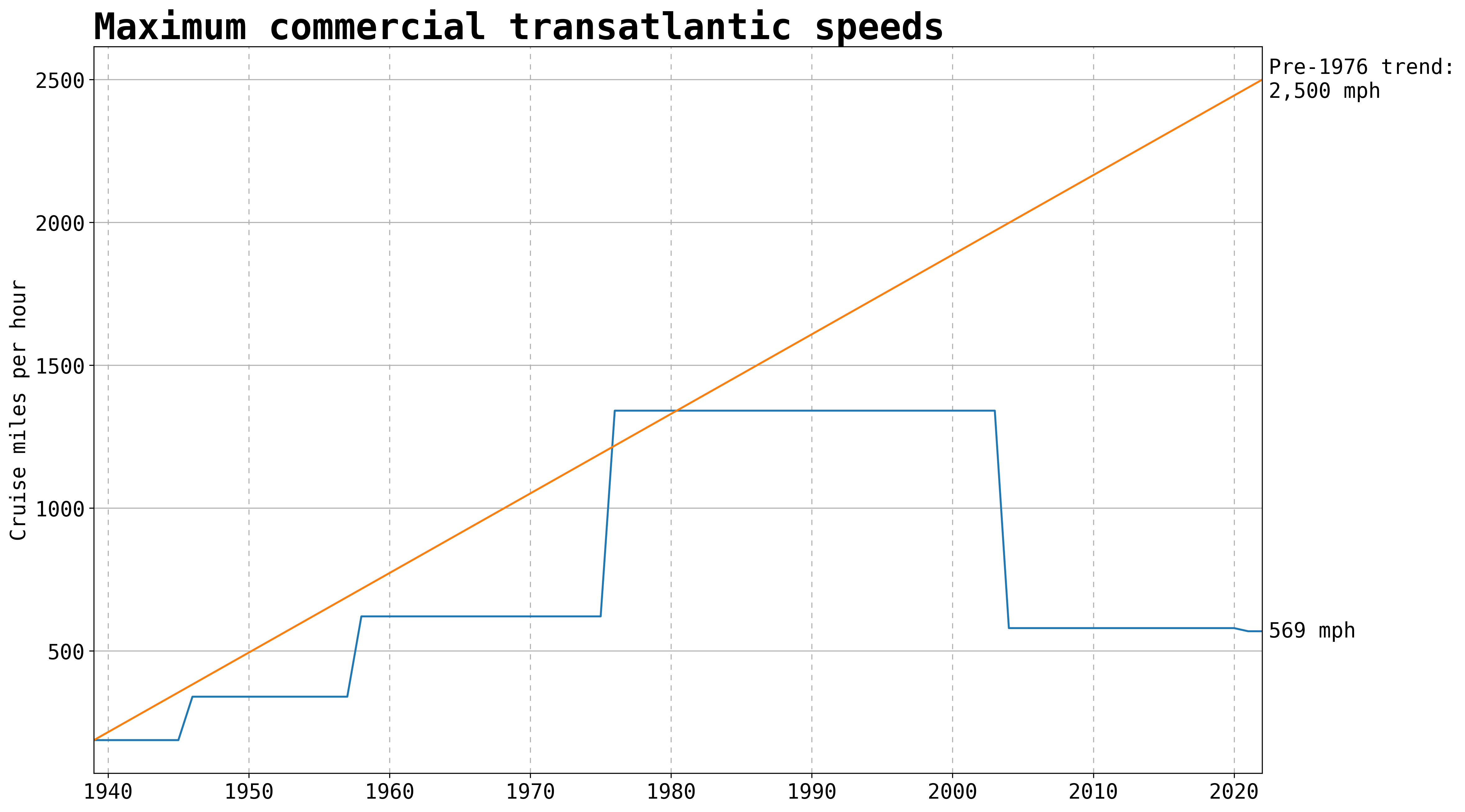
Fifty years ago today, on March 23, 1973, Alexander P. Butterfield, the Administrator of the Federal Aviation Administration, issued a rule that remains one of the most destructive acts of industrial vandalism in history.
“No person may operate a civil aircraft at a true flight mach number greater than 1 except in compliance with conditions and limitations in an authorization to exceed mach 1 issued to the operator under Appendix B of this part.”
This text was slightly modified in 1989 and again in 2021, but the upshot remains the same. The rule imposed a speed limit on US airspace. Not a noise standard, which would make sense. A speed limit.
This speed limit has naturally distorted the development of civil aircraft. For fifty years, the aviation industry has worked to improve subsonic aviation. Commercial passenger aircraft are safer and more economical today than they were in 1973, but they are no faster.
If we had propagated the rate of growth in commercial transatlantic aircraft speeds that existed from 1939 to the mid-1970s, we would have Mach-4 airliners by now. But the overland ban put an end to all that. It made small supersonic aircraft, which need to fly shorter overland routes, essentially illegal, closing off the iteration cycle that could drive progress in the industry.
That’s Eli Dourado who notes that modern designs greatly reduce sonic boom. I would also add the following. In 2019 there were 811 million passengers on US domestic flights and 241 million passengers on US international flights. The average duration of a domestic flight is about 2.5 hours and an international fight about 7.3 hours so Americans spend about 3.7 billion hours every year on airplanes. If we could cut even 20% of that time that’s a saving of 757 million hours which has to be weighed against a few people experiencing sonic booms near airports. Indeed, since the people on the airplane are subjected to a lot of the noise the total amount of noise experienced could easily go down with faster aircraft!
The central claim of our work is that GPT-4 attains a form of general intelligence, indeed showing sparks of artificial general intelligence. This is demonstrated by its core mental capabilities (such as reasoning, creativity, and deduction), its range of topics on which it has gained expertise (such as literature, medicine, and coding), and the variety of tasks it is able to perform (e.g., playing games, using tools, explaining itself…). A lot remains to be done to create a system that could qualify as a complete AGI.
A Washington Post poll finds that 41 percent of Americans support a federal ban of the popular short-videoapp, while 25 percent say they oppose it. And 71 percent are concerned that TikTok’s parent company is based in China, including 36 percent who say they are “very concerned.”
Here is the WaPo article. A single poll on this issue is not dispositive, but still it suggests to me that if our politicians force the sale of TikTok to an American company that would not be an electorally unpopular move.
You can see the broader pattern here:
1. Change starts with the states, many of which have been restricting the use of TikTok on government phones. Then the momentum spreads to the federal government.
2. American companies end up heavily favored (yes the competitors gain, as a side issue who will Elizabeth Warren allow to buy TikTok? Certainly not Meta.) Market concentration rises.
3. National security considerations, or ostensible national security considerations, win out.
4. For all the talk of polarization and gridlock, both parties get on board.
5. TikTok is the Girardian sacrifice to the American national vision, which in any case proceeds with rampant surveillance.
The SEC allowed Coinbase to go public in 2021, he [Brian Armstrong] wrote, including after reviewing its disclosures that “clearly explained our asset listing process and included 57 references to staking.”
Here is the full WSJ article. Rule of law people, or “rule of men” (and women)? Which is it?
In The New Madness of Crowds I argued that SVB failed because “Greater transparency and lower transaction costs have intensified the madness of the masses and expanded their reach.” A piece by Miao, Zuckerman and Eisen in the WSJ now adds to to the other side of the problem. Depositors were working on twitter time, the regulatory apparatus was not.
Depositors were draining their accounts via smartphone apps and telling their startup networks to do the same. But inside Silicon Valley Bank, executives were trying to navigate the U.S. banking system’s creaky apparatus for emergency lending and to persuade its custodian bank to stay open late to handle a multibillion-dollar transfer.
Instead of hearing a rumor at the coffee shop and running down to the bank branch to wait on line to withdraw your money, now you can hear a rumor on Twitter or the group chat and use an app to withdraw money instantly. A tech-friendly bank with a highly digitally connected set of depositors can lose 25% of its deposits in hours, which did not seem conceivable in previous eras of bank runs.
But the other part of the problem is that, while depositors can panic faster and banks can give them their money faster, the lender-of-last-resort system on which all of this relies is still stuck in a slower, more leisurely era. “When the user interface improves faster than the core system, it means customers can act faster than the bank can react,” wrote Byrne Hobart. You can panic in an instant and withdraw your money with an app, but the bank can’t get more money without a series of phone calls and test trades that can only happen during regular business hours.
It’s not obvious whether the right thing to do is slow down depositors, at least in some circumstances, or speed up regulators but the two systems can’t work well at different speeds.
Historian Tom Holland joined Tyler to discuss in what ways his Christianity is influenced by Lord Byron, how the Book of Revelation precipitated a revolutionary tradition, which book of the Bible is most foundational for Western liberalism, the political differences between Paul and Jesus, why America is more pro-technology than Europe, why Herodotus is his favorite writer, why the Greeks and Persians didn’t industrialize despite having advanced technology, how he feels about devolution in the United Kingdom and the potential of Irish unification, what existential problem the Church of England faces, how the music of Ennio Morricone helps him write for a popular audience, why Jurassic Park is his favorite movie, and more.
Here is one excerpt:
COWEN: Which Gospel do you view as most foundational for Western liberalism and why?
HOLLAND: I think that that is a treacherous question to ask because it implies that there would be a coherent line of descent from any one text that can be traced like that. I think that the line of descent that leads from the Gospels and from the New Testament and from the Bible and, indeed, from the entire corpus of early Christian texts to modern liberalism is too confused, too much of a swirl of influences for us to trace it back to a particular text.
If I had to choose any one book from the Bible, it wouldn’t be a Gospel. It would probably be Paul’s Letter to the Galatians because Paul’s Letter to the Galatians contains the famous verse that there is no Jew or Greek, there is no slave or free, there is no man or woman in Christ. In a way, that text — even if you bracket out and remove the “in Christ” from it — that idea that, properly, there should be no discrimination between people of different cultural and ethnic backgrounds, based on gender, based on class, remains pretty foundational for liberalism to this day.
I think that liberalism, in so many ways, is a secularized rendering of that extraordinary verse. But I think it’s almost impossible to avoid metaphor when thinking about what the relationship is of these biblical texts, these biblical verses to the present day. I variously compared Paul, in particular in his letters and his writings, rather unoriginally, to an acorn from which a mighty oak grows.
But I think actually, more appropriately, of a depth charge released beneath the vast fabric of classical civilization. And the ripples, the reverberations of it are faint to begin with, and they become louder and louder and more and more disruptive. Those echoes from that depth charge continue to reverberate to this day.
And:
COWEN: In Genesis and Exodus, why does the older son so frequently catch it hard?
HOLLAND: Well, I’m an elder son.
COWEN: I know. Your brother’s younger, and he’s a historian.
HOLLAND: My brother is younger. It’s a question on which I’ve often pondered, because I was going to church.
COWEN: What do you expect from your brother?
HOLLAND: The truth is, I have no idea. I don’t know. I’ve often worried about it.
Large language models (LLMs) have demonstrated remarkable capabilities in natural language understanding and generation across various domains, including medicine. We present a comprehensive evaluation of GPT-4, a state-of-the-art LLM, on medical competency examinations and benchmark datasets. GPT-4 is a general-purpose model that is not specialized for medical problems through training or engineered to solve clinical tasks. Our analysis covers two sets of official practice materials for the United States Medical Licensing Examination (USMLE), a three-step examination program used to assess clinical competency and grant licensure in the United States. We also evaluate performance on the MultiMedQA suite of benchmark datasets. Beyond measuring model performance, experiments were conducted to investigate the influence of test questions containing both text and images on model performance, probe for memorization of content during training, and study calibration of the probabilities, which is of critical importance in high-stakes applications like medicine. Our results show that GPT-4, without any specialized prompt crafting, exceeds the passing score on USMLE by over 20 points and outperforms earlier general-purpose models (GPT-3.5) as well as models specifically fine-tuned on medical knowledge (Med-PaLM, a prompt-tuned version of Flan-PaLM 540B). In addition, GPT-4 is significantly better calibrated than GPT-3.5, demonstrating a much-improved ability to predict the likelihood that its answers are correct. We also explore the behavior of the model qualitatively by presenting a case study that shows the ability of GPT-4 to explain medical reasoning, personalize explanations to students, and interactively craft new counterfactual scenarios around a medical case. Implications of the findings are discussed for potential uses of GPT-4 in medical education, assessment, and clinical practice, with appropriate attention to challenges of accuracy and safety.
Here is the full paper by Harsha Nori, Nicholas King, Scott Mayer McKinney, Dean Carignan, and Eric Horvita. Ho hum, people, ho hum!