Month: April 2023
Wednesday assorted links
1. Some GPT advances so far. And good survey of views on existential risk.
2. The paradox of social capital in Northern Ireland.
3. Scott Sumner movie reviews, noting I think he is underrating Return to Seoul, EO, and Pillow Talk. Usually I agree with Scott 100%.
4. Did the Counter-Reformation harm science?
5. Everybody is the main character. Or is “leadership that which is scarce”?
6. Why did human society make so little progress for 300,000 years?
The Arrow Replacement Effect and the Dynamics of US Inventors
anonymized, person-level identifiers, known as Protected Identification Keys (PIKs) so they also have individual data on earnings and employment and they link that data to data on firms.
Ultimately, we observe the employment histories of approximately 760 thousand inventors associated with 3.6 million patents granted between 2000 and 2016.
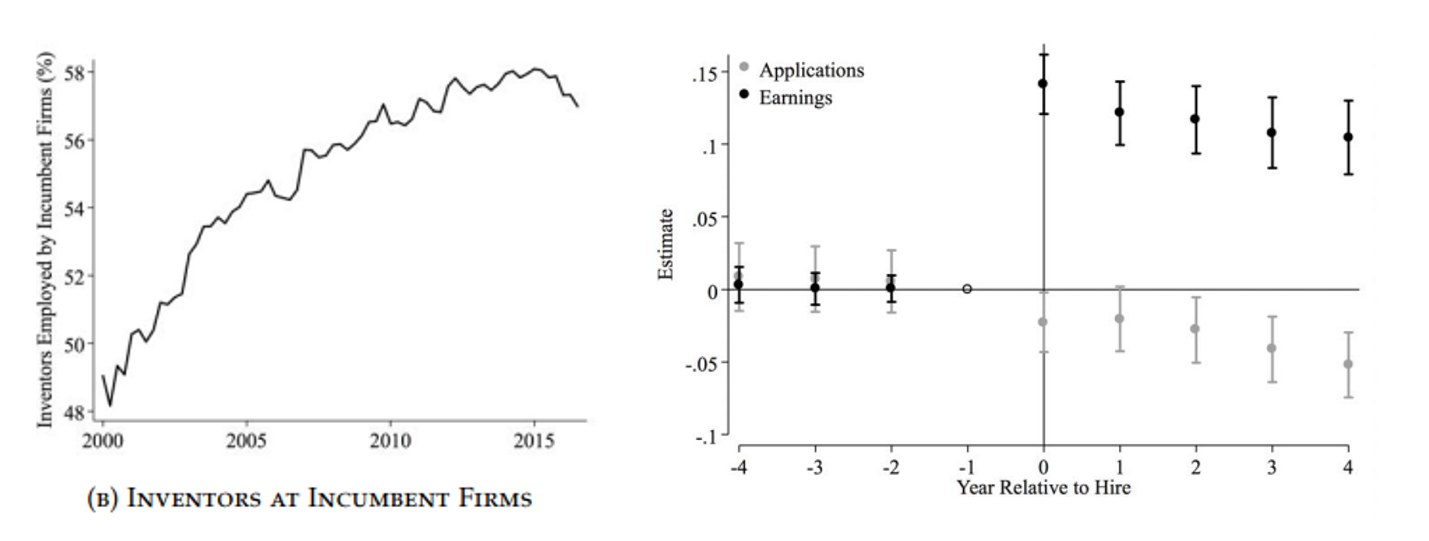
What they find is twofold. First, an increasing number of inventors are being hired by large incumbent firms (left below). Second, when inventors move to large incumbent firms they earn more but they invent less, compared to similar inventors who go to young firms (right below). Why would an incumbent firm pay more for less productive workers? One possible answer is the Arrow replacement effect, namely a monopolist has less incentive to innovate than a competitive firm becasue the monopolist has a bigger opportunity cost, namely it’s own profits. As Arrow put it: “The preinvention monopoly power acts as a strong disincentive to further innovation.” A logical extension is that a monopolist will be willing to pay not to innovate and one way of doing that is to hire inventors who, if they worked at an entrant, would threaten their monopoly profits.
This is an important paper on declining dynamism in the US economy.
Addendum: In a second paper they use their extensive data to discuss the demographic characteristics of inventors.
Khan Academy Joins with OpenAI
One model of a future course is a super-textbook: lectures, exercises, quizzes, and grading all available on a tablet with artificial intelligence routines guiding students to lectures and
exercises designed to address that student’s deficits and with human intelligence—tutors—on call on an as-needed basis, possibly for extra marginal fees.
That was Tyler and I in our 2014 paper. Here’s the Washington Post on the Khan Academy and OpenAI colloboration.
…last week, the private Khan Lab School campuses in Palo Alto and Mountain View welcomed a special version of the [GPT] technology into its classrooms.
Rather than solve a math problem for a student, as ChatGPT might do if asked, Khanmigo is programmed to act like “a thoughtful tutor that’s actually going to move you forward in your work,” says Salman Khan, the technologist-turned-educator who founded Khan Academy and Khan Lab School.
Khanmigo was developed in concert with OpenAI, the nonprofit tech start-up that created GPT-4, the underlying technology for the latest version of ChatGPT. OpenAI did not respond to a request for comment on the partnership.
How to visit Italy
Ajit requests such a post, and I note that plenty of people have plenty of experience with this topic. So I’ll offer a few observations at the margin:
1. Venice, Florence, and Rome have, on average, the worst food in Italy. They have some wonderful places, but possibly hard to get into, requiring advance planning, and often expensive. For random meals, those cities are not impressive, noting that Rome, due to its size, is much better than Venice or Florence.
2. My favorite “single sights” in Italy, moving beyond the core sights of Rome, Venice and Florence, are the Giotto chapel in Padua, the Basilica in Ravenna, and the Cathedral in Monreale in Sicily (near Palermo). To this day, they remain underrated sights. As for the major cities, both Genoa and Torino are underrated.
3. My favorite food in Italy would be in Sicily, Naples, and the lower-tier towns of the North, such as Bologna and Parma. The area near Torino/Piedmont would be another contender. I have heard Veneto is wonderful for food, though have only had a single meal there, which was indeed outstanding. In Sicily, don’t order the usual Italian dishes (which are available and excellent), rather look for regional offerings which reflect the area’s Arabic heritage. Orange slice and mint — bring it on!
4. Usually there is little gain from pursuing Michelin-starred restaurants in Italy. You want the “two-forker” places with outstanding regional cuisine. Originality, which is rewarded by the Michelin system, too often is a negative in Italian food.
5. Italy has a large number of third-tier towns which are wonderful for walking through. But you don’t need to overnight in them, so there is much to be said for randomly driving around Italy, but avoiding the larger cities. Stop, walk for a few hours, take a meal, and then move on.
6. There is a great deal of available trip prep material for Italy in the form of movies, fiction, and history. Most of all, however, you should focus on using picture books to have an advance sense of the art and architecture. The classic book on Italy, Luigi Barzini’s The Italians, is still worth reading. And often the postwar fiction, or even Manzoni, are better trip prep than the very famous classics such as Dante and Petrarch (though you should read them anyway, but for other reasons).
What else?
The game theory of an AI pause
The issues go well beyond China:
What might countries such as Israel or Japan do if their most important ally decides to pause work on AI? Might this not lead to a proliferation of GPT-like models across more countries — exactly what the pause advocates were trying to avoid?
And if the goal is to “Pause Giant AI Experiments,” which is what the letter is titled, what of smaller ones? What if a small company has an ongoing experiment but is nowhere close to having an effective product? A six-month suspension would damage their future business prospects and serve to entrench the incumbents. What if one of those new upstarts is working to come up with very good safety and alignment procedures? What if its AI might help cure cancer?
There is little evidence that proponents of a delay have thought through the major secondary effects of their 600-word proposal. Maybe they could have made a stronger argument if they they’d had more time to prepare — say, another six months?
Here is my full Bloomberg column.
Tuesday assorted links
A new paper on infrastructure costs
Despite infrastructure’s importance to the US economy, evidence on its cost trajectory over time is sparse. We document real spending per new mile over the history of the Interstate Highway System. We find that spending per mile increased more than threefold from the 1960s to the 1980s. This increase persists even conditional on pre-existing observable geographic cost determinants. We then provide suggestive evidence on why. Input prices explain little of the increase. Statistically, changes in income and housing prices explain about half of the increase. We find suggestive evidence that the rise of “citizen voice” in government decision-making increased spending per mile.
That is from American Economic Journal: Applied Economics, by Leah Brooks and Zachary Liscow.
Does natural selection favor AIs over humans? Model this!
Dan Hendrycks argues it probably favors the AIs, paper here. He is a serious person, well known in the area, home page here, and he gives a probability of doom above 80%.
I genuinely do not understand why he sees so much force in his own paper. I am hardly “Mr. Journal of Economic Theory,” and I have plenty of papers that you could describe as a string of verbal arguments, but here is an instance where I would find an actual model very useful. Evolutionary biology is full of them, as is economics. Why not apply them to the AI Darwinian process? Why leap to such extreme conclusions in the meantime?
Here are two very simple ideas I would like to see incorporated into any model:
1. At least in the early days of AIs, humans will reproduce and recommend those AIs that please them. Really! We already see this with people preferring GPT-4 to GPT 3.5, the popularity of Midjourney 5, and so on. So, at least for a while, AIs will evolve to please us. What that means over time is perhaps unclear (maybe some of us opt for ruthless? But do we all seek to hire ruthless employees and RAs? I for one do not), but surely it should be incorporated into the basic model. How much ruthlessness do we seek to inject into the agents who do our bidding? It depends on context, and so is it the finance bots who will end the world? Or perhaps the system will be tolerably decentralized and cooperative to a fair degree. If you are skeptical there, OK, but isn’t that the main question you need to address? And please do leave in the comments references to models that deploy these two assumptions. (With the world at stake, surely you can do better than those bikers did!)
2. Humans can apply principal-agent contracts to the AI (again, at least for some while into the evolutionary process). Keep in mind if the AIs are risk-neutral (are they?), perhaps humans can achieve a first-best result from the AIs, just as they can with other humans. If the AIs are risk-averse, in the final equilibrium they will shirk too much, but they still do a fair amount of work under many parameter values. If they shirk altogether, we might stop investing in them, bringing us back to the evolutionary point.
Neither of those points are the proverbial “rocket science,” rather they are super-basic. Yet neither plays much if any role in the Hendrycks paper. There are some mentions of various points on for instance p.17, but I don’t see a clear presentation of modeling the human choices in a decentralized process. p.21 does consider the decentralized incentives point a bit more, but it consists mostly of two quite anomalous examples, such as a dog pushing kids into the Seine to later save them (how often?), and “the India cobra story,” which is likely outright false. It doesn’t offer sound anecdotal empirics, or much theoretical analysis of which kinds of assistants we will choose to invest in, again set within a decentralized process.
Dan Hendryks, why are you so pessimistic? Have you built such models, fleshing out these two assumptions, and simply not shown them to us? Please show!
If the very future of the world is at stake, why not build such models? Surely they might help us find some “outs,” but of course the initial problem has to be properly specified.
And more generally, what is your risk communication strategy here? How secure, robust, and validated does your model have to be before you, a well-known figure in the field and Director at the Center for AI Safety, would feel justified in publicly announcing the > 80% figure? Which model of risk communication practices (as say validated by risk communication professionals) are you following, if I may ask?
In the meantime, may I talk you down to 79% chance of doom?
Is U.S. deposit outflow an overrated problem?
US bank deposits are a third higher than they were at the start of 2020, which makes worries about a banking system liquidity crisis seem a little overwrought (though, to be fair, it is changes in liquidity, not absolute liquidity levels, that matter most to markets)…
So there was a one-time outflow of about $185bn, or about 3 per cent of small banks’ deposits. The next week, however, small bank deposits were stable. With the usual qualifiers — things can always go wrong later, and so on — US banks do not seem to have a deposit outflow problem.
Here is more from the FT.
The Causal Effect of Economic Freedom on Female Employment & Education
While we have decades of evidence that economically free economies grow faster and are more productive than un-free ones, we have less knowledge about the effect of economic freedom on groups that have traditionally been disadvantaged. I study the causal effects of large and sustained jumps in economic freedom on women’s labor force participation and primary school enrollment. I find that these jumps have a positive and significant effect in both cases–economic freedom is good for women’s labor force opportunities and female education.
That is from Robin Grier at TTU.
Monday assorted links
1. IRL dates with virtual boyfriends.
2. Tina Turner and Marvin Gaye.
3. One can repudiate Eliezer’s latest stuff, the more important point being it should cause you to rethink what intelligence means and what it is good for. EY did delete that tweet but the point remains and one can intellectually trace where that logic comes from.
4. Twelve Books at Herculaneum That Could Change History.
5. Henry Oliver’s Virginia notes.
6. Yang Bing-yi, RIP (NYT). And more Ezra (NYT).
Peltzman Revisited
Casey Mulligan has an excellent new paper, Peltzman Revisited: Quantifying 21st-Century Opportunity Costs of Food and Drug Administration Regulation. What are the costs of delaying a new drug or a vaccine? Longer and bigger clinical trials increase safety but I’ve often made the point that the people who would have lived had a good drug been approved sooner are buried in an invisible graveyard and thus these costs are typically undercounted–the failure to see the invisible graveyard biases decisions in favor of delay. Mulligan makes a different and rarely considered point about substitution effects. If a vaccine isn’t available there are substitutes but these substitutes are themselves potentially unsafe and ineffective. But who is testing the substitures?
Many of these substitute interventions, such as remote work, closing schools, and canceling normal medical appointments, are beyond the jurisdiction of the FDA and can be utilized without any attempt to demonstrate their safety or efficacy.
If the substitutes work, the costs of delay are reduced. The FDA, for example, is right to prioritize drugs for which there are few alternative treatments. But the standards for many vaccine or drug substitutes are completely different than those used to approve a vaccine:
Closing schools to in-person learning is an important example of a prevention activity that was available, was applied to tens of millions of children in the United States, and was outside the FDA’s jurisdiction…Obviously the FDA’s effectiveness standard for vaccines differs from the effectiveness standard (if any) that school districts applied in deciding to close schools.
Where were the randomized controlled trials for closing schools, shutting the parks and beaches, and delaying medical appointments? Thus, it’s quite possible that greater safety of vaccines comes at the expense of greater time under less safe and possibly unsafe substitutes. As Mulligan concludes:
Approval delays for pandemic tests and vaccines pushed tens of millions of individuals and businesses into preventions and treatments that were both outside FDA jurisdiction and hardly safe or effective. The pandemic experience raises the question of whether, on the whole, consumers engage in more unsafe and ineffective practices than they would if FDA approval were not a prerequisite for pharmaceutical sales.
Addendum: Much else of interest in the paper including a calculation of the value of the vaccines in the hundreds of billions and trillions very much in line with work done by the AHT team, including myself ,in the AER PP (especially the appendix) and Science.
The Effect of Population Aging on Economic Growth, the Labor Force, and Productivity
Population aging is expected to slow US economic growth. We use variation in the predetermined component of population aging across states to estimate the impact of aging on growth in GDP per capita for 1980–2010. We find that each 10 percent increase in the fraction of the population age 60+ decreased per capita GDP by 5.5 percent. One-third of the reduction arose from slower employment growth; two-thirds due to slower labor productivity growth. Labor compensation and wages also declined in response. Our estimate implies population aging reduced the growth rate in GDP per capita by 0.3 percentage points per year during 1980–2010.
That is from Nicole Maestas, Kathleen J. Mullen and David Powell, in the new AEJ: Macroeconomics. Uh-oh!
Econ Journal Watch — new issue
In this issue:Hospitals, communication, and dispute resolution: Florence R. LeCraw, Daniel Montanera, and Thomas A. Mroz criticize the statistical methods of a 2018 article in Health Affairs, and tell of their effort to get their criticisms into Health Affairs.Health Insurance Mandates and the Marriage of Young Adults: Aaron Gamino comments on the statistical modeling in a 2022 Journal of Human Resources article, whose authors Scott Barkowski and Joanne Song McLaughlin reply.Origins of the Opioid Crisis Reexamined: A 2022 article in the Quarterly Journal of Economics on the origins of the opioid crisis assigns considerable explanatory weight to the introduction and promotion of OxyContin. Robert Kaestner looks at the empirics behind the conclusion and suggests that it is without much foundation.Temperature and Economic Growth: As he did in the previous issue of this journal, David Barker investigates a piece of Federal Reserve research purporting to show that high temperatures decrease the rate of economic growth. Barker looks under the hood, replicates, and reports.Classical Liberalism in Romania, Past and Present: Radu Nechita and Vlad Tarko narrate the classical liberal movements in Romania, from the beginning of the 19th century, through the awful times of the 20th century, and down to today. The article extends the series on Classical Liberalism in Econ, by Country.Edward Westermarck’s Lectures on Adam Smith, delivered in 1914 at the University of Helsinki. Westermarck, of Finland, was an influential sociologist, anthropologist, and philosopher. His lectures are remarkably attentive toward Smith’s Theory of Moral Sentiments. The lectures are translated and introduced by Otto Pipatti.French economic liberalism versus occupational privilege: In 1753, Vincent Gournay wrote a memorial blasting the exclusionary privileges conferred upon guilds. The Chamber of Commerce of Lyon replied, and Gournay then responded with another memorial. The three-part exchange is translated here for the first time, and introduced by Benoît Malbranque.Professor McCloskey’s 1988 Letter Responding to a Letter from the President of Penn State: In 1988, Donald (now Deirdre) McCloskey received a letter about a passage in The Applied Theory of Price in an exercise on discrimination in labor markets. The letter and McCloskey’s response are reproduced here.EJW Audio:
- Sheilagh Ogilvie on 900 Years of European Guilds
- Art Carden on William H. Hutt
- David Barker on Temperature and Economic Growth
EJW books from CL Press:
My Irish lineage
Travis, an MR reader, set out to trace my Irish lineage, and here is what he found (the other, more recent parts of his story check out 100% with what I know):
I was having fun, so I traced your whole family rather than just the Cowens. Good news–we’ve got definite Irish origins for almost all of them, at least by county. The Bohans are from Killyfea in county Leitrim. The Crosbys from the Common of Lloyd in county Meath. The Wards from somewhere in County Donegal. The Cowens are the trickiest–not because there were no records, but because they were surprisingly mobile. Your immigrant ancestor John Cowen was married in the town of Longford, baptized a first child in Enniskerry, Wicklow, baptized a second in Dublin, then baptized all the rest in Kells. If I had to guess I’d say he was from Longford, but I can’t say with any certainty. His wife and his son’s wife were both likely from Kells (of Book of Kells fame).
It was extremely impressive what Travis found, including a whole line of grocers and lots of time spent in New Jersey. I am also 1/8th from the Madeira islands, but that is a story for another day…In the meantime, many thanks to Travis!