Month: September 2026
Wednesday assorted links
Very good news
Michael Kremer picked as World Bank chief economist (Bloomberg). Here are many many previous MR posts on Kremer, of course Alex also worked with him on Operation Warp Speed.
What Regulatory Capture Actually Looks Like
It’s amazing how a theory can take over a brain. Consider the idea that people believe what serves their interests. As heuristics go, it’s a good one. I use it all the time. Yet when Dario Amodei says AI is dangerous, perhaps even an extinction risk, some people conclude he must be running a marketing campaign. That is stupid. Which is more likely, that a useful heuristic sometimes misfires or that “our product might kill you” is a clever way to sell it? Death threats are a poor marketing strategy.
We also have plenty of evidence that the fears of AI experts are sincere. Amodei, Altman and Musk were all publicly warning about AI risk long before they had AI companies to promote. The worry runs well beyond the executive suite; rank and file researchers share it. And it extends outside the industry altogether, to computer scientists with no product to sell, among them Nobel laureate Geoffrey Hinton. Hinton left a high-paying job at Google precisely so he could speak out and Hinton is not in a Berkeley polycule with Eliezer Yudkowsky, at least as far as I know. Whatever else you may say about the belief that AI presents a serious risk, plenty of AI researchers believe it sincerely.
Similarly, when Amodei recently proposed to slow the pace and install independent safety teams at AI companies many people jumped to the conclusion that this was regulatory capture. Sorry, but no, that theory doesn’t make sense. To see why, we should review the theory of regulatory capture.
Regulatory capture came out of the political science literature especially Marver Bernstein’s 1955 classic, Regulating Business by Independent Commission. Bernstein argues for a regulatory life cycle: Gestation, Youth, Maturity, Old Age. A scandal brings a bureaucracy into existence—or gives an existing one new powers. The public’s attention, like Sauron’s eye, fixes on the issue of the day: something must be done. The thalidomide scandal, for example, helped establish the modern FDA.
Gestation gives way to a youthful burst of reform and the do-gooders come to Washington ready to battle the industry. Inevitably, however, the public’s eye looks elsewhere. But the industry never looks away. It lobbies Congress, hires former regulators, trains future ones, and supplies much of the information the agency needs. As the agency matures, accommodation replaces confrontation. By old age, the regulator has become the industry’s protector. The classic example is the ICC, created to regulate the railroads but it eventually came to shield them from competition from the trucking industry.
Notice that classic regulatory capture takes time, it’s a process of erosion rather than a battle, it happens in the shadows, in the backrooms, away from the public’s eye. As Culpepper argues in Quiet Politics and Business Power, business power goes down as political salience goes up. Regulatory capture and lobbying does a good job explaining why roasting coffee beans was defined as “domestic manufacturing”, thereby lowering Starbuck’s tax rate by 2%. It does less well at explaining big cross-industry issues the public cares about such as environmental regulation or race and gender discrimination regulation. Finally, don’t confuse capture with firms making the best of a bad situation. Philip Morris supported the 2009 Tobacco Control Act not because FDA regulation was Philip Morris’s unconstrained ideal but because it knew regulation was coming and it wanted a seat at the table to nudge the rules in its favor. That’s ordinary political bargaining—or rent-seeking—not evidence that the regulator has been captured.
Now let’s evaluate Amodei’s call for regulation in light of regulatory capture theory. AI regulation is in gestation. Public attention is fixed on the industry, and much of that attention is hostile. The big profits in AI lie in automating work, and job loss is a much more salient fear than extinction. AI politics is now loud–precisely the environment in which Culpepper predicts business power will be weakest. A mature industry can bend regulation to its purposes through revolving doors, longstanding relationships and obscure rulemaking. An industry under Sauron’s eye has much less power and faces much greater risk that politics will bend regulation to its purposes. Political actors are eager for an excuse to redistribute AI rents away from capitalists and toward favored groups (ala Peltzman).
Regulation will reduce AI profits. That doesn’t prove that every rule Amodei favors is innocent of self-interest, an absurd proposition. I suspect that Amodei’s ideal may be something like a single regulated AI monopoly—safe and reasonable profitable, like the old AT&T. But that’s not the profit maximizing outcome. If transformative AI can capture even a fraction of the enormous labor market–the world’s biggest market–laissez-faire would mean vastly greater profits. Amodei may simply prefer a smaller fortune and a safer world. That is perfectly consistent with self-interest playing a role; it is not consistent with the bastardized theory that profit maximization is the only thing that matters or that “capture” is universal.
Go ahead: argue that Amodei and other AI experts are wrong about AI risk. Ask whether his proposals favor Anthropic. But calling “our product might kill you” a clever marketing and regulatory-capture strategy isn’t sophisticated analysis. The facts don’t fit regulatory capture theory and trying to make them fit requires epistemically painful Ptolemaic epicycles. Even a dull Ockham’s razor cuts through that story to the obvious alternative: Amodei actually believes what he’s saying.
The economics of cyber risk
From Aniket Baksy and Daniele Caratelli, here is part of the abstract:
Because larger firms are more attractive targets but also invest more in protection, the model generates an inverse-U relationship between firm size and attack risk, consistent with the data. Introducing cyber risk reduces firm entry by 3.6 percent, aggregate productivity by 0.6 percent, and total output by 1.8 percent. These effects arise from general equilibrium adjustments in entry, firm size, and spillovers that are absent in typical partial-equilibrium analyses. Policy responses differ sharply: appropriately designed subsidies and minimum cybersecurity requirements can raise aggregate output, while bailouts reduce it.
Note this is not a paper about AI. But it may help us develop estimates of the future costs of AI cyberattacks. We need much more effort in this direction, and I hope this subfield rises in status rapidly.
When discussing AI policy, start with China
Whatever your ideas for regulating AI, I say start with China. Do not put China as an afterthought at the end of your proposal, mentioned in a vague wish that something good ought to happen and that maybe the future of humanity can be secured.
During the 2023 U.S.-China nuclear talks, America proposed missile-launch notifications, a nuclear crisis hotline, and processes to limit the use of outer space for military conflict. China declined all of those. Blame the U.S. if you wish (do we always keep our word?), but that is what happened.
China also broke off meaningful arms control talks. You may think it is their right to play catch-up, and to be cynical of our motives, but that is what happened.
How well did China exchange timely information about Covid, and cooperate with stopping its initial spread?
Get the picture?
If you start with China in your discussion, you will end up with sensible proposals before getting too caught up in your moods of the day. If you are reading proposals or for that matter tweets for AI regulation, and the writer does not deal with these China issues in a forthright and very specific manner, you should be very suspicious indeed.
Here is Ezra and Matt Sheehan, discussing related issues (NYT).
Callum Williams on cybersecurity prices
Share prices of cyber firms have jumped around a lot in recent weeks, leading one side or the other to claim victory. But the crucial point is that, relative to the historical norm, the market is not really pricing ANYTHING big to change. There was a much bigger move in cyber stocks in both 2020-22 (up) and 2022-23 (down) but no one read “AI x-risk” into this.
Here is the full post with graph.

Hardly the final word, and I am myself more pessimistic than those numbers indicate. But at least with this we are getting somewhere concrete and scientific rather than just scare stories. As for meta-commentary on the discourse itself, you really should be asking who are the people insisting on data here, and who are the people trying to talk you away from focusing on the data so much.
Tuesday assorted links
1. Easy to bioengineer a very dangerous virus?
2. The astrophysicists are getting antsy too. Princeton is also getting nervous. If nothing else, these are huge PR own goals. The guy is a Mill scholars, can you imagine J.S. Mill tweeting that way?
4. One Chinese view of AI risk. And from Richard Hanania.
5. Arnold Kling on Polanyi knowledge.
6. Jeremy Stern profile of Mark Zuckerberg. Great piece.
7. China’s first AI-generated TV series.
8. Introducing Free Press Excursions.
9. Redux of my earlier talk/session at St. Andrews on Effective Altruism as a philosophy.
The striking thing is how late the market moved
Here’s the S&P 500 (daily close) with the key COVID and policy events marked; the numbered key is below the chart.

Event key:
- Dec 31 – China reports the Wuhan pneumonia cluster to the WHO
- Jan 21 – First confirmed US case (Washington state)
- Jan 23 – Wuhan locked down
- Jan 30 – WHO declares a global health emergency (PHEIC)
- Feb 19 – S&P 500 all-time high, 3,386
- Feb 24 – Italy outbreak; first big US selloff
- Mar 3 – Fed emergency 50 bp cut
- Mar 11 – WHO declares pandemic; Europe travel ban; NBA suspends season
- Mar 13 – US national emergency declared
- Mar 15–16 – Fed cuts to zero and restarts QE; worst day since 1987 (−12%)
- Mar 23 – Fed announces unlimited QE; market bottom at 2,237
- Mar 27 – CARES Act signed
- Apr 2 – 6.6 million initial jobless claims in one week
- Apr 20 – WTI oil futures settle below zero
- May 8 – April jobs report: 20.5 million jobs lost, 14.7% unemployment
The striking thing is how late the market moved. Wuhan was locked down and the WHO had declared an emergency a full month before the peak. The 34% drawdown then took 23 trading days, and the bottom coincided with the Fed’s unlimited-QE announcement rather than with any turn in the epidemiological news, which was still getting worse through April.
Addendum: Mostly from a query to Claude. You may fill in the missing context.
Those new service sector jobs
Horwitz is in the business of playing a version of mom for local college students. Concierge companies offering student support have existed for decades. But in recent years, a new crop of upstarts — such as Horwitz’s company, MindyKnows; the Bama Mama in Alabama; the GA Mom in Georgia; and Campus Mom in Texas — have met additional demand from a new generation of worried parents…
The specific services vary here and there, but share commonalities. Campus Mom offers “holistic wellness check-ins,” laundry services and sorority recruitment support packages, sent to the sisters to up a child’s odds of acceptance. Carrie Eckhardt, the Bama Mama, will clean students’ dorm rooms and check in if parents haven’t heard from their child in a few days (“just pop in and say hi, and take a picture and send it to their mom”)…
Horwitz, for her part, brings students balloons on their birthdays and chicken soup when they’re sick, sits with them in the emergency room and picks up their prescriptions if they’re busy. She bakes homemade challah, coordinates with the bedbug exterminator, texts photos and updates to faraway parents and doles out recommendations on the best local doctors and landlords.
Here is more from Kristy Alpert at the NYT.
Did the ACA reduce mortality?
Many of us brought up related points at the time, but basically we were booed off the reservation:
While recent research has provided evidence that the Medicaid expansions of the Affordable Care Act (ACA) reduced mortality, there is no evidence on the effect of the Affordable Care Act (ACA) net of the Medicaid expansions on mortality. This is an important gap in knowledge because the ACA significantly increased health insurance coverage in non-expansion states. In this article, we exploit the large increase in health insurance coverage brought forth by the ACA to examine the effect of the ACA and Medicaid expansions on mortality. Unlike prior studies that relied solely on geographic variation in Medicaid expansions to estimate the net effect of the expansion, we use a novel empirical approach that allows us to investigate the effect of the ACA net of Medicaid expansion on mortality, the incremental effect of the Medicaid expansion, and the overall effect of the ACA including Medicaid expansion. We use longitudinal data from the NHIS Linked Mortality Files (LMF) and a nationally representative sample of 40 to 58-year-olds combined with a difference-in-differences and a difference-in-differences-in-differences research design to obtain estimates of the effect of the ACA on mortality. We find no evidence that the Medicaid expansions had a beneficial effect on mortality but do find that the ACA net of Medicaid expansion reduced mortality.
That is from a new NBER working paper by
Monday assorted links
1. Will driverless cars increase or reduce urban density?
2. One decomposition approach to why interest rates have been going up.
3. New Guinness record holders.
4. Is there any chance of finding Rembrandt DNA?
6. High school students plus AI solve math problem.
7. “China’s top spy chief has warned that artificial intelligence could pose a direct threat to the Chinese Communist Party’s hold on power, in what is the highest-level and most detailed articulation yet of how Beijing sees the technology’s security risks.” (NYT)
8. Good data: cybersecurity stocks surged today.
AI, Redistribution, and the Size of the Pie
Anthropic’s economic team, including Anton Korinek and Chad Jones, have a valuable new paper, Economic Scenarios for Transformative AI. They make their assumptions explicit and provide a scenario explorer that lets you change them. How capable will AI become? How quickly will firms adopt it? Will it augment workers or automate their tasks? You can see what different answers imply for growth, wages, and unemployment.
In their extreme scenario AI takes on a lot of tasks, GDP is 32.4% higher by 2030 than without AI and labor share declines from 60% to 45.2% but they make this striking point:
“Total labor income in 2030 in the extreme scenario is almost exactly what it would have been without AI: the labor share falls by a quarter while GDP rises by a third, and 0.45×1.32 ≈ 0.60.”
Exactly. That is the central point of my paper, How Much Redistribution Will AI Require. A falling labor share does not necessarily mean falling labor income. Workers can receive a smaller share of a much larger economy and still earn as much as they would have without AI.
Using the code behind their scenario explorer I updated their results to a 10 year horizon and plotted them on my redistribution graph. Only under the modest scenario is some net labor transfer required to make AI Pareto improving at the aggregate level.
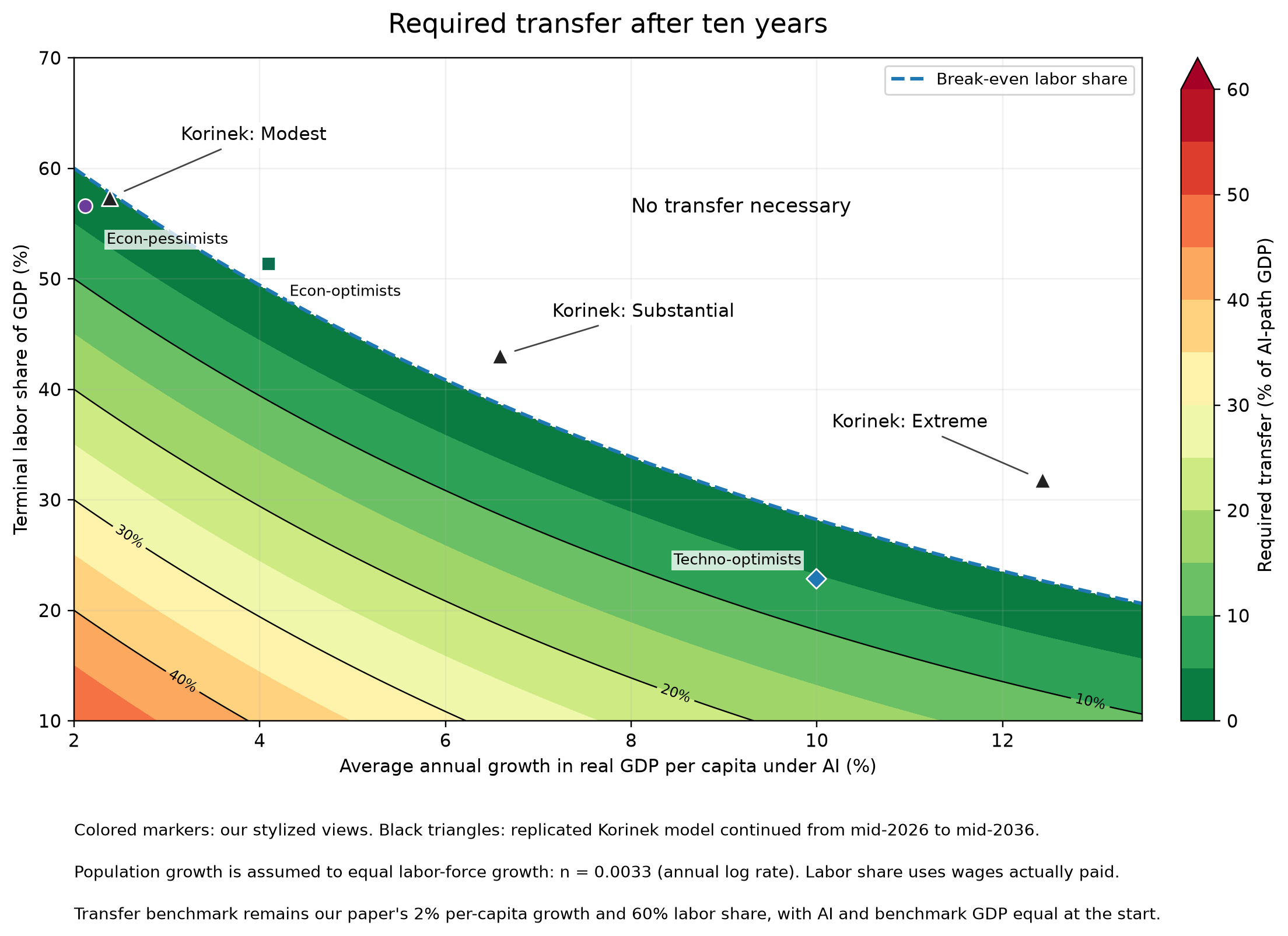
Aggregate labor income, of course, conceals differences among workers. Korinek et al. find that cognitive occupations lose income while other occupations gain. In their extreme scenario, restoring the cognitive occupations’ wage bill to its no-AI level would require about 9% of GDP. They argue that compensation on this scale in response to technological change has no precedent.
I think this makes the adjustment problem look too pessimistic.
First, adjustment happens through retirement and entry. A retiring accountant need not retrain as a nurse. A young person enters nursing rather than accounting. Neither becomes unemployed even as labor reallocates. Korinek et al. understand these channels but give them limited scope in their model. Admittedly, those margins don’t do much work by 2030 but they matter over ten years.
Second, compensation can take the form of shifting taxes from labor to consumption. In the long run labor’s share of consumption tends to equal its share of GDP, so the lower labor’s share becomes, the more relief a given tax shift provides. At a 45% labor share, each dollar shifted from labor taxation to consumption taxation reduces labor’s net burden by 55 cents. Shifting taxes worth 5% of GDP would thus provide net relief to labor of 2.75% of GDP, without increasing total tax revenue. Unemployed workers would still need payments, but compensation need not come entirely through additional government spending.
Third, we do have experience expanding income support rapidly. U.S. unemployment benefits reached approximately 2.5% of GDP in 2020, and that during a contraction. Britain’s compensation to slaveowners following abolition amounted to roughly 5% of GDP in a one-time settlement. These episodes show that governments can mobilize substantial resources for compensation. Moreover, the extreme AI scenario brings an enormous increase in output from which to finance compensation.
Preserving aggregate labor income does not protect every worker. But even the extreme Korinek scenario reinforces the point that a dramatic decline in labor’s share can coexist with stable or increasing aggregate labor income. To the extent labor income does decline, growth makes compensation affordable and attrition, entry, and tax shifting can make the intra-labor task smaller than it first appears.
Is it the screens? Or education systems?
The Dark Ages implies television and phones are the main cause of cognitive decline. This fails to explain the patterns in PISA scores. Why did England and Scotland fall so precipitously from 2000 to 2005 whilst America improved? Why did England and Estonia hold steady after 2015 whilst most other OECD countries declined? How have Singapore, Taiwan, Japan avoided decline altogether?
A better explanation is that a country’s education system is more important than its television diffusion.1 East Asian PISA and IQ scores have probably remained constant, or even risen, because of their rigorous education systems and intensive tutoring cultures. The two European countries which avoid PISA-malaise – Estonia and England – have more rigorous education systems than their neighbours. They (more or less) use the knowledge-rich curricula, direct instruction, and systematic phonics – techniques which their more progressive neighbours abandoned between 1975-1990.
Here is much more from Alexander Thompson, recommended.
Does AI assistance enhance or erode expertise?
From a new NBER working paper:
Whether AI assistance builds or erodes professional expertise is unsettled. In a pre-registered three-month randomized controlled trial, we gave 133 practicing patent lawyers at eleven U.S. intellectual property law firms access to a custom AI drafting assistant and measured both their performance while using AI and their professional judgment afterward without it. All work was scored by blinded expert patent attorneys. Paralleling findings from other white-collar domains, AI access raised the quality of work delivered on benchmark patent drafting tasks at 10 days (0.34 SD, p = 0.03) and 90 days (0.38 SD, p = 0.01), with larger gains among junior lawyers. After three months, all subjects redlined an existing patent application without AI, a core task of patent practice requiring expert judgment. Treated lawyers outperformed controls by 0.32 SD (p = 0.04), but this advantage was concentrated entirely among senior lawyers (0.45 SD, p = 0.02). Junior lawyers showed no average gain; their scores instead bifurcated, with sharply fewer mediocre scores offset by more poor and more good ones. The largest gains from AI thus accrued to the lawyers who retained the least. Foundational expertise may be a prerequisite for extracting durable skill from AI-assisted practice.
That is by David Autor, et.al. Do note that over time the allocation of humans to tasks will evolve so that more of the humans become more productive, not less. RCTs somehow have the odd disadvantage of requiring too many things to be held constant, and so they can miss the benefits of longer-term adjustments.