Not From The Onion
The 9,000-student K-8 district this week pulled all copies of Merriam-Webster's Collegiate Dictionary after an Oak Meadows Elementary School parent complained about a child stumbling across definitions for "oral sex."
The decision was made without consultation with the district's school board and has raised concerns among First Amendment experts and some parents.
Other parents and Menifee residents, though, have praised the district's decision, saying a collegiate-level dictionary is inappropriate for younger children.
Words fail me and now apparently also the students in Menifee.
The Boom and Bust Rap
The Keynes-Hayek rap video is finally here and it's brilliant. The lyrics cover Keynesian economics and Austrian business cycle theory very well but what I liked best were the many ways in which the visuals, the story and the music subtly and sometimes not so subtly (!) parallel the economics–e.g. note what happens to Keynes after the big party!
It's clear that a lot of thought went into integrating the music, the story and the lyrics in order to make the most of this medium and I give my colleague Russ Roberts and John Papola much props.
Rename Capitalism Socialism?
Here's a potentially confusing footnote from Roderick Long:
There’s an ongoing dispute among libertarians over the meaning of
“capitalism.” While most libertarians use the term to refer to a free
market, a growing minority (examples include Kevin Carson, Gary Chartier, Charles Johnson, Sheldon Richman, and Brad Spangler) tend to reserve “capitalism” for the corporatist status quo, favoring “socialism” for the free-market alternative;
In a post titled Libertarians against capitalism, Sheldon Richman explains:
We are a group of libertarians who understand that historically the word "capitalism" has meant, not the free market, but crony capitalism — that is, collusion between business and State at the expense of consumers/workers. Thus we refuse to use the word "capitalism" to describe what we favor: individual liberty in all respects and free, competitive markets. We believe that what we have today IS capitalism — and we oppose it.
It is true that capitalism was named by its enemies. Thus, it's interesting to note that a socialist is someone who believes in socialism, a communist someone who believes in communism but a capitalist is someone with capital.
It's also true that capitalism is a truly social system, a system that unites the world in cooperation, peace and trade. Thus, if all were tabula rasa socialism might be a good name for capitalism. But that boat has sailed.
So if we name crony capitalism, capitalism, and if we can't name capitalism, socialism, then what should capitalism be named?
Free Hearing
Who gets the right to free speech is a status marker and disputes over this right a status game, so argues Robin Hanson:
The usual rationale for “free speech,” which seems persuasive, is that in the long run we as a society learn more via an open competition for the best ideas, where anyone can try to persuade us as best they can, and listeners are free to choose what to hear. Yet that concept would best be called “free hearing” – a freedom to hear and evaluate any case presented, based on any criteria you like (including cost).
“Free hearing” would apply not just to hearing from adult citizens in good standing, but also to hearing from children, convicts, corporations, robots, foreigners, or demons. We wouldn’t argue if corporations have a right to speak, but rather if we have a right to hear what corporations have to say.
But in fact we have “free speech,” a right only enjoyed by adult citizens in good standing, a right we jealously guard, wondering if corporations etc. “deserve” it. This right seems more a status marker, like the right to vote, than a way to promote idea competition – that whole competition story seems more an ex post rationalization than the real cause for our concern. Which is why support for “free speech” is often paper thin, fluctuating with the status of proposed speakers.
There are other explanations for our focus on free speech rather than free hearing such as it’s the speech makers who are easiest to punish and control (being so many smaller in number than the speech hearers) but Robin’s point remains characteristically insightful.
Speech Balloons
Here from Maya Sen are speech balloons illustrating the importance of various words from the majority and then dissenting/concurring opinions in Citizens United v. FEC (more frequently used words are larger). It's interesting to me that just looking at the balloons I can tell which side was more concerned with the Constitution and which side was more concerned with a particular view of the ideal polity.
See Bainbridge for a much more complete roundup of the issues.
Crayola’s Law
PPP Fail
President Hugo Chavez ordered Sunday the seizure of a French-owned retail chain on accusations that it raised prices after Venezuela devalued the currency by half.
From the WSJ.
Haiti Tweet
Port-au-Prince, Charter City?
Hat tip: Tim Kane.
Zakaria on Incentive Design
As for the calls to treat the would-be bomber as an enemy combatant, torture him and toss him into Guantanamo, God knows he deserves it. But keep in mind that the crucial intelligence we received was from the boy's father. If that father had believed that the United States was a rogue superpower that would torture and abuse his child without any sense of decency, would he have turned him in? To keep this country safe, we need many more fathers, uncles, friends and colleagues to have enough trust in America that they, too, would turn in the terrorist next door.
From an excellent op-ed by Fareed Zakaria. Hat tip to Jeff Miron.
Incentives and the Supply of Oil
Addendum: I thought the picture interesting but don’t take this an attempted refutation of peak oil. Also, the data on oil rigs do not include rigs in Russia or onshore China which means that they are an underestimate, perhaps especially in the later years.
Predictably Amusing
Dan Ariely uses Google to look at the most common responses to "how can I get my boyfriend to" and "how can get my girlfriend to."
Simpler Times
Great clip from The Daily Show – slightly long but the ending is deep, true and psychologically astute.
| The Daily Show With Jon Stewart | Mon – Thurs 11p / 10c | |||
| Even Better Than the Real Thing | ||||
|
||||
Innovative Solutions to the Shortage of Transplant Organs
Millions of people suffer from kidney disease, but in 2007 there were just 64,606 kidney-transplant operations in the entire world.
Today in the WSJ I discuss innovative solutions to the worldwide shortage of transplant organs from places like Iran, India, Singapore, Israel and elsewhere. One interesting bit I haven't blogged about before is routine removal of organs without the donor's or their families consent. China? No. America. It's been legal here for decades.
In a number of U.S. states, medical examiners conducting autopsies may and do harvest corneas with little or no family notification. (By the time of autopsy, it is too late to harvest organs such as kidneys.) Few people know about routine removal statutes and perhaps because of this, these laws have effectively increased cornea transplants.
Here is another bit on the shadowy definition of death:
Organs can be taken from deceased donors only after they have been declared dead, but where is the line between life and death? Philosophers have been debating the dividing line between baldness and nonbaldness for over 2,000 years, so there is little hope that the dividing line between life and death will ever be agreed upon. Indeed, the great paradox of deceased donation is that we must draw the line between life and death precisely where we cannot be sure of the answer, because the line must lie where the donor is dead but the donor's organs are not.
In 1968 the Journal of the American Medical Association published its criteria for brain death. But reduced crime and better automobile safety have led to fewer potential brain-dead donors than in the past. Now, greater attention is being given to donation after cardiac death: no heart beat for two to five minutes (protocols differ) after the heart stops beating spontaneously. Both standards are controversial–the surgeon who performed the first heart transplant from a brain-dead donor in 1968 was threatened with prosecution, as have been some surgeons using donation after cardiac death. Despite the controversy, donation after cardiac death more than tripled between 2002 and 2006, when it accounted for about 8% of all deceased donors nationwide. In some regions, that figure is up to 20%.
More on markets for organs, presumed consent, and point systems at the WSJ,
Words of Wisdom from Robert Shiller
Strategic default on mortgages will grow substantially over the next
year, among prime borrowers, and become identified as a serious
problem. The sense that ‘everyone is doing it’ is already growing, and
will continue to grow, to the detriment of mortgage holders. It will
grow because of a building backlash against the financial sector,
growing populist rhetoric and a declining sense of community with the
business world. Some people will take another look at their mortgage
contract, and note that nowhere did they swear on the bible that they
would repay.
From the WSJ's Real Time Economics.
Soviet Growth & American Textbooks
In the 1961 edition of his famous textbook of economic principles, Paul Samuelson wrote that GNP in the Soviet Union was about half that in the United States but the Soviet Union was growing faster. As a result, one could comfortably forecast that Soviet GNP would exceed that of the United States by as early as 1984 or perhaps by as late as 1997 and in any event Soviet GNP would greatly catch-up to U.S. GNP. A poor forecast–but it gets worse because in subsequent editions Samuelson presented the same analysis again and again except the overtaking time was always pushed further into the future so by 1980 the dates were 2002 to 2012. In subsequent editions, Samuelson provided no acknowledgment of his past failure to predict and little commentary beyond remarks about “bad weather” in the Soviet Union (see Levy and Peart for more details).
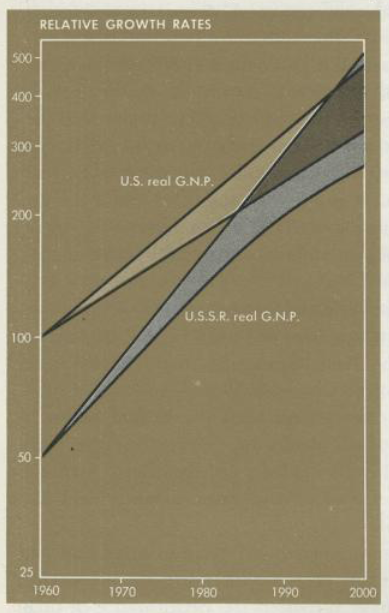 Among libertarians, this story has long been the subject of much informal amusement. But more recently my colleague David Levy and co-author Sandra Peart have discovered that the story is much more interesting and important than many people, including myself, had ever realized.
First, an even more off-course analysis can also be found in another mega-selling textbook, McConnell’s Economics (still a huge seller today). Like Samuelson, McConnell estimated Soviet GNP as half that of the United States in 1963 but he showed that the Soviets were investing a much larger share of GNP and thus growing at rates “two to three times” higher than the U.S. Indeed, through at least ten (!) editions, the Soviets continued to grow faster than the U.S. and yet in McConnell’s 1990 edition Soviet GNP was still half that of the United States!
A second case of being blinded by “liberal” ideology? If so, Levy and Peart throw another curve-ball because the very liberal even “leftist” texts of the time, notably those by Lorie Tarshis and Robert Heilbroner did not make the Samuelson-McConnell mistake.
Tarshis and Heilbroner were more liberal than Samuelson and McConnell but offered a more nuanced, descriptive and tentative account of the Soviet economy. Why? Levy and Peart argue that they were saved from error not by skepticism about the Soviet Union per se but rather by skepticism about the power of simple economic theories to fully describe the world in the absence of rich institutional detail.
To make their predictions, Samuelson and McConnell relied heavily on the production possibilities frontier (PPF), the idea that the fundamental tradeoff for any society was between “guns and butter.” Thus, in the 1948 edition Samuelson wrote:
The Russians having no unemployment before the war, were already on their Production-possibilities curve. They had no choice but to substitute war goods for civilian production-with consequent privation.
Note that Samuelson assumes all countries and economic systems are efficient (the Russians are “on” the curve) only the choice of guns versus butter differs. When the war ended, the fundamental tradeoff became one between investment and consumption and since the Soviets invested a greater share of GNP they would naturally consume less but grow faster. Moreover, since the Soviet’s had solved the unemployment problem they were, if anything, more efficient than the U.S. (here we see the Keynesian influence).
Levy and Peart conclude that although ideology may have played a role what arguably made a bigger difference was the blindness imposed by chosen tools. As they write:
We are all constrained by means of models: we gain insight in one dimension by blinding ourselves to events in other dimensions. Competition among models may be necessary to insure that the benefits of the models exceeds their cost.
(Applications to the financial crisis are apposite.)
Addendum: Bryan Caplan also comments. As Bryan notes, a very good economist can use PPFs and still get the story right.