Are his shoes too small?
We are delighted to have Tim Harford joining us for some Christmas blogging this week. Tim will be defending Scrooge, attacking Santa Claus, and in sundry other ways showing that economists know how to economize on love.
Get Behind Me Satan
Get Behind Me Satan is wildly uneven but the best tracks rock. Take a listen to Blue Orchid, Denial Twist or Take, Take, Take for a taste. Compare with the awful Little Ghost if you also want to sample the lows.
Plus ca change…
I had the same reaction as Pablo Halkyard at the PSD Blog to yesterday’s article in the NYTimes on Bolivian water privatization so here is his post:
Juan Ferrero’s
article in today’s New York Times discusses the poor results of water
privatization and nationalization in Bolivia, as well as the country’s
turbid future as it struggles to reform.After
days of protests and martial law, Bechtel – the American multinational
that had increased rates when it began running the waterworks – was
forced out. As its executives fled the city, protest leaders pledged to
improve service and a surging leftist political movement in Latin
America celebrated the ouster as a major victory, to be repeated in
country after country.Today, five years later, water is again as cheap as ever, and a
group of community leaders runs the water utility, Semapa. But half of
Cochabamba’s 600,000 people remain without water, and those who do have
service have it only intermittently – for some, as little as two hours
a day, for the fortunate, no more than 14.The sad
part is that I have read the exact same article by Juan at least four
times in the last two years – although sometimes the names of Peru or
Ecuador are plugged in for Bolivia, or electricty/gas replaces water as
the featured sector.
See also my earlier post on some surprising benefits of water privatization.
How to fold a shirt
Adverse selection is NOT the problem
The adverse selection story is a wonderful example of McCloskey’s argument that great rhetoric persuades even when it shouldn’t. The market for lemons is simple enough for your friends to understand but profound enough for them to be impressed at your learning, so it’s a hard story not to tell!
The facts of the matter, however, are that adverse selection is not an important part of the market for automobiles (trucks), or of auto, life insurance or health insurance (on the latter see below).
One reason adverse selection may not be that important in practice is because buyers and sellers use testing and certification to remove the most important information asymmetries. You can buy a decent used car, for example just get it inspected or certified. Only if such adjustments are illegal, or in some other way not allowed, will adverse selection become important.
Second, the asymmetry may run in favor of the sellers. Do I really know more about my own life expectancy than an insurance firm that has access to sophisticated actuarial models? And, assuming that I do have extra information is it all that important? After all "the race is not to the
swift, nor the battle to the strong, neither yet bread to the wise… but
time and chance happen to them all." Or, more prosaically, the signal is near irrelevant when the noise to signal ratio is high.
Third, propitious selection can be more important than adverse selection. What sort of person buys a lot of life insurance? Is it people who expect to die soon? Or is it the sort of person who is so worried about not leaving their family in trouble that not only do they buy life insurance they also buckle their safety belt and eat healthy? The price of life insurance falls the more you buy so evidently insurance companies believe it is the latter.
Everyone talks about adverse selection in the market for health insurance but in fact non-group policies in these markets are not relatively expensive and not hard to get. The national average annual premium for reasonably generous coverage for a single person is just $2,268.
Sure, that’s a lot of money but the point is that it’s not a lot relative to what an employed person and their employer would pay for similar coverage in the group market. There is no evidence for an adverse-selection death spiral in the market for health insurance. That’s not surprising because non-group health insurance is medically underwitten (i.e. medical inspections just like car inspections). Most people are accepted a few are not. Only in states that require insurance companies to accept all or most buyers are rates high relative to the group market (rates in New Jersey, an outlier, are almost three times as high as the national average.)
There are problems in the health insurance market, including a lack of long term insurance, job lock and the inequity of affordability, but adverse selection is not one of them.
Thanks to Bryan Caplan, Robin Hanson, Tyler Cowen, Tim Harford, and Ray Lehmann for discussion.
Addendum: Comments are open.
Can you Spot a Random Walk?
Two doctoral students in Switzerland are running an online test to see whether people can spot the difference between true stock prices and a random walk. I was surprised to guess correctly 3 times out of 3.
Pay Go, No Go
It’s not just GM, United Airlines and the Federal government who have made unsustainable promises to current and future retirees. State and local governments have also been irresponsible, to the tune of perhaps a trillion dollars in unfunded liabilities.
For years, governments have been promising generous medical
benefits to millions of schoolteachers, firefighters and other
employees when they retire, yet experts say that virtually none of
these governments have kept track of the mounting price tag. The usual
practice is to budget for health care a year at a time, and to leave
the rest for the future.Off the government balance sheets – out
of sight and out of mind – those obligations have been ballooning as
health care costs have spiraled and as the baby-boom generation has
approached retirement.…most states and cities have set aside no money to pay for retiree
medical benefits. Instead, they use the pay-as-you-go system – paying
for former employees out of current revenue.
Handbook for Cyber-Dissidents
Reporters without Borders has put together a Handbook for Bloggers and Cyber-Dissidents explaining such things as how to blog anonymously. Contributors to the book include Arash Sigarchi, an Iranian blogger who was sentenced to 14 years in prison for criticizing the Iranian regime.
Thanks to Carl Close for the pointer.
Tabarrok on Feldstein on Capital Taxation
The plethora of discount
rates and taxes obscures the basic point in Feldstein’s argument against
capital taxation. Here is a bare-bones version.
There are three
goods, labor, apples and oranges. Assume that the government taxes
oranges at a higher rate than apples. A tax on oranges is also a tax
on labor since you need labor to buy oranges and if the price of
oranges is high the value of your labor is low.
Now let’s show
that a reduction in the orange tax matched by an increase in the labor
tax to keep total tax revenues constant can make everyone better
off. The simplest case is to assume a tax on oranges so high
that no one buys any oranges. Orange tax revenue is therefore zero.
Now we get rid of the tax on oranges and add an equal-revenue tax on labor
(zero). So long as the consumer cares at all about oranges he now buys
more oranges and is better off (because he now consumes a variety of
fruit and has an increased incentive to work). The consumer will still be better off even if we replace the zero-revenue orange tax with a
small labor tax which increases government revenues. The zero-revenue assumption makes the argument obvious but is not at all necessary for the results.
The basic point is that the tax on oranges distorts the labor-leisure choice and the apples-oranges choice. A tax on labor distorts only the labor-leisure choice and so is preferred.
For Feldstein’s argument rename oranges as savings, apples as present consumption and labor as income. To see a counter-argument introduce more people into the model and rename oranges as yachts.
Email beats Doorbell
I’m sitting at home working on my computer when I get an email saying that UPS just delivered a package to my door. So I get up, walk 10ft, open the door and sure enough there is my package. We live in a magical world.
Must I Retire Now? Must You?
I will leave the philosophical assumptions unquestioned. What about the economic assumptions?
1) What happens if everyone follows the philosopher’s advice and
retires so long as they are below the median of the unemployed? Is
there a stable equilibrium? Yes, in equilibrium every worker with a
job must be better than the average worker without a job. This
certainly seems possible although it is hard to see how it is optimal –
can no change in wages or job assignments make it beneficial to hire
more workers? The fixity of jobs assumption is very strong.
2) More generally, if workers are
paid their marginal product and are appropriately assigned (e.g. better doctors work on harder cases) then no worker need retire. With appropriate assignment, when a below-median doctor does retire he would not be replaced by an above-median doctor. Instead, the new better doctor would be slotted in for
more difficult work, everyone else would move down slightly and the
retiring doctor would be replaced by one only marginally better.
3) What happens in general equilibrium? With flexible markets everyone gets a job so the worker who retires because he is below median is replaced by a worker from another industry. It’s no longer obvious that this is optimal.
Most generallly, comparative advantage tells us that markets find a place for even the lowest-quality workers. For the argument to apply we need a relatively fixed number of jobs, relatively fixed wages and a large reserve army to draw from. Supreme Court justices come to mind.
Canadians Need Global Warming
As an expatriate I had to laugh at those Canadians in Montreal bundled up in their parkas and toques protesting global warming! If there is any place in the world that could use some more warming it is the great frozen north.
That was my opening for the interview with the BBC on global warming and AIDS. Unfortunately, it was something of a disappointment as that was about all that I got to say.
Alex on the Beeb
I will be on the BBC, BBC Radio Five Live, on Sunday night 9-10 pm EST talking about pensions, global warming and other topics with the host and other guests. It’s a call-in, email-in show so it should be fun.
Wired Ads a Leading Indicator?
Is it time to invest in technology stocks again? Mark Frauenfelder at Boing Boing Blog points us to this graph (before getting too excited, however, I would want to detrend for seasonality, i.e. the Christmas effect):
Rich Giles made a graph that compares the page counts of past issues of Wired
with the the rise and fall of Nasdaq over the years.You’ll note that the Nasdaq (red) lags Wired’s page count (blue) by a
few months [No longer true, in the updated graph -see below – although they do seem to move together, AT]. I’m not suggesting you go an buy technology shares, but gee, I’m
thinking the reports of money pumping back into technology companies might just
be true given the big up-tick in this months page count (294).
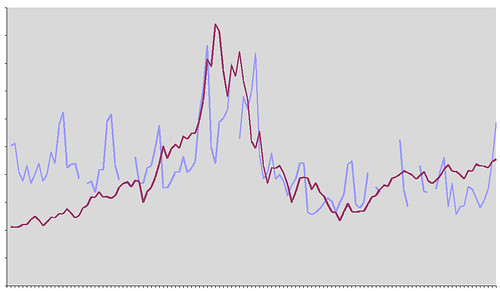
Addendum: There were some problems with the author’s original graph. He corrected and I have reposted. The data are available here. Thanks to the Stalwart and Paul N for pointing me to the problem.
Freakonomics Sells
The first signed copy of Freakonomics inscribed, "To Tim, The first book I’ve ever signed. You can probably get at least $9.50 on
eBay. Steve Levitt," sold on EBay for $610!
Congratulations to the winner of the auction, to Tim Harford who donated the funds to charity and to Steve who doubled the donation.
Tim Harford, by the way, will be speaking at GMU on Monday Dec. 5, 7:30 in the Johnson Center meeting room B. The Undercover Economist is a great read and Tim is a fun speaker so I invite all to come and enjoy. You can even ask him to sign your copy of the Undercover Economist!