Thursday assorted links
1. John Tomasi to head Heterodox Academy.
2. Browser interview with Applied Divinity Studies.
3. Maxwell T. on start-up cities and the housing crisis. And here is the new Profectus Magazine more generally.
4. A vision of the future inspired by classical antiquity.
5. Florida now 19th for per capita vaccinations.
6. Stupid barter markets in everything how can this kind of stuff happen?
A simple illustration of the benefits of feminization
Fox’s Tucker Carlson, the most important nationalist voice in America, seemed to sympathize with the gender politics of Taliban-supporting Afghans. “They don’t hate their own masculinity,” he said shortly after the fall of Kabul. “They don’t think it’s toxic. They like the patriarchy. Some of their women like it too. So now they’re getting it all back. So maybe it’s possible that we failed in Afghanistan because the entire neoliberal program is grotesque.” (By “neoliberalism” he seems to mean social liberalism, not austerity economics.)
From Michelle Goldberg (NYT), that in a nutshell is the case for the feminization of society, which I see as bringing strongly positive net benefits for both men and women, in most but by no means all cases.
Do note that if you ever see me describing this feminization in not entirely glowing terms, that is part of my desire to give you the entire unvarnished picture, as I would with most other topics. (The most common reading mistake you can make in these parts is to over-infer an entire mood affiliation from a single post.)
When it comes to feminization, I also think sometimes of my grade and junior high school gym teacher, Mr. O (I will omit his full name, but in fact we also called him “Mr. O”). He acted like a tough guy, but in fact was just a…grade school gym teacher. Nonetheless he acted as if he was auditioning for the role of Patton in a Hollywood movie.
He smoked his cigarillos (?) in that kind of plastic thing-y, like the Penguin did on the original Batman show.
If a smaller or less athletic kid took a tough spill, or was picked on by the others, he would say “Suck it up, kid!”, with little sympathy. (If you are wondering, the worst he ever said to me was “That was a stupid foul, kid,” in a fifth-grade basketball contest. So I didn’t bear a personal grudge against him.)
He seemed to love the game of Bombardment, as in fact I did too. (I still remember being one of the last two men standing, but losing to Jimmy Gravelis, who caught my too-weak toss.)
He was a Roman Catholic and a veteran of the Korean War. He seemed to stare too long at the boys entering and leaving the shower, after the exercise period of gym. But no one really questioned this.
Even as a kid, I thought he was a bit…sick and also over the top. In some ways though he was a good teacher and he definitely maintained discipline. Kids were afraid of him. And he toughened them up for the world to come.
Still, at the end of the day I am not wishing to return to the cultural ascent of Mr. O.
I would rather live in a more feminized world, even if I still miss Bombardment. But if you are not a fan of this new arrangement…hey, “Suck it up kid!”
Addendum: You might argue that I had the best of both worlds, namely to grow up in the “tougher” society, but live most of my life in the more feminized society — maybe so!
Toward a theory of Emergent Ventures
Tony Kulesa, a biomedical venture capitalist, has a very nice new piece up about how Emergent Ventures works. He overrates me in particular, but the overall account is quite accurate and insightful, and the piece is based on a considerable amount of detailed research. Here is one excerpt:
Tyler’s success at discovering and enabling the most talented people before anyone else notices them boils down to four components:
- Distribution: Tyler promotes the opportunity in such a way that the talent level of the application pool is extraordinarily high and the people who apply are uniquely earnest.
- Application: Emergent Ventures’ application is laser focused on the quality of the applicant’s ideas, and boils out the noise of credentials, references, and test scores.
- Selection: Tyler has relentlessly trained his taste for decades, the way a world class athlete trains for the olympics.
- Inspiration: Tyler personally encourages winners to be bolder, creating an ambition flywheel as they in turn inspire future applicants.
Self-recommended! The piece is interesting throughout, and has much social science in it.
Wednesday assorted links
1. Is America’s aerospace industry regenerating?
2. Sam Enright’s guide to recreational math videos on-line.
3. “A good start” — they should be working for us, not us for them. And yes I believe in following the science — the science of expected utility maximization. They are the ones who do not really believe in science, just their own status within their own branch of science.
4. What kind of Berkeley protest is this?
What I’ve been reading
1. Anne Serre, The Beginners. What is it like for a woman to go from loving one man to another? This newly translated French novel was fun enough, insightful enough, and direct and short enough for me to finish.
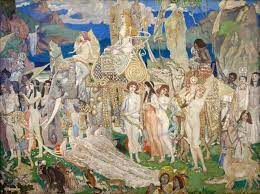
2. Lachlan Goudie, The Story of Scottish Art. Even if you don’t care about art, this is a wonderful way to learn the history of Scotland. My takeaway favorite painters were Allan Ramsey (friends with Smith and Hume), Henry Raeburn, David Wilkie, and John Duncan, more or less consistent with my earlier views but now they are better informed. A good book with a nice blue and yellow cover.
 3. Frank Herbert, Dune. For me a reread, I loved it when I was twelve, but how does it stand up? I am struck by how excellent and pathbreaking the best chapters are, including the introductory chapter. The influence on Star Wars is obvious, as is the role of Islam in the story. It strikes me as remarkably cinematic, with the right kinds of transitions to boot — how was this never put successfully on the big screen? I am about two-thirds through it right now, and maybe it 2/3 holds up? But would you want all of the slow pacing of the detail removed?
Carole Hooven, T: The Story of Testosterone, the Hormone that Dominates and Divides Us. Recommended.
Aubrey Clayton, Bernoulli’s Fallacy: Statistical Illogic and the Crisis of Modern Science. I found this most interesting as a history of probability theory, and with more coverage of Quetelet than one usually finds.
How is nursing evolving? (from my email)
From Andrew K. Stein, MR reader:
There’s a massive and massively underreported shift going on right now in hospital nurse staffing that is interesting from a health and labor economics POV.
In normal times, hospitals pride themselves on having little or no use of “agency” nurses — i.e., not relying on nursing staffing companies to fill their bedside nursing slots. But it seems now that most hospitals can’t escape using agency (e.g., travel nurses) for a large plurality of their nursing staff. (In my day job, I talk to hospital Chief Nursing Officers somewhat regularly.)
Agency nurses are very expensive (high wages + agency markup) and also rather disruptive — every new travel nurse needs to learn the local hospital care processes (e.g., IV dressing changes). What you’re paying for as a CNO is the convenience of an on-tap nursing workforce. Pre-COVID, you’d hear agency labor described as an addictive drug — once you get hooked, it’s hard to wean yourself off.
What’s happening in the labor market, I think, is that there are two paths for a bedside nurse in the COVID era — keep working for a hospital or go work for an agency. Agency pay has gotten ridiculously high, so more and more nurses are quitting the local hospital, signing on with the agency, and then going to work for any hospital that can pay the agency’s rates. In exchange for going wherever the highest bidder is, they get huge increases in their take-home pay. No shame in that.
The net effect, I suspect, is that the bargaining power of nursing labor is going way up, though with unequal gains; to benefit, you have to quit your hospital-employed job and be willing to go wherever the agency sends you.
And then your open slot gets backfilled by another agency nurse from somewhere else!
It’s a reinforcing cycle: As nursing shortages rise, nurses increasingly “work short” — i.e., caring for more patients per shift than is reasonable — or work more shifts per week than typical. That daily stress spurs many nurses to either leave the bedside for something more 9-to-5 (think outpatient clinics) or jump into travel nursing to at least get paid for the extra load everyone is being forced to bear right now.
Agencies and travel nurses win, hospitals and hospital-employed nurses lose.
You could also tell the story that the labor supply of nursing has historically already been constrained (though of course now more so), and that nurses have historically been underpaid from a supply-demand perspective, and that now it’s a more liquid market (with agencies acting as market makers), so the price for labor is rising.
I’d be interested if any MR readers have seen data on how big of an effect this is (e.g., hospitals’ average % of agency staff).
I suspect that high use of agency staffing is the new normal, at least until the nursing labor supply grows to meet it — emergency authorization of 100,000 work visas for immigrant nurses? — or we invent robot nurses.
*The Money Illusion*, the new Scott Sumner book
The subtitle is “Market Monetarism, the Great Recession, and the Future of Monetary Policy.” I just got my copy, self-recommending of course. In fact, hard to think of a better example of “self-recommending” than this one.
You can buy it here.
Tuesday assorted links
1. Rating the menus.
2. The Fed takes duration risk.
3. Margaritaville Times Square markets in everything.
4. Brazilian criminal group ties hostages to getaway cars. That was to deter gunfire from the police.
5. The five best Faulkner books?
That was then, this is now, storm watch edition
Then Hurricane Ida hit, and the 911 call center crashed, failing its first major test. Calls for help didn’t go through. The center was offline for 13 hours on Monday. The Orleans Parish Communication District, which runs the dispatch center, was forced to take to Facebook to tell people that if they had an emergency, they should walk to a nearby fire station or flag down a police officer to report it.
“Our technology is antiquated,” Tyrell Morris, the district’s executive director, said Monday.
Here is the full story, at least the levees did hold…
The capital life extension query
From Arjun Narayan:
Loyal reader here and I’ve been pondering an altered version of your post [the other day] -You have the power to grant 100% more capital (that they deployed in their lifetime) to a person or institution who prematurely ran out of capital too soon. Who do you pick?
It’s worth considering the counterfactual: Elon Musk almost ran out of money in 2008 and was bailed out by Daimler. we would be far worse off on a few dimensions (lithium ion battery production, but also the urgency with which every carmaker is now attacking the transportation electrification problem). Who else should we go back in time and similarly bail out?
My answer is the companies that built the NYC subway which went bankrupt – the BMT, IRT, and IND. After the city takeover in ~1940, construction slowed over a generation, and no infrastructure has been built since. It’s unclear if infrastructure will ever be built in NYC again. It’s clear to me that the only time to build was right then and there, and we should have “overbuilt” to the maximum extent possible when we could.
And in terms of returns to society, what is the value of 10% more efficient subway service (faster/longer/more frequent)? 20? 50%? We could absorb more population (NIMBYs notwithstanding), and as the largest city in the US, the agglomeration effect means it is most impactful here.
I am very curious what your answer would be!
I do not have a better answer than that, unless you start getting into military scenarios. If you are allowed to consider cyclical scenarios, how about more money to bail out U.S. banks in the 1929-1932 period? More funds to limit the German deflation before Hitler, or alternatively to bail out the Weimar government so hyperinflation and later social collapse does not come? But I take those possibilities as beyond the initial question.
Could a cash infusion alone have kept Intel active and successful in the high-quality chips market? Somehow I doubt that. More money for Novavax in 2020-21 as a contender? That could have helped the rest of the world a good deal, given how slow they have been to convert their very important science into an actual product.
Monday assorted links
1. Consumers believe products work better for others.
2. Music sentiments and stock returns (speculative, though in a good journal).
3. My Bloomberg column on Larry Elder.
5. The Biden tax bill is being scaled back (New York).
Don’t shoot the messenger — on the value of human life
Thus, to analysts, picking one such meta-analysis may feel as hard as picking a single “best study.” This paper responds by taking the meta-analysis another step, estimating a meta-analysis (or mixture distribution) of six meta-analyses. The baseline model yields a central VSL of $7.0m, with a 90% confidence interval of $2.4m to $11.2m. The provided code allows users to easily change subjective weights on the studies, add new studies, or change adjustments for income, inflation, and latency.
Further progress on the wage rigidity question
From Benjamin Schoefer, bravo:
I propose a financial channel of wage rigidity. In recessions, rather than propping up marginal (new hires’) costs of labor, rigid average wages squeeze cash flows, forcing firms to cut hiring due to financial constraints. Indeed, empirical cash flows and profits would turn acyclical if wages were only moderately more procyclical. I study this channel in a search and matching model with financial constraints and rigid wages among incumbent workers, while new hires’ wages are flexible. Individually, each feature generates no amplification. By contrast, their interaction can account for much of the empirical labor market fluctuations—breaking the neutrality of incumbents’ wages for hiring, and showing that financial amplification of business cycles requires wage rigidity.
The piece is titled “The Financial Channel of Wage Rigidity.” One of the best macro papers! It puts all of the pieces together, including the finance channel, and the difference between incumbent and new workers, identifying the relevant counterfactuals, and is not content to simply say “wage rigidity.”
Here is more on Schoefer, who as a sideline runs the Wirtschaftspolitik-Diskussionsrunde. Here is his (entirely sober) Twitter account.
Gordon S. Wood’s *Power and Liberty*
The subtitle is Constitutionalism in the American Revolution, and of course self-recommending. Here is one excerpt:
The breadth and depth of popular interest in the Constitution in 1787-1788 was remarkable. The towns of Massachusetts, for example, elected 370 delegates to the state’s ratifying convention, of whom 364 attended. Most were eager to meet and discuss the Constitution. It took six days for the delegates from Bath, Maine (then part of Massachusetts), to make their way south across rivers and through snow to Boston. The people of Massachusetts believed they were involved, as the little town of Oakham told its delegates, in deciding an issue of “the greatest importance that ever came before any Class of Men on this Earth.”
And this:
Many expected the electoral college to work as a nominating body in which no one normally would get a majority of electoral votes; therefore, most elections would take place in the House of Representatives among the top five candidates, with each state’s congressional delegation voting as a unit.
You can buy it here.
Which post-1960 creators built their own sonic worlds?
Of course this question is motivated by the passing of the great Lee Perry. Who else might make such an exclusive list? Note here we are not talking about whether you like the style, the melodies, or whatever. Did the creator come up with a fundamentally new way of organizing our musical universe? (Rolling Stones, Paul Simon, ABBA, many other notables don’t come close here, despite their considerable merits.) Here is the list off the top of my head:
Miles Davis
John Coltrane
Ornette Coleman
Sun Ra (Monk I count as pre-1960?)
The Beatles
Brian Wilson
Hendrix and Led Zeppelin?
Rap and electronica, respectively, with arguments as to where the individual credit should go
Funk/JB/Sly/Fela
Brian Eno
Kraftwerk
Velvet Underground
Sex Pistols
Kevin Shields/My Bloody Valentine
Sonic Youth
Philip Glass
Steve Reich
LaMonte Young
Robert Ashley
Xenakis
And of course Lee Perry
Who cares what you like? I would say study them to learn music!
Who else? Kurt Cobain? The Byrds? Someone from MPB? Helmut Lachenmann? Sunn O)))? Others? Anyone else from psychedelic music? Post-1960 Stockhausen and Cage (or did they bloom earlier?)? Scelsi? Can? Bill Evans? Astral Weeks? What else?